
A competency-based assessment checks what a person can actually do against a defined standard for a role, then shows the gap between the two. It does not rank people against each other or test what they remember. In the workplace, the process has four parts: define the competencies that matter, choose methods that produce evidence, score that evidence consistently, and use the results to hire, develop and promote. This guide walks through each part with examples from U.S. government and professional sources.
TL;DR
- A competency-based assessment compares demonstrated performance with a target proficiency level for a role, so the output is a gap you can act on.
- Start with a competency model built from a job analysis. Keep it to the tasks and skills that are critical to success, not every activity in the job.
- Combine methods: self-assessment, manager input, peer or 360 feedback, work samples, simulations and structured interviews. One method alone rarely tells the full story.
- Fairness comes from clear scoring rules, trained raters, documented decisions and regular monitoring.
- The value is in what happens next: targeted development, tracked over time, for everyone and not only for managers.
Table of Contents
- What a competency-based assessment measures
- Competency-based assessment, education and interviews
- Start with a competency model
- Methods for assessing competencies
- What it looks like in practice
- Making assessments fair, consistent and scalable
- Turn results into hiring, development and growth
- Where Leaderly fits
- Our perspective
- A step-by-step plan to launch your first assessment
- FAQ
- Sources
What a competency-based assessment measures
Start with the two words that matter. The U.S. Office of Personnel Management (OPM) describes a competency as a measurable pattern of knowledge, skills and abilities that lets a person perform successfully. It describes an assessment as a systematic way of gathering information about people to support employment or career decisions.
Put together, the assessment looks at how someone performs a task or skill and sets that against the target. The Association for Talent Development (ATD) explains that a competency assessment compares a person's capabilities with the job requirements set out in a competency model. The person's selected proficiency level is compared with the target level, and the difference shows where to develop.
This is different from a knowledge quiz or a personality profile. Three features set it apart:
- A standard exists before anyone is scored. The target comes from the role, not from the group.
- Evidence is observable. Behaviors, work products and responses to realistic scenarios count. Opinions about someone's potential do not.
- The result is a gap, not a grade. The output says what to build next.
For leadership roles, the competencies might include coaching, giving feedback, decision making, emotional intelligence or leading change. The mechanics are the same as for technical skills. You define what good looks like at each level, gather evidence, and compare.
Competency-based assessment, education and interviews
The phrase gets used in three settings, and the search results mix them. It helps to separate them.
Competency-based education. Students move forward when they show mastery, not when a semester ends. The U.S. Department of Labor notes that in this model students can progress as rapidly as they can demonstrate their knowledge, and the content is geared to the work role. The Texas Association of Community Colleges adds that these assessments are built to give pass/fail proof of a high level of mastery in targeted tasks, which is quite different from tests designed to produce a broad grading curve.
Competency-based interviews. These are structured conversations in which a candidate describes past behavior in response to set questions, scored against the same competencies for every candidate. They are one method inside a competency-based assessment strategy, not the whole of it.
Workplace competency assessment. This is the subject of this article: a repeatable process that measures current employees, or applicants, against the competencies of a role. It serves hiring, development, succession and performance management.
Start with a competency model
You cannot assess against a standard you have not written down. The CareerOneStop Competency Model Clearinghouse, sponsored by the U.S. Department of Labor, describes a competency model as a collection of competencies that together define successful performance in a particular work setting. It also says these models are the foundation for recruitment, training and development, and performance management.
How to choose what to assess
OPM's guidance on structured interviews gives a sequence that works for any assessment, not only interviews. To select the competencies to assess, organizations should:
- Conduct a job analysis to determine the critical tasks and competencies.
- Review the competencies needed to perform those tasks.
- Identify which competencies are required on entry to the job.
- Get confirmation from subject matter experts.
OPM's hiring guidance adds a documentation step. The manager and HR professional should confirm the job analysis and record the process, including critical duties, the competencies required and the factors that matter when evaluating people, so it can be reused later.
Keep the model short
The most common failure is a model that tries to capture everything. ATD stresses that a useful model contains only the tasks and skills that are critical to success, not every activity someone performs in the job. Eight to twelve well-defined competencies, each with clear proficiency levels, will beat a forty-line spreadsheet that nobody can score consistently.
If you are building a leadership model from scratch, our walkthrough of leadership competency models and their five parts shows how to define, level and measure each one.
Methods for assessing competencies
No single method fits every competency. A technical skill suits a work sample. Coaching ability may need a simulation and observations from direct reports. Government HR resources list the options clearly.
The California Department of Human Resources workbook on skills and competencies lists these ways to determine proficiency levels: self-assessments, managerial assessments, peer assessments, 360-degree assessments, role-based assessments, skill tests, job knowledge assessments, evaluations and appraisals, desk audits and job analysis. It also notes that its model defines five distinct proficiency levels.
OPM's Agency Resource Center lists a complementary set of tools, each tied to job-relevant competencies: job knowledge tests, cognitive ability tests, situational judgment tests, work samples, assessment centers, writing assessments and structured interviews.
| Method | Best for | Evidence it produces | Watch for |
|---|---|---|---|
| Self-assessment | Building awareness, starting a development conversation | The person's own view of their proficiency | Over- or under-rating without a shared rubric |
| Manager assessment | Day-to-day performance against role expectations | Observed behavior over time | One rater's bias; inconsistent standards across managers |
| Peer or 360 feedback | Interpersonal and leadership behaviors | Multiple perspectives on the same behaviors | Small rater pools; vague questions |
| Work sample | Technical and task-based skills | A real product scored against criteria | Time to design and score |
| Situational judgment test | Decision making, handling people situations | Choices in realistic scenarios | Scenarios that do not reflect the actual job |
| Simulation or role play | Coaching, feedback, difficult conversations | Observable behavior in a controlled setting | Needs trained raters and clear rubrics |
| Structured interview | Hiring and promotion decisions | Scored past-behavior examples | Skipping the shared scoring guide |
A practical rule: use at least two methods for any competency that drives a high-stakes decision, and let the lighter methods, such as self-assessment, do the work in low-stakes development.
What it looks like in practice

A concrete example helps. The U.S. Department of the Interior's IBC Competency Framework Guide describes assessments that typically combine an employee self-assessment weighted 40% and a supervisory assessment weighted 60%. The results are then used to identify training and developmental activities that line up with competency gaps and future career opportunities.
Here is how that might play out for a first-line supervisor role:
- Define. "Gives feedback" is one of eight competencies, with five proficiency levels. Level 3 is described in behavioral terms, such as "holds a feedback conversation within a week of an observed issue and agrees on a next step."
- Target. The role requires level 3. A newly promoted supervisor is expected to reach it within the first year.
- Assess. The supervisor rates themselves. Their manager rates them. A short scenario exercise adds evidence.
- Compare. The self-rating is 4, the manager's is 2, and the scenario suggests 2. The gap is a shared conversation, not a verdict.
- Act. A development plan targets that one competency with practice, reflection and follow-up observation, and a reassessment is scheduled.
The example is illustrative, but the structure follows the weighted self and manager approach above. The conversation about why the two ratings differ is often the most valuable part of the process.
Making assessments fair, consistent and scalable
Once an assessment affects hiring, promotion or pay, it needs to stand up to scrutiny. OPM's memo on designing a competency-based assessment strategy says agencies should ground assessments in competencies identified through job analysis, not credentials or self-reported experience. It says aligning classification, qualifications and assessments creates a defensible, skills-based process.
The same memo points to practical safeguards. Its main points, in the order you would apply them:
- Set scoring methods before you begin. Decide what each level looks like and how scores combine.
- Use multiple hurdles, starting with low-burden screens. Save time-intensive methods for people who pass the early stage.
- Train subject matter experts on scoring and on the competency definitions.
- Document your qualification decisions and keep them impartial.
- Monitor fairness and impact, and update tools as competencies or mission needs change.
That last point is easy to skip. OPM describes competency-based assessment as needing ongoing monitoring, including whether the tools identify people who really have the required competencies. A competency model written three years ago for a role that has since changed will quietly produce poor decisions.
If you are designing the question sets, rating scales or scoring logic yourself, a free coaching readiness check is a useful example of how a short structured assessment can be framed and scored.
Check whether your methods predict performance
SHRM's guidance on talent analytics says that by tracking assessment scores, interview ratings and eventual job performance, HR can see which assessment methods add real predictive value and which do not. In practice, that means keeping records. If your interview scores never correlate with later performance, change the interview.
Scaling beyond a small group
Most manual processes work for ten leaders and break at a thousand. Scale usually fails for three reasons: rubrics that depend on a single expert, assessments that need a facilitator for each person, and results that sit in spreadsheets nobody reviews. The fixes are shared rubrics, assessments that people can complete on their own device, and dashboards that show patterns by team, role or cohort. Our guide on reducing the leadership skills gap covers how to spot where those gaps are widest.

Turn results into hiring, development and growth
An assessment with no follow-up is an expensive survey. The U.S. Department of Labor's literature review notes that a competency model can be used to develop behaviorally based interview protocols and assessment tools for selecting the right person. It can also prepare current staff for succession through development plans, training, and a performance review system built on the same model.
That gives HR three uses for the same data:
- Hiring and promotion. Score candidates on the same competencies you later develop.
- Development. Turn each gap into a focused plan with specific behaviors to practice.
- Succession. Identify who is closest to the next role, and what they still need.
Measure change, not just the starting point
The first assessment is a baseline. Value shows up when you reassess and see movement. That requires a few metrics tracked consistently, which we cover in three numbers for measuring behavior change. It also helps to use short, low-stakes checks along the way, as described in our guide to formative assessment in leadership.
Development works better when it is built in steps. Our article on scaffolded learning in leadership explains how to sequence practice so that each competency builds on the last. For credentials that recognize progress, see our seven-step guide to piloting digital badges at work.
Where Leaderly fits
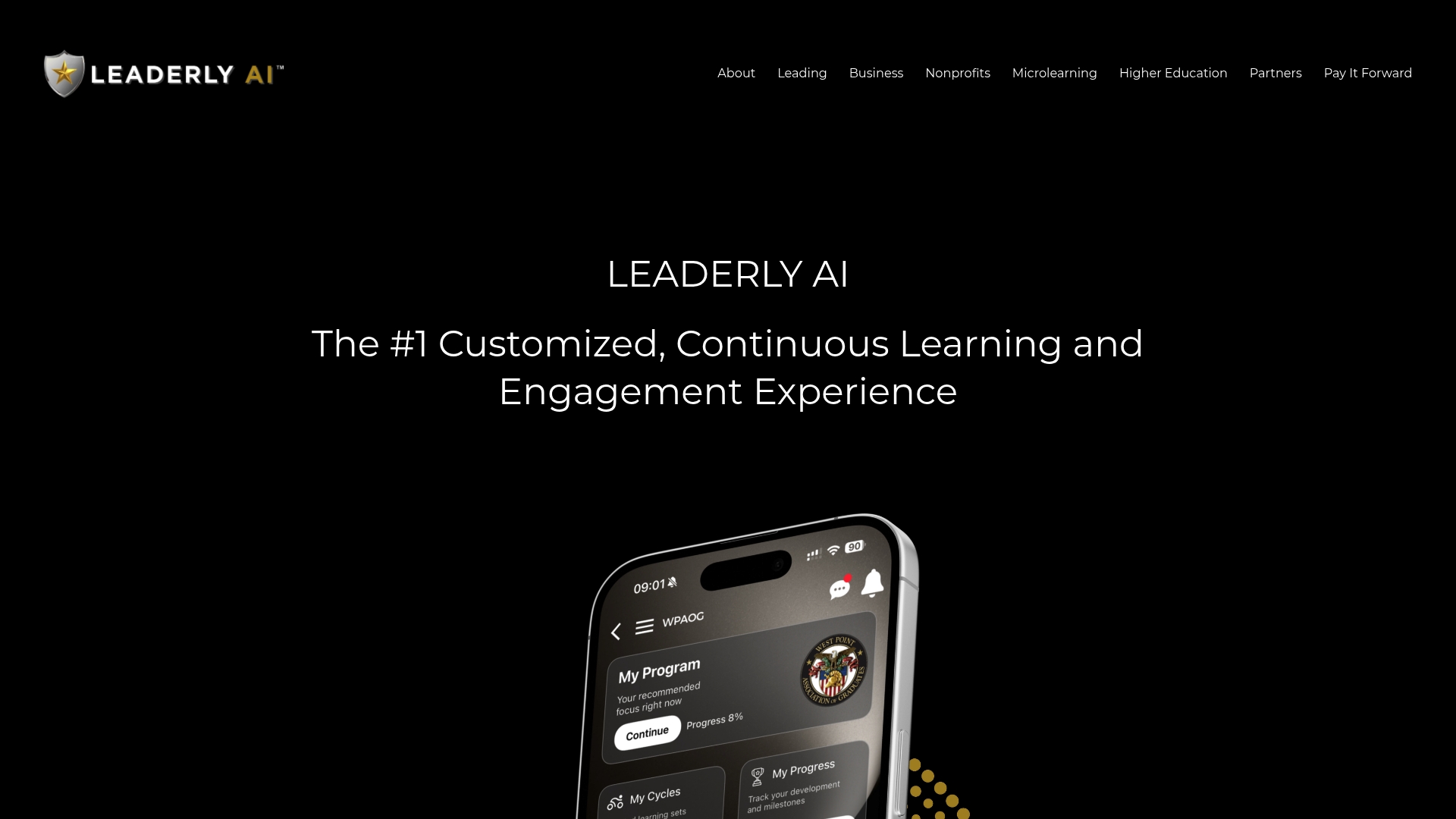
We built Leaderly AI for the stage after the gap is identified, and for HR teams who want to reach every employee, not only managers. It is a mobile-first platform that combines self-assessments (including DiSC, EQ and MBTI), personalized microlessons, behavioral exercises, simulations and analytics dashboards. Learning journeys can be customized by HR or educators, and the content adapts to each user's progress.
For corporate teams, see Leaderly for business. Colleges and universities can look at Leaderly AI for higher education, and mission-driven organizations at Leaderly AI for nonprofits. You can also get started with Leaderly to talk through your use case.
If you want to see how microlessons support day-to-day practice, read about Leaderly microlearning.
Our perspective
Most competency programs we see are strong on the model and weak on the practice. Organizations spend months defining competencies and run one assessment, then wait a year to run another. Meanwhile, behavior changes in small, repeated moments.
We think assessment should be part of a loop: a baseline, a short burst of practice every week, a quick check, and a visible trend. That is why we pair self-assessments with microlessons and behavioral exercises. A leader who spends a few minutes a day on one competency will usually make more progress than one who attends a single workshop and then goes back to the same habits.
We also believe leadership development should not stop at the manager level. Emerging leaders, front-line employees, volunteers and students all lead in some way. When HR or educators can customize journeys and see analytics across a cohort, they can run competency-based development for the whole organization without adding headcount.
Our approach rests on behavioral science: make the target behavior specific, make practice easy, and make progress visible. Assessment gives you the target. Habit formation gets you there.
Drew
A step-by-step plan to launch your first assessment
If you are starting from zero, this sequence keeps scope manageable:
- Pick one role family. Front-line supervisors are a common choice because the group is large and the stakes are clear.
- Run a short job analysis. Interview high performers and their managers, review the work itself and list the critical tasks.
- Draft 8 to 12 competencies with behavioral descriptions at each level. Have subject matter experts confirm them.
- Choose two or three methods. A self-assessment, a manager rating and a scenario is a workable start.
- Train your raters on the rubric using sample responses.
- Run a pilot with one group and compare ratings across raters. Large unexplained differences mean the rubric needs work.
- Link results to development within two weeks, while the findings are fresh.
- Reassess on a schedule and review the tools whenever the role changes.
For programs in higher education, our piece on aligning leadership coursework with industry needs shows how to connect competencies to what employers expect. If your audience is working adults, engaging adult learners in leadership training covers what keeps them participating.
FAQ
What is a competency-based assessment?
It is a structured way to measure how well a person performs the skills and behaviors a role requires, compared with a defined target level. The result is a gap that guides hiring, development or promotion decisions. It is built on a competency model, which lists the competencies critical to success in the role.
How is it different from a performance review?
A performance review usually looks back at results over a period, often against goals. A competency-based assessment looks at the underlying skills and behaviors that produce those results, against a fixed standard for the role. The two work best together when they use the same competency model.
How many competencies should we assess?
Fewer than most teams expect. Focus on the tasks and skills that are critical to success in the role, and leave out the rest. A short list with clear proficiency levels is easier to rate consistently and easier for employees to act on.
Can we use competency-based assessments for leadership development?
Yes. Leadership competencies such as coaching, feedback, emotional intelligence and decision making can be defined in behavioral terms and assessed through self-assessment, manager input, 360 feedback and simulations. The results then feed a development plan with specific practice and regular reassessment.
Sources
- The Guide to Better Occupational Questionnaires (OPM)
- What Is a Competency Assessment? (ATD)
- Competency-based education and the Department of Labor (Ennis, 2008)
- Finding Strong Footing: The Future of Assessment (TACC)
- Developing a Competency Model (CareerOneStop)
- Selecting competencies for structured interviews (OPM)
- Confirm the Job Analysis and Assessment Strategy (OPM)
- Skills and Competencies Workbook (CalHR)
- Developing Your Assessment Strategy (OPM Agency Resource Center)
- IBC Competency Framework Guide (U.S. Department of the Interior)
- Designing a Competency-Based Assessment Strategy (OPM)
- How Organizations Use Talent Analytics (SHRM)
- Coaching readiness check