
Digital badges are worth exploring when they carry verifiable evidence and connect to real hiring or internal mobility workflows, not when they simply mark course completion. If you run HR or L&D, the smart next step is a focused pilot: pick one skill, build a validated assessment, issue badges on a standard like Open Badges, and tie the result to a concrete decision such as promotion eligibility or a hiring shortlist.
TL;DR:
- Digital badges gain credibility when built on standards like Open Badges 3.0, which allow for verifiable cryptographic proofs and trusted authenticity checks.
- Employers value badges primarily when they include demonstrable evidence, such as scored assessments or projects, which influence hiring and promotion decisions.
- Badges are most effective for concrete, assessable skills, while soft skills like communication or adaptability are harder to validate with credible evidence.
- Successful badge programs require precise outcome definitions, integration with hiring systems, clear governance, and strong verification practices; weak evidence and poor integration lead to failure.
- Microlearning combined with badge assessments enhances skill adoption, especially for leadership behaviors, when delivered within an integrated platform that streamlines lesson, practice, and recognition.
Table of Contents
- What a digital badge actually is and how it works
- Why employers actually care about badges
- What badges mean for employees building their careers
- How to design a badge program that holds up
- Measuring impact, cost, and timeline
- A step-by-step pilot-to-scale checklist
- Common mistakes that turn badges into clutter
- How badges and microlearning reinforce each other
- A practical way to pilot badge-linked microlearning
- FAQ
- Sources
What a digital badge actually is and how it works
A digital badge is a structured, machine-readable file that represents a specific skill or achievement, not just a decorative icon. The meaningful part is the metadata: who issued it, what criteria earned it, what evidence backs it, how it aligns to a skill framework, and the result and date of assessment. A badge with no evidence field is closer to a sticker than a credential.
The issuance lifecycle has four parts. An issuer (an employer, training provider, or university) defines criteria and runs an assessment. The learner completes that assessment, whether a project, simulation, or scored test. The platform packages the outcome into a badge artifact with its metadata intact. The recipient then stores that badge in a digital wallet or portfolio and can share it with a hiring manager, a learning platform, or a professional network.
Standards matter here because they determine whether anyone outside the issuing system can trust the badge. Open Badges 3.0 from IMS Global aligns badge data with the Verifiable Credentials Data Model and adds cryptographic proofs, which means a badge can be checked for authenticity rather than taken on faith. That shift from an image file to a verifiable credential is what separates a badge employers can act on from one they will ignore.
A well-built badge typically carries fields like these:
- Criteria: the specific skill or performance standard the earner had to meet.
- Evidence: a link to the project, score, or artifact that proves the skill.
- Alignment: a reference to an external competency framework.
- Result and result date: the score or outcome and when it was recorded.
The TrustEd Credentials profile for Open Badges 3.0 spells out exactly these expectations, which is why badges built to that profile read consistently across different wallets and verifier systems.
Why employers actually care about badges
Employers do not treat all badges equally, and the research is fairly consistent about why. Drexel University research found that hiring managers view digital badges positively as screening signals, and that badges can influence interview decisions when paired with other information like work history. The badge alone rarely closes the deal, but it changes how a resume gets read.
A 2024 pilot study published in the Small Business Institute Journal surveyed HR directors and found that most believed digital badges would play a growing role in hiring and internal promotion decisions, though that confidence was tied directly to badge quality and verification.
Employers overwhelmingly prefer demonstration evidence over completion markers, according to the Aspen Institute's analysis of what employers want from skills validation. Video evidence, assessment scores, and simulation results carry far more weight in hiring decisions than a badge that only confirms attendance. The same research found that saving time or money is the leading motivator for employers adopting skills validation tools in the first place, which is why ATS and HRIS integration shows up as a top adoption factor rather than a nice-to-have.
Put plainly: employers want badges for three jobs. Screening candidates for a defined skill before a resume review, supporting internal promotion decisions with evidence rather than tenure, and targeting reskilling investment at employees who can prove readiness for a new role. Badges that skip the evidence step rarely move the needle on any of the three.

What badges mean for employees building their careers
For employees, a badge is portable proof of a skill that does not depend on a single employer's internal records. That portability matters for internal mobility (a badge earned in one department can support an application in another) and for external job searches, since the same credential can travel with the person.
The earnings research here is mixed but notable. A study in the Journal of Human Resources found that completing a microcredential in an online labor market correlated with an average 8.9% increase in earnings shortly after, along with a measurable rise in project value. The effect varied by cohort and did not help every type of worker equally, particularly first-time entrants to a given market, so it is a signal of potential, not a guarantee.
Badges work best for skills that are concrete and assessable: a software tool, a certification-style competency, a completed simulation. Soft skills like communication or adaptability are harder to badge convincingly because the evidence is subjective, which is a real limitation worth naming rather than glossing over.
When you communicate badge value to employees, be specific about what the badge unlocks. A badge that feeds into a promotion conversation or an internal mobility application motivates participation far more than one that only adds a line to a LinkedIn profile. Employees respond to badges tied to a visible next step, not to credentials that disappear into a digital drawer.
How to design a badge program that holds up
The single biggest decision in any badge program is what gets badged in the first place. Badge high-value, assessed outcomes, not every module completion. A badge for finishing a video has little credibility; a badge for passing a scored simulation or delivering a graded project does.
Once you know what to badge, build the supporting structure:
- Criteria and rubrics: write the specific, observable standard the earner must meet, not a vague description.
- Evidence requirements: require a project, test result, or simulation output that a verifier could actually review.
- Governance: decide who holds issuer authority, whether endorsements from other organizations are accepted, and whether badges expire.
- Privacy and consent: be explicit with employees about what data a badge stores and who can see it.
- Integration: connect the badge platform to your ATS, HRIS, and single sign-on systems through APIs so badge data actually reaches the people who make hiring and promotion decisions.
Integration is the quiet make-or-break factor. A badge system that lives in its own silo, disconnected from the ATS or HRIS, tends to get used once and forgotten. The Aspen Institute's employer research found integration with existing hiring systems to be a major factor in whether employers actually adopt a credentialing tool, not a secondary feature.
Verification practices also separate serious programs from decorative ones. A cryptographically signed badge built on Open Badges 3.0 can be checked for authenticity by any compliant verifier. An image-only badge, by contrast, can be copied, altered, or claimed without any way to confirm it is real.

Pro Tip: Before you build anything, write down the one hiring or promotion decision the badge is meant to inform. If you can't name that decision, the badge probably isn't worth issuing.
Measuring impact, cost, and timeline
A badge program earns its budget when it changes a measurable outcome, not when it generates a pile of issued credentials. Track a short list of KPIs rather than trying to measure everything at once.
- Time-to-fill for roles where badges are used in screening.
- Internal mobility rate, meaning how often badge holders move into new roles.
- Badge earn rate, the share of eligible employees who complete the assessment.
- Assessment pass rate, which flags whether the rubric is calibrated correctly.
- Quality-of-hire signals, such as manager ratings of badge holders after 90 days.
Expect a realistic measurement window. At three months, you should have assessment data and early earn rates. At six months, look for shifts in internal mobility applications. At twelve months, you can reasonably evaluate whether time-to-fill or promotion outcomes moved for badge holders compared to non-holders.
Cost tends to break down into four buckets: the badge platform itself, the time and expertise needed to design valid assessments, integration work with your ATS or HRIS, and internal communications to drive adoption. Assessment design is usually the most underestimated line item, since a weak rubric undermines the entire program regardless of how good the technology is.
Define success criteria before the pilot starts, not after you see the results. A simple rule works: if badge holders show a measurable edge on one or two of the KPIs above within twelve months, scale the program; if not, revisit the assessment design before assuming badges don't work.
A step-by-step pilot-to-scale checklist
Running a badge pilot works best as a deliberate sequence with decision gates, not an open-ended experiment.
- Define the goal. Pick one business problem, such as faster screening for a technical role or clearer criteria for a specific promotion track.
- Scope the pilot. Choose one skill, one team, and one cohort size small enough to manage closely.
- Build the rubric and assessment. Create a scored project or simulation with explicit criteria, following the demonstration-evidence approach employers consistently say they want.
- Select the tech stack. Choose a badge platform that supports Open Badges 3.0 and can integrate with your HRIS or ATS.
- Run the pilot cohort. Issue badges only to those who pass the assessment, not everyone who participates.
- Evaluate results. Review earn rates, pass rates, and any early mobility or hiring signals against the KPIs you set.
- Make the scale decision. Expand the program, adjust the rubric, or stop, based on what the pilot actually showed.
Involve the right people from the start. L&D owns the rubric and content, talent acquisition owns how badges feed into screening, IT owns the integration work, legal reviews privacy and consent language, and a business sponsor owns the budget and the final scale decision. Skipping any of these roles tends to surface as a problem later, usually around data privacy or a system that nobody outside L&D actually uses.
Produce a few concrete artifacts during the pilot: a one-page rubric, a sample badge with filled-in metadata, a short report comparing badge holders to a control group, and a integration diagram showing how badge data flows into the ATS or HRIS. Teams building their first employee development pathway often find these artifacts double as onboarding material for the next cohort.
Pro Tip: Run your first pilot with a cohort small enough that you can personally review every piece of evidence submitted. That's how you catch a weak rubric before it scales.
Common mistakes that turn badges into clutter
Most failed badge programs share the same handful of problems, and each one is avoidable.
- Weak evidence requirements turn badges into participation trophies that employers and managers learn to ignore.
- Badge inflation, issuing credentials for low-effort activities, erodes trust in every badge the organization issues, including the good ones.
- Poor integration means badge data never reaches the people making hiring or promotion calls, so the program quietly dies from disuse.
- Unclear governance around who can issue badges or whether they expire creates confusion about what a badge actually certifies.
The fix for each ties back to earlier decisions: require real evidence, hold the line on assessment rigor even under pressure to issue more badges, integrate with ATS and HRIS systems from day one, and write governance rules down before the first badge goes out. A compact best-practices checklist: badge outcomes, not attendance; require evidence; standardize on Open Badges 3.0; integrate early; review governance annually.
How badges and microlearning reinforce each other
Badges work better when they close a loop rather than stand alone. A microlesson teaches a specific behavior, the learner practices it in a real scenario, an assessment measures whether the behavior stuck, and the badge marks that it did. Skip the practice and assessment steps and the badge just marks exposure to content, which is the weak version employers have learned to discount.
This mapping matters most for leadership skills, where habits form through repetition rather than a single training session. A short lesson on giving feedback, followed by a practice exercise and a scored scenario, produces a badge that actually means something to a manager reviewing a promotion case. That sequence, lesson to practice to assessment to badge, is the structure worth building toward regardless of which platform runs it.
— Drew
A practical way to pilot badge-linked microlearning
Some platforms pair personalized microlearning with behavioral assessments and gamified recognition, which gives HR and L&D teams a single place to run the lesson-practice-assessment loop that makes a badge worth issuing. Instead of stitching together a separate content platform, an assessment tool, and a badge issuer, the workflow lives in one system built around habit formation and measurable skill-building.
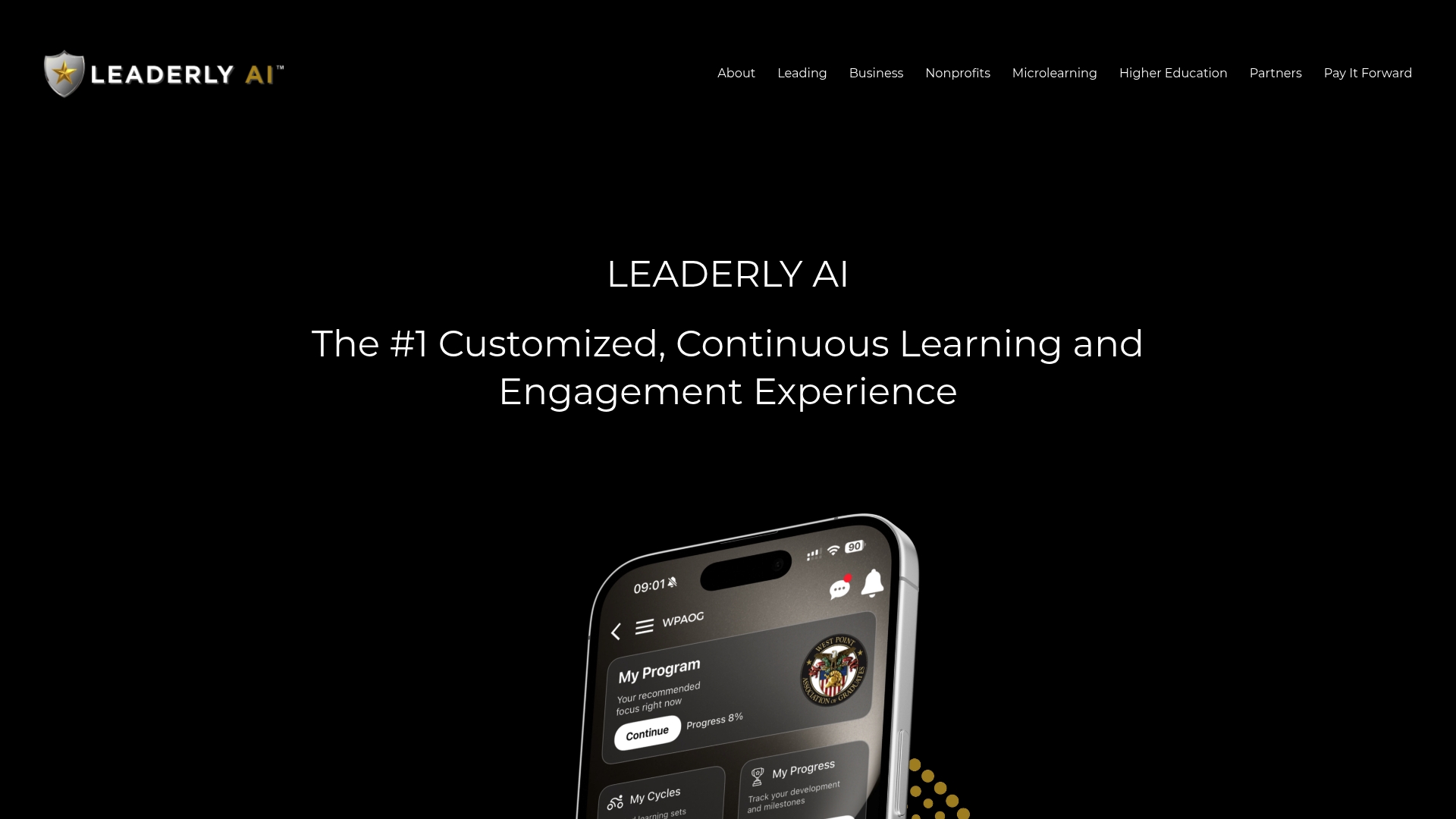
If your organization is comparing standalone badge issuers against something more integrated, the practical difference shows up in setup time. A standalone badge platform still requires you to build the microlearning content and assessments elsewhere and connect the pieces yourself. Leaderly AI's approach to continuous professional development keeps the microlesson, the practice exercise, and the recognition step in one flow, which shortens the distance between launching a pilot and seeing real data.
A few starting points depending on your organization:
- Corporate teams can start with a pilot cohort through Leaderly AI's business page.
- Higher education programs can explore Leaderly AI for Higher Education for cohort-based leadership credentialing.
- Nonprofits can review Leaderly AI for Nonprofits for mission-aligned development programs.
Request a conversation about a pilot through Leaderly AI to see how microlearning, assessment, and recognition can work together for your team.
FAQ
Do employers care about digital badges?
Employers care about digital badges when they come with real evidence behind them, such as a scored assessment or project rather than a completion mark. Research from Drexel University found hiring managers view badges positively as screening signals, especially alongside other candidate information.
Can you provide an example of a digital badge?
A typical example is a badge for completing a scored project, such as a leadership simulation, that includes metadata fields for the criteria met, a link to the evidence, and the date the result was recorded. Badges built on the Open Badges 3.0 standard also include cryptographic proof so a receiving system can verify authenticity.
What is the point of digital badges?
The point of a digital badge is to give a portable, verifiable record of a specific skill that can inform hiring, promotion, or internal mobility decisions. Without verification and evidence, a badge functions more like a participation marker than a credential employers can act on.
How do I get a digital badge?
You earn a digital badge by completing the assessment or project an issuer requires, such as a course provider, employer, or university, and meeting its defined criteria. Once issued, the badge typically lands in a digital wallet or portfolio that you can share with employers or on professional networking profiles.
Sources
- Digital Badges: A Pilot Study of Employer Perceptions
- The Case for Validated Skills: What Employers Want and Need
- Open Badges specification (IMS Global)
- Do microcredentials help new workers enter the market? (Journal of Human Resources)
- Exploring digital badges as signaling and screening mechanisms in the contemporary labor market