
What does formative assessment mean in leadership?
Formative assessment in leadership is a continuous, evidence-based process of gathering feedback and using it to adjust leadership behaviors before problems compound. Unlike a year-end review or a performance rating, it happens in real time, mid-course, while there is still room to change direction. The Comprehensive Assessment of Leadership for Learning (CALL), developed through IES-funded research, defines it precisely: a process that modifies thinking or behavior toward intended outcomes, not a summative judgment of a positional leader.
For educational and organizational leaders, that distinction carries real weight. Summative evaluation tells you how a leader performed. Formative assessment tells you what to do differently while the work is still in progress.
The core components of formative assessment in leadership include:
- Ongoing data collection: Gathering evidence from staff surveys, classroom walkthroughs, team check-ins, and self-reflection rather than waiting for formal review cycles.
- Feedback cycles: Creating structured loops where leaders receive input, reflect on it, and respond visibly so staff can see the connection between their feedback and leadership action.
- Adaptive strategy: Adjusting leadership approaches based on what the data reveals, not what was planned at the start of the year.
- Learning-focused culture: Treating the organization itself as a place where adults, not just students, are expected to grow and improve continuously.
Why formative assessment matters for leaders
Leaders who use formative assessment consistently make better decisions faster. They catch misalignments early, before a struggling teacher becomes a disengaged one or a flawed initiative becomes an entrenched failure. The U.S. Department of Education's TEAL Center identifies formative assessment as the most powerful moderator in enhancing achievement, citing Hattie and Timperley's research on feedback quality.

That finding applies beyond the classroom. When leaders treat their own practice the way skilled teachers treat instruction, the benefits multiply across the organization.
Key benefits include:
- Faster course correction: Real-time feedback lets leaders adjust before small problems become systemic ones.
- Stronger staff trust: When teachers and staff see that their input actually changes something, they engage more honestly in future feedback cycles.
- Better instructional outcomes: A review of the evidence from IES Regional Educational Laboratory Central found that formative assessment positively impacts student achievement, particularly in math, when leaders actively support its implementation.
- Increased leader self-awareness: Regular reflection on one's own practice surfaces blind spots that annual reviews never reach.
- Organizational agility: Teams led by formative leaders adapt to new challenges more readily because adjustment is already built into the culture.
Research note: Meta-analyses through early 2025 show formative assessment positively impacts student achievement, especially in math, when school leadership actively supports its use.
Five leadership strategies drawn from formative assessment research
The WestEd "How I Know" project, which supported three urban districts from 2017 to 2020, identified five leadership practices that consistently strengthened formative assessment implementation. They are worth treating as a framework, not a checklist.
- Foster understanding: Leaders cannot delegate what staff do not yet grasp. Before rolling out any formative assessment initiative, invest time in building shared knowledge about what it actually looks like in practice.
- Communicate a compelling vision: Teachers commit to change when they understand why it matters for students. A vision that connects formative assessment to student agency and equity tends to generate more genuine buy-in than one framed around compliance.
- Model a learning culture: Leaders who seek feedback on their own practice, and who talk openly about what they are learning, signal that growth is expected at every level. This is the practice most leaders skip, and the one that matters most.
- Lead professional development: Site-based professional learning, designed around real instructional challenges rather than generic workshops, builds the shared capacity teachers need to implement formative assessment with fidelity.
- Nurture scaling conditions: Structural supports, including time in the schedule, space for professional conversation, and protection from competing initiatives, determine whether formative assessment takes root or fades after the first semester.
Pro Tip: Start small. Pick one feedback tool, such as a brief anonymous staff survey or a structured debrief after a team meeting, and use it consistently for six weeks. Visible follow-through on even minor feedback items builds the trust that makes larger feedback cycles possible.
Formative vs. summative assessment: what leaders need to know

The distinction is not just academic. Leaders who confuse the two end up using formative data the wrong way, or ignoring it entirely in favor of the annual report.
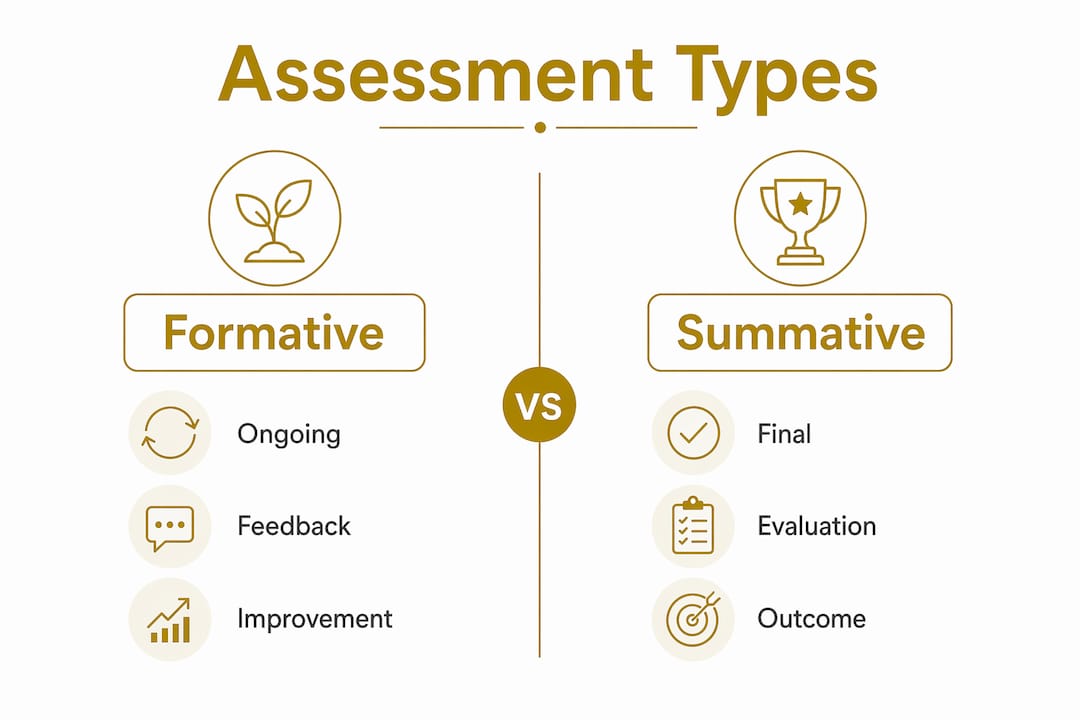
| Feature | Formative assessment | Summative assessment |
|---|---|---|
| Purpose | Guide ongoing improvement | Evaluate final performance |
| Timing | Continuous, mid-process | End of a cycle or program |
| Use of data | Adjust current strategies | Judge overall outcomes |
| Feedback direction | Feeds forward into next steps | Documents past results |
| Leader role | Active participant and learner | Evaluator or recipient of ratings |
| Risk if misused | Becomes punitive, erodes trust | Misses opportunities for growth |
Formative assessment informs what a leader does next. Summative assessment accounts for what already happened. Both are necessary, but they serve different purposes and should never be substituted for each other. A leader who uses formative data to rank staff performance has misapplied the tool entirely.
The most effective leaders treat these two types as complementary. Formative data prepares teams for summative evaluations by closing gaps before the end-of-year reckoning arrives. Summative results, in turn, identify patterns that should feed directly into the next formative cycle.
Common mistakes leaders make with formative assessment
The research is clear on where this goes wrong, and the most common errors are not technical. They are cultural and attitudinal.
- Treating it as a teacher-only responsibility: Leaders who see formative assessment as something that happens in classrooms, not in their own practice, disconnect it from organizational improvement. Leadership must actively engage in evidence use for school-wide growth to occur.
- Using formative data as a summative product: Collecting feedback and then filing it as documentation for an audit is the opposite of what formative assessment is for. Successful leaders focus on collective inquiry and instructional adjustment, not compliance records.
- Failing to act on feedback: Gathering input and then doing nothing with it is worse than not asking at all. Staff who share honest feedback and see no response stop sharing. Trust erodes quickly and rebuilds slowly.
- Over-burdening staff with tools: Piling on surveys, exit slips, and reflection protocols without reducing other demands signals that formative assessment is an add-on, not a priority.
- Focusing on checklists instead of culture: A rubric completed and filed is not formative assessment. The process requires genuine reflection and a willingness to change, not a box checked.
- Skipping anonymity: Feedback collected without anonymity protections tends to reflect what staff think leaders want to hear, not what is actually happening.
How to combine formative and summative assessments for leadership growth
The goal is not to choose one over the other. It is to use each at the right moment and let them inform each other.
- Use formative data to prepare for summative evaluations: When leaders track progress continuously, end-of-year reviews hold fewer surprises. Staff arrive at summative evaluations with documented growth rather than a single snapshot of performance.
- Let summative results launch the next formative cycle: After a program evaluation or annual review, identify two or three specific areas where the data points to a gap. Build the next round of formative feedback around those gaps rather than starting fresh.
- Communicate findings at both stages: Share formative data with staff as it emerges. Share summative results with the broader community, including parents, board members, and district leadership, with context that explains what the organization is doing in response.
- Align professional development to both data streams: Formative data reveals what teachers need right now. Summative data reveals what the organization needs to build over the next year. Effective professional development addresses both time horizons.
- Protect the formative process from accountability pressure: When summative stakes are high, leaders often default to using all data for evaluation. Building a clear firewall between formative feedback and formal ratings preserves the psychological safety that makes honest feedback possible.
Building a culture of formative leadership
The leaders who get the most from formative assessment are the ones who treat it as a way of being, not a set of tools. Research on reflective leadership practice shows that principals who model humility and seek anonymous feedback from staff build trust and empower teachers to take instructional risks. That trust is the precondition for everything else.
Becoming a "lead learner" means making your own learning visible. Talk about what you are reading, what a recent observation taught you, or where your assumptions turned out to be wrong. When staff see a leader doing this without defensiveness, they begin to do the same.
Advanced practices for building a formative leadership culture include:
- Use data for collective inquiry, not compliance monitoring: Frame feedback sessions around shared questions ("What are we learning about how students respond to this approach?") rather than individual performance judgments.
- Build psychological safety deliberately: Leaders who model reflective practice and seek feedback on their own behaviors create the conditions where staff feel safe to innovate and report honestly.
- Embed coaching and mentoring into the feedback cycle: One-time feedback without follow-up coaching rarely produces lasting change. Assessment-rich leadership programs that combine simulations with ongoing coaching produce stronger behavioral change than feedback alone.
- Make feedback cycles predictable: Staff engage more honestly when they know feedback will be sought regularly, not just when something goes wrong.
- Celebrate learning, not just results: Recognize teams that tried a new approach and adjusted based on what they learned, even when the first attempt did not produce the expected outcome.
Pro Tip: Schedule a brief "learning debrief" at the end of every leadership team meeting. Ask two questions: "What did we learn this week?" and "What will we do differently next week?" Done consistently, this practice shifts the team's default from reporting to reflecting.
How to communicate formative assessment results to stakeholders
Formative data is only useful if the right people understand it and can act on it. The communication challenge is different at each level of the organization.
With teachers and staff, share findings quickly and in plain language. A brief summary of what the feedback revealed, paired with a clear statement of what leadership will do in response, closes the loop and reinforces that the process is genuine. Avoid presenting data in ways that feel evaluative or that could be traced back to individuals.
With district leadership and board members, frame formative data as evidence of organizational learning rather than a report card. Show how the data is driving specific adjustments to professional development, resource allocation, or instructional strategy. Leaders who can connect formative feedback to measurable mid-year shifts in practice build credibility with oversight bodies.
With parents and community members, translate findings into outcomes. What did the feedback reveal about student experience, and what changed as a result? Concrete examples, such as a shift in how a school structures intervention time based on teacher feedback, make the process tangible and build community confidence.
How to train and support staff in using formative assessment
Staff cannot implement what they do not understand, and understanding alone is not enough. They also need time, structures, and a leader who models the practice.
Start with professional development that is grounded in real classroom or organizational challenges, not abstract frameworks. Teachers learn formative assessment best by examining student work together, practicing feedback conversations, and reflecting on what the evidence reveals about their instruction. The same principle applies to organizational leaders learning to use staff feedback.
Build in collaborative structures. Professional Learning Communities (PLCs) give teachers a regular forum to analyze formative data together, share what is working, and adjust their approaches collectively. A Midwestern high school case study found that creating dedicated time in the schedule and space for professional conversation about student achievement was central to successful formative assessment implementation.
Provide coaching alongside training. A workshop introduces concepts; a coach helps a teacher or leader apply them in their specific context. Pair new formative assessment practices with follow-up observation and feedback so staff can refine their approach with support rather than in isolation.
Tools and technologies that support formative assessment in leadership
The right tool depends on what kind of feedback you need and how quickly you need it.
For gathering anonymous staff feedback, platforms like Google Forms, Microsoft Forms, and Mentimeter allow leaders to deploy quick pulse surveys after meetings or professional development sessions. The anonymity feature is not optional. Research on formative leadership strategies consistently shows that anonymous feedback produces more honest and useful data than identified responses.
For tracking leadership development over time, rubric-based systems like CALL (Comprehensive Assessment of Leadership for Learning) allow school leadership teams to self-assess against core leadership tasks and receive structured feedback. CALL focuses on distributed leadership tasks rather than individual positional ratings, which aligns well with formative principles.
For ongoing microlearning and behavioral development, platforms like Leaderlyapp use machine learning to deliver personalized leadership content that adapts as a leader's practice evolves. The combination of microlessons, behavioral science, and continuous assessment mirrors the formative cycle: gather evidence, adjust, repeat.
For classroom-level formative data that informs instructional leadership, curriculum-based measurement tools and learning management systems with built-in analytics give principals real-time visibility into student progress without waiting for summative test results.
Measuring the impact of formative assessment on organizational performance
Measuring impact requires deciding in advance what you are trying to change and how you will know it changed. Vague goals produce vague evidence.
Start by identifying two or three specific leadership behaviors or organizational outcomes you expect formative assessment to influence. These might include teacher retention, the frequency of instructional coaching conversations, student engagement indicators, or the speed at which the leadership team responds to emerging problems.
Track leading indicators, not just lagging ones. A lagging indicator like annual test scores tells you what happened. A leading indicator like the number of teachers who report feeling supported in trying new instructional approaches tells you whether the conditions for improvement are in place. Formative assessment is fundamentally about leading indicators.
Use pre and post comparisons where possible. A study of undergraduate leader development using formative assessment found that all thirteen of an institution's core leadership competencies increased from pre-semester to post-semester scores, with no significant differences across instructors. That kind of structured comparison, applied to organizational leadership programs, gives you defensible evidence of impact.
Finally, share what you find, including the results that are disappointing. An organization that only reports positive outcomes from its formative processes signals that the data is being managed rather than used. Honest reporting of what the evidence reveals, and what the leadership team is doing in response, is itself a formative act.
Leaderlyapp supports your formative leadership practice
Formative assessment works best when it is embedded in daily leadership habits, not reserved for formal review cycles. Leaderlyapp is built around exactly that principle. The platform delivers personalized microlessons grounded in behavioral science, adapting to each leader's growth trajectory so that development is continuous rather than episodic. Whether you are an emerging leader building self-awareness or a seasoned principal refining your feedback culture, Leaderlyapp gives you the tools to cultivate people-centric leadership through evidence-based practice.
Explore how Leaderlyapp can help you build the habits that make formative leadership sustainable.
Key Takeaways
Formative assessment in leadership works because it turns ongoing feedback into adjusted behavior, building the trust and learning culture that drives real organizational improvement.
| Point | Details |
|---|---|
| Formative assessment is a process, not an event | It happens continuously during leadership practice, not at the end of a cycle. |
| Leaders must model the practice themselves | Leaders who seek feedback on their own behavior create psychological safety for staff to do the same. |
| Acting on feedback is what builds trust | Collecting input and doing nothing with it erodes staff confidence faster than not asking at all. |
| Formative and summative assessments serve different purposes | Use formative data to adjust mid-course; use summative data to account for outcomes and plan the next cycle. |
| Culture matters more than tools | Anonymous feedback, collective inquiry, and visible follow-through matter more than which survey platform you use. |