
To align leadership coursework with industry needs, use labor-market-informed backward design: extract employer skill signals from job-posting data, translate them into behaviorally specific learning outcomes, build performance-based rubrics, and co-design microcredentials with employer partners. That sequence, grounded in curriculum-alignment best practices, is the method. Everything else is execution.
Start here, this week:
- Pull a skills map draft. Run a sample of current job postings through Lightcast or O*NET to extract a selection of employer-demanded competencies relevant for your target role cluster.
- Convene an advisory council. Send invitations to several senior employer contacts for a co-design workshop within a month.
- Draft one sample rubric. Take the top-ranked competency from your skills map and write a four-level behavioral rubric faculty can calibrate against.
Key Takeaways
Aligning leadership coursework with industry needs requires labor-market-informed backward design, employer co-design governance, behaviorally specific rubrics, and six-month follow-up measurement to produce ROI sponsors will fund again.
| Point | Details |
|---|---|
| Start with labor-market data | Use Lightcast, O*NET, or LinkedIn Talent Insights to extract the top 20 employer competencies before writing a single learning outcome. |
| Apply backward design | Map competencies to measurable behavioral outcomes, then build assessment tasks that produce observable evidence of those behaviors. |
| Co-design with employers | Convene an advisory council of 6–10 employer representatives; embed them in governance, not just a one-time focus group. |
| Measure beyond satisfaction | Track pre/post behavioral change, time-to-proficiency, and promotion rates at 6–12 months post-program, not just end-of-course scores. |
| Leaderlyapp scales the method | Leaderlyapp delivers AI-driven microlearning, rubric-based assessments, and cohort dashboards that operationalize the full alignment playbook. |
Table of Contents
- What does your 90-day alignment sprint look like?
- How do you align leadership coursework with industry needs, step by step?
- How do you write rubrics that employers actually recognize?
- How do microcredentials connect coursework to employer career ladders?
- Which tools and data sources support skills mapping at scale?
- What does a realistic 3–12 month pilot plan look like?
- How do you measure ROI and report it to employers?
- Marshall Online MAPS: what the pilot actually showed
- The case for long-term employer partnerships over one-off projects
- Leaderlyapp operationalizes this playbook at scale
- Sources
What does your 90-day alignment sprint look like?
Alignment fails when it stays in committee. Assign a program owner, then run three parallel workstreams.
Roles: The program owner drives the sprint. Career services and HR supply labor-market context. Faculty own outcome translation and rubric writing. A data analyst (or a contracted Lightcast/Burning Glass seat) handles the extraction workflow.
Governance cadence: Weekly design team check-ins for the first 60 days; monthly steering committee with at least two employer representatives.
| Milestone | Deliverable | Owner |
|---|---|---|
| Day 30 | Skills extraction report (top 20 competencies, sourced from job postings) | Data analyst + program owner |
| Day 60 | Draft program learning outcomes mapped to competencies; sample rubric for top 3 skills | Faculty lead |
| Day 90 | Pilot course design with assessment plan; employer advisory council convened | Program owner + employer partners |
How do you align leadership coursework with industry needs, step by step?
The core method is backward design fed by labor-market signals, described in detail by Chmura's curriculum-alignment framework.
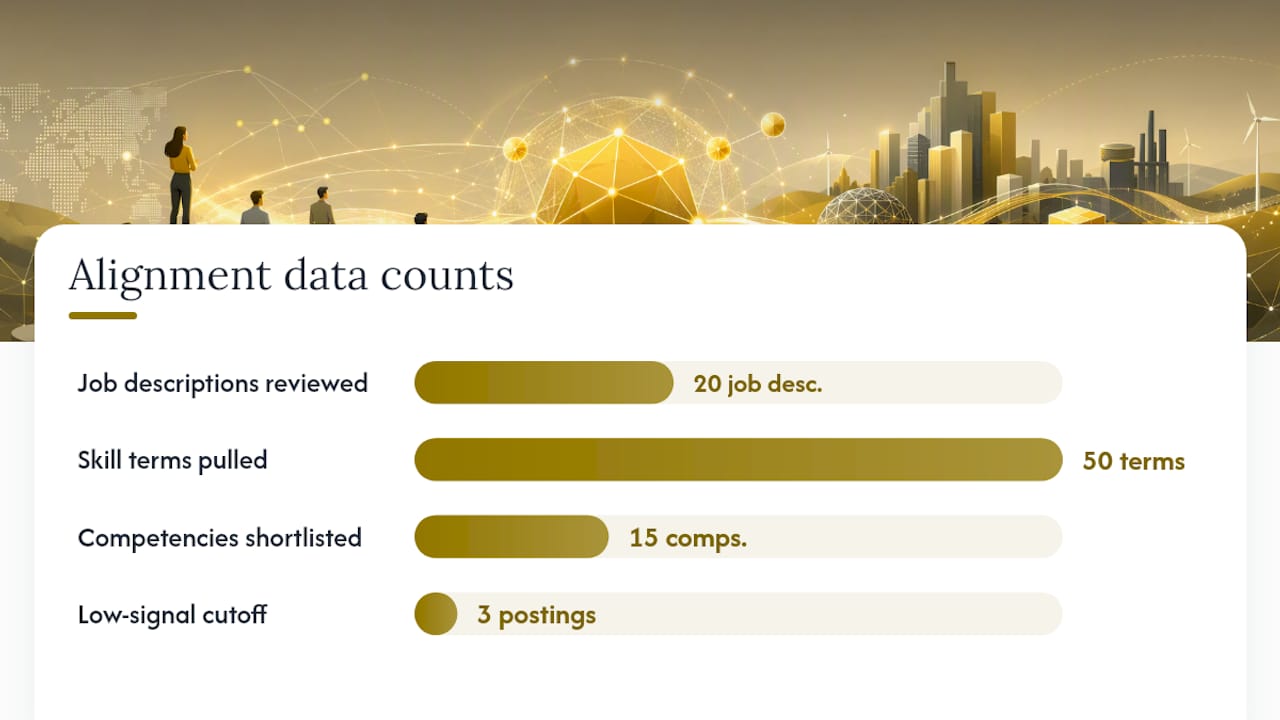
- Extract employer skill signals. Query Lightcast, Burning Glass Technologies, LinkedIn Talent Insights, or O*NET for the target occupation. Pull the 50 most-frequent skill and competency terms from recent postings.
- Run thematic analysis. Group raw employer language into competency clusters (e.g., "drives cross-functional initiatives" + "manages stakeholder expectations" = stakeholder influence). This is where employer vocabulary becomes pedagogical vocabulary.
- Apply backward design. For each cluster: define the enduring competency, write a measurable behavioral outcome, then design the assessment task that would prove a learner has it.
- Validate with faculty. Labor-market data surfaces employer terminology, but faculty must confirm pedagogical integrity and flag transient trends. A two-hour faculty workshop per competency cluster is enough.
- Map to program sequence. Assign each outcome to a course or module. Identify gaps where no current course addresses a high-demand competency.
Sample AI extraction prompt: "Review the following 20 job descriptions for [role]. List the 15 most frequently required leadership competencies as action-verb phrases. Group synonyms. Flag any competency appearing in fewer than 3 postings as low-signal."
Pro Tip: Never let a data pull drive curriculum alone. Faculty validation is what separates a defensible alignment process from a trend-chasing exercise. Schedule the validation workshop before the data report is finalized, not after.
How do you write rubrics that employers actually recognize?
A rubric is only useful if it describes behavior an employer would observe on the job. Start with the employer's action verb, not an academic abstraction.
Conversion example: The job-posting phrase "drives cross-functional initiatives" becomes the learning outcome "The learner coordinates a multi-team project, resolves at least one documented conflict, and delivers a stakeholder update." That outcome is assessable. "Understands collaboration" is not.
| Performance Level | Behavioral Evidence | Assessment Source |
|---|---|---|
| Exemplary | Proactively identifies stakeholder misalignment; proposes and implements a resolution | Simulation debrief + manager rating |
| Proficient | Addresses conflict when raised; communicates resolution to relevant parties | Case study write-up |
| Developing | Recognizes conflict but defers resolution to supervisor | Reflective journal |
| Beginning | Does not identify or address stakeholder misalignment | Observation checklist |
For leadership self-assessment to feed rubric baselines, have participants complete a pre-program behavioral inventory before the first module. That pre-data becomes your control point for measuring change.
Pro Tip: Run a faculty calibration session using three anonymized student work samples before the pilot cohort begins. Below that, the behavioral descriptors need sharper language.
AACSB guidance also calls for plural epistemic perspectives in executive education design, meaning rubrics should account for diverse managerial contexts, not just Western corporate norms. Build at least one scenario per rubric that reflects a cross-cultural or sector-specific leadership challenge.
How do microcredentials connect coursework to employer career ladders?
Co-designing microcredentials with HR links each stackable credential directly to an internal career-ladder rung or succession-planning milestone. That connection is what converts a training program into a measurable HR investment.
Co-design formats that work:
- A half-day employer workshop where HR and line managers map their internal competency framework to your draft learning outcomes
- An Industry Advisory Council of 6–10 senior employer representatives, meeting at least twice a year, with structured incentives: intern pipelines, sponsored capstone projects, early access to graduates
Questions to ask employers in the co-design session:
- Which competencies are gating promotions to first-line manager right now?
- What does "ready" look like at 6 months post-hire versus 18 months?
- Are there regulatory or compliance skills that must appear in any credential you'd recognize?
- What cultural or sector-specific leadership behaviors matter most in your context?
Sustainable university-industry partnerships depend on recurring governance, not one-off workshops. Embed employer representatives in curriculum governance so updates happen continuously, not at the next accreditation cycle.
For sector-specific rubric examples, the campaign leadership qualities list from Campaign Buddy illustrates how role-specific behavioral anchors differ from generic leadership frameworks.
Which tools and data sources support skills mapping at scale?
Each tool contributes something different. Use them in combination.
Data sources:
- Lightcast (formerly Emsi Burning Glass): Real-time job-posting aggregation, skills taxonomy, regional demand signals. Best for extracting the 20–30 most-demanded competencies for a specific role and geography.
- Burning Glass Technologies (now integrated into Lightcast): Historical trend data and skills adjacency mapping. Useful for identifying which competencies are rising versus plateauing.
- LinkedIn Talent Insights: Employer-specific hiring patterns and talent-flow data. Valuable when co-designing for a named employer partner or industry vertical.
- O*NET: Free, government-maintained occupational profiles with task lists, knowledge requirements, and skill ratings. A strong starting point before purchasing a commercial seat.
Operational workflow: Extract skills from the data source, run thematic analysis in a spreadsheet or qualitative coding tool, validate with faculty, then populate your LMS with the resulting outcome statements. AI-enabled skills mapping platforms can automate the extraction step and produce semester-by-semester curriculum maps that advisors and students can navigate directly.
LMS and e-portfolio integration: Tag each course module with the competency it addresses. Use an e-portfolio tool (Portfolium, Anthology Portfolio, or a Canvas-native option) to collect behavioral evidence artifacts. Those artifacts feed rubric scoring and become the evidence base for microcredential issuance.
What does a realistic 3–12 month pilot plan look like?
A pilot does not need a large cohort to generate credible data. Twenty to thirty participants across one course or module is enough to test rubric reliability and collect pre/post behavioral data.
- Months 1–3 (Design): Complete skills extraction, outcome mapping, and rubric development. Convene advisory council. Finalize pilot course design.
- Months 4–6 (Delivery): Run the pilot cohort. Collect pre-assessments, formative rubric scores, and employer check-ins at the midpoint.
- Months 7–9 (Measurement): Administer post-assessments. Gather manager ratings and workplace-application evidence. Calculate pre/post behavioral change scores.
- Months 10–12 (Iteration and scale decision): Present findings to steering committee. Revise rubrics and outcomes based on data. Decide on full-program rollout or second pilot.
Success criteria checklist:
- Skills coverage: at least 80% of the top-20 employer competencies addressed in the curriculum
- Employer satisfaction: advisory council members rate the credential as "relevant" or "highly relevant" to their hiring criteria
- Behavioral change: measurable pre/post improvement on at least 3 of the 5 priority rubric competencies
- Placement signal: pilot cohort participants advance to interviews or promotions at a higher rate than the prior cohort
Budget shape: The largest cost is typically faculty time for rubric development and calibration and a data tool subscription. O*NET is free; Lightcast and LinkedIn Talent Insights carry licensing fees that vary by institution size.
How do you measure ROI and report it to employers?
Top-performing executive education programs measure workplace application months after delivery, not just end-of-program satisfaction scores. Build that follow-up into the program design from day one.
Metrics that matter to HR buyers:
- Pre/post behavioral change scores on rubric competencies
- Time-to-proficiency for new hires from the program versus the prior cohort
- Promotion rate within 12–18 months of program completion
- Employer Net Promoter Score from advisory council members and hiring managers
- Cohort-level dashboard: skills coverage, assessment completion, and placement outcomes
For a practical leadership training ROI framework, track at minimum three data points per cohort: a pre-program self-assessment, a rubric-scored capstone, and a six-month manager rating. Those three points give you a defensible before-and-after story.
Present ROI to HR sponsors in their language: time saved in onboarding, reduction in first-year attrition, and promotion pipeline depth. Avoid academic jargon in sponsor reports.
Marshall Online MAPS: what the pilot actually showed
Marshall Online built its Academic & Career Readiness MAPS toolkit using Lightcast labor-market data and a tiered generative AI prompt workflow to extract curriculum skills, identify gaps, and sequence developmental experiences semester by semester. Human validation was applied at each stage.
What changed:
- Curriculum gaps became visible at the course level, not just the program level
- Students and advisors could see a clear semester-by-semester readiness sequence tied to employer-demanded competencies
- Employer engagement increased because the maps used employer language, not academic catalog language
Lessons for your pilot:
- Start with one program, not the whole institution
- Use AI extraction as a first pass, then require faculty sign-off before any outcome is finalized
- Share the maps with employer partners before publishing them to students — their feedback at that stage is faster and cheaper to act on than post-launch revisions
The case for long-term employer partnerships over one-off projects
Most programs treat employer engagement as a project: convene a focus group, update the syllabus, repeat in three years. That cycle is too slow for the current pace of skills change, and EFMD's research on executive education partnerships confirms that the best programs treat design as ongoing co-creation, with impact measured long after delivery. AACSB guidance reinforces the same point: longitudinal partnerships, not episodic reviews, are what keep curriculum current and credible. The programs that earn employer trust are the ones where an employer rep sits in a governance meeting and sees their own competency language reflected in the rubric. That is not a transaction. It is a relationship that compounds over time.
Leaderlyapp operationalizes this playbook at scale
The method described here requires AI-assisted skill extraction, microlearning delivery, behavioral rubrics, cohort dashboards, and a governance layer that keeps employer input flowing. Leaderlyapp's mobile-first SaaS platform covers all of it: AI-driven microlessons mapped to specific competencies, built-in self-assessments (DiSC, EQ, MBTI), analytics dashboards for cohort-level behavioral tracking, and customizable learning journeys that mirror the semester-by-semester sequencing the Marshall MAPS model demonstrated.
For institutions and corporate training teams ready to move from planning to delivery, Leaderlyapp offers a structured pilot pathway. You define the target competencies; the platform handles delivery, rubric scoring, and the six-month follow-up measurement that sponsors need to see. Explore people-centric leadership development on Leaderlyapp, or visit Leaderlyapp to start a pilot conversation.
Sources
The following sources and tools support the method described in this article.
- Building a curriculum-alignment process that labor data can defend
- What the most effective executive education partnerships have in common
- A New Model for University-Industry Partnerships