
The leadership skills gap is defined as the distance between the competencies your leaders currently have and the competencies your organization needs to execute its strategy. 77% of organizations report that leadership is lacking, causing sluggish decision-making and stalled innovation. That number signals a systemic failure, not an isolated HR problem. To reduce the leadership skills gap in your organization, you need a strategy that starts with precise diagnosis, applies targeted development methods, and builds reinforcement into daily work. Generic training programs do not close this gap. Evidence-based, strategy-aligned development does.
How to identify leadership skills gaps in your organization
The single most important step before any development program is a rigorous needs analysis. A needs analysis before program design increases transfer effects more than any other design decision. That means diagnosing gaps before choosing solutions, not after.
Start by defining what leadership success looks like in your specific operating context. Starting with generic competencies rather than business strategy is a common and costly mistake. Your success criteria must reflect your organization's actual strategy, risk profile, and operating model.
Once you have defined success, use objective methods to measure current performance against it:
- 360-degree feedback: Collects input from direct reports, peers, and managers to surface blind spots that self-report surveys miss entirely.
- Assessment centers: Simulate real leadership scenarios and produce observable, ratable behavior data.
- Work samples and performance records: Reveal patterns in how leaders actually make decisions and develop their teams.
- Skills matrix: Maps required competencies against current performance for each leader or leadership tier.
The skills matrix is particularly useful for HR professionals. It converts subjective impressions into a visual gap map that prioritizes development investment. Focus on high-impact gaps first, specifically the ability to develop talent, make decisions under ambiguity, and build psychological safety. These gaps multiply organizational risk faster than technical skill deficits.
| Assessment method | Best for | Limitation |
|---|---|---|
| 360-degree feedback | Identifying behavioral blind spots | Requires psychological safety to be honest |
| Assessment centers | Observable skill measurement | Time-intensive and resource-heavy |
| Skills matrix | Prioritizing gaps across a team | Only as accurate as the competency criteria |
| Work samples | Real-world performance evidence | Requires structured observation protocols |
Pro Tip: Avoid borrowing a generic competency framework from an industry association. Build your leadership success criteria directly from your business strategy and the decisions your leaders must make in the next 12–24 months.
What interventions actually close leadership skills gaps?
Closing a leadership skills gap requires matching the right development method to the specific gap type. A one-size-fits-all approach, such as a two-day offsite workshop, produces knowledge but rarely produces behavior change. Organizational culture and context heavily determine which competencies matter most, which means your interventions must be tailored to your environment, not borrowed from a generic catalog.
The most effective interventions share four characteristics:
- Spaced delivery: Learning spread over weeks or months outperforms intensive single events. Spaced practice gives the brain time to consolidate new behaviors.
- Deliberate practice with feedback: Leaders must practice specific skills in real situations and receive structured feedback immediately after. Feedback without practice is advice. Practice without feedback is repetition.
- Embedding in real work: Development embedded in daily workflows outperforms occasional retreats. Leaders learn faster when the development task is their actual job, not a simulation of it.
- Micro-experiments: Micro-experiments in daily work create feedback loops that convert knowledge into observable behavior change, preventing the "knowing but not doing" failure mode.
"Program cost is not a significant moderator of leadership development effectiveness. Design factors, specifically spaced delivery, deliberate practice, and structured feedback, drive results. Organizations with limited budgets can outperform expensive external programs by getting the design right."
Executive coaching, action learning sets, peer cohorts, and mentoring each address different gap types. Coaching works best for senior leaders navigating complex interpersonal challenges. Action learning works best when the gap involves strategic problem-solving. Peer cohorts build accountability and shared language across a leadership tier. Mentoring accelerates development for emerging leaders who need role modeling, not just instruction.
Pro Tip: Before purchasing an external program, audit its design against three criteria: Does it include spaced delivery? Does it require deliberate practice in real work? Does it build in structured feedback? If it fails two of three, redesign it internally before spending the budget.

Building a feedback culture that sticks inside your organization also accelerates the transfer of leadership skills from training into daily practice. Feedback is the mechanism that converts intent into behavior.
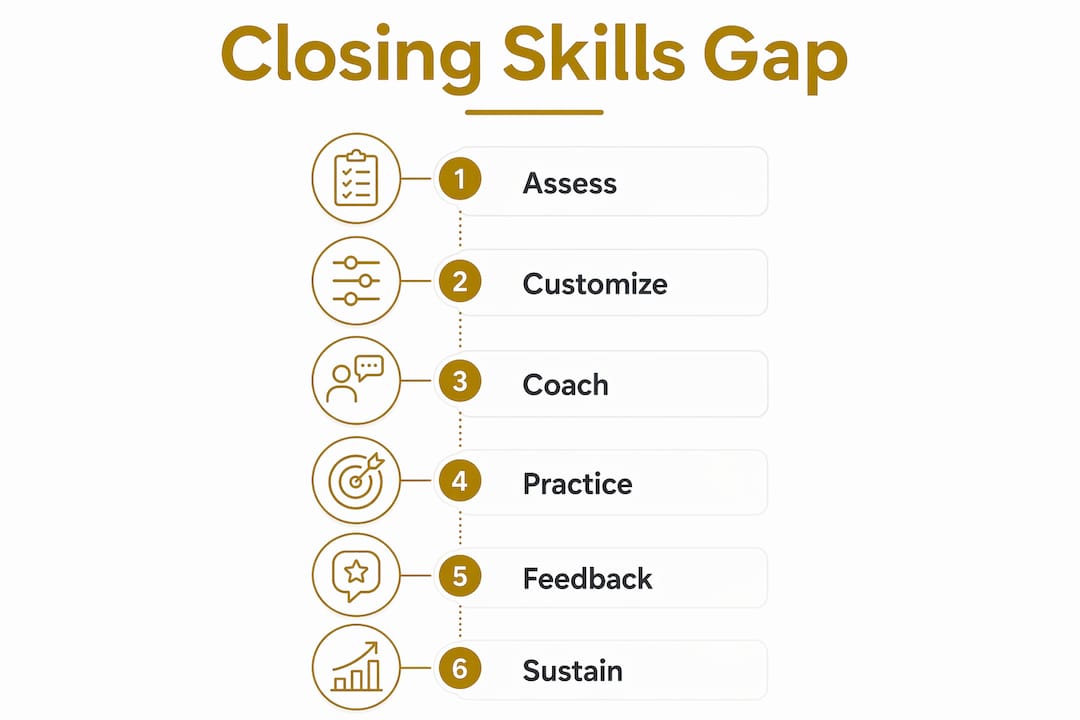
How to sustain leadership development beyond the training event
Most leadership development fails not because the program was poor, but because nothing happens after it ends. Without reinforcement, new behaviors decay within weeks. The research is clear: measuring behavior change at 3–6 months after training, rather than relying on immediate reaction surveys, is the only reliable way to know whether development actually worked.
Sustaining behavior change requires three reinforcement mechanisms working together:
- Scheduled follow-up coaching: Coaching sessions placed at 30, 60, and 90 days after a program address real obstacles as they arise on the job. This is not a check-in. It is a problem-solving conversation tied to specific behavioral goals.
- Social accountability structures: Public goal setting within a peer cohort creates social pressure that sustains effort. Leaders who share their development goals with peers are more likely to follow through than those who keep goals private.
- Environmental redesign: Changing the environment to mandate structural time, such as dedicated coaching slots or protected reflection periods, facilitates leadership behaviors. Knowledge alone does not change behavior. Structure does.
Leadership development programs that span pre-work, experiential practice, accountability structures, and sustained coaching transfer skills far more effectively than programs that stop at the training event. Think of development as a system, not an event.
Pro Tip: Build a 90-day post-program plan into every leadership development initiative before the program launches. If you cannot describe what accountability looks like at day 30, 60, and 90, the program is not finished yet.
Connecting leadership development to employee recognition programs also reinforces new behaviors. When leaders see their development efforts recognized, they repeat those behaviors more consistently.
How do you measure ROI in leadership development?
Measuring the return on leadership development requires defining success metrics before the program starts, not after. The most common mistake is treating participant satisfaction scores as evidence of effectiveness. Satisfaction scores measure whether people enjoyed the experience. They do not measure whether behavior changed.
Use a multi-source, longitudinal approach instead:
- Pre and post 360-degree assessments: Measure specific behavioral competencies at baseline and again at 3–6 months post-program.
- Manager observations: Ask direct managers to rate observable leadership behaviors at 30, 60, and 90 days after development.
- Business KPIs: Track engagement scores, retention rates, team performance metrics, and promotion readiness for participants versus a comparison group.
- Qualitative interviews: Capture specific examples of behavior change from direct reports and peers. Numbers tell you what changed. Stories tell you how.
| Metric type | What it measures | When to collect |
|---|---|---|
| 360-degree feedback | Behavioral competency change | Baseline and 3–6 months post-program |
| Manager observation ratings | On-the-job behavior transfer | 30, 60, and 90 days post-program |
| Engagement and retention data | Downstream organizational impact | Quarterly, compared to pre-program baseline |
| Participant satisfaction scores | Program experience quality | Immediately post-program only |
Specificity in identifying gaps tied directly to business strategy enables targeted development and measurable results. The clearer your gap definition at the start, the easier it is to prove impact at the end. Revisit development plans every six months and adjust based on what the data shows. Leadership development is a continuous feedback loop, not a one-time investment.
Key Takeaways
Reducing the leadership skills gap requires a strategy-aligned needs analysis, evidence-based interventions, sustained reinforcement, and longitudinal measurement tied to real business outcomes.
| Point | Details |
|---|---|
| Start with strategy, not skills | Define leadership success criteria from your business strategy before identifying any gaps. |
| Use objective assessments | Apply 360-degree feedback, assessment centers, and skills matrices to measure gaps accurately. |
| Match methods to gap types | Use coaching, action learning, peer cohorts, or micro-experiments based on the specific gap. |
| Build in reinforcement | Schedule follow-up coaching at 30, 60, and 90 days to prevent behavior decay after training. |
| Measure behavior, not satisfaction | Track competency change at 3–6 months post-program using multi-source assessments and business KPIs. |
Why most organizations are solving this problem backwards
The uncomfortable truth I have seen repeated across organizations of every size is this: most leadership development programs are designed to make HR feel productive, not to make leaders more effective. The program gets launched, the feedback scores come back positive, and everyone moves on. Six months later, nothing has changed.
The real problem is sequencing. Organizations pick a program first and diagnose the gap second, if they diagnose it at all. That is backwards. A needs analysis is not a bureaucratic formality. It is the single decision that determines whether your investment produces behavior change or just a certificate.
The other pattern I find consistently underestimated is the environment. You can put a leader through the best program in the world, and if they return to a culture that punishes the behaviors you just trained, those behaviors will disappear within weeks. Structural changes, protected time, and public accountability are not nice-to-haves. They are the mechanism through which training becomes performance.
Leadership development is a business risk management tool. Treat it like one. Define the gap in business terms, design the intervention with the same rigor you would apply to a product launch, and measure the outcome with the same discipline you would apply to a financial investment. The organizations that do this consistently build leadership pipelines that outlast any individual program or hire.
— Drew
How Leaderlyapp supports your leadership development strategy
Leaderlyapp is built for exactly the challenge this article describes: closing real leadership gaps with development that sticks.
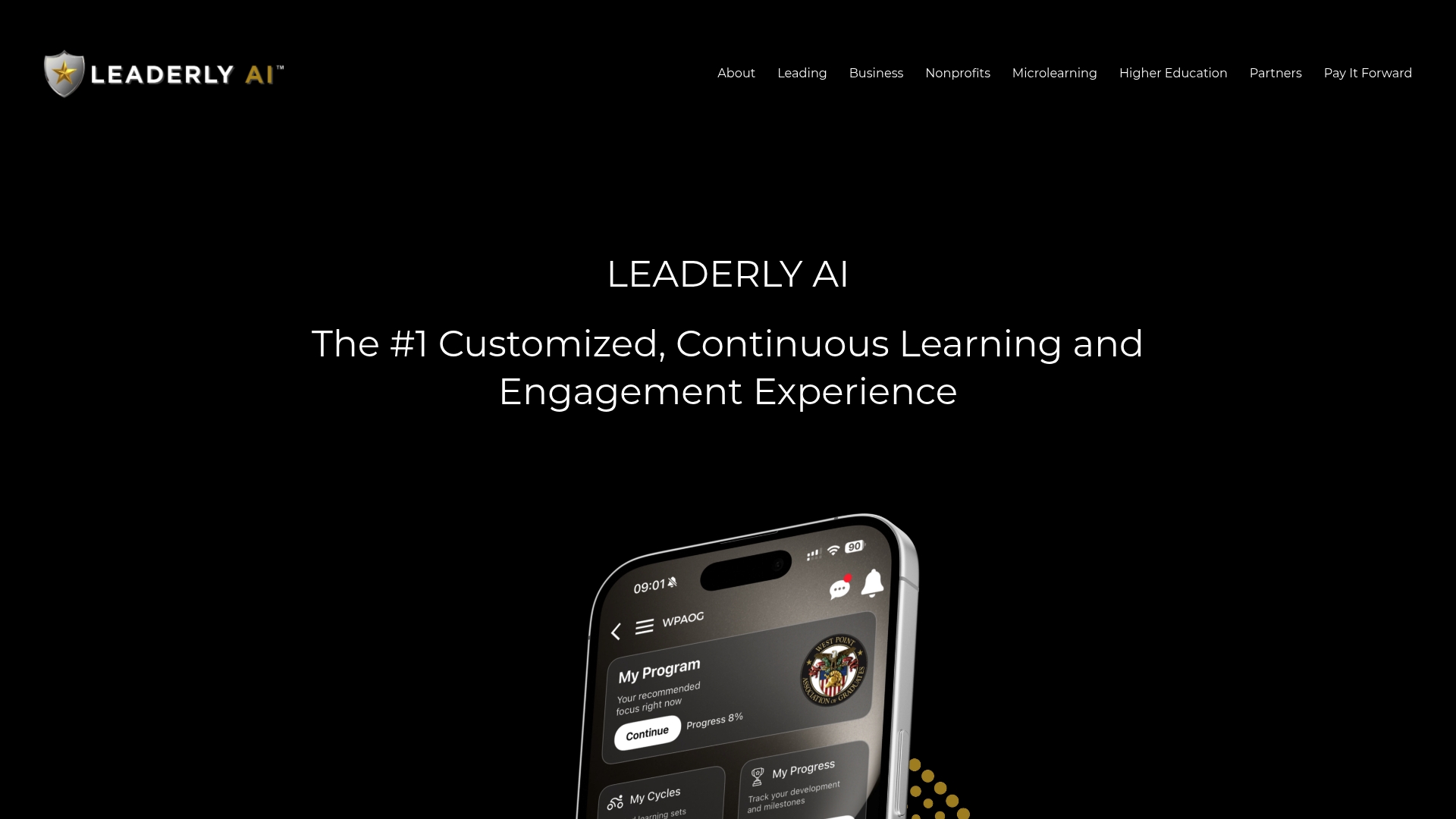
The platform delivers personalized microlessons grounded in behavioral science, adapting to each leader's specific development needs as they progress. HR professionals and organizational leaders use Leaderlyapp to move beyond generic training and build people-centric leadership skills that connect directly to business outcomes. The platform supports spaced delivery, practical exercises, and assessments that track real competency growth over time. Whether you are developing emerging leaders or building depth at the senior level, Leaderlyapp gives you the structure to continuously learn to lead at every stage.
FAQ
What is a leadership skills gap?
A leadership skills gap is the measurable difference between the competencies leaders currently demonstrate and the competencies an organization needs to achieve its strategic goals. It causes slower decisions, weaker talent pipelines, and reduced organizational performance.
How do you identify leadership skills gaps accurately?
Use 360-degree feedback, assessment centers, and skills matrices aligned to your business strategy rather than generic competency frameworks. A needs analysis conducted before program design is the single most important factor in identifying gaps that matter.
What is the most effective way to close a leadership skills gap?
Combine spaced delivery, deliberate practice in real work, structured feedback, and post-program coaching at 30, 60, and 90 days. Programs that embed development into daily workflows consistently outperform offsite retreats.
How long does it take to see results from leadership development?
Behavior change becomes measurable at 3–6 months post-program when assessed through multi-source feedback and manager observations. Immediate satisfaction scores do not predict whether behavior actually changed.
Why do most leadership development programs fail?
Most programs fail because they lack reinforcement after the training event ends. Without scheduled follow-up coaching, social accountability, and environmental support, new behaviors decay within weeks of the program closing.