
Scaffolded learning in leadership means deliberately sequencing supports — modeling, coached practice, structured prompts, and peer collaboration — so that leaders move from dependent novice to confident, independent practitioner. The supports don't stay forever; they fade as evidence of readiness grows. If you're an educational leader reading this for the first time, here's your immediate next step: pick one leadership task you're currently asking a new leader to do alone, and design two structured supports around it before next week. That single shift is where scaffolded leadership development starts.
The global leadership development market is a very large industry, yet a persistent transfer problem means much of that investment doesn't change how leaders actually behave on the job. Scaffolding is the structural fix most programs skip. The University of Illinois at Chicago's three-course redesign is one of the clearest published examples of what it looks like when you get it right.
Key Takeaways
Scaffolded leadership development works because it sequences supports deliberately, keeps them in place until evidence of readiness appears, and then removes them — producing independent practitioners rather than permanent workshop attendees.
| Point | Details |
|---|---|
| Scaffolding defined | Sequenced supports (modeling, coached practice, prompts, fading) move leaders from novice to independent practitioner. |
| Transfer is the core problem | The roughly USD 60 billion invested annually in leadership development underperforms primarily because of poor training transfer; scaffolding directly addresses this. |
| Fading requires evidence triggers | Remove supports based on observable evidence (rubric scores, artifact quality), not elapsed time, to avoid premature independence or over-reliance. |
| Measurement needs two horizons | Track scaffold use and rubric scores during the program; follow up at 3–6 months to confirm behavior change transferred to daily practice. |
| Leaderlyapp as a turnkey scaffold | Leaderlyapp's microlearning, analytics, habit-building, and adaptive sequencing operationalize each scaffold element without requiring a full program build from scratch. |
Table of Contents
- What does scaffolded learning mean for leadership development?
- What core elements should every scaffolded leadership program include?
- Why does scaffolded leadership development produce better outcomes?
- How do you design a scaffolded leadership program step by step?
- What program models can you adapt for your school or district?
- What are the most common pitfalls in scaffolded leadership programs?
- How do you measure whether your scaffolded program is working?
- How does a platform like Leaderly operationalize scaffold elements?
- A quick-start checklist you can use this week
- The case for continuous scaffolding, not episodic events
- Leaderlyapp makes scaffolded leadership development practical
- Sources
What does scaffolded learning mean for leadership development?
The term scaffolding comes from educational psychology, specifically from Lev Vygotsky's concept of the Zone of Proximal Development (ZPD). The ZPD describes the gap between what a learner can do independently and what they can do with skilled support. Vygotsky's insight was that learning happens most efficiently inside that gap — not below it (too easy) and not above it (too hard without help).
Applied to leadership, the ZPD reframes the question. Instead of asking "What does this leader know?" you ask, "What can this leader do with support that they cannot yet do alone?" That shift changes everything about how you design a program.
Scaffolded leadership learning translates the ZPD into four operational moves:
- Sequenced supports: Competencies are ordered from foundational to complex. A new assistant principal practices giving structured observation feedback before facilitating a full instructional coaching cycle.
- Modeling and demonstration: The leader first sees the target practice performed well, with narration of the thinking behind it. A mentor principal talks through a difficult parent conversation before the emerging leader attempts one.
- Coached practice with prompts: The leader attempts the task with a structured template, a coaching partner, or a guiding protocol — not alone. Observation rubrics, reflection stems, and decision frameworks all count as scaffolds.
- Deliberate fading: Supports are withdrawn incrementally as the leader demonstrates readiness. The template gets simpler. The coaching check-in moves from weekly to monthly. The goal is independence, not permanent reliance.
Research on principal preparation argues that theory itself should be scaffolded — positioned not as abstract content to memorize but as a practical lens for analyzing real problems. When a new principal frames a staff conflict through a distributed leadership model, theory becomes a tool, not a test question. That's the ZPD in action at the leadership level.
The UIC three-course redesign operationalized this sequence by moving aspirant leaders through three competency stages: knower (understanding concepts), assessor (applying them to real cases), and demonstrator (leading others through the practice). Each course built on the last, with active learning tasks replacing passive content delivery.
What core elements should every scaffolded leadership program include?
A scaffolded program isn't just a training series with more steps. It has specific structural components that work together. Miss one, and the whole architecture weakens.
- Sequenced competencies: Map the progression from foundational to advanced before you design a single session. A school leader shouldn't be asked to lead a data team meeting before they've practiced interpreting assessment data with a coach.
- Modeling and demonstration: Every new practice needs a visible example. This can be a video of a skilled principal facilitating a difficult conversation, a live co-observation with a mentor, or a detailed written case. The key is that the learner sees the target before attempting it.
- Coached practice: Scheduled, structured coaching touchpoints — not optional check-ins — are non-negotiable. Scaffolding frameworks in educational leadership consistently point to guided, purposeful interactions as the mechanism that shifts culture from top-down directives to shared purpose.
- Prompts, tools, and templates: Observation checklists, structured reflection stems ("What did I notice? What does it mean? What will I do?"), decision-making frameworks, and meeting agendas all function as cognitive scaffolds. They reduce the working memory load so the leader can focus on the practice itself.
- Peer collaboration: Cohort structures — where leaders work through cases together, observe each other, and debrief — accelerate learning in ways solo coaching cannot. A co-lead microproject, where two emerging leaders jointly run a professional learning session, is a low-cost, high-yield scaffold.
- Formative assessment: Rubrics tied to observable behaviors (not just knowledge) let both the leader and the coach see progress. Without formative checkpoints, fading becomes guesswork.
- Deliberate fading: This is the element most programs forget. Supports should be withdrawn on a schedule tied to evidence, not to time. When a leader consistently produces high-quality observation notes without the template, the template goes away.
These elements map directly to the three progression stages: knowers need modeling and sequenced content; assessors need prompts, coached practice, and peer collaboration; demonstrators need fading, independent tasks, and formative feedback that confirms readiness.
Why does scaffolded leadership development produce better outcomes?
The core problem with most leadership programs is the transfer gap. Leaders complete a workshop, score well on a post-test, and then return to school and do exactly what they did before. Scholars tracking the substantial investment in leadership development note that poor training transfer is the primary reason programs underperform — and scaffolding is the structural intervention most likely to close that gap.
The transfer problem is the leadership development problem. Scaffolding addresses it by keeping supports in place until the leader can perform independently in context, not just in the training room.
The evidence base, while still growing, points in a consistent direction:
- A case-based analysis study with mid-level Air Force officers found statistically significant improvements in critical thinking when scaffolding learning aids were included. Scaffold use declined nearly linearly across three repeated cases as learners internalized the skills — exactly the fading pattern a well-designed program should produce.
- The LIS master's-level course using scenario-based assignments and cohort supports reported qualitative gains in motivation, engagement, and alignment to leadership competencies including change management, adaptive leadership, and emotional intelligence.
- The UIC three-course redesign demonstrated that sequencing active learning across a full program — rather than delivering content in isolated workshops — surfaces the tensions between coursework and practice that leaders need to work through to build real competence.
For schools specifically, the outcomes that matter most are instructional leadership behaviors (how often and how well a principal observes and coaches teachers), distributed leadership culture (whether teacher leaders are genuinely empowered), and retention. Scaffolded programs that connect learning to daily work — rather than pulling leaders out for episodic training — tend to produce more durable change on all three.
How do you design a scaffolded leadership program step by step?
Program design follows a clear sequence. Skipping steps doesn't save time; it just moves the failure point downstream.
- Define outcomes and competencies. Start with the observable behaviors you want leaders to demonstrate at the end of the program. "Understands instructional leadership" is not an outcome. "Conducts a 15-minute observation and delivers specific, evidence-based feedback within 24 hours" is.
- Map a competency progression. Arrange competencies from foundational to complex. Identify which ones are prerequisites for others. This becomes your sequencing spine.
- Design active tasks and supports for each stage. For each competency, identify the task (what the leader will do), the scaffold (what support they'll have), and the evidence of readiness (what you'll see when they're ready to move forward).
- Schedule coaching and peer practice. Build these into the calendar before anything else. Coaching that happens "when there's time" doesn't happen.
- Plan the fading schedule. Decide in advance which supports drop at which stage and what evidence triggers the drop. This prevents both premature fading (pulling supports before the leader is ready) and over-scaffolding (keeping supports so long the leader never builds independence).
- Build assessment and reflection loops. End every practice cycle with a structured reflection and a rubric-based check-in. These loops are what make the program self-correcting.
A sample 4-week microsequence for a new instructional leader
Week 1: Modeling. The leader watches two recorded observations with narrated coaching debrief. They complete a structured note-taking template while watching. Artifact: completed observation notes with coach feedback.
Week 2: Co-observation. The leader observes a classroom alongside a mentor, using the same template. They write their own notes, then compare with the mentor's. Artifact: annotated observation notes plus a 15-minute debrief summary.
Week 3: Coached solo observation. The leader conducts an independent observation using the template. The coach reviews the notes and provides written feedback before the leader delivers feedback to the teacher. Artifact: observation notes plus teacher feedback summary.
Week 4: Independent observation with reflection. The leader conducts and debrief independently. The template is simplified to three prompts. Artifact: observation notes, teacher feedback, and a written reflection on what changed from Week 1.
Program components checklist:
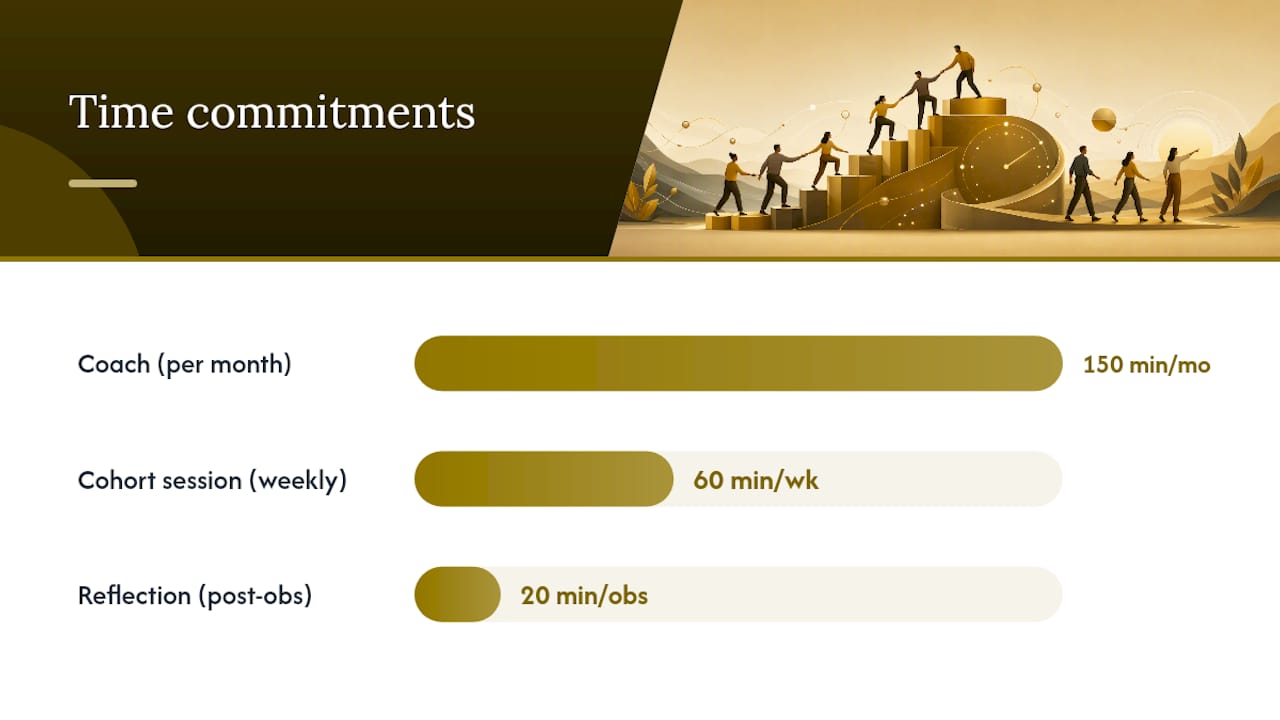
- One designated coach or mentor per emerging leader (2–3 hours per month)
- Observation template (full version for Weeks 1–2, simplified for Week 3 onward)
- Peer cohort of 3–5 leaders for case discussions (one 60-minute session per week)
- Reflection protocol (written, 20 minutes post-observation)
- Rubric with three performance levels tied to observable behaviors
- Fading schedule with evidence triggers documented before the program starts
Pro Tip: Design your fading schedule before you run the first session. Decide which specific evidence — a rubric score, an artifact quality, a self-assessment — will trigger each support removal. Leaders who know the fading criteria in advance tend to work toward independence more deliberately than those who don't.
What program models can you adapt for your school or district?
Three models from published research offer practical blueprints, each suited to a different context.
The UIC three-course continuous model
The University of Illinois at Chicago redesigned three consecutive courses in an educational leadership preparation program to form a single scaffolded arc. Each course built on the last, moving aspirant leaders from conceptual understanding (knower) through applied analysis (assessor) to demonstrated practice (demonstrator). Active learning tasks replaced lectures; cohort structures replaced individual assignments. The key design insight was continuity: the scaffold didn't reset between courses. Competencies developed in Course 1 were practiced and assessed in Course 2, then demonstrated independently in Course 3. For a district, this translates to a multi-year leadership pipeline where each year's program builds explicitly on the previous one, rather than treating each year as a standalone event.
The scenario-based cohort model
The LIS master's-level course model used a common scenario-based assignment across a cohort, with multi-modal supports: asynchronous eLearning modules, facilitated discussion, and an experiential field component. Leaders worked through the same scenario independently, then debriefed in cohort, then applied the learning in a real workplace task. This model works well for blended or hybrid school leadership programs where leaders can't always meet in person. The scenario creates a shared reference point; the cohort debrief is where the real learning happens.
The workplace micro-cohort model
This model requires no formal program structure. Three to five leaders in the same building or district form a peer observation cohort. They use a shared observation protocol, observe each other's practice monthly, and debrief using a structured protocol. A facilitator or coach joins quarterly to calibrate the rubric and push the group's thinking. The scaffold here is the protocol and the cohort structure itself. As the group develops shared language and trust, the protocol simplifies and the facilitator's role fades.
A copyable activity: the "co-lead and debrief" microproject
This works for any leadership task a new leader is about to attempt alone for the first time.
- The experienced leader models the task (e.g., running a data team meeting) while the emerging leader observes using a structured note-taking template.
- The emerging leader co-leads the next instance, with the experienced leader present but in a supporting role.
- The emerging leader leads independently. The experienced leader observes and completes the same rubric the emerging leader uses for self-assessment.
- Both complete a 20-minute structured debrief using three prompts: What went well and why? What would you change? What support do you still need?
The whole cycle takes three to four weeks and produces a concrete artifact at each stage. You can run it for facilitation skills, coaching conversations, or any other leadership practice you're trying to develop.
What are the most common pitfalls in scaffolded leadership programs?
Most programs fail in predictable ways. Knowing the failure modes in advance is half the fix.
- Episodic, one-off training: A single workshop, no matter how well designed, cannot scaffold anything. It delivers content; it doesn't build practice. Fix: commit to a minimum three-session sequence with practice tasks between sessions, even if the sessions are short.
- Coaching that exists on paper only: Scheduled coaching that gets canceled when things get busy is worse than no coaching, because it creates the illusion of support without the substance. Fix: protect coaching time in the calendar the same way you protect instructional time. Make it non-negotiable.
- No transfer support: Leaders learn something in a program and then return to a school environment that doesn't reinforce it. Fix: design a "transfer task" — a specific, observable action the leader will take within two weeks of each session — and build in a brief accountability check.
- Missing assessment: Without rubrics tied to observable behaviors, neither the leader nor the coach knows whether progress is happening. Fix: use a simple three-level rubric (beginning, developing, demonstrating) for each core competency. Review it at every coaching touchpoint.
- Premature fading: Pulling supports before the leader is ready produces anxiety and regression, not independence. Fix: use evidence triggers (rubric scores, artifact quality) rather than time elapsed to decide when to fade.
- Low engagement: Leaders who don't see the relevance of program activities disengage quickly. Fix: adult learner engagement research consistently shows that relevance and autonomy are the two strongest engagement drivers. Let leaders choose which competency to focus on within a structured sequence.
Organizational constraints are real. Time and budget are the most common barriers. Low-cost mitigations include using existing meeting structures (staff meetings, PLC time) as practice contexts, pairing leaders for peer observation instead of hiring external coaches, and using free or low-cost digital tools for asynchronous reflection and artifact submission.
How do you measure whether your scaffolded program is working?
Measurement in scaffolded leadership programs needs to track both learning and behavior change — and those two things require different data collection strategies.
Sample rubric dimensions
| Dimension | Beginning | Developing | Demonstrating |
|---|---|---|---|
| Observation quality | Notes are descriptive but lack evidence-based specificity | Notes include specific evidence; some inference errors | Notes are consistently specific, evidence-based, and tied to instructional impact |
| Coaching facilitation | Leader tells; limited questioning | Leader uses open questions; some co-construction | Leader consistently facilitates leader-driven problem-solving |
| Decision framing | Decisions are reactive; limited use of data | Decisions reference data; some theoretical framing | Decisions consistently integrate data, theory, and stakeholder input |
| Stakeholder feedback | Feedback is general; limited specificity | Feedback is specific; some follow-through gaps | Feedback is specific, timely, and consistently followed through |
Data collection timeline
- Baseline (before the program starts): Self-assessment against the rubric, one artifact sample (e.g., existing observation notes), and a brief coach intake conversation.
- Mid-pilot (end of Week 2 or 3): Rubric check-in with coach, one artifact review, brief participant reflection survey.
- Post-pilot (end of the program): Full rubric assessment, artifact portfolio review, participant and coach debrief.
- 3–6 month follow-up: One observation of the leader in practice, a brief staff survey on instructional leadership behaviors, and a self-assessment comparison against baseline.
The Air Force case-based study offers a useful measurement insight: track scaffold use over time, not just performance. When leaders stop using the template and still produce high-quality work, that's your clearest evidence of genuine internalization. If scaffold use drops but quality drops with it, fading happened too fast.
For school-level indicators, connect leader behavior data to proximal outcomes: teacher observation frequency, coaching conversation logs, PLC facilitation quality, and — over a longer horizon — staff retention and student learning trends.
How does a platform like Leaderly operationalize scaffold elements?
Technology doesn't replace the human elements of scaffolding — coaching, peer observation, and real practice tasks still require people. What a platform can do is host the prompts, track the artifacts, automate the reflection cycles, and give coaches and administrators visibility into where each leader is in the progression.
Leaderlyapp maps to scaffold elements in specific ways:
- Modeling: Personalized microlearning modules deliver short, scenario-based content that shows leadership practices in context, not just describes them.
- Prompts and templates: Built-in habit-building exercises and structured assessments (including DiSC, EQ, and MBTI) function as cognitive scaffolds, reducing working memory load during practice.
- Coached practice: Analytics dashboards give coaches real-time visibility into which leaders are engaging, which competencies are developing, and where to focus the next coaching conversation.
- Fading: Leaderlyapp's personalized learning journeys adapt to each user's demonstrated progress, automatically adjusting content complexity and support level as competence grows.
- Formative assessment: Simulations and self-assessments create regular evidence checkpoints without requiring manual rubric scoring at every touchpoint.
A six-week pilot scenario
A district leadership coordinator identifies six assistant principals in their first year. The coordinator sets up a Leaderlyapp cohort with a shared competency sequence: instructional observation, coaching facilitation, and data-driven decision-making. Each week, leaders complete two 10-minute microlearning modules and one habit-building exercise. Bi-weekly, the coordinator reviews the analytics dashboard and schedules 20-minute coaching calls with the two leaders showing the least progress. At Week 6, each leader submits one observation artifact and completes a self-assessment. The coordinator compares baseline and post-pilot rubric scores and uses the data to plan the next eight-week sequence.
The platform handles the scheduling, the content delivery, the habit tracking, and the data aggregation. The coordinator handles the coaching and the artifact review. Neither role is optional; the platform makes the coordinator's time more targeted, not unnecessary.
A quick-start checklist you can use this week
You don't need a full program to start. A single scaffolded sequence around one leadership task is enough to test the model and build your own confidence in the design.
- Pick one task. Choose a leadership practice a new or developing leader in your building is currently doing without support (e.g., running a data team meeting, delivering observation feedback, facilitating a difficult parent conversation).
- Identify a coach or observer. This can be you, a peer leader, or a mentor. The role is to observe, give structured feedback, and debrief — not to evaluate.
- Design a two-step scaffold. Step 1: model the task (live or recorded) with narrated thinking. Step 2: co-lead the next instance with the emerging leader, then debrief using three structured prompts.
- Schedule a 30-minute reflection. Within 48 hours of the first solo attempt, the leader completes a written reflection using a simple protocol: What did I notice? What would I change? What support do I still need?
- Collect one artifact. Observation notes, a meeting agenda with annotations, or a written feedback summary — anything that makes the practice visible and reviewable.
A 4-week microsequence you can copy
- Week 1: Model + observe. Leader watches and takes structured notes.
- Week 2: Co-lead. Leader leads with coach present; debrief same day.
- Week 3: Solo with full scaffold. Leader leads independently using the full template; coach reviews artifact.
- Week 4: Solo with reduced scaffold. Template simplified to three prompts. Leader self-assesses against rubric. Coach compares to Week 1 baseline.
Minimal resource requirements: one coach (2 hours total across four weeks), one observation template (one page), one rubric (three levels, four dimensions), and a shared folder for artifacts. That's it. You can run this pilot with zero budget and produce real evidence of learning.
For a broader view of leadership development models that can inform your competency definitions, the research base is deeper than most practitioners realize.
The case for continuous scaffolding, not episodic events
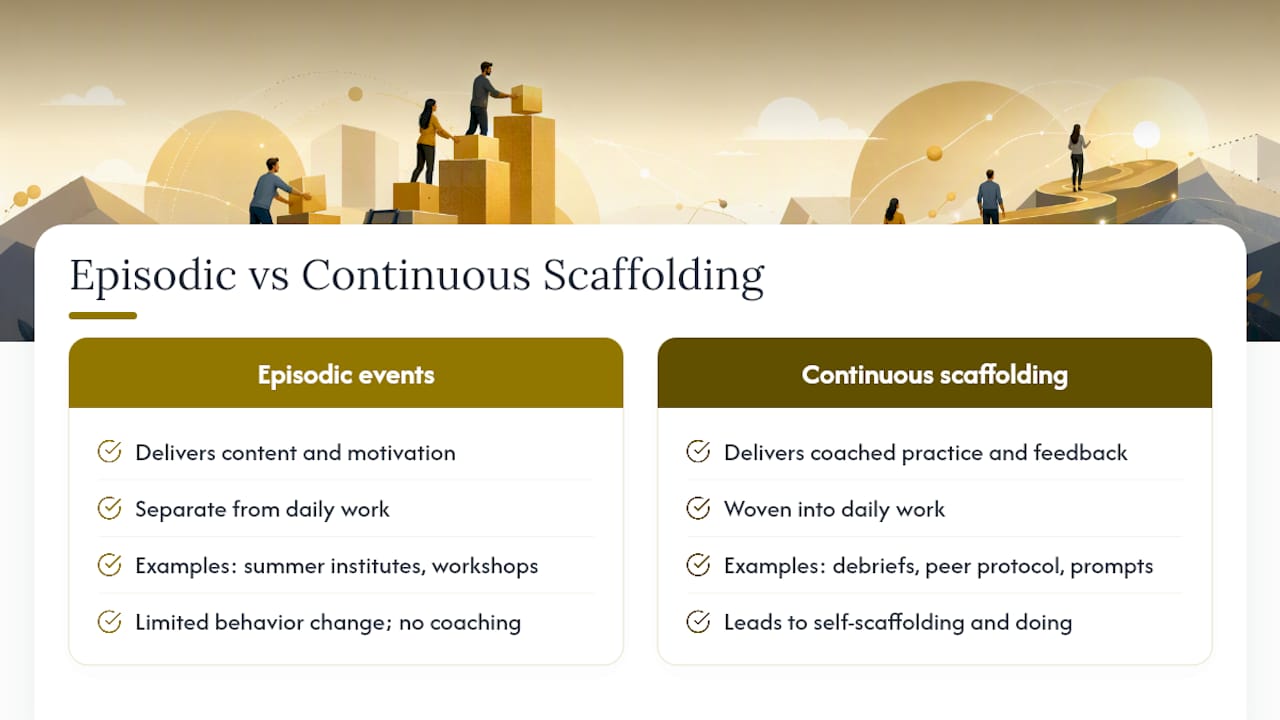
Most leadership development in schools is still episodic. A two-day summer institute. A one-time workshop on instructional coaching. A conference session on data-driven decision-making. These events are not useless, but they are structurally incapable of producing the kind of behavior change that scaffolded learning produces. The reason is simple: behavior change requires practice, feedback, and repetition in context. A workshop can deliver content and motivation. It cannot deliver the coached repetition that moves a leader from knowing to doing.
The more interesting argument is about integration. The most effective scaffolds aren't separate from daily work — they're woven into it. A structured debrief after a staff meeting is a scaffold. A shared observation protocol used by a peer cohort is a scaffold. A 10-minute reflection prompt sent to a leader's phone after a difficult conversation is a scaffold. None of these require a formal program. They require intentional design and the discipline to keep them in place until the leader no longer needs them.
The principal preparation research on scaffolding theory into practice makes a point that applies beyond preparation programs: when leaders have a theoretical frame for analyzing their own practice, they become self-scaffolding. They stop waiting for the next workshop and start diagnosing their own gaps. That's the long-term goal of any scaffolded leadership program — not dependency on the scaffold, but the capacity to build your own.
Leaderlyapp makes scaffolded leadership development practical
Designing a scaffolded leadership program from scratch takes time most administrators don't have. Leaderlyapp gives you the architecture pre-built: personalized microlearning sequences, habit-building exercises grounded in behavioral science, self-assessments (DiSC, EQ, MBTI), analytics dashboards that show you exactly where each leader is in their progression, and simulations that create low-stakes practice contexts. The platform adapts to each leader's demonstrated progress, so fading happens automatically rather than requiring a coordinator to manually adjust every learner's path.
A 60-day pilot with Leaderlyapp looks like this: in the first two weeks, leaders complete baseline self-assessments and begin their personalized microlearning sequences. By Week 4, coaches are using the analytics dashboard to target their conversations. By Week 8, you have rubric data, habit-tracking data, and artifact evidence to compare against baseline. That's a complete evidence cycle in two months, with minimal coordinator overhead.
If you're ready to move from episodic training to a continuous leadership development model that actually transfers to practice, Leaderlyapp is built for exactly that. Start your pilot discovery at Leaderlyapp.
Sources
- Instructional scaffolding implemented across a master's-level Management in Information Organizations course (LIS example)
- A strategy to scaffold critical thinking during analysis of leadership cases
- Scaffolding Criticality: Iterations of Theory in Principal Preparation