
A leadership competency model is a concise set of role-aligned competencies, meaning observable behaviors paired with proficiency levels, that connect leader performance to business strategy and make development measurable. HR teams use one to select leaders more consistently, guide coaching and microlearning, and build defensible succession plans. Practice-based evidence shows these models work best when behaviors are specific and tracked over time.
TL;DR:
- Define whether the model will guide hiring, development, succession, or all three, then write observable indicators and validate them against performance data before rollout.
- Use behavioral interviews for hiring, 360 degree feedback for development, and work samples to test execution or strategic skills under realistic conditions.
- A four tier proficiency scale should describe distinct behaviors at each level; social and tactical skills may improve faster than systems thinking or creativity.
- Smaller organizations should limit frameworks to eight to twelve competencies; nonprofits should weight mission alignment, while universities should account for influence in shared governance.
- An HR lead typically spends six to ten weeks building and piloting a model; review it every 18 to 24 months or after major shifts.
Table of Contents
- What a leadership competency model is: components and how it's structured
- Common competency domains and concrete competency examples you can benchmark
- How to build a leadership competency model: a practical, step-by-step process
- Proficiency levels and behavioral indicators: templates HR can copy
- How to use the competency model across HR processes
- What the evidence says: research-backed best practices and development timelines
- Integrating competency models with continuous learning platforms
- Customizing competency models for different organizational contexts
- Methods to assess and validate leadership competencies effectively
- Keeping competency models current as leadership demands shift
- What to prioritize when time and budget are tight
- How Leaderly AI can help scale competency-based development
- FAQ
- Sources
What a leadership competency model is: components and how it's structured
A leadership competency model turns abstract traits into a working HR tool. It takes knowledge, skills, and abilities, often shortened to KSAOs, and expresses them as behaviors you can actually observe in a meeting, a performance review, or a 360 survey. A competency is not "good communicator." It is "summarizes decisions in writing within 24 hours and checks for understanding before moving on."
To work in practice, a model needs five parts:
- Competency name: a short label like "strategic thinking" or "collaborative influence."
- Behavioral indicators: specific, observable actions tied to that competency.
- Proficiency tiers: levels showing how the behavior matures with experience.
- Role and level mapping: which competencies matter most at which leadership tier.
- Strategic alignment: a stated link between the competency and a business priority.
A first-line supervisor might need "coaches direct reports weekly," while a vice president needs "builds a three-year capability plan tied to revenue targets." Same domain, different altitude.
Common competency domains and concrete competency examples you can benchmark
Most leadership competency frameworks group individual competencies into a handful of domains, which keeps the list usable instead of overwhelming. Five domains cover most organizational needs: strategic (seeing the big picture and setting direction), execution (getting results through planning and accountability), people (building and leading teams), change (navigating ambiguity and driving transformation), and self (self-awareness and personal accountability).
Within those domains, a practical shortlist might include:
- Strategic thinking and business acumen
- Vision setting and goal alignment
- Results orientation and accountability
- Decision-making under uncertainty
- Collaboration and cross-team influence
- Coaching and talent development
- Communication and active listening
- Change leadership and adaptability
- Innovation and problem-solving
- Self-awareness and emotional regulation
- Integrity and ethical judgment
- Conflict resolution
- Delegation and empowerment
- Inclusive leadership
Domain emphasis shifts as leaders move up. Frontline managers lean heavily on execution and people competencies because they are closest to daily output and morale. Senior executives shift toward strategic and change competencies, since their decisions shape direction rather than daily tasks. Self-domain competencies, like self-awareness, matter at every level but show up differently: a new manager might need to recognize when they are micromanaging, while a senior leader needs to recognize blind spots in organizational culture.
How to build a leadership competency model: a practical, step-by-step process
Building a model is a sequencing problem more than a creative one. Skip a step and the model either gets ignored or gets challenged the first time it is used in a promotion decision.
- Clarify purpose, scope, and success metrics. Decide upfront whether the model will drive hiring, development, succession, or all three, and define what success looks like, such as faster time-to-promotion-readiness or better interview consistency.
- Gather strategy input and SME evidence. Pull from business strategy documents, behavioral interviews with high performers, and performance data to find what actually separates strong leaders from average ones.
- Draft competencies and write behavior-based indicators. Use observable verbs, like "sets measurable goals" or "solicits feedback weekly," rather than vague adjectives like "strong" or "effective."
- Define proficiency tiers and assessment approaches. Decide how you will measure each competency, whether through manager ratings, 360 feedback, or work samples.
- Validate with data and stakeholders, then pilot. Test the draft model with a small cohort, check whether ratings correlate with actual performance, and revise before a full rollout.
Typical roles and time commitments: an executive sponsor spends a few hours approving scope and reviewing drafts; an HR lead typically owns the project for six to ten weeks; subject matter experts contribute through a handful of structured interviews; and pilot participants commit to one assessment cycle, often eight to twelve weeks, which pairs well with a cohort blueprint for leadership development if you are testing the model inside an academic or training program.
Pro Tip: Pilot your model in one business unit before an enterprise rollout. A smaller test group surfaces unclear indicators faster and costs far less to fix than a company-wide launch.
Proficiency levels and behavioral indicators: templates HR can copy
Proficiency tiers turn a competency from a label into a measurement scale. A simple four-tier structure works for most organizations: novice, competent, advanced, and expert. Each tier should describe a visibly different behavior, not just "more of the same."
Take strategic thinking as an example:
- Novice: identifies how their own team's work connects to a department goal.
- Competent: builds a quarterly plan that accounts for resource constraints and dependencies.
- Advanced: anticipates market or operational shifts and adjusts team priorities before they become urgent.
An expert tier might add that the leader shapes multi-year strategy and mentors others in strategic planning.
Indicators are only useful if they connect to a real assessment method. Behavioral interviews work well for hiring decisions, since candidates describe specific past situations tied to each indicator. 360-degree feedback works well for development, since it surfaces how peers and direct reports experience a leader's behavior day to day. Work samples, like a budget proposal or a project retrospective, work well for validating execution and strategic competencies where talk is cheap and output is not.
How to use the competency model across HR processes
A competency model earns its budget when it shows up in actual decisions, not just a PDF in a shared drive.
- Selection: build interview questions and scorecards around specific behaviors, such as asking candidates to describe a time they adjusted a plan mid-project, then scoring responses against your proficiency tiers.
- Development: map each competency gap to a microlearning sequence or coaching focus, so a leader weak in delegation gets short, repeated practice rather than a single workshop.
- Succession: use competency ratings, not just tenure or performance scores, to calibrate promotion readiness across candidates at the same level.
- Measurement: track a baseline rating at the start of a development cycle, watch for progress signals like improved 360 scores, and connect those to business outcomes such as retention or internal promotion rates.
This is also where a formative assessment approach pairs well with competency tracking, since it gives leaders frequent, low-stakes feedback instead of waiting for an annual review to reveal a gap.
What the evidence says: research-backed best practices and development timelines
Leadership competencies do not all develop on the same timeline. A peer-reviewed study on leadership competency trajectories found that competencies vary in how fast they grow, with some showing statistically significant improvement over a program's duration while more complex, integrated competencies required longer, practice-rich exposure to develop. Social and tactical competencies tend to respond faster to coaching and short practice cycles, while competencies like systems thinking or creativity need sustained, on-the-job stretch experience.
The research shows leader identity supports competency acquisition over time, which means a model should track growth across months, not weeks, for the harder competencies while expecting quicker wins on simpler ones.
Sector-specific frameworks back this layered approach. The NCHL Health Leadership Competency Model 3.0 organizes 28 core competencies into action domains and enabling domains, each with behavioral descriptions across multiple proficiency levels. The practical implication: prioritize a compact set of measurable behaviors and validate your model using both subject matter expert judgment and real performance data before scaling it.
Integrating competency models with continuous learning platforms
A competency model that lives in a spreadsheet rarely changes behavior. The real value shows up when competencies connect directly to learning content delivered on a regular cadence, not once a year during performance review season.
Continuous learning platforms can take a proficiency gap, such as a leader rated "novice" on coaching, and automatically surface short, focused lessons tied to that exact behavior. Instead of sending a manager to a generic leadership course, the system can assign a five-minute lesson on asking better coaching questions, followed by a prompt to practice it in their next one-on-one. Personalization matters here because two leaders rated "novice" on the same competency might need different inputs: one needs a conceptual nudge, another needs a script to practice.
This kind of integration also solves a measurement problem. When learning content is tagged to specific competencies and proficiency tiers, you can track whether completing a microlesson actually correlates with a rating improvement at the next assessment cycle. That feedback loop, content tied to competency tied to measured behavior change, is what separates a model that drives development from one that just sits in an HR policy document. Tools like a leadership self-assessment can also feed this loop by giving leaders a starting data point before any content gets assigned.
Customizing competency models for different organizational contexts
A competency model built for a 10,000-person enterprise will frustrate a 40-person nonprofit, and the reverse is just as true. Context changes what gets measured and how deep the model goes.
Smaller organizations and SMEs generally do better with a compact model, often eight to twelve competencies total, since a sprawling 30-competency framework is hard to maintain without a dedicated HR analytics team. Focus on competencies tied directly to near-term business survival: execution, adaptability, and resourcefulness tend to matter more than long-horizon strategic planning competencies in an early-stage company.
Nonprofits often need to weight mission alignment and stakeholder influence more heavily, since nonprofit leaders spend significant time managing volunteers, donors, and board relationships rather than traditional direct reports. A competency like "builds coalitions across groups with no formal authority" matters more in this context than in a typical corporate hierarchy.
Higher education presents its own shape: academic leaders often operate in shared-governance structures where influence matters more than direct authority, and competency models in this space frequently need to account for both administrative leadership and faculty leadership tracks. Mapping competencies to academic program curricula gives these institutions a way to connect leadership development to credit-bearing coursework rather than treating it as a separate HR initiative. In every context, the fix is not a different framework from scratch. It is adjusting domain weighting and trimming the competency list to match what actually predicts success in that setting.

Methods to assess and validate leadership competencies effectively
A competency model is only as good as the measurement behind it. Three methods, used together, give a reliable picture.

Behavioral event interviews ask candidates or current leaders to describe specific past situations tied to a competency, then score the response against your defined indicators. This works well for hiring and for baseline assessments, since it is hard to fake a detailed, specific example on the spot.
360-degree feedback gathers ratings from a leader's manager, peers, and direct reports, which surfaces blind spots that self-assessment or manager-only reviews miss. A leader might rate themselves highly on "delegation" while their team's responses tell a different story.
Work samples and simulations, such as a strategic planning exercise or a mock difficult conversation, test whether a leader can actually perform the behavior under realistic conditions rather than just describe it.
Validation itself is a separate step from assessment design. Combine subject matter expert review of your indicators, coding of behavioral interview responses for consistency, and a basic statistical check, such as whether competency ratings correlate with existing performance ratings. A model that shows no relationship to actual performance outcomes needs revision before it drives real decisions. Piloting in a single business unit before an enterprise rollout remains the most reliable way to catch problems early.
Keeping competency models current as leadership demands shift
A leadership competency model is not a one-time project. Business strategy shifts, new work patterns emerge, and competencies that mattered five years ago can become background noise while new ones, like leading distributed teams or navigating AI-assisted workflows, move to the foreground.
A reasonable review cadence is every 18 to 24 months, or sooner if a major strategic shift happens, such as a merger, a new market entry, or a significant restructuring. The review should ask three questions: are these still the behaviors that separate strong leaders from average ones, are the proficiency tiers still calibrated correctly, and has new performance data surfaced a competency gap the current model does not capture.
Updating a model does not mean starting over. Most revisions involve adjusting indicators within existing competencies, adding one or two new competencies tied to a strategic shift, or retiring a competency that no longer predicts success. Keep a record of what changed and why, since this history becomes useful evidence the next time leadership asks whether the model is still worth maintaining. Organizations that treat the model as a living document, reviewed on a schedule rather than ignored until a crisis forces a rewrite, get more consistent use out of it across hiring, development, and succession decisions.
What to prioritize when time and budget are tight
If I had to build a competency model with limited time, I would cut the list to five or six competencies and skip the temptation to cover every leadership trait that sounds good in a slide deck. A long aspirational list looks thorough and gets ignored, because nobody can hold fifteen behaviors in mind during a hiring decision or a coaching conversation.
Observable behaviors beat broad traits every time. "Builds impressive stakeholder networks" sounds nice but cannot be scored consistently. "Schedules a monthly check-in with two cross-functional peers" can be.
Short, frequent practice moves faster than occasional workshops. A leader who gets a five-minute prompt weekly, tied to one specific behavior, builds the habit faster than one who attends an annual off-site.
— Drew
How Leaderly AI can help scale competency-based development
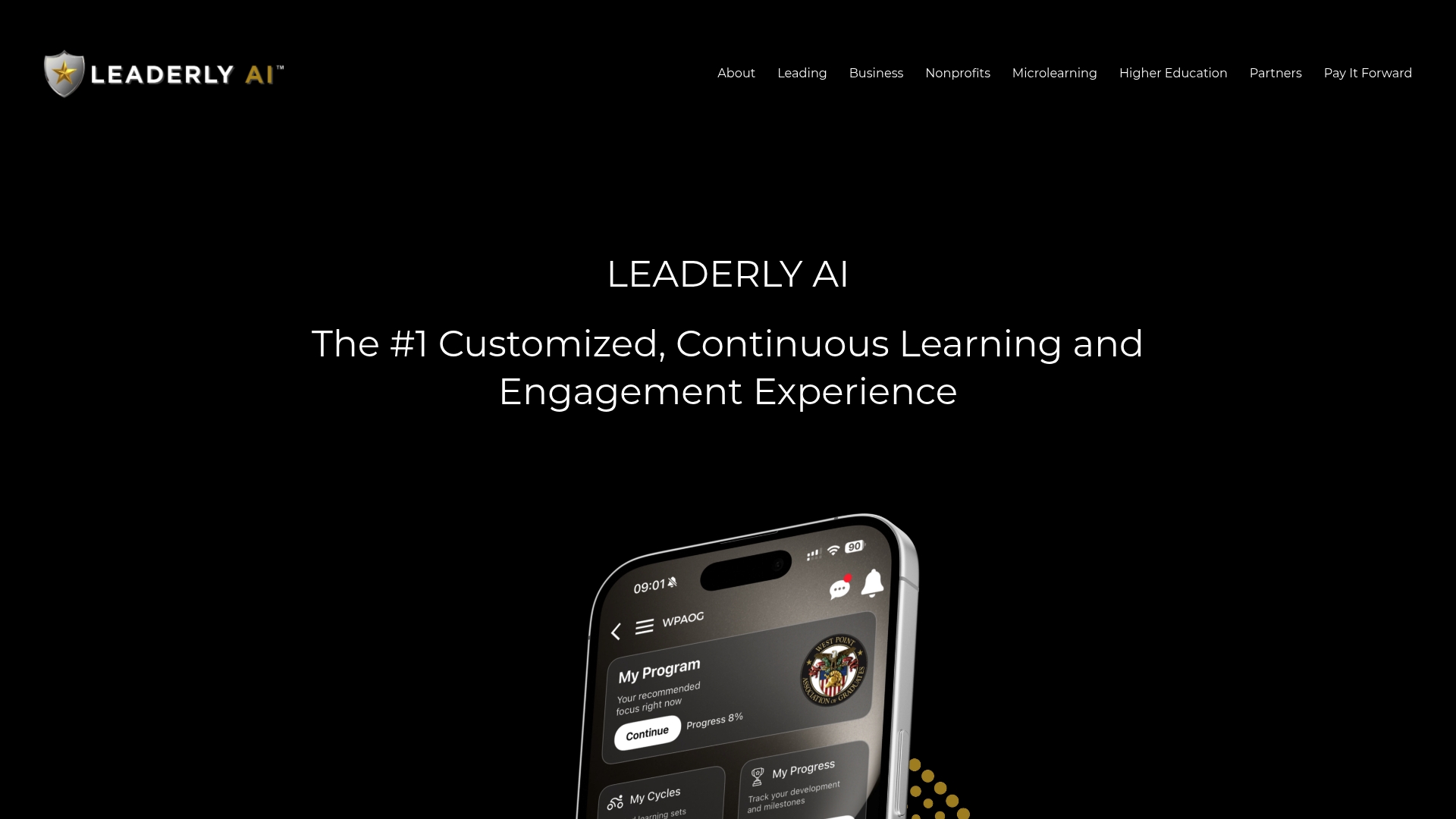
Once you have a working competency model, the harder part is keeping it alive across every manager and every review cycle without adding a mountain of administrative work. That is where a platform built around personalized microlearning and behavior tracking earns its place. We built Leaderly AI around exactly this gap: taking a competency framework and turning it into daily, bite-sized practice rather than a document nobody revisits.
With our platform, we connect proficiency gaps to tailored microlessons, behavioral exercises, and assessments, so a competency rating turns into an actual next step for the leader, not just a number on a dashboard.
What this looks like in practice:
- Personalized learning paths that adjust as a leader's proficiency ratings change over time.
- Analytics dashboards that let HR teams track competency progress across teams, not just individuals.
- Gamified recognition and short practical exercises that reinforce behaviors between formal review cycles.
If you are ready to put your competency model into daily practice across your organization, visit our business platform page to see how we support teams of any size, or explore our nonprofit-focused offering if your organization fits that profile.
FAQ
What are the seven key leadership competencies?
Definitions vary by organization and industry, so there is no single universal list of seven. Most frameworks group competencies into domains like strategic thinking, execution, people leadership, change leadership, and self-awareness, then select specific competencies within each domain based on organizational needs.
What are the five leadership competencies?
As with the seven-competency question, the specific five vary by framework and employer. A common pattern groups them around strategic thinking, results orientation, collaboration, change leadership, and self-awareness, though organizations adapt this based on their own strategy and culture.
What are the seven leadership models?
This refers to a range of distinct leadership theories and frameworks, such as transformational, situational, servant, and authentic leadership models, each describing a different approach to leading rather than a fixed list of seven competencies. The specific set of "seven" depends on which source or textbook is being referenced.
What are the nine leadership competencies?
Like the five- and seven-competency lists, a nine-competency framework depends on the specific model an organization adopts. Sector-specific frameworks, such as the NCHL Health Leadership Competency Model, organize far more than nine competencies across broader action and enabling domains, so the right number depends on your organization's scope and purpose.
How long does it take to build a leadership competency model?
A typical build, from clarifying purpose through piloting with a cohort, takes roughly six to ten weeks for an HR lead working with executive sponsors and subject matter experts. More complex, multi-level models for large enterprises can take longer, especially when validating against performance data across several business units.
Sources
- Research on trajectories of leadership competency development (peer-reviewed study)
- NCHL Health Leadership Competency Model 3.0