
A leadership style assessment is a structured evaluation that identifies how a leader naturally motivates, communicates with, and manages their team. The formal term used across organizational psychology is "leadership style inventory" or "leadership profile," though "assessment" is the standard working term for most managers. These tools take 25–35 minutes to complete, making them practical for busy professionals. The core goal is not to label you but to reveal your default patterns so you can build on your strengths and address blind spots. Styles commonly measured include autocratic, democratic, transformational, servant, transactional, and laissez-faire. Understanding which of these drives your behavior is the first step toward stronger team outcomes and more deliberate personal growth.
What is a leadership style assessment, and why does it matter?
A leadership style assessment is a data-driven process that maps a leader's behavior, values, and decision-making preferences against established frameworks. Leadership style reflects personality, values, and past experiences and evolves as leaders gain awareness. That evolution does not happen automatically. Without structured feedback, most managers repeat the same patterns regardless of whether those patterns fit the situation.
The practical value is direct. Assessments improve communication by showing you how your natural style lands with different team members. They sharpen decision-making by revealing whether you tend to consult others or act unilaterally. They also create a shared language for coaching conversations, which makes development plans more specific and easier to track.

The importance of leadership style extends beyond individual growth. Teams led by managers who understand their own style show higher engagement and clearer role expectations. When a leader knows they default to a directive approach, for example, they can deliberately create space for team input during complex projects.
What are the common types of leadership styles assessed?
Six styles appear consistently across validated leadership evaluation methods. Each carries distinct strengths and trade-offs depending on context.
Autocratic leadership centralizes decision-making with the leader. It works well in crisis situations or with inexperienced teams that need clear direction. The risk is that it suppresses initiative over time.
Democratic leadership distributes decision-making across the team. It builds buy-in and surfaces diverse perspectives, but it can slow execution when speed matters.
Transformational leadership is often regarded as the most effective style for business environments. Transformational leaders motivate through a shared vision, demonstrate emotional intelligence, and push teams toward growth beyond immediate tasks.
Servant leadership prioritizes team needs above the leader's own agenda. It builds trust and loyalty but requires a mature team that can operate with significant autonomy.
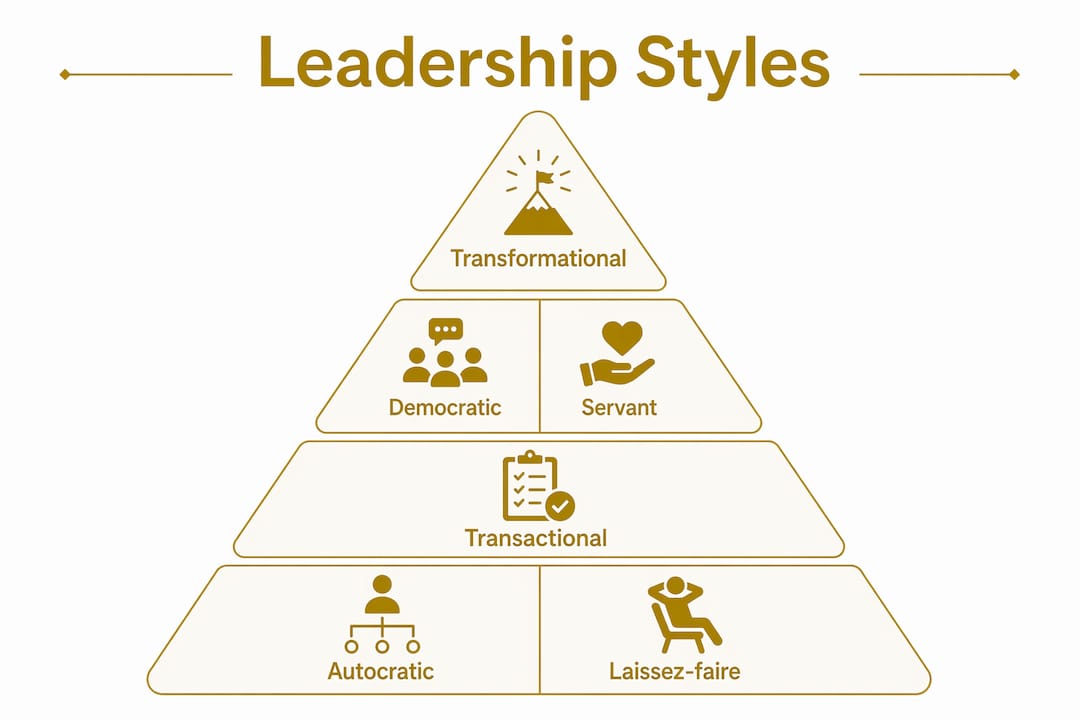
Transactional leadership relies on clear expectations and reward-or-consequence structures. It drives short-term performance but rarely inspires long-term commitment.
Laissez-faire leadership delegates nearly all decisions to the team. It suits highly skilled, self-directed professionals but fails when teams need guidance or accountability.
The table below compares these styles on three practical dimensions.
| Style | Decision-making | Best context | Primary risk |
|---|---|---|---|
| Autocratic | Leader decides alone | Crisis, low-skill teams | Suppresses initiative |
| Democratic | Shared with team | Complex problems, high stakes | Slow execution |
| Transformational | Vision-driven, collaborative | Growth phases, culture change | Requires emotional energy |
| Servant | Team-centered | High-autonomy, mature teams | Leader burnout |
| Transactional | Rules and rewards | Operational, compliance-heavy | Low intrinsic motivation |
| Laissez-faire | Fully delegated | Expert, self-directed teams | Lack of accountability |
Two theoretical models underpin most leadership style questionnaires used today. Lewin's leadership theory groups behavior into authoritarian, democratic, and delegative categories. The Blake-Mouton Managerial Grid plots concern for people against concern for production to identify a manager's dominant orientation. Both models reinforce the same conclusion: no single style wins in every situation.
How do leadership style assessments work?
Leadership assessments use three primary formats, and each measures something different.
-
Personality questionnaires ask leaders to rate their own preferences and tendencies. They are fast and easy to deploy but rely entirely on self-perception, which can be distorted by social desirability bias.
-
360-degree multi-rater feedback collects ratings from the leader, their direct reports, peers, and managers. Most 360-degree feedback measures perception, not absolute behavior. The gap between how you see yourself and how others see you is often the most useful data point in the entire report.
-
Behavioral simulations place leaders in realistic scenarios and score their responses. These are the most resource-intensive format but produce the most objective data on actual decision-making under pressure.
The most rigorous tools go beyond frequency counts. Effective assessments measure not just behavior frequency but also the importance of that behavior for the role. This gap analysis prevents a common failure: praising a leader for excelling in behaviors that barely matter for their specific position. A well-structured tool like the Linking Leader Profile (LLP|360) measures 13 essential linking skills through 78 specific items and multi-rater inputs, covering competencies from leading self to driving organizational performance.
Pro Tip: When reviewing your 360 results, focus first on the items where your self-rating and rater scores diverge the most. Those gaps, not your highest scores, are where the real development work lives.
Rater bias is real and worth accounting for. A direct report who recently received critical feedback may rate a leader lower than their actual performance warrants. Skilled coaches use these discrepancies as conversation starters rather than treating scores as objective truth.
Why does context matter so much in leadership assessments?
There is no single best leadership style. Effective leaders adapt based on team expertise, urgency, and organizational culture. This is the core premise of situational leadership, a concept that shifts the question from "What is my style?" to "What does this situation require?"
Context shapes which behaviors matter most. A manager leading a team of senior engineers through a product launch needs a different approach than one onboarding a group of new hires. An assessment that ignores role context produces feedback that feels generic and fails to drive real change.
Gap analysis makes this concrete. When an assessment measures both how often a behavior occurs and how important it is for the role, the resulting report shows alignment or misalignment directly. A leader who scores high on directive communication but works in a culture that prizes collaboration will see that tension clearly in the data.
"The goal of leadership assessment is to expand a leader's range of adaptable behaviors, not just label their default style. Understanding how important certain behaviors are to a specific role improves the quality and relevance of feedback for development."
Consider two scenarios. A plant manager in a safety-critical environment needs high directive behavior during emergencies. The same manager running a post-incident review needs democratic behavior to surface honest input from the team. One person, two styles, both appropriate. Assessments that capture this nuance produce development plans that actually fit the job.
Effective leaders blend multiple styles and adjust their approach as team needs and project demands shift. Adaptability is not a soft skill. It is a measurable leadership competency, and the best assessments treat it as one.
How can managers apply assessment results for real growth?
Assessment results are only useful if you act on them. The following steps turn data into development.
-
Identify your top two strengths and your clearest blind spot. Do not try to fix everything at once. Pick the one behavior gap that, if closed, would have the biggest impact on your team's performance right now.
-
Map feedback to specific situations. If raters scored you low on listening, recall the last three team meetings. Where did you cut people off or redirect too quickly? Concrete memories make abstract scores real.
-
Build a targeted development plan. A plan that says "improve communication" is useless. A plan that says "ask two clarifying questions before responding in every one-on-one this month" is measurable and achievable. Leaderlyapp's personalized microlessons are built around exactly this kind of behavioral specificity.
-
Integrate multiple styles deliberately. If your default is transformational, practice transactional clarity when setting project deadlines. If your default is democratic, practice decisive direction when a team member needs a clear answer fast.
-
Reassess regularly. Leadership behavior changes with experience, role, and organizational context. A single assessment is a snapshot. Reassessing every 12–18 months tracks whether your development efforts are producing visible change in how others experience your leadership.
Pro Tip: Share your key development focus with your team. Saying "I'm working on listening more before I respond" invites accountability and signals psychological safety. Teams respond well when leaders model the growth they ask of others.
Improving your leadership communication skills is one of the highest-return applications of assessment data. Communication style is visible to everyone on your team, which means changes there produce the fastest and most widely noticed results.
Key Takeaways
A leadership style assessment is most valuable when it measures behavior against role context, not just frequency of actions in isolation.
| Point | Details |
|---|---|
| Definition and purpose | A leadership style assessment identifies natural leadership patterns to improve communication, decisions, and team outcomes. |
| No single best style | Effective leaders adapt their approach based on team expertise, urgency, and organizational culture. |
| Gap analysis is critical | Measuring behavior importance alongside frequency prevents feedback that praises irrelevant strengths. |
| 360-degree feedback reveals perception gaps | Discrepancies between self-ratings and rater scores are the most useful data for development. |
| Reassess regularly | Leadership behavior evolves with experience, so annual reassessment tracks real behavioral change over time. |
What I've learned from watching managers misuse assessments
Most managers treat a leadership style assessment as a personality test. They read their profile, feel validated or mildly defensive, and file the report away. That is the most common and most costly mistake I see.
The real value is in the discomfort. When your self-rating on "listens actively" is a 4 out of 5 and your team rates you at 2.3, that gap is not a flaw in the tool. It is the most honest data you will receive all year. The managers who grow fastest are the ones who sit with that discomfort long enough to ask why the gap exists, not just how to close it on paper.
Context is the other piece most assessments underserve. A score without role context is like a blood pressure reading without knowing the patient's age, weight, and activity level. Knowing you score high on directive behavior means nothing until you know whether your role actually calls for it. The best leadership development tools build role context directly into the feedback structure.
My honest recommendation: treat your first assessment as a baseline, not a verdict. Commit to one specific behavior change, get reassessed in 12 months, and compare the data. That longitudinal view is where real leadership growth becomes visible.
— Drew
Leaderlyapp and the next step in your leadership development
Leadership assessments give you the data. What you do with it determines whether anything actually changes.
Leaderlyapp combines AI-driven personalization with behavioral science to turn assessment insights into daily leadership habits. The platform delivers personalized microlessons that adapt to your specific development focus, whether that is building democratic communication, sharpening decisive direction, or expanding your range across multiple styles. For managers who want more than a one-time score, Leaderlyapp provides the structured, continuous feedback loop that makes growth measurable and sustainable across your entire team.
FAQ
What is a leadership style assessment?
A leadership style assessment is a structured tool that identifies how a leader naturally motivates, communicates with, and manages their team. Validated assessments typically take 25–35 minutes and measure traits, decision-making preferences, and communication patterns.
How many leadership styles are there?
Most frameworks identify six core styles: autocratic, democratic, transformational, servant, transactional, and laissez-faire. Effective leaders draw on multiple styles depending on team needs and situational demands.
What does a 360-degree leadership assessment measure?
A 360-degree assessment collects ratings from the leader, their direct reports, peers, and managers to measure perceived leadership behavior. The gap between self-ratings and rater scores is often the most useful data for development conversations.
How often should managers complete a leadership assessment?
Reassessing every 12–18 months gives managers enough time to implement behavioral changes and produce measurable shifts in how others experience their leadership. A single assessment is a starting point, not a final answer.
What is the most effective leadership style?
Transformational leadership is widely regarded as the most effective style for business environments because it combines integrity, emotional intelligence, and vision-driven motivation. Situational context still determines which style produces the best results in any given moment.