
A learning maturity model is a staged framework that shows how developed your organization's learning and development (L&D) practice is, from ad hoc training to learning that shapes business decisions. You score yourself against the stages, find the gaps, and decide what to build next. This guide covers the best-known models, a practical way to assess where you stand, and what moving up looks like for HR teams, educators and leaders who want leadership development to reach every employee, not just managers.
TL;DR
- A learning maturity model gives you a shared scale (usually five levels) for judging how organized, measured and embedded your learning practice is.
- The major models agree on the arc: from ad hoc and course-based, to standardized, to data-driven, to continuously improving and tied to business results.
- Assess before you buy or build: survey leaders and employees, benchmark, then rank gaps by importance and current maturity.
- Higher maturity depends on measurement beyond completion rates and on accountability for applying what people learn.
- For leadership development, frequent microlearning with built-in assessments and analytics is one way to build the habits and data the upper levels require.
Table of Contents
- What a learning maturity model is
- The main learning maturity models compared
- What maturity models actually assess
- How to assess your current learning maturity
- What moving up looks like in practice
- Using a maturity model well
- Who gets the most from a maturity assessment
- Where Leaderly AI fits
- FAQ
- Sources
What a learning maturity model is
Maturity models come from the idea that capability develops in recognizable stages. In learning, the model describes how your organization plans, delivers, measures and improves learning, and it names what the next stage looks like. One overview describes the purpose as letting L&D teams compare themselves with others on a like-for-like basis and giving the team a tangible goal.
That gives you three practical uses:
- A diagnosis. You see which parts of your learning practice are strong and which are improvised.
- A common language. HR, finance and business leaders can discuss "Level 2 to Level 3" instead of arguing about whether training is "good."
- A roadmap. Each stage implies specific next steps, so you can sequence investments instead of buying tools in the hope that one fixes everything.
You will also see the same idea called an L&D maturity model, a training maturity model or a learning ecosystem assessment. The labels differ, the logic is the same.
The main learning maturity models compared
No single model is the standard. Most use five levels, and each emphasizes something slightly different.
| Model | Levels | What it emphasizes |
|---|---|---|
| Training Industry's Training Organization Maturity Model | Disorganized, Established, Replicable, Managed, Optimized | How consistently training is documented, standardized, measured and improved |
| Aspen Institute's 2025 Upskilling Playbook | Five levels, from transactional job-specific training to learning embedded in operations | Linking upskilling to internal mobility, leadership development and business success |
| ATD's Skills-Based Talent Development Maturity Model | Awareness, Foundation, Expansion, Optimization, Leading | A company-wide diagnostic built around skills |
| Bersin's High Impact Learning Organization model (2012), as summarized here | Incidental Training, Training and Development Excellence, Talent and Performance Improvement, Capability Development | Moving from training events to organizational capability |
A closer look at the Training Industry levels
This is the easiest model to self-score, so it is a good starting point. Per Training Industry:
- Level 1, Disorganized: practices are ad hoc and undocumented.
- Level 2, Established: practices are defined and documented but applied inconsistently.
- Level 3, Replicable: practices are standardized and built into organizational processes.
- Level 4, Managed: the team monitors results through data collection, analysis and quality control.
- Level 5, Optimized: continuous improvement through new and innovative approaches.
If your leadership program runs differently in every department, you are likely at Level 1 or 2. If every new manager gets the same program but nobody knows whether behavior changed, you are around Level 3.
What the Aspen and ATD models add
The Aspen Institute's playbook frames the top level as learning embedded in business operations that shapes workforce decisions before skill gaps appear. ATD's model is meant as a diagnostic for the whole company, and it notes that time spent in each phase varies by organization. Read together, they tell you the top of the scale is less about more courses and more about learning being wired into how work and talent decisions get made.
What maturity models actually assess
Models differ in labels, but they tend to score the same handful of capabilities:
- Strategy and leadership support: whether learning goals follow business goals and senior leaders sponsor them.
- Content and delivery: whether learning is relevant, consistent and reaches people in the flow of work.
- Infrastructure and data: whether you can see who is learning what and with what result.
- Measurement: whether you go beyond attendance and satisfaction to application and impact.
- Accountability: whether learners are expected to apply what they learn.
The University of Minnesota's six-factor enterprise capability model (leadership, assessment, prioritization, learning objectives, measurement, design) is a good example. Its authors argue that two imperatives drive success: capabilities must be relevant to business reality and actually used, and learners must be held accountable for applying new knowledge through the performance management system.
How to assess your current learning maturity
You do not need a consultant to run a first pass. A defensible assessment follows the pattern BCG describes: a company-wide pulse check, a benchmark, then a roadmap.
Step 1: Run a pulse check across functions
Ask leaders and employees in different functions how they rate your learning strategy, content, delivery channels, infrastructure and connections to outside learning providers. BCG's approach also tracks indicators such as cost of learning, number of employees engaged in learning and frequency of engagement.
Where it goes wrong: surveying only the L&D team, or only managers. If your goal is leadership development for everyone, front-line employees and new leaders must be in the sample.
Step 2: Map the evidence to a model's levels
Pick one model and score each capability against its level descriptions. Use documents and data, not impressions: Is the process written down? Is it followed the same way in every unit? Do you collect results? A simple rule helps: if you cannot show evidence for a level, score the level below.
Step 3: Rank gaps by importance and maturity
Gartner's HR Score for L&D rates activities on two dimensions, importance and maturity, and treats the largest gap between high importance and low maturity as the biggest opportunity. You can copy the logic in a spreadsheet: list your L&D activities, rate each from 1 to 5 on both dimensions, and sort by the difference.
Step 4: Benchmark and decide
BCG's process benchmarks results against peers and then builds a roadmap. Its 2021 assessment of more than 60 leading companies found fewer than 20% were world-class "leader" learning enterprises, and about a third were "performers" with the potential to get there by fixing cracks in their learning ecosystems. Being mid-scale is normal, which is why the roadmap matters more than the score.
McKinsey's ACADEMIES model, as written up by Nick van Dam, adds a useful habit: have the L&D leadership team review the level descriptors together, agree on current position, and discuss the support, resources and funding needed to advance.
What moving up looks like in practice
The jump between levels is rarely about buying more content. It usually comes from three shifts.
From events to habits
At the low levels, leadership development is a workshop or an annual program for a select group. Higher levels treat it as continuous. Short, frequent practice is one way to get there, because people can apply an idea at work the same week they meet it. For a closer look at how that format works, see our page on microlearning for leadership.
From completion to application
The Minnesota authors note that few organizations venture beyond Kirkpatrick Level 1 "smile sheet" evaluations, the post-session reaction forms. The same paper cites a survey finding that executive education programs measured more often and more rigorously were more likely to succeed. The Kirkpatrick levels and Jack Phillips' fifth level, return on investment, are laid out in ROI Institute materials: learning, application, impact, then ROI against cost.
A Florida State University study of 72 Lockheed Martin Space employees shows why the application step deserves attention: 57% applied their training on the job, while 43% struggled to, citing competing priorities and lack of support. Learning that never reaches the job does not move maturity or results.
If you want to build this measurement layer, our guides on leadership training ROI metrics and tracking employee leadership growth walk through what to capture.

From isolated programs to a connected system
Van Dam describes the value of a maturity framework as structured identification of current capabilities, continuous development through ongoing assessment, and integration that fosters collaboration across departments. In practice that means HR, business unit heads and finance share one picture of capability. Tying learning to wider strategy and new technology choices is part of the same work, as in this piece on integrating new technologies into business strategy.
BCG's 2021 analysis makes the same point about proof: organizational learning is only as good as your ability to show its impact, which takes analytics on employee performance and development, skills anticipation and a clear business case. If you are choosing the tooling behind that, our comparison of LMS and LXP platforms and our overview of scalable HR learning platforms cover the options by type.
Using a maturity model well
A few habits keep the exercise honest and useful.
- Pick one model and stay with it. Switching models between years makes progress impossible to compare.
- Score each capability separately. An organization can be Level 4 on measurement and Level 2 on leadership sponsorship. A single overall number hides that.
- Expect uneven timelines. ATD notes that time in each phase varies by organization, so treat the levels as a sequence, not a schedule.
- Back self-reports with data. Surveys capture perception. Pair them with participation, application and performance data wherever you can.
- Use the gap list, not the label. The value is the prioritized list of what to fix next, not being able to say you are "Level 3."
Who gets the most from a maturity assessment
HR and L&D leaders use it to build the business case and sequence investments. Educators can apply the same stages to a campus leadership program: is it a one-off elective, a standardized curriculum, or a measured pathway with outcomes data? Emerging leaders and veterans moving into civilian roles can use the stages from the other side: ask what level of development support an employer actually has, and look for continuous practice and feedback rather than a single orientation course.
Our view: maturity is built in small, repeated reps
We built Leaderly AI around a simple belief: leadership development fails when it is reserved for a few managers and delivered a few times a year. Every maturity model above climbs toward the same place, learning that is continuous, measured and tied to real work, and that place is reached by the habits people practice, not by the courses a catalog lists.
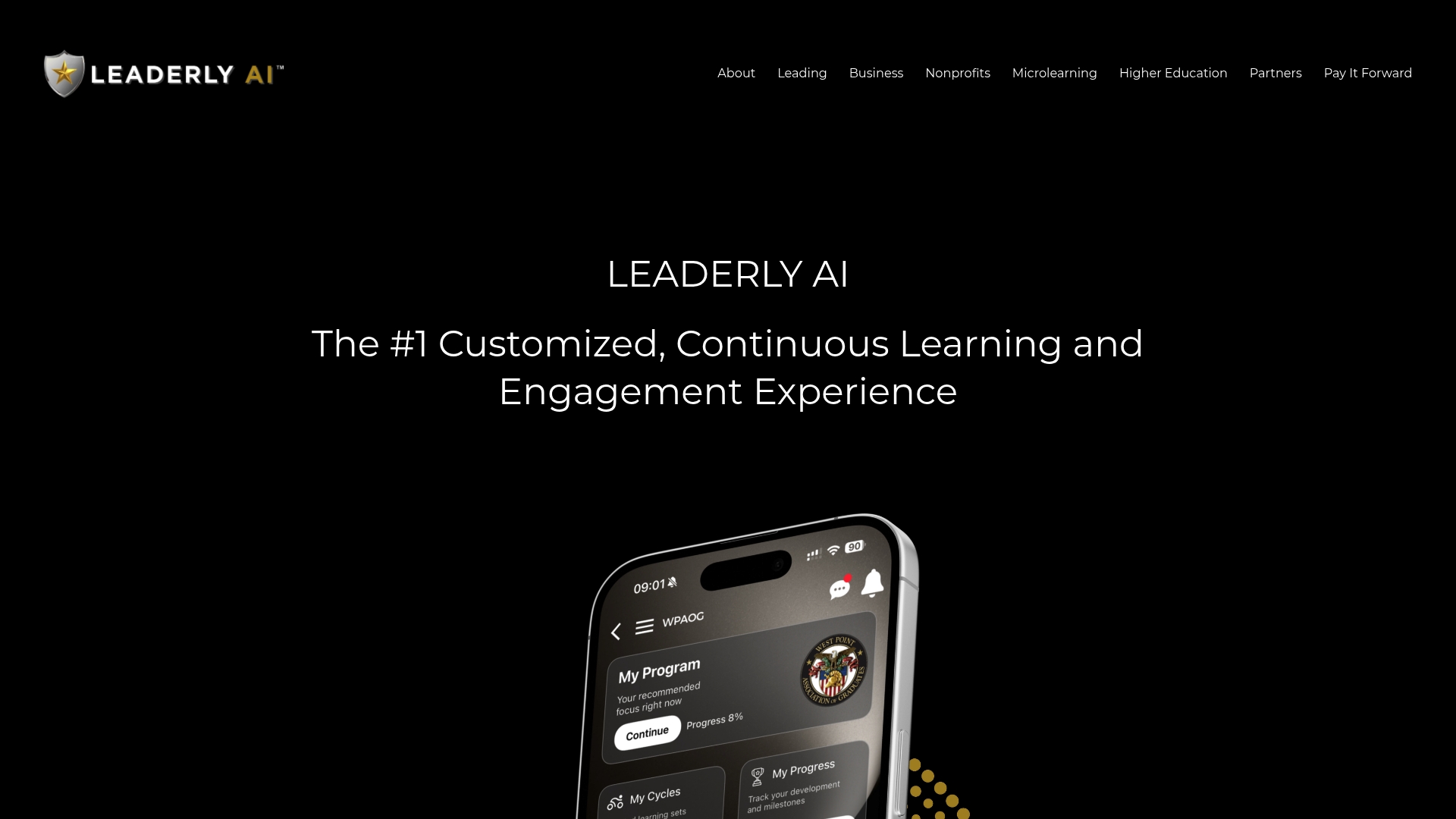
That is why our platform combines behavioral science, frequent microlearning and machine-learning personalization, so each person's journey evolves with them. HR teams and educators can customize programs and scale them to all employees, not just managers. Built-in self-assessments such as DiSC, EQ and MBTI, practical exercises and analytics dashboards give you the evidence the middle and upper levels demand: who is practicing, what is changing, and where the gaps are.
If you are scoring your organization at Level 2 or 3, the most useful next move is usually to make development continuous and visible. Everything else on your roadmap gets easier once you can see it.
Drew Bartkiewicz
Where Leaderly AI fits
Leaderly AI is a mobile-first platform that delivers personalized microlearning, behavioral habit-building exercises, customizable learning journeys, assessments, surveys, simulations and analytics dashboards to an organization's people. It serves businesses, nonprofits and higher education institutions, and HR teams can customize content and scale programs across the whole organization. To see how it could move your own gaps, start at leaderlyapp.com.
If measurement is your lowest-scoring area, our guide to skills analytics for L&D shows how to connect learning activity to behavior change.
FAQ
What is the difference between a learning maturity model and a learning organization?
A learning organization is the goal: a company where continuous learning is part of how work gets done. A learning maturity model is the measuring stick that shows how far along you are and what to build next. You use the model to plan the journey toward that kind of culture.
How many levels does a learning maturity model have?
Most have four or five. Training Industry, ATD and Aspen each use five, while the Bersin model uses four. The exact names differ, but they move from informal, ad hoc training toward measured, continuously improving learning linked to business outcomes.
Is L&D part of HR?
In many organizations, yes: L&D often sits within HR or talent management, though some companies place it in a separate learning function or in the business units. Maturity models are useful in either structure because they ask HR, L&D and business leaders to agree on one view of capability.
How often should we reassess our maturity?
A yearly reassessment fits most planning cycles, with a lighter pulse check midyear. Because time spent in each phase varies by organization, use the repeat assessment to confirm that specific gaps have closed, not to expect a new level every year.
Where should a small team start?
Choose one model, score six to eight core activities from 1 to 5 for importance and maturity, and sort by the biggest gap. Fix the top one or two before expanding. A focused start gives you measurable progress and a stronger case for further investment.
Sources
- Learning Maturity Models, The Learning Ideas Network
- Training Organization Maturity Model, Training Industry
- Upskilling Playbook, Aspen Institute (2025)
- Skills-Based Talent Development Maturity Model, ATD
- A Model for Strategy and Tactical Steps that Create Enterprise Capability, University of Minnesota
- 3 Steps to Turn a Company into a Learning Powerhouse, BCG (2020)
- Organizational Learning Creates Competitive Advantage, BCG (2021)
- HR Score for Learning & Development, Gartner
- A Maturity Framework (McKinsey ACADEMIES model), Nick van Dam
- Getting Measurable Results from Training, ROI Institute
- Training at Lockheed Martin Space, Florida State University (2024)
- Integrating New Technologies into Your Business Strategy