
There are seven main types of scalable HR learning platforms: learning management systems (LMS), learning experience platforms (LXP), learning content platforms (LCP), microlearning platforms, virtual classroom software, authoring tools and content marketplaces, and skills or competency platforms. Each solves a different job. An LMS handles compliance tracking and structured course delivery. An LXP curates and recommends content the way a streaming service recommends shows. An LCP pairs licensed content with delivery and analytics. Microlearning platforms break development into daily habit-forming lessons. Virtual classrooms run live, instructor-led sessions at scale. Authoring tools and marketplaces let you build or license content. Skills platforms map every course back to a competency framework.
Here's the taxonomy in plain terms:
- LMS — compliance training, certifications, structured onboarding
- LXP — self-directed skill building with content recommendations
- LCP — licensed content plus native delivery, personalization, and analytics
- Microlearning platforms — short, habit-based lessons for busy employees
- Virtual classroom software — live, cohort-based instructor sessions
- Authoring tools and marketplaces — build custom content or license existing libraries
- Skills/competency platforms — map learning to job roles and measurable capability gaps
Which one should you evaluate first? It depends on your primary job-to-be-done. If compliance and audit trails are the pressure point, start with an LMS. If your goal is developing leaders and managers across a growing workforce, a microlearning or LCP-style platform built specifically for behavior change, like Leaderly AI, is worth evaluating before anything else. Leadership development doesn't scale well inside a generic course library. It scales through daily, personalized habit-building, which is a different architecture entirely.
Key Takeaways
Matching the platform category to your actual learning goal, compliance, skills, or leadership development, matters more than any single vendor feature.
| Point | Details |
|---|---|
| Start with the job-to-be-done | Compliance needs an LMS; leadership growth needs microlearning or an LCP built for personalization. |
| Verify scalability with specifics | Check for multi-tenancy, SCIM provisioning, and bulk admin operations, not marketing language. |
| Demand interoperability | Require SCORM, xAPI, and LTI support plus documented API rate limits before signing. |
| Pilot for a full quarter | Run pilots across a natural business cycle with 50 to 150 users to get real adoption signal. |
| Consider Leaderly AI for leadership development | Leaderly AI pairs personalized microlessons and behavioral assessments with analytics built for habit change at organizational scale. |
Table of Contents
- What "Scalable" Actually Means for HR Learning Platforms
- The Main Types of Scalable HR Learning Systems and When to Use Each
- How to Choose a Scalable HR Learning Platform Without Regretting It Later
- Rolling Out a Pilot That Actually Scales Into a Full Program
- Why Learning Content Platforms and Skills Intelligence Are the Growth Vector to Watch
- Why Leadership Development Needs Its Own Scalability Standard
- How Leaderly AI Maps to the Scalability Checklist
- Frequently Asked Questions
- Sources
What "Scalable" Actually Means for HR Learning Platforms
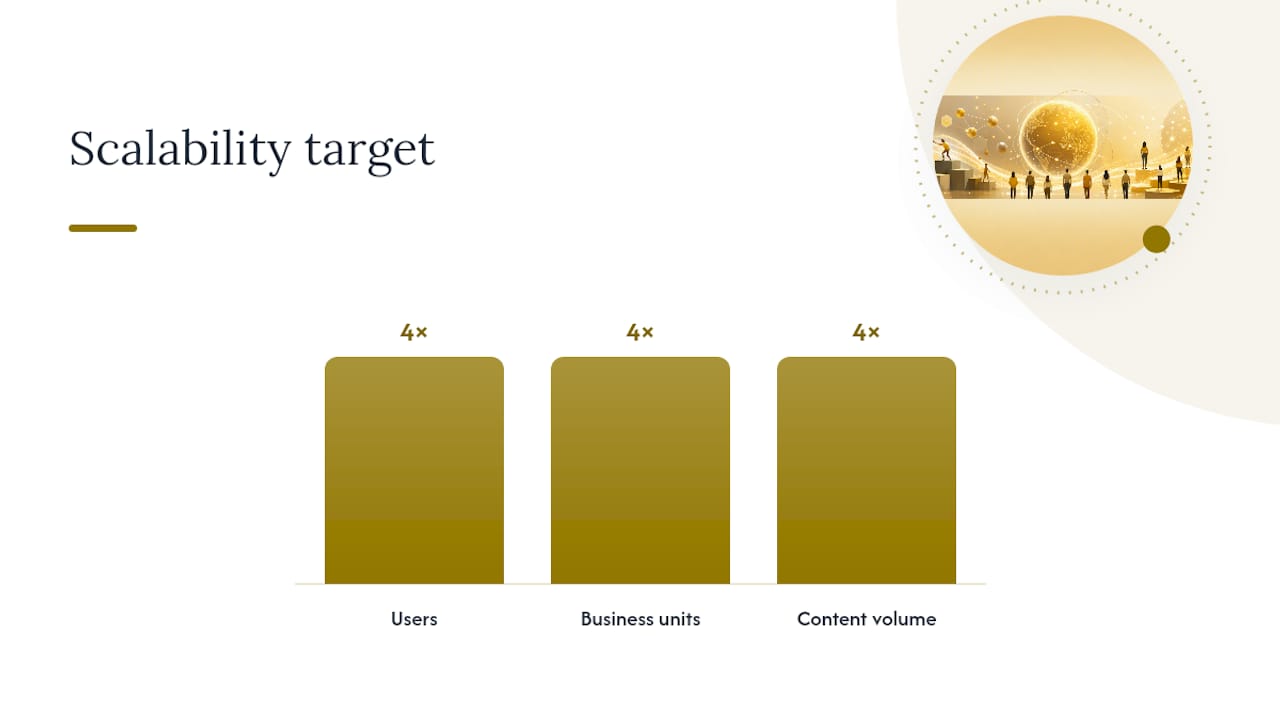
Vendors use "scalable" as a marketing word. HR buyers need it as an engineering spec. A platform is genuinely scalable when it can absorb a fourfold increase in users, business units, or content volume without a corresponding jump in admin headcount or a drop in performance.
That comes down to a handful of concrete characteristics. Concurrency is how many simultaneous logins and content streams the system handles before load times degrade, which matters enormously during a global onboarding cohort or an annual compliance push. Multi-tenancy determines whether one instance can serve multiple business units, brands, or subsidiaries with separate branding and permissions, versus forcing you into separate deployments that each need their own maintenance. Auto-provisioning through SCIM (System for Cross-domain Identity Management) means new hires and role changes sync automatically from your HR information system instead of requiring manual account creation. API maturity determines whether your HCM (human capital management) platform, your SSO (single sign-on) provider, and your learning platform actually talk to each other, or whether someone on your team is exporting spreadsheets every Friday.
None of this is abstract. A buyer's guide from CIOPages makes the point directly: the platform category you choose matters more than the specific vendor features once you're inside the right category, because switching categories after deployment is expensive and disruptive.
Here's a quick glossary for terms that show up constantly in vendor demos and RFPs:
| Term | What it means for HR buyers |
|---|---|
| Multi-tenant | One platform instance serves multiple business units or subsidiaries with separate data and branding |
| SCIM | A standard protocol for auto-provisioning and de-provisioning user accounts from your HRIS |
| SSO | Single sign-on; employees log in with existing corporate credentials, no separate password |
| xAPI | Experience API; tracks learning activity beyond course completion, including informal and offline learning |
| LTI | Learning Tools Interoperability; lets third-party tools plug directly into your learning platform |
| Concurrency | The number of simultaneous active users a system supports without performance loss |
| Throttling | Rate limits a vendor imposes on API calls or content requests, which can bottleneck integrations |
| Provisioning | The process of creating, updating, or removing user accounts and access rights |
The Main Types of Scalable HR Learning Systems and When to Use Each
Every category below solves a real problem. The trick is matching the category to your actual job-to-be-done, not to whichever vendor gave the best demo.
Learning management systems (LMS) remain the backbone for compliance and certification tracking. They excel at structured curricula, audit trails, and reporting that satisfies regulators. The scalability signal to check: does the LMS support bulk user operations (importing 5,000 new hires in one batch, not one at a time) and role-based admin so regional HR teams can manage their own rosters without IT tickets? The tradeoff is that most LMS platforms feel rigid and course-centric, which makes them a poor fit for open-ended skill development. A practical breakdown of core LMS functionality notes that choosing the right deployment category (cloud, self-hosted, open-source, enterprise) often matters more than picking a specific vendor.
Learning experience platforms (LXP) work like a content aggregator with a recommendation engine. They pull from internal courses, external libraries, videos, and podcasts, then surface what's relevant to each employee's role and goals. Best for organizations trying to build a self-directed learning culture rather than push mandatory courses. The scalability signal here is content-source flexibility: can the LXP ingest from multiple external providers via API without a six-month integration project? The downside is LXPs can become a "content dump" if nobody curates the recommendation logic.
Learning content platforms (LCP) are a newer category that ISG defines as systems that pair licensed or curated content with native delivery, personalization, and analytics, and require support for SCORM, xAPI, and LTI. LCPs sit between content marketplaces and full LMS platforms. They matter for organizations that need both breadth of content and the ability to prove learning outcomes tie to skills. The scalability tell is metadata discipline: does the platform tag content by skill, role, and level accurately enough that personalization actually works at scale with many users?
Microlearning platforms deliver short, focused lessons, often five minutes or less, built around habit formation rather than course completion. This is the category to evaluate for leadership development, behavior change, and continuous skill reinforcement, because long courses have poor completion rates once you scale past a single department. Leaderly AI operates in this space, using personalized microlessons built on behavioral science rather than static video modules. The scalability signal to look for in any microlearning vendor: does personalization actually adapt per user, or is it the same content sequence for everyone with a different name on the dashboard?

Virtual classroom software powers live, instructor-led sessions, cohort-based programs, and synchronous workshops. Essential when you need real interaction, like leadership coaching circles or new-manager cohorts, that async content can't replicate. Scalability here means concurrent session capacity and breakout-room reliability at high headcounts, not just video quality.
Authoring tools and content marketplaces let you build custom courses or license existing libraries instead of relying on a vendor's built-in content. Best for organizations with unique compliance requirements or proprietary processes that no off-the-shelf course covers. The tradeoff: content ages fast, and someone has to own governance, or your library turns into an unmaintained graveyard of outdated slide decks.
Skills and competency platforms map every learning activity back to a skills framework and job architecture. The World Economic Forum's 2025 jobs research makes a strong case that skills-based approaches, not job titles, are becoming the dominant hiring and development logic. If your organization is moving toward internal mobility and skills-based talent decisions, this category (or a platform with skills-mapping built in) becomes non-negotiable.
Academic-style LMS platforms like Moodle dominate higher education, but corporate buyers should be careful not to confuse that category with enterprise HR needs. Academic LMS optimize for grading and course credit, not for compliance audits or leadership pipelines.
How to Choose a Scalable HR Learning Platform Without Regretting It Later
Start with the job, not the feature list. A compliance-first LMS, a skills-first LXP, an LCP, and an HCM-native learning module solve genuinely different problems, and picking the wrong camp is far more costly to fix than picking the wrong vendor inside the right camp.
Build your evaluation checklist around four buyer goals: compliance tracking, skills development, leadership growth, and external or partner training. Each pulls toward a different category. A checklist built for compliance (audit trails, certification expiry alerts, mandatory completion reporting) will steer you toward traditional LMS features. A checklist built for leadership growth should prioritize personalization depth, behavioral tracking, and habit-formation mechanics over course catalog size.
When you get vendors in the room, ask questions that expose architecture, not just features:
- Does the platform support SCORM, xAPI, and LTI natively, or only through paid add-ons?
- What's the actual API rate limit, and does it throttle during peak usage like open enrollment?
- Who owns the data if we leave? Can we export skills and completion data in a usable format?
- What's the SLA (service level agreement) for uptime, and what's the historical track record, not just the contract language?
- How does personalization actually work? Ask for a specific example of what changes between two users with different roles.
Watch for red flags that show up in demos but rarely in sales decks. Opaque AI personalization, where a vendor can't explain why the system recommended a particular course, is a governance risk. SHRM's 2025 research specifically calls for explainability and governance around AI-driven HR features, which means "trust us, it's smart" is not an acceptable vendor answer anymore. Other red flags: no exportable skills data, admin interfaces that require a support ticket for basic tasks like bulk user updates, and vague answers about integration timelines.
Pricing shapes vary widely. Per-user pricing charges a flat rate per seat regardless of activity, which is predictable but can get expensive fast at scale. Active-user pricing charges only for people who log in during a billing period, which rewards engagement but complicates budgeting. Tiered enterprise pricing bundles features by organization size, often with custom quotes above a certain headcount. Content licensing fees stack on top of any of these if you're pulling from external libraries. Implementation timelines range from two weeks for a lightweight microlearning rollout to four months or more for a full LCP or skills-platform deployment with HCM integration.
Rolling Out a Pilot That Actually Scales Into a Full Program
Most scaling failures happen because the pilot was designed to prove the platform works, not to prove it works at scale. Those are different tests.
Size your pilot cohort deliberately. A group of 50 to 150 employees across at least two departments gives you enough signal to catch adoption problems without betting the whole budget. Include a mix of tenure levels and at least one manager cohort if leadership development is part of the plan, because manager engagement patterns differ sharply from individual contributor patterns. Run the pilot for a full quarter, long enough to see habit formation, not just initial enthusiasm that fades by week three.
Governance matters more than most L&D teams expect going in. Assign a platform owner, a content governance lead, and an integration point of contact from IT before launch, not after the first sync failure. Leadership training programs fail at scale most often when nobody owns the handoff between pilot and enterprise rollout.
Track metrics that predict business outcomes, not just vanity numbers. Completion rate tells you almost nothing on its own. Pair it with competency acquisition (measured through pre and post assessments), manager-reported behavior change, and retention among program participants versus non-participants. Development programs tied to retention give you a business case that survives budget scrutiny far better than a completion percentage does.
A few tactics make the pilot-to-enterprise jump smoother:
- Automate provisioning through SCIM before you hit 500 users, not after manual account creation becomes a full-time job.
- Build admin templates and playbooks during the pilot so regional HR teams can self-serve when you expand.
- Train a small group of "super admins" per business unit rather than centralizing every request through one overworked person.
Pro Tip: Size your pilot cohort so at least one full department or business unit completes a natural full cycle, like a quarterly review or onboarding wave. A pilot that ends mid-cycle produces data that looks good on paper but doesn't hold up once you scale, because you never actually saw how the platform performs under the exact business rhythm it needs to survive.
Why Learning Content Platforms and Skills Intelligence Are the Growth Vector to Watch
The market is splitting into two camps, and the split matters for anyone buying in the next budget cycle. On one side sit content marketplaces, essentially catalogs you license and plug into whatever delivery system you already have. On the other sit Learning Content Platforms, which ISG defines as systems that combine licensed content with native delivery, personalization, and analytics in one package, built around AI-assisted tagging and skills intelligence.
That distinction changes what you should ask vendors during procurement. A content marketplace can hand you thousands of courses, but if none of them are tagged consistently by skill, role, and proficiency level, personalization is a marketing claim, not a working feature. ISG's research points to AI-assisted metadata tagging and skills intelligence as the actual differentiators inside the LCP category, not content volume.
| Capability | Content marketplace | Learning content platform (LCP) |
|---|---|---|
| Content sourcing | Licensed, external catalogs | Licensed content plus native delivery |
| Metadata tagging | Often inconsistent across sources | AI-assisted, skill and role based |
| Analytics depth | Basic completion tracking | Skills intelligence, outcome mapping |
| Interoperability | Varies by provider | SCORM, xAPI, LTI required |
Vendor product pages increasingly lean into "agentic" AI features, with platforms like LearnUpon advertising AI-assisted content creation and automated learning journeys as core selling points. That trend is real and worth watching, but it raises the exact governance question SHRM flags: if an AI system is deciding what each employee sees next, HR needs to be able to explain that decision to an employee who asks why.
The operational implication for procurement teams is straightforward even if the execution isn't: build metadata discipline and licensing visibility into your RFP requirements now, because retrofitting a tagging taxonomy across 10,000 pieces of content after the fact is one of the most expensive mistakes a growing L&D function can make.
Why Leadership Development Needs Its Own Scalability Standard
Most of the scalability conversation in HR technology centers on compliance and content volume. That's the wrong lens for leadership development, and it's worth saying plainly: a platform built to track certification completions is not built to change how someone leads a team meeting.
Leadership behavior change scales through repetition, personalization, and feedback loops tight enough that someone notices a shift in their own habits within weeks, not a year-end review cycle. That's an architecture problem before it's a content problem. Leaderly AI's approach leans on machine learning that adjusts each user's microlesson sequence based on how they engage and what they report back through self-assessments, rather than assigning everyone the same 12-week leadership course regardless of role or starting point.
Mapped against the buyer criteria covered earlier, that looks like personalized microlessons instead of static courses, behavioral exercises paired with assessments like DiSC and EQ instead of quiz-based completion checks, and analytics dashboards built around habit tracking rather than course-completion percentages alone. None of that replaces the need for compliance tracking or skills-framework mapping elsewhere in your tech stack. It's a different job, done by a platform built specifically for that job.
How Leaderly AI Maps to the Scalability Checklist
If leadership development is the gap you're trying to close, here's how Leaderly AI lines up against the evaluation criteria covered above. On scalability, the platform is built mobile-first and supports growing organizations without forcing every business unit through a separate deployment. On content support, it delivers personalized microlessons and behavioral exercises rather than static video courses, which is exactly the format that holds completion rates up as headcount grows. On analytics, dashboards track habit formation and behavioral change, not just completion percentages, giving HR leaders something closer to a real signal for developing people-centric leadership skills across the organization.
Leaderly AI also builds in self-assessments including DiSC, EQ, and MBTI directly into the learning journey, so personalization isn't a black box. HR teams can see exactly what's driving a recommendation for a given employee. For organizations weighing whether to build this in-house through a custom authoring stack, it's worth reading what building an e-learning SaaS product from scratch actually involves before committing engineering resources to that path instead.
If you're ready to see how this fits your organization's growth plan, the next step is straightforward: request a walkthrough of Leaderly AI's leadership development approach and ask to pilot it with one cohort, whether that's your emerging managers or a specific business unit. You'll see the personalization engine and analytics dashboard working against your own team's data, not a generic demo account.
Frequently Asked Questions
What is the difference between an LMS and an LXP?
An LMS is course-centric and built for structured, often mandatory training like compliance certifications. An LXP is recommendation-driven, pulling from multiple content sources and adapting to what each employee wants to learn, similar to how a streaming platform suggests content based on viewing habits.
Which type of scalable HR learning platform is best for leadership development?
Microlearning platforms built around personalization and behavioral science tend to outperform traditional LMS courses for leadership development, since habit change requires repetition and adaptive feedback rather than a one-time course completion.
How long does it take to implement a scalable HR learning platform?
Implementation timelines range from two to six weeks for lightweight microlearning tools to sixteen weeks or more for a full learning content platform with HCM and SSO integration, depending on data migration and content governance needs.
What integration standards should I require from a vendor?
Require support for SCORM, xAPI, and LTI at minimum, along with SSO and SCIM for automated user provisioning. These standards determine whether your platform can actually connect to your existing HR technology stack without custom development work.
Is Leaderly AI a replacement for a compliance LMS?
No. Leaderly AI is built specifically for leadership development through personalized microlessons and behavioral exercises, not compliance tracking. Many organizations run it alongside a traditional LMS that handles certifications and mandatory training records.
Sources
- AI in HR — 2025 Talent Trends (SHRM)
- The Future of Jobs Report 2025 (digest)
- Buyer's Guide: Corporate Learning Management Systems (LMS / LXP) | CIOPages Buyer Guide