A learning journey is a planned sequence of learning experiences, formal and informal, that moves a person from where they are today to an observable change in how they work. To design one, start with the business result you want, translate it into behaviors you can see, then sequence instruction, practice, and reinforcement around those behaviors. This guide walks through each step, with leadership examples, a section on learning playlists, and a way to measure whether the journey worked.
TL;DR
- A journey is not a course. A course delivers content once; a journey connects instruction, practice, feedback, and reminders over weeks or months.
- Work backward: business need, then observable behaviors, then learning objectives, then activities, then evaluation.
- Blend formal lessons, peer learning, practice that resembles real work, and reinforcement in the flow of work.
- Treat 70-20-10 as a prompt to build in on-the-job learning and coaching, not as an exact budget split.
- Measure behavior and application at 30, 60, and 90 days, not just completion.
Table of Contents
- What a learning journey is, and how it differs from a course or a path
- The stages of a learning journey
- Step 1: Start from an observable leadership outcome
- Step 2: Choose a mix of learning experiences
- Step 3: Sequence for early application and retention
- Learning journey examples for leadership
- Learning playlists: a simple way to package a journey
- What the 70-20-10 rule means for your design
- Measure behavior, not just completion
- Common design mistakes
- Perspective
- Build your journey with Leaderly AI
- A one-page checklist before you launch
- FAQ
- Sources
What a learning journey is, and how it differs from a course or a path
Three terms get mixed up, so it helps to separate them.
- A course is a single block of content with a start and an end. It answers "what should people know?"
- A learning path is an ordered list of courses or resources. It answers "what should people take, and in what order?"
- A learning journey wraps a path in everything that makes learning stick: live sessions, practice, peer discussion, manager involvement, nudges, and measurement. It answers "what should people be doing differently, and what will get them there?"
The distinction matters because knowing something and doing it are different outcomes. Kraiger and Ford's 2021 review of workplace instruction argues that instructional design has to connect to transfer and job performance, not stop at acquiring knowledge. A journey is the design answer to that argument.
The stages of a learning journey
Most frameworks describe the same arc under different names. The IFC Guide to Training treats a curriculum as a visual roadmap that links business measures, program goals, performance outcomes, learning objectives, activities, and evaluation. Training Industry's 4D Learning Lifecycle frames it as Design, Develop, Deliver, and Debrief.
Put together, you get six working stages:
- Define the need. What business measure should move? Retention on a team, time to first-line manager readiness, engagement scores, customer escalations.
- Describe the behaviors. What will people do differently when the need is met?
- Set learning objectives. What must they know, practice, and believe to do it?
- Select experiences. Lessons, role-plays, peer sessions, assignments, coaching, job aids.
- Sequence and pace. Order the pieces so people can apply early and revisit later.
- Evaluate and adjust. Check behavior and results, then revise.
If you are asked for "the four steps of a learning journey," the Design, Develop, Deliver, Debrief version is the compact answer. The six-stage version simply breaks Design into the three questions that decide whether the rest works.
Step 1: Start from an observable leadership outcome
The most common design failure is a journey built around topics ("communication," "delegation") instead of behaviors. A topic has no finish line. A behavior does.
The University of Northern Iowa's guide to transfer of training recommends defining skills behaviorally: the conditions, the behavior, and the criteria for mastery. Its example repeats role-plays until the learner performs unassisted at 100% accuracy. You may not need that standard for every leadership skill, but the structure is worth borrowing.
Here is the difference in practice:
| Topic-based goal | Behavior-based goal |
|---|---|
| Improve feedback skills | After a missed deadline, a new manager gives specific, timely feedback within 48 hours and agrees on a next step |
| Learn delegation | A team lead hands off one recurring task per month with a clear outcome, a deadline, and a check-in date |
| Build emotional intelligence | In a tense meeting, a manager pauses, names the issue neutrally, and asks one open question before responding |
Write two or three of these for your audience. They become the spine of the journey: every lesson, exercise, and reminder should trace back to one.
Step 2: Choose a mix of learning experiences
A journey that is all video lessons is a course with a nicer name. A sturdier design uses four kinds of experience.
Formal instruction introduces a framework or model. Keep it short. A ten-minute lesson on a feedback model is enough to give people shared language.
Peer and community learning gives people a place to discuss what they tried, compare notes, and hear how others handled the same situation. Cohort conversations, discussion threads, and manager roundtables all work.
Practice with feedback is where skill forms. The transfer research emphasizes that practice should approximate real work and be followed by environmental support, coaching, and chances to apply the skill. Role-play with a peer, a simulated scenario, or a real assignment with a debrief all qualify.
Reinforcement keeps the learning alive after the formal part ends: reminders, job aids, short scenarios delivered in the flow of work, and a manager who asks about it in one-on-ones.
The order matters less than the balance. Many journeys are heavy on the first and thin on the last three.

Step 3: Sequence for early application and retention
The IFC guide recommends sequencing objectives so learners can apply what they learn on the job quickly, and arranging them for retention. Two practical rules follow.
Apply within days, not weeks. If someone learns a feedback model on Monday, give them a real conversation to try it in by Friday. Waiting a month for the "practice module" wastes the motivation the lesson created.
Revisit, don't just repeat. Return to a skill in a new context rather than replaying the same lesson. A manager who practiced feedback on a missed deadline can practice it again on a conflict between two teammates.
A simple pacing pattern for a leadership journey looks like this:
- Week 1: Live kickoff or short intro, a first micro-lesson, and one small on-the-job commitment.
- Weeks 2 to 4: One short lesson per week, a peer practice session, and a reflection prompt.
- Weeks 5 to 8: Scenario-based practice, a manager conversation about progress, and a second, harder application.
- Days 30, 60, 90: Touchpoints to check what people are actually doing differently.
The 30-60-90 rhythm echoes Training Industry's recommendation of post-training touchpoints at those intervals, along with tracking behavior change, application, and business outcomes.
Learning journey examples for leadership
Here are three examples at different scales. The first is documented by the company; the other two are design patterns you can adapt.
A structured onboarding program for new managers
Amazon describes a seven-week Leadership Liftoff program that teaches prioritization, delegation, and effective communication through immersive workshops and role-play scenarios. It shows a journey with a clear audience (new managers), a short, fixed length, and practice built into the core of the design.
A first-time manager journey you can build in-house
Target behavior: giving timely, specific feedback.
- A live kickoff where managers name a feedback conversation they have been avoiding.
- A five-minute self-paced lesson on a simple coaching model.
- A facilitated role-play in pairs, with a checklist for the observer.
- A real conversation within the week, followed by a short written reflection.
- Weekly reminders with a one-minute scenario ("A strong performer misses two deadlines. What do you say first?").
- A peer discussion at week four and a manager check-in at day 30.
An all-employee journey for everyday leadership
Leadership is not only for people with direct reports. A journey for all employees might focus on three habits: asking better questions, sharing credit, and giving a clear "yes, no, or not yet." Each habit gets a weekly micro-lesson, one small action, and a short reflection. Because the units are small, it scales across a large organization without pulling people out of their work for days. Our post on personalized learning journeys at work goes deeper on tailoring this for different roles.
Learning playlists: a simple way to package a journey
A learning playlist is a curated, ordered set of resources (short videos, articles, exercises, quizzes) grouped around one goal. Think of it as the content layer of a journey. People searching "playlist learning" are usually looking for this: a way to bundle existing material so learners see one clear sequence rather than a library.
To build one that supports a journey:
- Set a measurable objective. "Run a 10-minute one-on-one that ends with an agreed action" beats "learn about one-on-ones."
- Select only relevant content. Cut anything that does not serve the objective, even if it is good.
- Organize into short modules. Group by the sequence of the behavior: prepare, hold the conversation, follow up.
- Add interactive checks. A short quiz, a scenario question, or a reflection prompt after each module.
- Review and update. Look at completion and feedback, retire what is stale, and add what people ask for.
A playlist alone is still a path. It becomes part of a journey when you add the practice, peer, and reinforcement elements from step 2. Short, focused microlearning units are a natural fit for playlist modules because each one targets a single behavior and takes minutes, not hours.
What the 70-20-10 rule means for your design
People asking about the 70-20-10 rule want to know whether to divide their program that way. The model, first introduced by the Center for Creative Leadership, holds that roughly 70 percent of development comes from on-the-job learning, 20 percent from coaching and mentoring, and 10 percent from formal learning, as the Bridgespan Nonprofit Leadership Development Toolkit explains.
Use it as a design reminder rather than a formula. It originated in retrospective reports and is not a validated allocation of time or budget. What it usefully tells you is that formal lessons are the smallest part of how leaders grow. Surround them with real assignments, feedback from a manager or coach, and learning with peers. If your journey is 90 percent content, the model is a signal to rebalance, not a target to hit to the decimal.
Measure behavior, not just completion
Completion rates tell you who clicked through. They do not tell you whether anyone leads differently. Build measurement into the design from the start, using the same behaviors you defined in step 1.
- Application: Did people try the behavior on the job? Ask learners and their managers.
- Behavior change: Are others noticing a difference? Short pulse surveys of direct reports or peers work well.
- Business outcomes: Is the measure you named in stage one moving, such as engagement scores, retention, or time to readiness?
- Learning signals: Assessment results, scenario performance, and reflection quality show where people are stuck.
Check at 30, 60, and 90 days, then feed what you learn back into the journey. Kraiger and Ford's review makes the same point in research terms: the learner, the instructional principles, and the delivery methods all need to link to transfer and job performance.
Common design mistakes
- Starting with content. Begin with the behavior, then find or build content to serve it.
- Leaving managers out. Learners need a manager who knows the goal and asks about it. Without that, practice stalls.
- Making it too long. A focused eight-week journey on one or two behaviors usually beats a year-long curriculum on twelve.
- Designing only for people managers. Leadership habits matter across roles. Limiting access leaves most of the organization behind.
- Skipping reinforcement. The weeks after the last lesson are when habits form or fade.
Perspective
We built Leaderly around a simple belief: leadership development fails when it is treated as an event. A workshop can spark ideas, but habits form in small, repeated actions over time. That is why we pair behavioral science with short microlessons, practical exercises, and assessments, and let the experience adapt to each person's path.
We also think the audience is usually drawn too narrowly. Emerging leaders, individual contributors, volunteers, faculty, and seasoned executives all benefit from leadership habits, and the economics of a journey should let HR and educators offer it to everyone, not only managers. Our approach is designed to make customizing a journey easy for the people running the program, and to give them analytics to see what is happening as it unfolds.
If you take one idea from this guide, make it this: define the behavior first, then build the smallest journey that gets people practicing it this week.
Drew
Build your journey with Leaderly AI
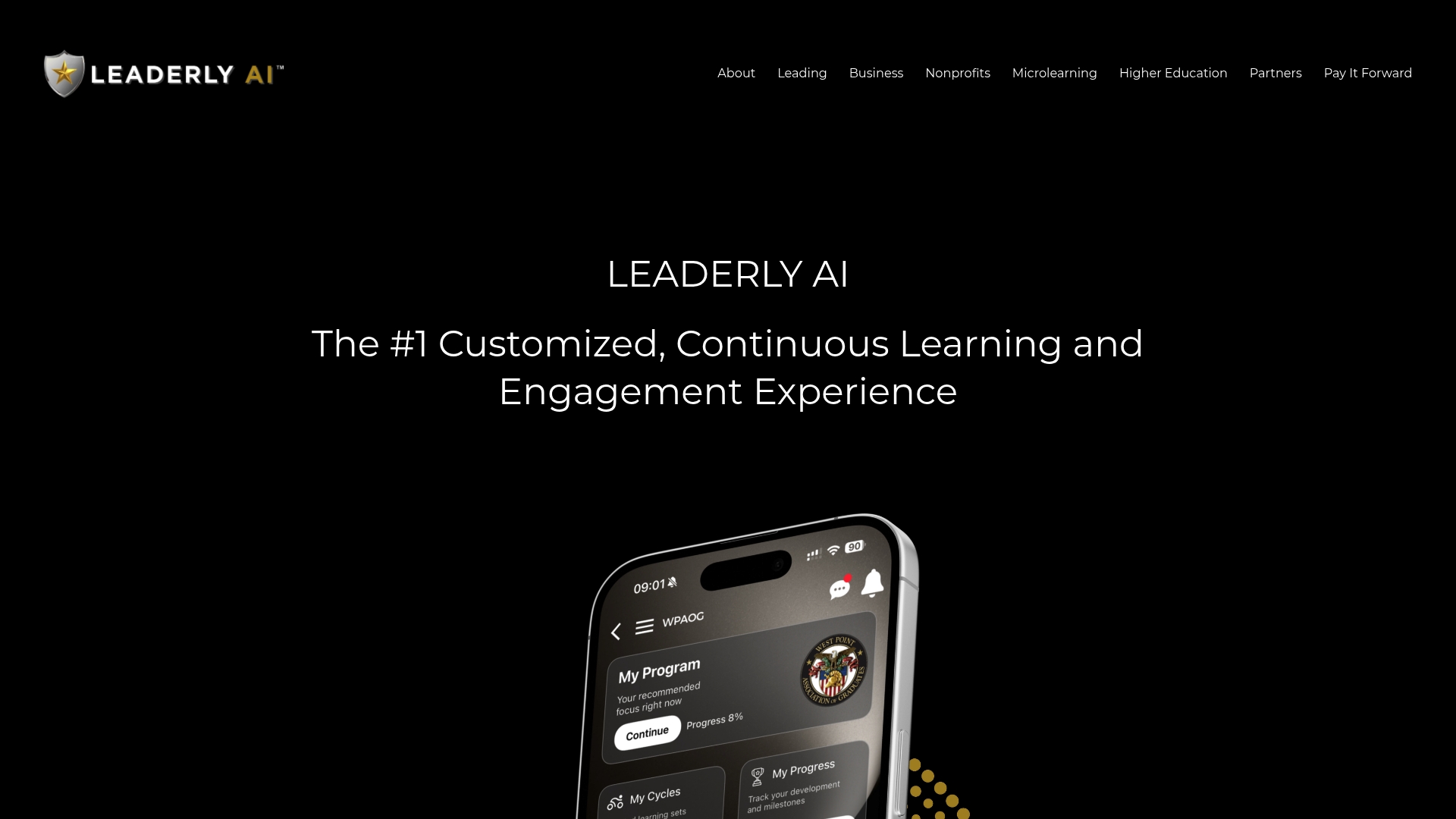
If you are an HR or L&D leader who wants to put this into practice without stitching together separate tools, Leaderly AI is a mobile-first platform for personalized leadership development. It combines microlearning, habit-building exercises, customizable learning journeys, self-assessments including DiSC, EQ, and MBTI, simulations, surveys, and analytics dashboards. Programs can be tailored for corporate teams, nonprofits, and higher education.
See how a journey could work for your organization at leaderlyapp.com. For a worked pilot plan for managers, read our guide to a one-quarter remote leadership pilot.
A one-page checklist before you launch
Before you release a journey to learners, confirm you can answer yes to each of these:
- Can you state the business measure the journey should move?
- Have you written two or three behaviors in observable terms?
- Does every lesson and activity trace back to one of those behaviors?
- Is there at least one practice activity that resembles real work, with feedback?
- Do managers know the goal and have a simple prompt for one-on-ones?
- Are reminders scheduled after the formal content ends?
- Do you have a plan to check application and behavior at 30, 60, and 90 days?
- Do you know who will review the data and update the journey?
If any answer is no, fix that before adding more content. The gaps are almost always in practice, manager involvement, or follow-up, not in the volume of lessons.
FAQ
What is the difference between a learning journey and a learning path?
A learning path is an ordered list of courses or resources. A learning journey includes that path plus practice, peer learning, manager involvement, reinforcement, and measurement. The path tells people what to take; the journey is designed to change what they do.
What are the stages of a learning journey?
A useful sequence is: define the business need, describe the observable behaviors, set learning objectives, select experiences, sequence them, and evaluate. A shorter version used in the field is Design, Develop, Deliver, and Debrief.
How long should a learning journey be?
Long enough for people to practice and revisit, short enough to stay focused. For one or two leadership behaviors, a program of roughly six to eight weeks with follow-up at 30, 60, and 90 days is a practical starting point. Adjust based on the complexity of the skill and what your learners can fit alongside their work.
Do I need to follow the 70-20-10 rule?
No. It is a heuristic, not a validated budget split. Use it to remind yourself to include on-the-job assignments, coaching, and peer learning around any formal lessons.
How do I know if a learning journey worked?
Look beyond completion. Track whether people applied the behaviors, whether peers and direct reports notice a difference, and whether the business measure you chose has moved. Review at 30, 60, and 90 days and adjust the journey based on what you find.
Sources
- IFC Guide to Training: Designing Curricula
- Facilitating transfer of training to the workplace (University of Northern Iowa)
- The 4D Advantage: An Alternative Way to Think About Training (Training Industry)
- The Science of Workplace Instruction: Learning and Transfer (Annual Review of Organizational Psychology)
- From college graduate to Amazon manager in less than a year
- Nonprofit Leadership Development Toolkit (Bridgespan)