
Learning in the flow is the practice of delivering short, task-focused instruction exactly when and where an employee needs it to perform a job, embedded directly inside the tools they already use. Organizations that build it well see faster time to competency and higher retention than programs relying only on scheduled courses, because the content arrives at the moment of need rather than weeks before it. The evidence behind it comes from decades of research on spaced retrieval practice and just-in-time information design.
TL;DR:
- Flow learning is most effective for procedural, repeatable tasks with low failure costs and content that can be reduced to under two minutes.
- Prioritize findability, tagging, and content discoverability to ensure employees can access relevant assets within 30 seconds or less.
- Successful pilots require clear goals, simplified content, manager engagement, and thorough measurement of both engagement and performance change.
- Accessibility for diverse learners mandates mobile-first content, plain language, and supports for visual or hearing impairments to reach every employee.
- Organizational leadership must actively model and reinforce flow learning practices to embed a culture that sustains behavioral change.
Table of Contents
- What Is Learning in the Flow of Work?
- Why Does In-Flow Learning Actually Work?
- When Should You Use Flow Learning Instead of Formal Training?
- How Do You Design Content That Fits the Flow?
- How Do You Pilot and Scale a Flow Learning Program?
- What Metrics Prove Flow Learning Is Working?
- What Common Mistakes Sink Flow Learning Programs?
- How Does Leaderly AI Support In-Flow Learning Design?
- How Do You Make Flow Learning Accessible to Every Employee?
- Leadership Perspective: Why Culture Determines Whether This Works
- Ready to Pilot Learning in the Flow?
- Sources
What Is Learning in the Flow of Work?
Learning in the flow of work means content shows up inside the systems people already use, whether that's a CRM, a help desk tool, or a Slack channel, rather than requiring a trip to a separate portal. Josh Bersin framed this as a new paradigm for corporate training, capturing a real shift: learning stopped being a destination and became a service that travels to the employee.
That's a meaningful departure from two things it often gets confused with.
- Formal training builds foundational schema through structured courses, usually before someone starts a role, and it's still necessary for licensure, safety certification, or complex conceptual frameworks.
- Generic microlearning just shrinks course content into shorter videos, but if a learner still has to log into a separate LMS to find it, it hasn't solved the access problem.
- Learning in the flow solves both the timing and the location problem, surfacing a specific answer inside the exact screen or workflow where the question came up.
Just-in-time learning research backs this distinction: supplying focused instruction exactly when a need arises measurably increases learner satisfaction and shortens the gap between having a question and resolving it. The paradigm shift matters because most LMS platforms were built around content storage, not delivery timing. Flow-based learning inverts that priority.
Why Does In-Flow Learning Actually Work?
The performance case for learning in the flow rests on three levers: faster competency, better retention, and lower cost per learning outcome.
Faster competency. When training happens right before or during task execution, employees apply it immediately instead of trying to recall a session from three weeks earlier. That immediacy is the entire premise behind just-in-time delivery.
Better retention through spacing. Spaced learning and retrieval practice reliably outperform massed practice for long-term retention. A single all-day workshop crams information into working memory that mostly evaporates within days. Five-minute reinforcement touches spread across two weeks, timed to when someone is actually doing the task, stick.
By the numbers: Cognitive science on the spacing effect consistently shows spaced, retrieval-based practice produces stronger long-term retention than a single concentrated study session, which is the mechanism embedded learning experiences are built to exploit.
Lower cost per outcome. A sales rep who gets a brief objection-handling refresher inside the CRM right before a call costs almost nothing to serve compared to pulling that same rep into a half-day workshop. Multiply that across a workforce, and the difference in delivery cost compounds fast.
Consider a support team that embeds troubleshooting steps directly inside the ticketing tool: agents resolve issues without escalating, and average handle time drops because the answer sits three clicks from where the question appeared. That's workflow learning doing its actual job.
- Faster onboarding for repetitive, procedural roles
- Fewer escalations because frontline staff self-serve at the point of need
- Higher completion rates than optional e-learning modules, since the content is unavoidable at the moment it's relevant
When Should You Use Flow Learning Instead of Formal Training?
Not every skill belongs in a five-minute nudge. Learning in the flow of work isn't always the right call when a task demands foundational knowledge, regulatory certification, or a complex mental model that takes real time to construct.
Use this checklist to sort a skill before you build for it:
- Does the task require a license, audit trail, or compliance sign-off? If yes, keep formal training.
- Is the skill procedural and repeatable, something a person does the same way each time? Flow learning fits well.
- Does performing the task correctly depend on judgment built from prior conceptual grounding? Build the foundation formally first, then reinforce it in the flow.
- Is the failure cost low if someone gets it slightly wrong on the first try? Low-stakes tasks are ideal candidates for in-the-moment nudges.
- Can the content be reduced to under two minutes without losing meaning? If not, it's probably not atomic enough for flow delivery yet.
New-hire product certification usually needs a structured cohort experience. Refreshing that same rep on a pricing change six months later is a perfect flow-learning moment.
Pro Tip: Run every candidate skill through the checklist before building anything. Teams that skip this step often end up cramming complex, high-stakes content into a five-minute nudge, and it fails both jobs at once.
How Do You Design Content That Fits the Flow?
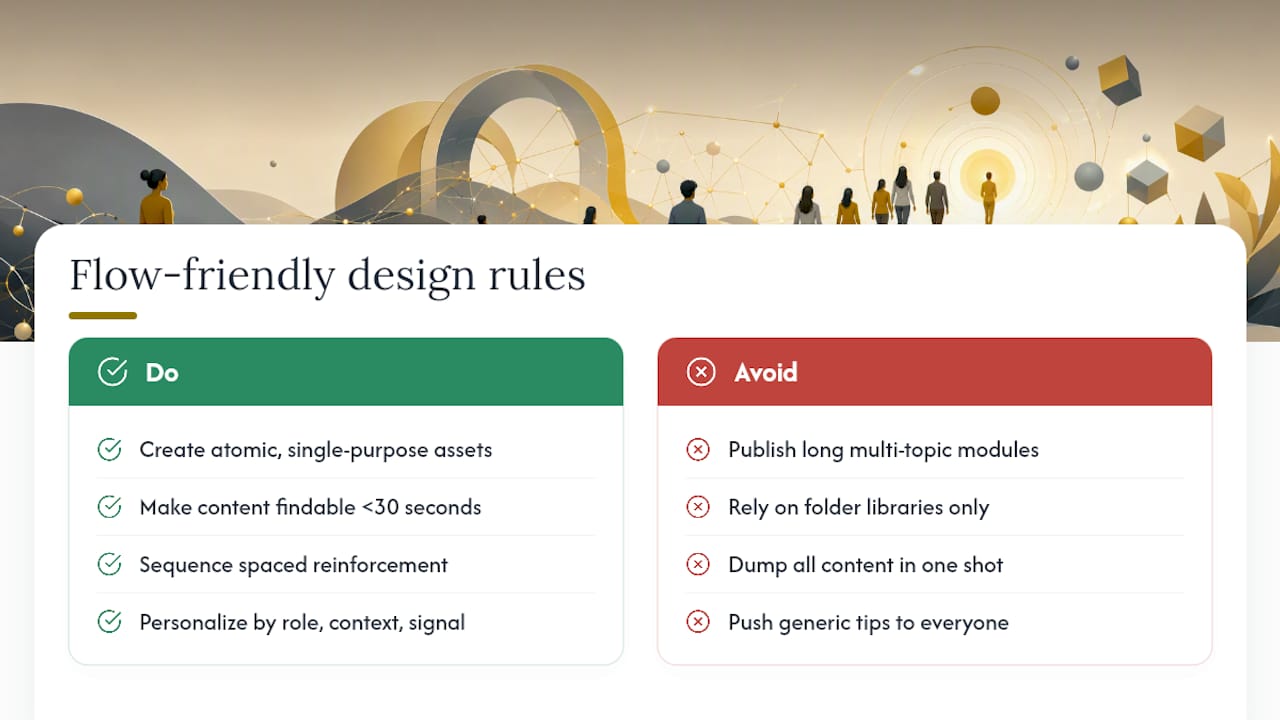
Good flow-based learning follows a handful of design rules that hold regardless of industry.
Build atomic, single-purpose assets. Experts recommend atomic content: one-minute videos, single-screen job aids, precise checklists that answer exactly one question. A ten-minute module covering five topics fails the flow test because nobody has ten uninterrupted minutes mid-task. Leaderlyapp's approach to combining microlearning and macrolearning treats the atomic unit as the base building block, then sequences those units into a larger competency arc without ever forcing a long single session.
Make everything findable in under 30 seconds. Content depth means nothing if nobody can locate it. The strongest programs move away from folder-based libraries toward tag-based search and proactive triggers that surface the right asset without the employee typing a query at all. Practitioners who over-invest in library depth and under-invest in discoverability consistently see lower adoption, no matter how good the content is.
Design for spacing, not one-shot delivery. Sequence reinforcement touches over days and weeks rather than dumping everything at once. Peer-reviewed work on just-in-time presentation design shows supportive information works best before a task cluster while prerequisite information works best delivered during practice, a sequencing rule that's easy to violate if content ops treats every asset the same way.
Integrate through the channels people already trust. In-app prompts, chatbots, and Slack or Teams triggers all work, but each one needs a privacy review before rollout since many of these signals draw on behavioral or usage data.
Personalize by role, context, and signal. AI-driven personalization is becoming central to effective in-flow design, since the same generic tip pushed to every employee regardless of tenure or role wastes attention that could have gone to something relevant.
Pro Tip: If an asset can't be consumed and applied in under two minutes on a phone screen, it's not ready for flow delivery. Cut it down before you ship it, not after adoption numbers come in low.
How Do You Pilot and Scale a Flow Learning Program?
A credible pilot needs a defined shape before it launches, not a vague intention to "try embedded learning."
Step 1: Design the pilot template. Pick one goal (reduce average handle time, cut onboarding time, lower error rate on a specific task), one cohort of 20 to 50 people doing the same job, a six to eight week timeline, and two or three metrics you'll track before and after.
Step 2: Assign roles and governance. Content ops for this kind of program has to run like a small newsroom rather than a traditional curriculum team: a compact team producing minimum-viable-content atomic assets, watching usage signals, and iterating weekly beats a large team producing polished content nobody finds. Assign one owner for taxonomy and tagging so search doesn't degrade as the library grows, one owner for the tech integrations, and one liaison to the manager population.
Step 3: Build the tech checklist. Confirm the platform can push content into the tools employees already use, not just host it in a separate destination. Check that search and tagging are functional before launch, not after. Instrument analytics on three things minimum: content views, task completion tied to the content, and time-to-answer. Understanding the different platform types available for scalable HR learning helps decide whether existing infrastructure can support in-tool delivery or needs an added layer.
Step 4: Enable managers before you enable employees. A pilot succeeds or dies based on whether managers reinforce it. Manager coaching follow-up is what actually converts microlearning exposure into behavior change; without it, employees see the content once and never apply it under pressure. Brief managers on what's changing, give them a one-page summary of what their team will see, and ask them to reference the content in one on ones during the pilot window.
Governance for scale looks different from governance for a pilot:
- A pilot needs a single accountable owner; scale needs a standing content council with rotating subject matter experts.
- A pilot can tolerate manual tagging; scale needs a tagging taxonomy enforced by templates.
- A pilot measures one team; scale needs a dashboard segmented by department, tenure, and role.
What Metrics Prove Flow Learning Is Working?
Measurement has to connect content consumption to actual performance change, not just completion counts.
Leading indicators tell you whether the mechanics are working before performance data catches up: time-to-answer (how fast someone finds the relevant asset), content engagement rate inside the workflow tool, and search success rate (queries that return a usable result on the first try).
Lagging indicators tell you whether behavior actually changed: error rate on the targeted task, average handle time, ramp time for new hires, and voluntary turnover in roles where skill gaps drive frustration.
- Instrument the workflow tool itself for view and completion events, not a separate LMS report that nobody checks.
- Pull performance data from the system of record for the task (ticketing tool, CRM, POS) rather than self-reported surveys alone.
- Run a cohort comparison, pilot group against a matched group that didn't get in-flow content, to separate the program's effect from seasonal or market noise.
A cohort design matters more than most teams realize. Comparing this quarter's numbers to last quarter's without a control group means you can't rule out other factors driving the change, whether that's a new hire class, a policy shift, or plain seasonality.
What Common Mistakes Sink Flow Learning Programs?
Most failures trace back to a handful of repeatable mistakes.
- Building library depth instead of findability. A large content library with weak search loses to a small one with excellent tagging every time.
- Skipping manager enablement. Content without a manager reinforcing it in real conversations rarely changes behavior on its own.
- Treating every asset the same length. Cramming a five-topic module into "microlearning" branding doesn't make it flow-ready.
- No spacing plan. Pushing all reinforcement in one burst instead of spreading it over weeks throws away the retention benefit spacing provides.
- Launching without instrumentation. If analytics aren't wired in before launch, you can't prove impact after the fact, and the pilot dies from lack of evidence rather than lack of results.
Each one has a direct fix: shorten content, brief managers again, or fix tagging before scaling further.
How Does Leaderly AI Support In-Flow Learning Design?
Leaderly AI was built around the same principles this playbook lays out: atomic content, findability, and personalization driven by behavioral signals rather than a static curriculum. Microlessons are built to be consumed in a few minutes, machine learning recommendations adjust what a user sees next based on their role and prior engagement, and analytics dashboards give L&D teams the leading and lagging indicators the measurement section above calls for.
| Playbook principle | How Leaderly AI applies it |
|---|---|
| Atomic content | Microlessons sized for a few minutes, not a course-length module |
| Personalization | Machine learning adjusts content sequencing to each user's journey |
| Findability and triggers | Behavioral prompts surface relevant lessons based on usage signals |
| Measurement | Analytics dashboards track engagement and behavior change over time |
A reasonable pilot configuration: a 4 to 6 week cohort test using self-assessments (DiSC, EQ, or MBTI) to establish a baseline, weekly microlesson delivery tied to a specific leadership behavior, and a dashboard review at week 6 against the metrics your team picked in the playbook above.
Client case studies and author credentials will be added here as they become available.
How Do You Make Flow Learning Accessible to Every Employee?
Flow learning fails part of the workforce if it's designed only around the median employee. Diverse learners need multiple entry points into the same content.
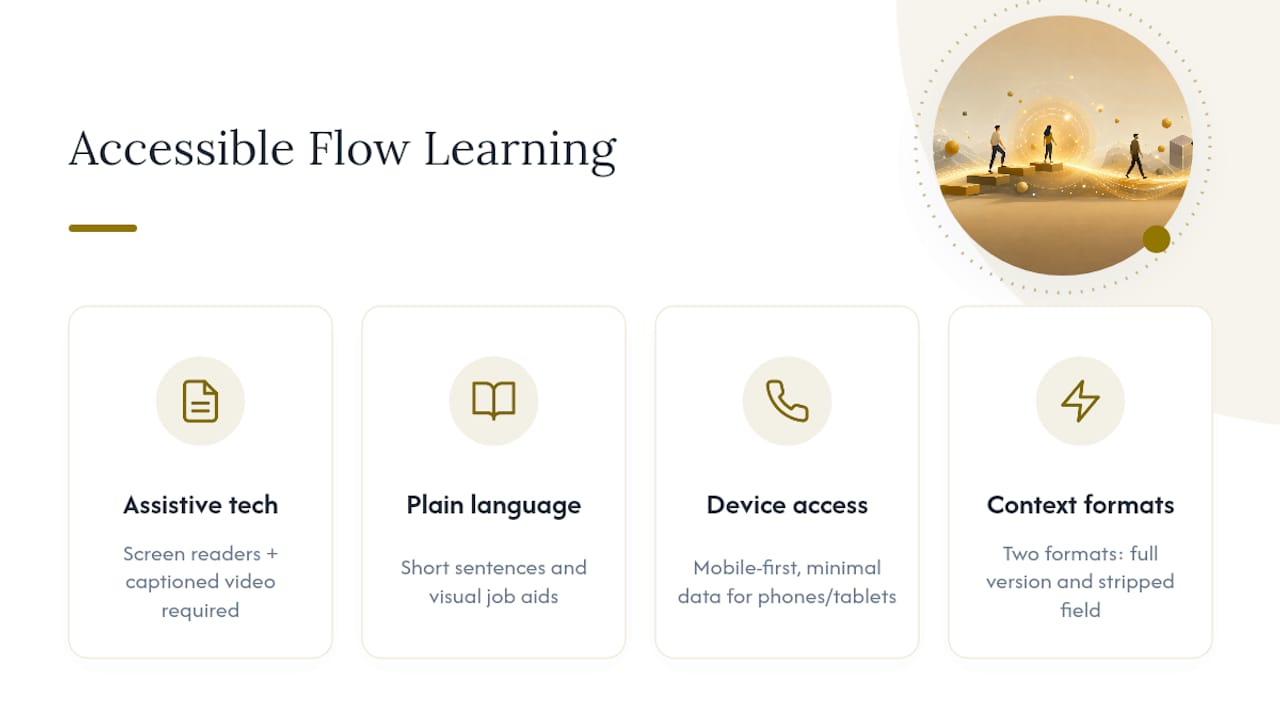
Screen reader compatibility and captioned video aren't optional extras. If a microlesson only works as a silent video or an image without alt text, employees with visual or hearing impairments are locked out of the exact moment-of-need support the whole approach promises. Text-based alternatives for every video asset solve this without duplicating content creation effort.
Language and literacy vary widely across a workforce, especially in industries with high frontline and shift-based staffing. Plain-language writing, short sentences, and visual job aids alongside text reduce the cognitive load for people reading in a second language or under time pressure on a warehouse floor.
Device access matters just as much as content format. Flow learning that assumes everyone has a company laptop excludes frontline and field staff who only have a shared tablet or a personal phone. Content built mobile-first, with minimal data requirements, reaches that population without a separate accommodation process.
Cognitive load differs by context too. Someone learning at their desk can handle slightly denser content than someone on a factory floor mid-shift. Building two formats of the same core lesson, a fuller version and a stripped-down field version, costs less than retrofitting accessibility after a launch reveals gaps.
Leadership Perspective: Why Culture Determines Whether This Works
The technical design matters less than most L&D teams assume. Two things separate programs that stick from ones that quietly die: leaders who model using the content themselves, and managers who ask about it in real conversations, not just a compliance dashboard that tracks completions nobody discusses.
Sponsor a pilot with an actual budget line and a named executive owner, not a side project someone squeezes in between other priorities. If leadership treats learning in the flow as optional, employees will too.
— Drew
Ready to Pilot Learning in the Flow?
If your team has been weighing a formal LMS overhaul against a leaner, embedded approach, Leaderly AI skips the multi-month implementation entirely. It delivers personalized microlessons and behavioral assessments directly to employees on their phones, with machine learning that adjusts each person's path instead of pushing the same static course to everyone.
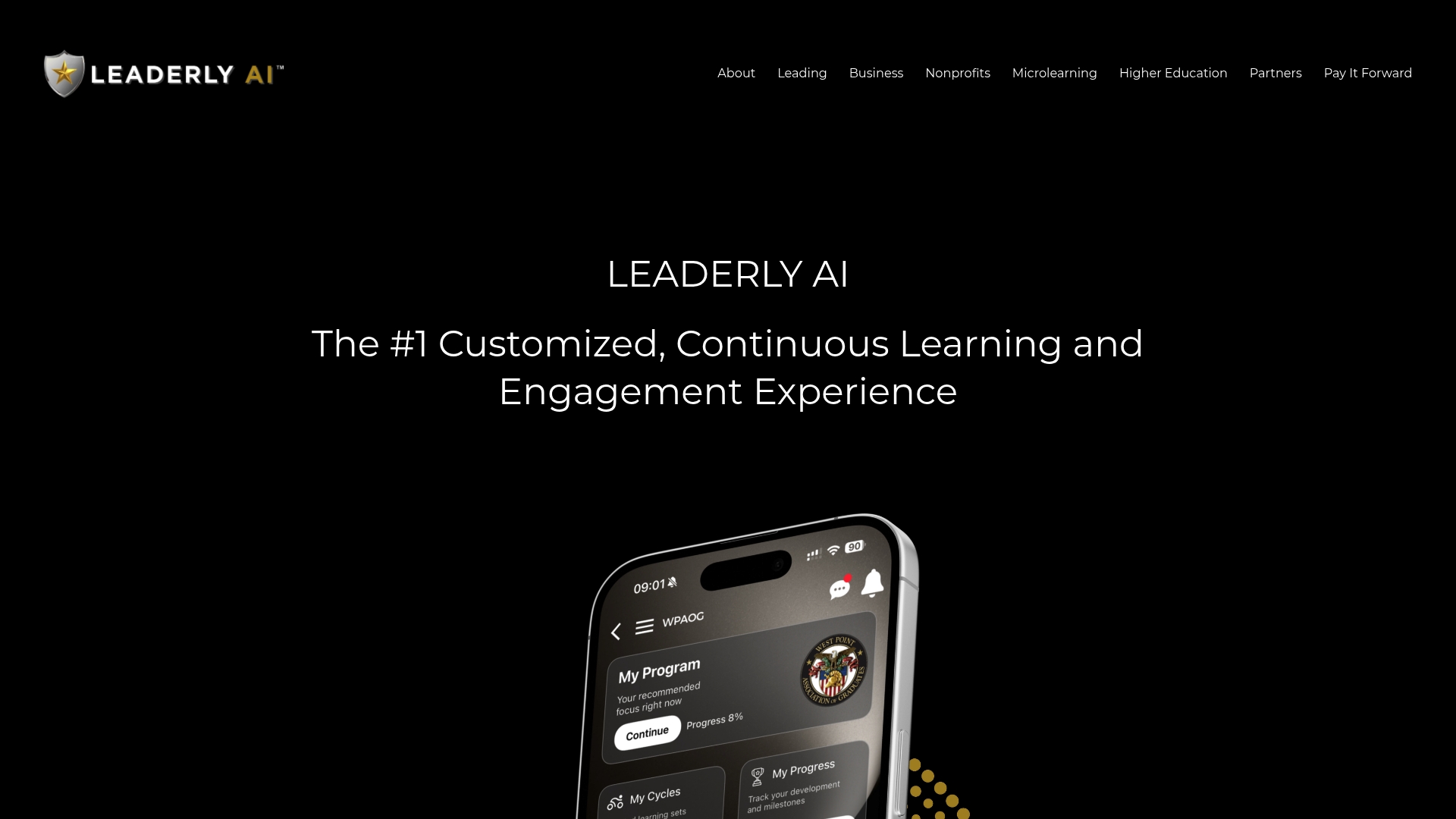
The platform is built for exactly the pilot structure this playbook describes: a defined cohort, a short timeline, and dashboards that show whether behavior actually changed. Explore Leaderly AI's approach to leadership development and request a pilot to see how a six-week cohort test could work for your organization.
Sources
- A New Paradigm For Corporate Training: Learning In The Flow of Work
- The right time to learn: mechanisms and optimization of spaced learning | Nature Reviews Neuroscience
- Learning in the flow of work: Designing person-centric learning experiences with just-in-time microlearning — Cambridge Core