
Neither wins. Macrolearning builds the mental models employees need for complex, novel skills, while microlearning keeps those skills sharp once the training is over. The strongest programs sequence them: a macrolearning event to establish depth, then scheduled microlearning to force retrieval and lock in behavior change over the following weeks and months.
TL;DR:
- Microlearning is most effective for quick, repeated reinforcement of known skills, while macrolearning builds deep understanding of complex, high-stakes topics.
- Structured sequencing of macrolearning events followed by regular microlearning refreshers significantly improves long-term retention and application.
- Using microlearning for routine updates and micro-assessments, and reserving macrolearning for foundational skills, maximizes training impact and cost efficiency.
- Common pitfalls include disconnected micro modules, passive content, and lack of alignment with macro objectives, which weaken learning outcomes.
- Automated platforms that map micro reinforcement to macro goals prevent decay and ensure sustained development without extra staff effort.
Table of Contents
- Microlearning vs Macrolearning: What Actually Separates Them
- What Are the Benefits and Limits of Each Approach?
- When Should You Use Microlearning vs Macrolearning?
- How Do You Design Effective Micro and Macro Content?
- How Do You Combine Microlearning and Macrolearning?
- How Do You Measure ROI for Micro and Macro Training?
- What Implementation Mistakes Should You Avoid?
- What Leaderly Has Learned About Blending Micro and Macro Training
- How Leaderly Helps You Build Both Layers Without Extra Headcount
- Sources
Microlearning vs Macrolearning: What Actually Separates Them
The difference comes down to time, cognitive load, and purpose, not just format. Microlearning delivers targeted, action-oriented content typically consumed in 30 seconds to 5 minutes, built to answer one question or reinforce one skill in the flow of work. Macrolearning runs for hours or days, layering concepts sequentially so learners build a durable mental model rather than a single fact.
That gap in duration drives everything else. A microlearning module can only carry a light cognitive load. It has to work with someone checking their phone between meetings, so it strips out everything but one objective. Macrolearning can afford complexity: case studies, role-plays, cohort discussion, guided practice across multiple sessions. It builds context that a five-minute clip never could.
- Microlearning: a 3-minute video on giving difficult feedback, delivered right before a manager's 1:1.
- Macrolearning: a two-day leadership workshop covering situational leadership theory, conflict resolution frameworks, and coaching practice.
- Typical formats for micro: push notifications, short quizzes, job aids, scenario cards.
- Typical formats for macro: workshops, multi-week cohort programs, capstone projects, certification tracks.
Some reviews put micro modules closer to 2 to 5 minutes in real-world practice, depending on the objective. Either way, the operating principle holds: microlearning answers "what do I do right now," and macrolearning answers "how do I think about this differently going forward."
What Are the Benefits and Limits of Each Approach?
Microlearning wins on speed and stickiness. Because it's short, it fits into gaps in a workday without requiring a calendar block, and learners who might avoid a 90-minute course will happily tap through a 3-minute refresher. Systematic reviews report that microlearning improves knowledge retention, engagement, and short-term performance across a range of contexts.
The trade-off: that same brevity is microlearning's ceiling. The research is clear that its effectiveness for complex, integrative competencies is limited unless the modules are scaffolded into something larger. A five-minute video cannot teach someone to run a difficult performance conversation from scratch. It can only remind them of a framework they already learned somewhere else.
Macrolearning benefits and limitations run almost the opposite direction:
- Builds foundational expertise and mental models that short content can't create alone.
- Justifies its cost and time investment for high-stakes skills: new manager transitions, safety-critical procedures, strategic decision-making.
- Costs more per learner in facilitator time, room bookings, and lost productive hours.
- Fades fast without reinforcement. Content delivered once in a two-day workshop decays quickly without follow-up.
The synthesis L&D teams keep landing on: use macrolearning when the skill is new, complex, or high-stakes, and use microlearning to keep that skill alive afterward. Treat them as separate budget lines and you'll underinvest in one or overbuild the other.
When Should You Use Microlearning vs Macrolearning?
The decision usually comes down to four variables: complexity, novelty, stakes, and how much time the learner actually has. High complexity and high novelty point toward macrolearning. Low complexity, high frequency, and tight time windows point toward microlearning.
A few scenarios make this concrete:
- Software update rolls out. Nobody needs a workshop to learn a new button placement. A 2-minute walkthrough microlearning module, pushed at the moment of login, is the right tool.
- Annual compliance refresher. This is reinforcement, not new learning. Microlearning quizzes spaced across the quarter beat a single mandatory hour-long webinar that everyone forgets by March.
- New employee onboarding. This needs both: a macrolearning orientation to build organizational context, followed by microlearning drips covering specific tools and processes over the first 90 days.
- First-time manager transition. This is the clearest case for macrolearning. New managers are acquiring a mental model for delegation, feedback, and conflict resolution that microlearning alone cannot build. Deep role transitions like this justify the heavier investment, with microlearning entering afterward to reinforce it.
- Role transition into a new department. Blend the two: a half-day macrolearning session on the new function's fundamentals, then weekly micro check-ins for the first month.
Pro Tip: If you're unsure which format fits, ask whether the learner needs new judgment or a reminder of judgment they already have. New judgment means macro. A reminder means micro.
Run any initiative through a short checklist: Is the skill genuinely new? Is the failure cost high if done wrong? Does the learner have more than 15 minutes available right now? Three "yes" answers usually mean macrolearning is worth the investment.
How Do You Design Effective Micro and Macro Content?

Both formats share the same backbone: a clear objective, built-in practice, timely feedback, and deliberate spacing. Skip any of those four and even a well-produced course underperforms, regardless of length. Cognitive science on spacing and retrieval practice applies whether the session runs five minutes or five hours.
For microlearning specifically:
- One objective per module. Never stack two skills into a three-minute clip.
- Include retrieval practice, not just content. A short quiz question after the video beats a passive watch-and-close.
- Design mobile-first. Assume the learner is on a phone, possibly one-handed, possibly distracted.
- Tag content with metadata so learners can search and resurface it later, not just consume it once.
For macrolearning:
A macrolearning sequence should scaffold, not lecture. Each session builds on the last, culminates in an integrated project or simulation, and includes mastery checks before moving forward. Spacing shouldn't wait until the program ends. It belongs inside the design.
A practical micro module skeleton: hook (10 seconds), single concept (60 to 90 seconds), scenario-based question, immediate feedback, optional resource link. A macrolearning sequence template: pre-work reading, live session with discussion, applied practice or role-play, mastery check, and a scheduled follow-up microlearning drip. Discussion-based formats, in particular, strengthen the reflective practice piece that macrolearning depends on. Leaderlyapp's own scaffolded learning approach follows this same logic, mapping each short lesson back to a larger competency rather than letting it float alone.
How Do You Combine Microlearning and Macrolearning?
The sequencing model that works best is what practitioners call the Macro-Micro Flip: deliver the foundational macrolearning event first, then schedule automated microlearning interventions at defined intervals to force retrieval and prevent decay. This isn't a theory. One study of a macrolearning program spanning 9 to 12 months found that structured sequences of microlearning units, organized carefully within that longer program, improved learner self-efficacy while preserving microlearning's engagement advantages over many months.
A workable cadence looks like this:
- Week 0: Run the macrolearning event, whether that's a workshop, cohort program, or certification course.
- Days 1 to 30: Deploy short retrieval quizzes and scenario cards tied directly to the macro content, spaced every 3 to 5 days.
- Days 30 to 60: Shift to application-focused microlearning, job aids the learner uses on real tasks, not just recall questions.
- Quarter 2 onward: Run a quarterly refresher microlearning series to catch decay before it shows up in performance data.
Map each micro touchpoint to a specific macro milestone rather than sending generic reminders. If the macro event covered delegation, the micro follow-up should be a delegation scenario, not a random leadership tip. At scale, this requires automation. Manually scheduling drip content for hundreds of learners breaks down fast, which is where a platform that sequences content based on individual progress earns its keep. Leaderlyapp's approach to continuous leadership development is built around exactly this kind of automated cadence.
How Do You Measure ROI for Micro and Macro Training?
Microlearning and macrolearning need different metrics because they operate on different timelines. Trying to judge a two-day workshop by its completion rate, or a two-minute module by its impact on promotion rates, will give you the wrong answer every time.
Short-term microlearning metrics:
- Completion and engagement rate per module
- Retrieval quiz accuracy over time
- Time-to-competency on a specific task
Long-term macrolearning metrics:
- Skill transfer, measured through manager observation or 360 feedback
- Business KPIs tied to the skill (error rates, sales conversion, safety incidents)
- Promotion and retention rates among program graduates
A practical framing: microlearning's documented gains in retention and engagement make it easy to measure quickly, but those gains mean little if they're never connected back to a macrolearning objective. Track both layers together, not in isolation.
A simple ROI template: baseline performance before training, short-term retrieval scores at 30 days, applied behavior change at 90 days, and a business metric at 6 months. Mixed-method designs, pairing quiz data with manager ratings, give you a defensible attribution story when leadership asks what the training budget actually bought.
What Implementation Mistakes Should You Avoid?
The most common failure is fragmentation: dozens of disconnected micro modules with no map showing how they connect to a larger skill. Fix it by visualizing the learning pathway so employees see progress, not a random content feed.
A close second is treating microlearning as marketing, glossy short videos with no practice or assessment attached. Every micro unit should require the learner to do something, not just watch something, or it fails to move the needle at all.
- Fragmented content: map every micro unit to a specific macrolearning objective before building it.
- Passive micro content: require a retrieval question or scenario response in each module.
- No reinforcement after macro events: schedule automated micro drips the moment the macro event ends, never after the fact.
- No ownership: assign a single governance owner who reviews the map quarterly.
Pro Tip: If a micro module doesn't map to a macro objective on a whiteboard in under 10 seconds, it probably doesn't belong in the program.
What Leaderly Has Learned About Blending Micro and Macro Training
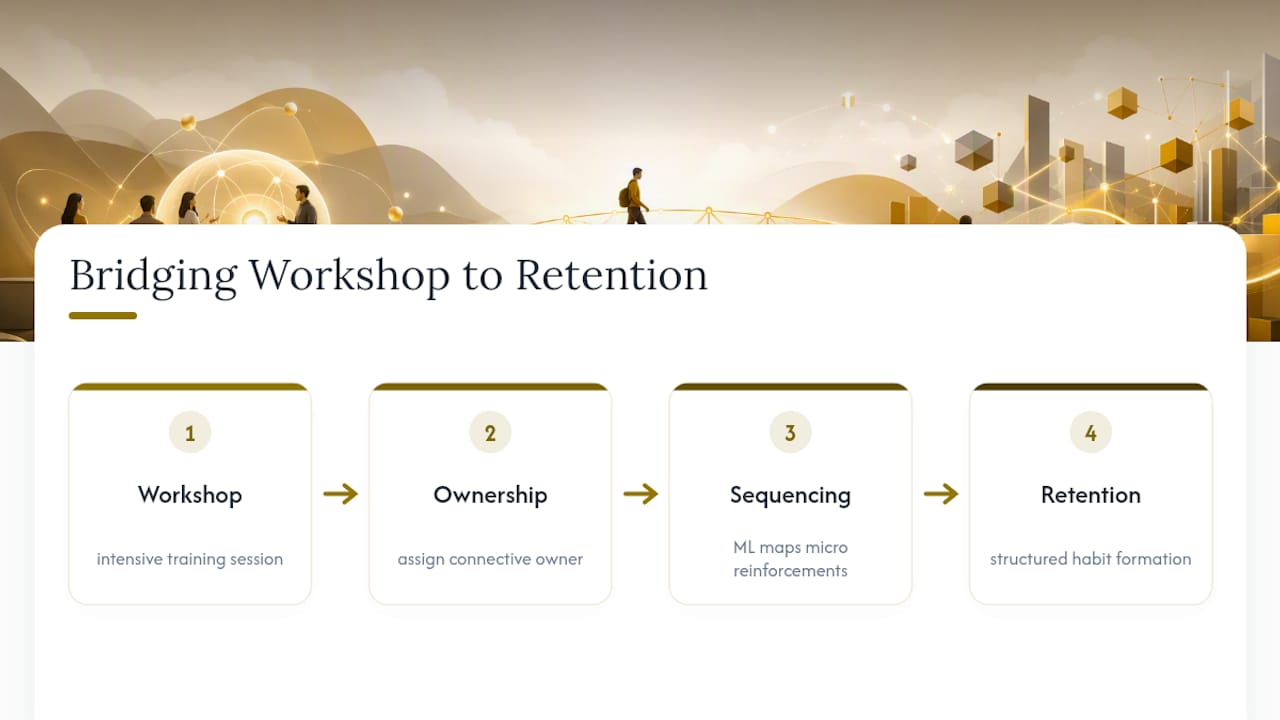
Building a platform around this exact problem changes how you see the debate. Most organizations don't fail because they pick the wrong format. They fail because nobody owns the connective tissue between a workshop and the weeks that follow it.
Leaderlyapp's machine learning sequencing exists specifically to solve that gap: it maps personalized micro reinforcements to each learner's broader development path instead of leaving that link to chance. The behavioral science behind microlearning's role in shaping lasting habits backs up what the research already shows. Retention needs structure, not just good content. If your organization runs strong workshops that fade within a month, that's a sequencing problem, not a content problem.
— Drew
How Leaderly Helps You Build Both Layers Without Extra Headcount
Most L&D teams don't lack good workshop content. They lack the bandwidth to build and schedule the microlearning follow-up that makes it stick. Leaderlyapp closes that gap by automating the reinforcement layer: once a macrolearning event ends, the platform sequences personalized micro modules, quizzes, and job aids based on each learner's role and progress, without your team manually building a drip campaign for every cohort.

The platform also runs self-assessments like DiSC and EQ, so the micro content that follows a leadership workshop actually reflects each person's specific gaps rather than a generic reminder everyone receives. That's the difference between a program that fades in 30 days and one that shows up in manager reviews six months later. If you're mapping out a leadership development pathway for the year ahead, take a look at Leaderly's continuous learning platform and request a demo to see how it sequences your existing macrolearning content into a measurable micro reinforcement plan.
Sources
- Microlearning beyond boundaries: A systematic review and a novel framework for improving learning outcomes
- Empirical study on macrolearning and microlearning concatenation (Springer article)
- Microlearning beyond boundaries: systematic review (ScienceDirect)