
Applying leadership learning in real work settings produces measurable gains in performance, retention, and organizational agility. That's the short answer. The longer one is that organizations spending billions on development programs often see little return because learning stays in the workshop and never reaches the work. Closing that gap is the single highest-leverage move available to HR leaders and executives right now.
Here's where to start this week:
- Pick one real business challenge your team is currently facing and use it as the anchor for a leadership learning activity.
- Schedule a 30-minute debrief with your direct reports after any decision-making moment, not just after formal training.
- Identify one leader who could benefit from a stretch assignment and assign it with a clear accountability structure.
Pro Tip: Write one specific "if-then" plan before your next leadership conversation: "If I notice someone disengaging in the meeting, then I will ask them a direct, open question." That single implementation intention increases follow-through more than any amount of general resolve.
Key Takeaways
Real-world leadership application produces measurable organizational outcomes when learning is embedded in actual work, reinforced by managers, and tracked over time.
| Point | Details |
|---|---|
| Application drives ROI | Organizations spend an estimated USD 60 billion annually on development; transfer rates stay low without embedded practice. |
| Five-phase framework works | Foundation, Before, During, Conclusion, and After phases each require distinct strategies; the "After" phase is most often skipped. |
| Scar tissue can't be skipped | Simulations and peer debrief build the emotional experience leaders need for hard decisions; content alone doesn't. |
| Measure early and often | Set a behavioral baseline before the program starts; track behavioral, team, and business indicators at 30, 90, and 365 days. |
| Leaderlyapp scales application | Microlessons, coaching nudges, and analytics dashboards support the full five-phase framework for continuous behavior change. |
Pro Tip: Start with one real challenge, five leaders, and eight weeks. That's a pilot small enough to run without a committee and large enough to generate data worth acting on.
Table of Contents
- What Are the Real Benefits of Applying Leadership Skills at Work?
- How Do You Actually Transfer Leadership Learning Into Real Behavior?
- Why Do So Many Leadership Programs Fail to Stick?
- What Framework Actually Maximizes Leadership Application and ROI?
- Real-World Leadership Application in Practice: Three Vignettes
- How Do You Measure Whether Leadership Application Is Working?
- Six Steps to Start Applying Leadership Learning This Month
- Why Applied Leadership Is the Highest-Return Development Investment
- How Leaderlyapp Turns Leadership Learning Into Lasting Behavior
- Sources
What Are the Real Benefits of Applying Leadership Skills at Work?
The importance of leadership skills isn't abstract. When leaders apply what they've learned in actual work contexts, five concrete outcomes follow.
1. Stronger financial and operational performance. Leaders who practice decision-sharing and continuous learning reduce friction across teams. ESADE's analysis of transformational leadership shows that combining strategic clarity with technical empowerment supports rapid growth by enabling distributed decision-making, which cuts delays and redundant escalations.
2. Better talent attraction and retention. A multi-method field study published in BMC Psychology found that authentic leadership training improved psychological safety and reduced turnover intention at a three-month follow-up. Leaders who practice transparency and balanced processing create environments where people stay. Research on coaching and retention reinforces this: consistent coaching behaviors, not one-off workshops, drive the retention effect.
3. Sharper strategy execution. Leadership application in practice means leaders are rehearsing the exact decisions their strategy requires. That repetition builds the muscle memory for execution under pressure, not just under ideal conditions.
4. Greater change capability. Organizations where leaders practice adaptive skills in real scenarios handle disruption faster. HBR's analysis of the growing power skills gap links deficits in interpersonal and trust-building skills directly to eroding innovation and falling engagement during periods of change.
5. Higher team engagement and psychological safety. When leaders model learning openly and apply feedback in real time, teams follow. The BMC Psychology study found that training in relational transparency and balanced processing reduced emotional exhaustion and improved engagement, two of the strongest predictors of team output.
Scale of the problem: Organizations worldwide spend an estimated USD 60 billion annually on leadership development, yet training transfer to the workplace remains persistently low, with some reviews reporting transfer rates in the single digits.
How Do You Actually Transfer Leadership Learning Into Real Behavior?
The gap between knowing and doing is where most programs fail. These strategies have the strongest evidence base for closing it.
Action learning and project-based work put leaders inside real problems with real stakes. Project-based learning builds leadership capacity precisely because the feedback is immediate and the consequences are genuine. There's no simulation of urgency when the project is actually due.
Simulations and role plays create what Dr. Andy Szeto calls "scar tissue" — the emotional weight of hard decisions that can't be taught from a syllabus alone. According to Faculty Focus, practice-based routines like mock interviews, peer debriefs, and simulations build the emotional experience leaders must carry into real decisions. You can't shortcut this. A leader who has never practiced a difficult conversation in a safe environment will freeze or default to avoidance when it counts.

Coaching and feedback loops provide the calibration that makes practice productive. Without feedback, leaders repeat mistakes with increasing confidence. Leadership coaching structures that feedback so it's specific, timely, and tied to observable behavior rather than general impressions.
Microlearning and spaced practice work because the brain consolidates learning through repetition over time, not through marathon sessions. Short, targeted lessons tied to current work challenges beat a two-day offsite for long-term behavior change.
Stretch assignments with accountability force leaders to operate at the edge of their current capability. The key word is accountability. A stretch assignment without a check-in structure is just extra work.
Pro Tip: Before any leadership development activity, write a specific if-then plan: "If I'm in a team meeting and someone raises a concern I disagree with, then I will ask two clarifying questions before responding." Research on implementation intentions shows this format dramatically increases follow-through compared to vague commitments like "I'll listen better."
Here's a quick checklist for designing application activities:
- Is the activity tied to a real work challenge the leader is currently facing?
- Does it include at least one feedback mechanism (peer, coach, or data)?
- Is there a scheduled follow-up within 30 days?
- Does the leader have a specific if-then plan for the next relevant situation?
- Is the manager aware and able to reinforce the behavior?
Why Do So Many Leadership Programs Fail to Stick?
Most leadership programs aren't bad. They're just disconnected. The learning happens in one place, the work happens somewhere else, and nothing bridges them. That structural gap explains most of the waste.
The common failure modes follow a predictable pattern:
- Weak links to real work. When training content doesn't connect to the actual decisions leaders face that week, it evaporates. Relevance isn't a nice feature; it's the mechanism of transfer.
- No optimizing system. A single workshop with no follow-up, no reinforcement, and no measurement is a donation, not an investment. The PMC framework review identifies the absence of an "optimizing system" as one of the primary reasons programs underperform.
- One-off delivery. Behavior change requires repetition. A two-day event followed by silence produces a temporary motivation spike, not a durable skill.
- Lack of manager reinforcement. If a leader's direct manager doesn't recognize, encourage, or model the new behaviors, the training signal gets drowned out by the organizational noise around it.
- Misaligned incentives or culture. Leaders who are rewarded for speed and individual heroics won't practice collaborative decision-making, regardless of what the training said.
The consequence of these failures isn't just wasted budget. It's eroded trust. Leaders who go through programs that produce no visible change become skeptical of development altogether, and that skepticism spreads. The mistakes leaders make after failed programs often include abandoning the behaviors they were just taught, because no one reinforced them.
What Framework Actually Maximizes Leadership Application and ROI?
The PMC systematic review of leadership development effectiveness identifies 65 evidence-informed strategies organized across five phases. Here's the practical version:
| Phase | Core Activities | Immediate Outcome |
|---|---|---|
| Foundation | Needs analysis, goal alignment, stakeholder buy-in | Program is tied to real organizational priorities |
| Before | Pre-work, goal setting, manager briefing, baseline assessment | Leaders arrive with context and a specific learning intention |
| During | Simulations, action learning, coaching, peer feedback | Skills practiced in conditions that resemble real work |
| Conclusion | Reflection, if-then planning, commitment contracts | Leaders leave with a concrete application plan |
| After | Follow-up coaching, microlearning nudges, measurement check-ins | Behaviors reinforced and tracked over 30–365 days |
The most commonly skipped phase is "After." Organizations invest heavily in the "During" phase and then go silent. That silence is where transfer dies.
Research signal: The same PMC review notes that some programs report transfer rates in the single digits, while well-designed programs with strong "After" phase support show substantially better outcomes. The difference is almost always organizational support, not content quality.
For leaders exploring which types of leadership development to pilot, the framework suggests starting with the Foundation phase: get clear on what business problem the development is meant to solve before choosing a delivery format.
The highest-impact strategies by phase:
- Foundation: stakeholder alignment and manager pre-briefing
- Before: individual goal setting and baseline self-assessment
- During: simulations, peer coaching, and action-learning projects
- Conclusion: written if-then plans and public commitment
- After: spaced microlearning, coaching check-ins, and 360 feedback
Real-World Leadership Application in Practice: Three Vignettes
Abstract frameworks only go so far. Here's what the impact of real-world leadership looks like in practice.
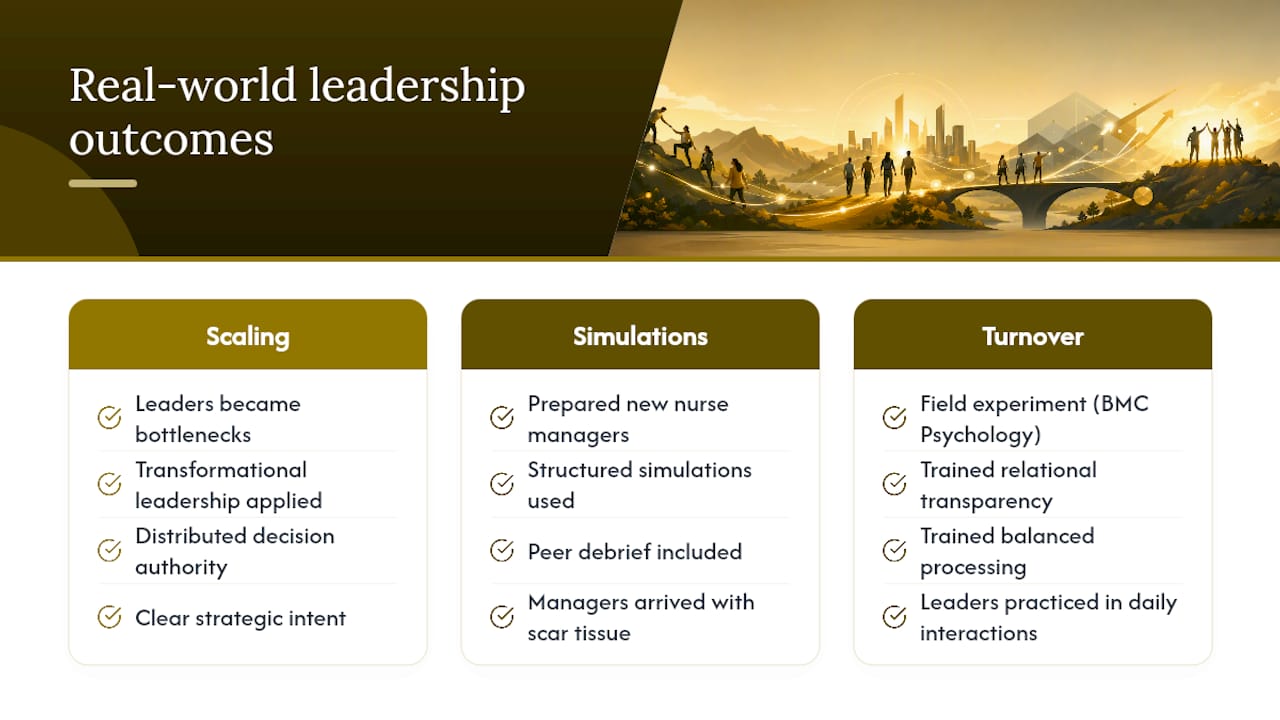
Scaling through transformational leadership. A technology company navigating rapid headcount growth found that its senior leaders were becoming bottlenecks. By applying transformational leadership principles — specifically, distributing decision authority and pairing it with clear strategic intent — the organization reduced approval cycles and improved cross-functional throughput. The leaders didn't learn this in a classroom. They practiced it in weekly operational reviews with explicit coaching on when to decide versus when to delegate.
Building scar tissue before the hard conversation. A healthcare organization preparing new nurse managers for difficult performance conversations used structured simulations with peer debrief. Dr. Andy Szeto concept of "scar tissue" captures exactly what happened: the managers who went through the simulation arrived at their first real conversation with emotional memory, not just a script. Those who skipped the simulation defaulted to avoidance.
Reducing turnover through authentic leadership practice. A field experiment documented in BMC Psychology trained leaders in relational transparency and balanced processing, then tracked outcomes at three months. The result was measurable improvement in psychological safety and a reduction in turnover intention among their direct reports. The mechanism wasn't the training content alone; it was the leaders actually practicing those behaviors in their daily interactions.
How Do You Measure Whether Leadership Application Is Working?
Measurement is where most organizations get vague at exactly the wrong moment. Here's a practical structure.
Behavioral indicators (30 days):
- Coaching conversation frequency (tracked by manager or self-report)
- 360-degree feedback changes on targeted behaviors
- Completion and quality of if-then plans
Team-level indicators (90 days):
- Engagement survey scores, particularly psychological safety items
- Meeting participation rates and decision-making speed
- Peer feedback on collaboration and communication
Operational indicators (90–180 days):
- Project throughput and time-to-decision metrics
- Reduction in escalations to senior leadership
- Quality of strategic planning outputs
Business indicators (365 days):
- Voluntary turnover rates among high-performers
- Internal promotion rates
- Revenue or efficiency metrics tied to the teams in the program
A measurement timeline that works:
- Set a behavioral baseline before the program starts.
- Run a 30-day check-in on behavioral indicators only.
- Conduct a 90-day team-level pulse survey.
- Review operational metrics at the six-month mark.
- Run a full business-impact analysis at 12 months.
The PMC review is clear that effect sizes and transfer rates vary widely across programs. That variability is the argument for rigorous measurement, not against it. If you don't track, you can't improve. Closing the leadership skills gap requires knowing which gaps actually closed.
Six Steps to Start Applying Leadership Learning This Month
These steps work for a team of 10 or a division of 1,000. Start small, measure fast, and expand what works.
- Identify one real business challenge that a leader or leadership cohort will own as the anchor for development. The challenge must be live, not hypothetical.
- Form an action-learning group of three to five leaders around that challenge. Meet bi-weekly. Rotate facilitation. Debrief decisions in real time.
- Schedule a rapid coaching cadence. Weekly 20-minute check-ins between a leader and their manager or coach, focused on one specific behavior from the development plan.
- Build an evaluation baseline now. Run a short pulse survey or 360 before any formal activity begins. You need a before-state to measure against.
- Assign manager reinforcement tasks. Give each participating leader's manager two or three specific behaviors to watch for and acknowledge in the next 30 days.
- Pilot microlessons tied to the live challenge. Three to five minutes of targeted content, delivered at the moment of relevance, beats a full-day workshop delivered six weeks before the work begins.
Quick wins to expect in the first 30 days:
- Leaders report higher clarity on what behavior to change.
- Managers notice at least one observable shift in how a leader handles a meeting or decision.
- The action-learning group surfaces at least one insight the organization hadn't previously articulated.
Keep the pilot small. Five to ten leaders, one real challenge, eight weeks. That's enough to generate data, build credibility, and find hidden leaders worth investing in further.
Why Applied Leadership Is the Highest-Return Development Investment
The evidence is consistent: leadership programs that stay in the classroom produce modest, short-lived gains. Programs that embed learning in real work, with feedback, repetition, and organizational support, produce durable behavior change and measurable business outcomes.
What gets underestimated is the compounding effect. A leader who applies one new behavior consistently for 90 days doesn't just get better at that behavior. They build a habit of applying learning, which makes every subsequent development investment more productive. The first application is the hardest. After that, the system starts working for you.
The organizations that get this right aren't spending more on leadership development. They're spending it differently: less on events, more on embedding, less on content delivery, more on practice and accountability. That shift in design philosophy is what separates programs that produce ROI from programs that produce slide decks.
How Leaderlyapp Turns Leadership Learning Into Lasting Behavior
Most leadership programs hand leaders a framework and wish them luck. Leaderlyapp is built for what comes after that moment.
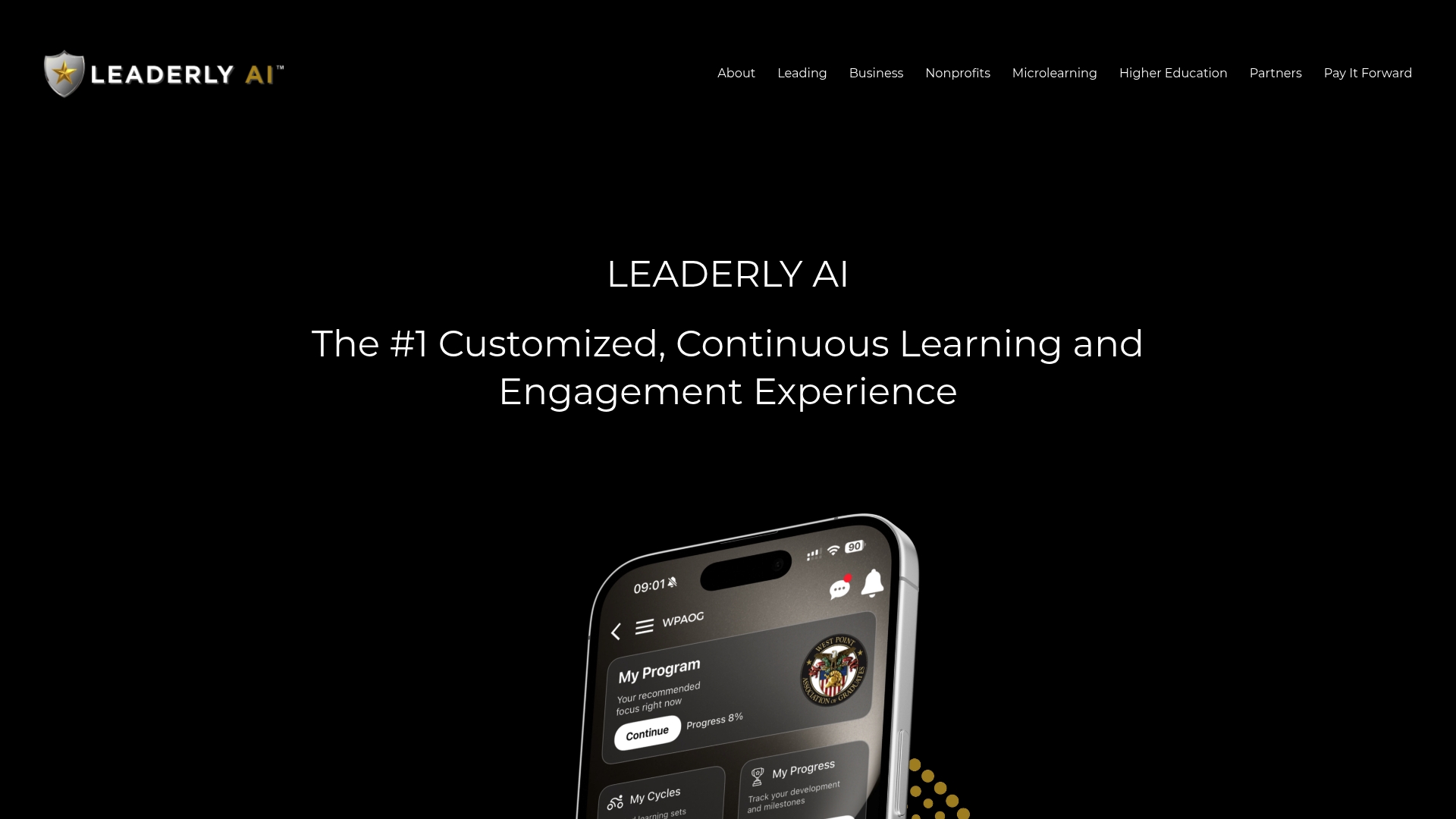
The platform delivers personalized microlessons tied to real leadership challenges, behavioral habit-building exercises grounded in behavioral science, and coaching nudges that arrive at the moment of relevance, not six weeks later. Its analytics dashboard tracks behavioral indicators at the individual and team level, so you always know whether application is happening, not just whether content was consumed. Simulations, self-assessments (DiSC, EQ, MBTI), and spaced practice prompts map directly to the five-phase framework: microlessons support the "During" phase, coaching nudges sustain the "After" phase, and the analytics give you the measurement baseline the framework requires.
For organizations ready to move from one-off workshops to a continuous development culture, explore Leaderlyapp's leadership development approach or review the internal leader cultivation playbook to see how a pilot could work for your team.
Sources
- Maximizing the Impact and ROI of Leadership Development: A Theory- and Evidence-Informed Framework - PMC
- The Syllabus and the Scar Tissue: What Leadership Preparation Programs Leave Out and Why It Matters - Faculty Focus
- Why Leaders Need “Power Skills” - HBR
- Transformational leadership - ESADE
- Authentic leadership, sustainable employee well-being and retention: a multi-method study | BMC Psychology