
Project-based learning (PBL) builds leaders by forcing practice under pressure, accountability for real outcomes, and repeated reflection cycles that convert knowledge into executable behavior. The fastest path to validating this for your organization: run a focused 60–90 day pilot pairing a live cross-functional project with AI-personalized microlearning nudges from Leaderlyapp.
Research from Welingkar confirms that PBL bridges classroom frameworks and organizational realities by requiring leaders to make decisions on real stakes. VIPR's multi-semester findings show leadership gains compound over time. And a meta-analysis in Frontiers in Psychology found PBL produces a positive effect on learning outcomes compared to traditional instruction. The mechanism is not mysterious. It is structural.
Table of Contents
- Why project-based learning builds leaders: the four core mechanisms
- Which project format develops which leadership skills?
- How do you design a PBL leadership program that actually scales?
- What should you measure, and when will you see results?
- How does AI-powered microlearning amplify PBL outcomes?
- Common implementation challenges and how to avoid them
- A 60–90 day pilot playbook you can run right now
- Key Takeaways
- The case for betting on projects, not programs
- Leaderlyapp makes PBL-style leadership development scalable
Why project-based learning builds leaders: the four core mechanisms
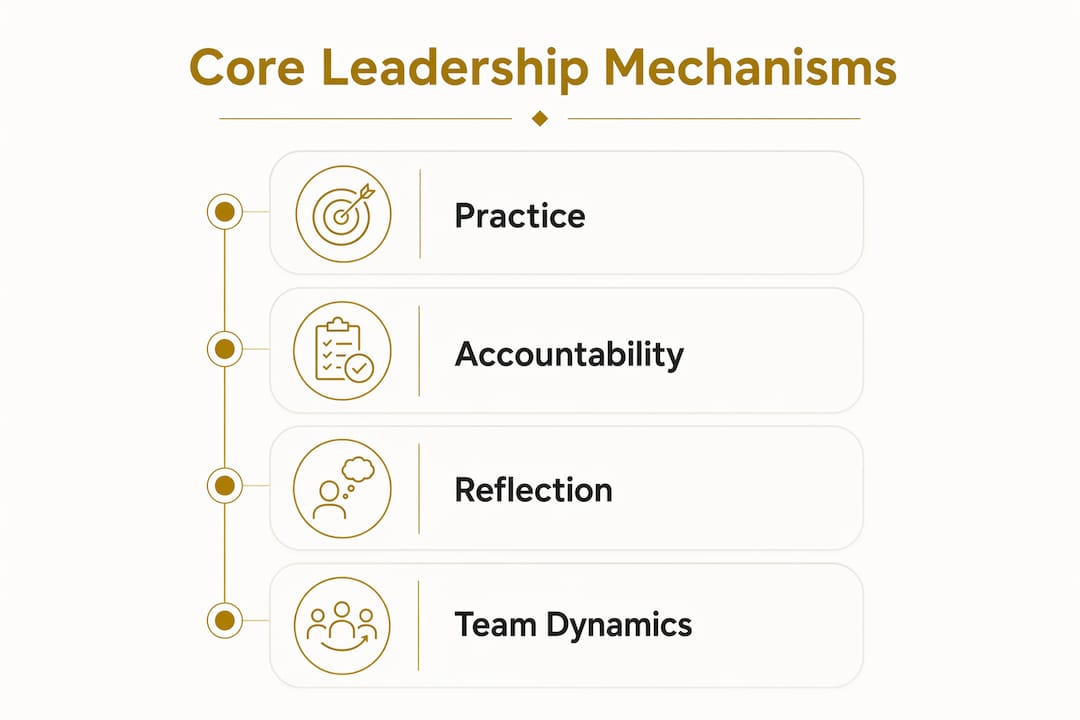
Four mechanisms drive leadership development in PBL, and each one is replicable by design.
Practice under pressure forces decisions on real outcomes rather than hypothetical cases. When a team must deliver a working solution to a real stakeholder, the cognitive load mirrors real-world leadership challenges. There is no answer key.
Accountability for outcomes is what separates PBL from case studies. Presenting results to stakeholders mimics boardroom accountability and builds resilience and decision-making confidence. Ownership follows consequence.

Reflective feedback cycles are where practice becomes durable behavior. Without structured reflection, experience is just activity. Edutopia's synthesis of PBL research shows that the learner-centered shift from passive consumption to active problem-solving depends on this loop.
Social influence and team dynamics round out the picture. A peer-reviewed study found group-based projects significantly outperform individual ones for developing leadership behaviors like motivation and communication. Leading peers you do not manage is exactly the challenge most mid-career professionals face.
Pro Tip: Structure reflection in three beats: immediately after a key project milestone, 48 hours later in writing, and once more at project close. Leaderlyapp's reflective learning modules are built around this cadence, so the habit forms without extra facilitation overhead.
Which project format develops which leadership skills?
Not all PBL formats produce the same leadership profile. Choosing the right format for the competency you want to grow is the first design decision.
MDPI research comparing project sponsorship types found a clear split: industry-sponsored projects drive professional execution skills, while faculty- or internally sponsored projects better develop teamwork and communication.
- Industry-sponsored projects: stakeholder management, client communication, punctuality, professional execution
- Internal stretch assignments: cross-functional collaboration, influence without authority, organizational navigation
- Cross-functional sprints: rapid decision-making, conflict resolution, adaptive communication
- Capstone projects: strategic thinking, synthesis across disciplines, public presentation under scrutiny
| Project Format | Primary Leadership Skills Developed |
|---|---|
| Industry-sponsored | Stakeholder management, professional execution |
| Internal stretch assignment | Influence, organizational navigation |
| Cross-functional sprint | Decision speed, conflict resolution |
| Capstone | Strategic thinking, public accountability |
A mid-career manager running a cross-functional sprint to redesign an onboarding process will build influence skills faster than any workshop. A new analyst on an industry-sponsored project learns client communication by doing it, not by reading about it. Match the format to the gap.
How do you design a PBL leadership program that actually scales?
Scale requires repeatable governance, clear sponsor selection, trained facilitators, and integration with existing workflows. Without those four, PBL stays a one-off experiment.
The essential roles are: an executive sponsor who owns the business problem and signals organizational commitment; a project steward who manages scope and connects participants to resources; a coach or facilitator who runs structured check-ins and reflection cycles; and peer reviewers who provide formative feedback at defined milestones. Formative assessment and iterative feedback are not optional add-ons; they are the mechanism by which learning transfers.
Project selection criteria matter as much as role design. Good pilot projects are scoped to 60–90 days, tied to a real business outcome, and require participants to lead people they do not directly manage. Linking project completion to performance reviews closes the accountability loop and signals to participants that this is real work, not a training exercise. For a practical overview of leadership development program formats and how they map to organizational outcomes, that resource is worth reviewing before finalizing your design.
Pro Tip: Build a one-page project brief template that specifies the business problem, success metric, stakeholder audience, and reflection cadence before any project launches. Consistency in setup is what makes PBL repeatable at scale.
What should you measure, and when will you see results?
Track behavioral indicators, performance KPIs, and engagement metrics across four defined milestones: project kickoff, mid-review (day 30–45), project close, and a 6–12 month follow-up.
VIPR's multi-semester research is clear on timing: leadership gains are more measurable in the second and third cycles of sustained engagement, not the first. Plan for that. A single 90-day project will show early behavioral signals; compounding gains require repeated cycles.
| Metric | Measurement Method | Cadence |
|---|---|---|
| Influence without authority | 360 peer feedback | Mid-review and project close |
| Decision speed | Manager observation log | Weekly during project |
| Conflict resolution frequency | Facilitator notes | Bi-weekly |
| Engagement with reflection prompts | Platform analytics | Continuous |
| Performance KPI movement | HR system data | 6 and 12 months post-project |
Key timing signal: Expect early behavioral shifts (communication, initiative) within the first project cycle. Measurable performance KPI movement typically appears in the second cycle and beyond, consistent with VIPR's multi-semester findings.
How does AI-powered microlearning amplify PBL outcomes?
Leaderlyapp accelerates leadership skill transfer by delivering just-in-time microlessons, personalized reflection prompts, and coaching nudges tied to live project events. The gap between a project experience and a lasting leadership habit is usually a reflection deficit. AI fills it at scale.
Specific capabilities that matter for PBL programs:
- Skill-mapped microlessons delivered at project milestones, matched to the competency the participant is actively practicing
- Adaptive reflection prompts that adjust based on prior responses, so the questions stay challenging rather than formulaic
- Peer-feedback orchestration that structures and schedules feedback exchanges without requiring facilitator coordination
- Project analytics that surface engagement patterns and flag participants who are disengaging before a facilitator would notice
Consider a cross-functional sprint where a team is redesigning a customer escalation process. Pairing that sprint with Leaderlyapp nudges at each milestone, such as a two-minute microlesson on conflict de-escalation before the mid-review, produces measurably different behavior than the project alone. The microlesson primes the skill; the project provides the practice rep; the reflection prompt locks in the learning.
Pro Tip: Embed one microlesson and one reflection prompt at each of the three main project milestones (kickoff, mid-review, close). Participants who engage with adult learning strategies tied to live work retain skills at a significantly higher rate than those who complete training separately.
Common implementation challenges and how to avoid them
Five challenges consistently degrade leadership outcomes in PBL programs, and each has a direct mitigation.
Scope creep kills learning depth. Fix it with a structured project brief that locks scope at kickoff and requires sponsor sign-off to change it.
Dominant team members crowd out leadership development for quieter participants. Rotate the formal leadership role at each project phase so every participant leads at least one milestone.
Assessment gaps leave behavioral change unmeasured. Build a rubric before the project starts that evaluates execution outcomes, not just deliverable quality.
Social dynamic breakdowns are the primary risk in group projects, per research on team-based PBL. Assign a facilitator with explicit authority to intervene, and schedule a structured team health check at day 30.
Facilitator overload happens when coaches carry too many projects. Cap each facilitator at three concurrent projects and use platform analytics to triage where attention is needed.
Pro Tip: At the day-30 mid-review, watch for two red flags: a team that has not had a single documented conflict (likely avoiding hard decisions) and a team where one person is presenting every update. Both signal a leadership development failure in progress. Coaching through leadership challenges at that moment is far more effective than waiting for the final review.
A 60–90 day pilot playbook you can run right now
A focused pilot with a single measurable leadership outcome, clear sponsors, and integrated microlearning can validate PBL in one quarter.
Days 0–30: Setup and kickoff. Select one department, one business problem, and one target leadership competency. Assign an executive sponsor and a facilitator. Brief participants using a one-page project brief. Activate Leaderlyapp for the cohort and schedule milestone nudges. Establish baseline behavioral data through a short 360 survey.
Days 30–60: Execution and mid-review. Run the structured mid-review with peer feedback and a facilitator-led reflection session. Check scope against the original brief. Deliver the mid-point microlesson sequence. Flag any team dynamic concerns and intervene early.
Days 60–90: Final review and measurement. Participants present deliverables to the executive sponsor and at least one external stakeholder. Collect post-project 360 data and compare to baseline. Document behavioral shifts observed by the facilitator. Make the go/no-go decision on a second project cycle based on the data.
Pro Tip: Keep the pilot cohort to 8–15 participants. Small enough to manage closely, large enough to generate meaningful behavioral data. For guidance on reducing the leadership skills gap at the organizational level, that resource maps well to what you will learn from your pilot results.
Key Takeaways
Project-based learning builds leaders by combining practice under pressure, stakeholder accountability, and structured reflection cycles that convert project experience into durable leadership behavior.
| Point | Details |
|---|---|
| Four core mechanisms | Practice, accountability, reflection, and team dynamics are the causal drivers of leadership growth in PBL. |
| Match format to competency | Industry-sponsored projects build execution skills; internal sprints build influence and collaboration. |
| Measure across cycles | Behavioral signals appear in the first project cycle; performance KPI movement typically requires a second or third cycle, per VIPR research. |
| AI amplifies transfer | Leaderlyapp delivers skill-mapped microlessons and reflection prompts at project milestones, accelerating behavior change at scale. |
| Pilot in 60–90 days | One department, one business problem, one measurable leadership outcome, and integrated microlearning is enough to validate the approach. |
The case for betting on projects, not programs
The honest tension in enterprise leadership development is this: most organizations know workshops do not work, but they keep buying them because they are easy to procure and easy to measure on a completion dashboard. PBL is harder to set up and harder to defend in a budget meeting, especially in the first cycle when the gains are still behavioral rather than financial.
What the VIPR research and the Welingkar practitioner evidence both point to is that the discomfort of the first cycle is the mechanism, not a design flaw. Leaders grow when they are responsible for outcomes they cannot fully control. That is not a bug in PBL. It is the whole point.
The pragmatic move is not to replace your existing programs with PBL overnight. It is to run one focused pilot in a low-risk function, pair it with Leaderlyapp's microlearning layer so the behavioral data is trackable, and let the second-cycle results make the case for you. Stakeholders who resist theory tend to respond well to numbers.
Leaderlyapp makes PBL-style leadership development scalable
Most organizations have the project work. What they lack is the infrastructure to turn that work into measurable leadership development. Leaderlyapp closes that gap by wrapping live projects with personalized microlessons, adaptive reflection prompts, manager dashboards, and cohort analytics, so every project becomes a structured leadership experience rather than just a task completed.
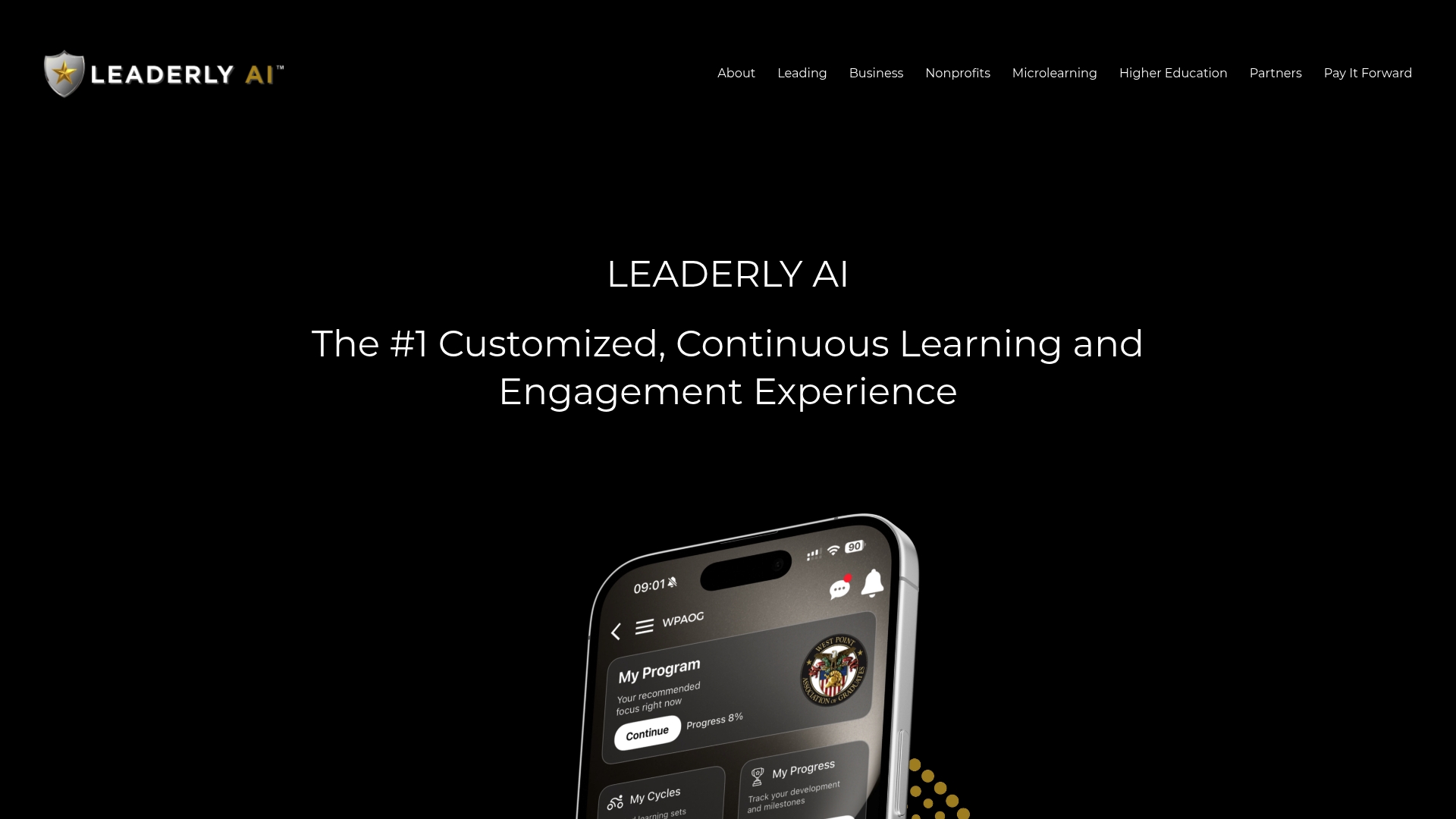
The platform delivers nudges at the exact milestones where behavior change is most likely: project kickoff, mid-review, and close. Manager dashboards surface engagement and behavioral signals in real time, so facilitators know where to focus coaching attention. Cohort analytics let L&D leaders compare leadership growth across teams and build the ROI case for the next cycle.
If you are ready to move from theory to a trackable pilot, start building your leadership pipeline with Leaderlyapp today. The first project cycle is where the evidence starts.