
Leadership development is defined by a fundamental design flaw: organizations spend over $366 billion annually on training yet 75% rate their programs as not very effective. Understanding why leadership training fails at scale starts with one uncomfortable truth: most organizations treat leadership capability as something you install in a workshop, not something you build over time. The Kirkpatrick Four-Level Model, the industry standard for evaluating training effectiveness, measures reaction, learning, behavior, and results. Most programs never get past level one. That gap between investment and impact is not a content problem. It is a systems problem.
Why leadership training fails at scale: the structural causes
The most common reason training fails is that organizations treat it as a one-time event. A two-day offsite, a keynote, a certification. Then everyone returns to their desks, and nothing changes. Leadership capability requires infrastructure, not installation. The workshop initiates a process that the organization never finishes.
Structural misalignment makes this worse. Performance systems often reward short-term individual results while training pushes long-term collaborative coaching. When the incentives contradict the training goals, people revert to old behaviors. The training did not fail because the content was bad. It failed because the organizational system punished the new behavior.
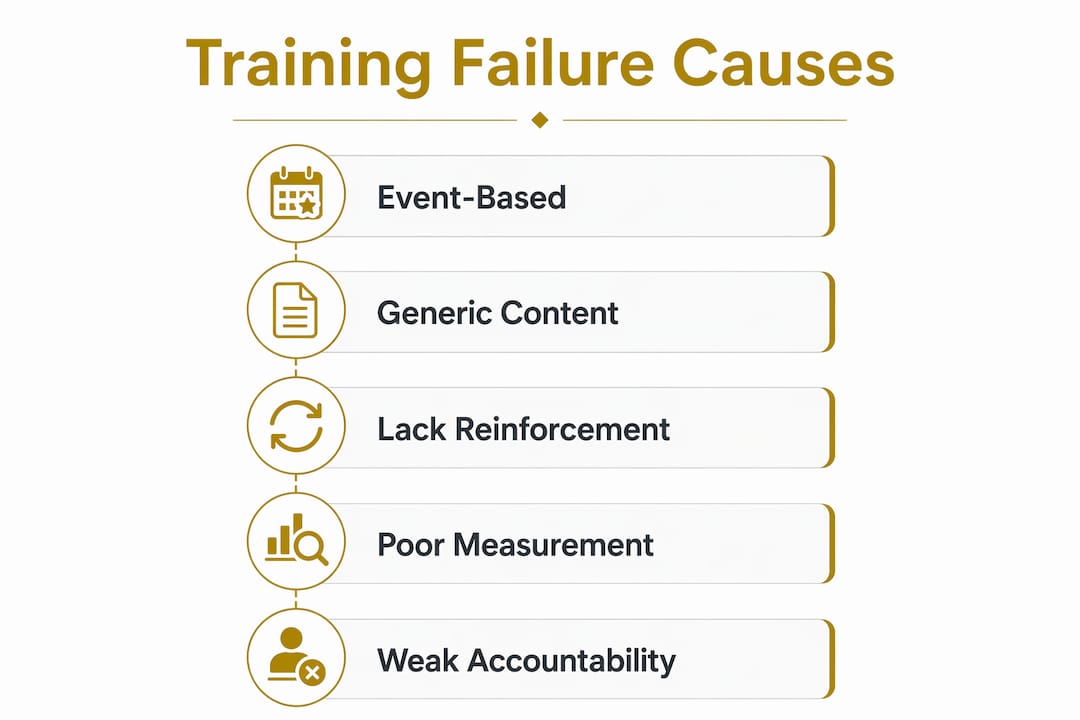
Four structural failure points appear consistently across organizations:
- Event-based design. Training is scheduled, delivered, and closed out. No follow-up infrastructure exists.
- Conflicting incentives. Promotion and bonus criteria reward behaviors that contradict what training teaches.
- Manager disengagement. Managers are rarely briefed before training or held accountable for reinforcing it afterward.
- Poor timing. 82% of new managers receive no formal training before taking their role. Training arrives too late to shape early habits.
That last statistic is striking. New managers form their leadership identity in the first 90 days. Training delivered 12 months later is corrective, not formative. It fights entrenched habits instead of building good ones from the start.
Pro Tip: Before designing any leadership program, map your current performance management criteria. If the incentives contradict the training goals, fix the incentives first. Content cannot overcome a misaligned reward system.

How does generic content undermine leadership program effectiveness?
Generic content is the second major failure point. A program built for "all leaders" serves almost none of them well. A frontline supervisor in a manufacturing plant faces entirely different challenges than a VP of product at a software company. When training ignores that gap, participants disengage and knowledge transfer collapses.
The problem runs deeper than role differences. Participants arrive with wildly different levels of prior experience. A 20-year veteran sitting through a session on "giving feedback" will check out by slide three. A first-time manager in the same room desperately needs that content. One-size-fits-all design creates a room full of people who are either bored or lost, and neither group learns.
Contextualized content fixes this. Organizations that segment training by leadership level, department context, and prior knowledge see measurably better application rates. The scenario used in a training exercise should mirror the actual decisions a participant makes on Tuesday morning. When it does, the learning sticks. When it does not, the participant files it under "interesting but irrelevant."
The workforce efficiency challenges that leaders face daily are specific and operational. Training that addresses those specific challenges, rather than abstract leadership theory, produces behavior change. Abstract theory produces good post-training survey scores and little else.
Why is ongoing reinforcement the most overlooked factor in training failure?
Reinforcement is where most programs completely collapse. Learners forget roughly 50% of new information within 24 hours without reinforcement. Within one week, that number reaches up to 90%. This phenomenon, known as the forgetting curve, is not new. Hermann Ebbinghaus documented it in the 1880s. Organizations have known about it for over a century and still design training as if it does not exist.
The fix is not complicated, but it requires commitment. Assigning a reinforcement owner, such as a direct manager or an external coach, to provide structured feedback over 3–6 months post-training is the single most reliable way to drive behavior change. Without that owner, reinforcement becomes everyone's responsibility and therefore no one's.
Pro Tip: Schedule a 30-minute manager briefing before every training cohort begins. Give managers three specific behaviors to watch for and one question to ask their direct reports in the week after training. That conversation alone doubles application rates.
Contrast the event model with embedded, continuous learning:
- Event model. One workshop. No follow-up. Behavior change rate: minimal.
- Bite-sized daily learning. Short, frequent practice tied to real work decisions. Retention improves significantly.
- Peer accountability groups. Small cohorts that meet biweekly to share application stories and obstacles.
- Manager reinforcement. Managers ask about training application in regular one-on-ones and recognize visible behavior change.
Training embedded in the flow of work with peer accountability and manager reinforcement produces behavior change at 4–5x the rate of event-only programs. That is not a marginal improvement. It is the difference between a program that works and one that does not.
The self-reflection practices that reinforce learning between formal sessions are just as important as the sessions themselves. Leaders who build a habit of reviewing their own decisions and behaviors consolidate new skills far faster than those who only engage during scheduled training.
How do measurement and accountability systems influence training success?
Most organizations measure the wrong things. Completion rates and satisfaction scores are easy to collect and feel like progress. They are not. Real failure shows up in the absence of mechanisms to measure skill application within 30 days post-training. Completion tells you someone attended. It tells you nothing about whether they changed.
Effective measurement requires an operational definition of the leadership behaviors you want to see. "Be a better communicator" is not measurable. "Conduct a structured one-on-one with each direct report every two weeks" is. When you define the behavior specifically, you can observe it, track it, and hold people accountable for it.
The accountability gap is equally damaging. When no one checks whether training translated into behavior, the implicit message is that it does not matter. Leaders read that signal clearly. The four levels of measurement that actually predict program success are:
- Behavior observation. Are managers and peers seeing the trained behaviors in practice?
- 30-day application check. Did participants attempt the new skill within a month of training?
- Business outcome linkage. Can you connect leadership behavior change to team performance metrics?
- Reinforcement completion. Did the assigned reinforcement owner complete their structured feedback sessions?
Visibility matters as much as measurement. When senior leaders publicly recognize behavior change, it signals that the training goals are real organizational priorities. When they do not, even the most motivated participant eventually stops trying.
What practical steps build effective leadership development at scale?
Building a leadership development system that actually works requires a different starting point. Most organizations begin with content. The right starting point is diagnosis. A thorough training needs analysis identifies the specific capability gaps, the organizational conditions that created them, and the structural barriers that will prevent change. Many programs address symptoms rather than root causes. A needs analysis forces you to distinguish between the two.
From that foundation, the practical steps are:
- Segment your audience. Design separate tracks for frontline managers, mid-level leaders, and senior executives. The challenges, vocabulary, and stakes are different at each level.
- Assign reinforcement ownership. Every participant needs a named person responsible for their post-training application. That person needs a structured plan, not a vague expectation.
- Align your incentives. Audit your performance management criteria before launch. Remove any metric that rewards behavior the training is trying to change.
- Embed measurement from day one. Define the observable behaviors before training begins. Build the measurement mechanism into the program design, not as an afterthought.
- Make senior leadership visible. Senior leaders who publicly model the trained behaviors accelerate adoption across the organization. Those who ignore the program quietly kill it.
The internal cultivation of strong leaders depends on treating development as an ongoing organizational system, not a calendar event. Organizations that build that system see compounding returns. Those that run annual workshops see compounding frustration.
Pro Tip: Pilot your program with one team or department before scaling. Use that cohort to test your reinforcement plan, measurement tools, and manager briefing process. Fix the gaps before you roll out to 500 people.
The knowledge retention challenges that affect technical workforces apply equally to leadership development. When organizations fail to build systems that capture and reinforce learning, that knowledge walks out the door with every leader who leaves or disengages.
Key Takeaways
Leadership training fails at scale because organizations design it as an event rather than a system, and the fix requires structural changes to reinforcement, measurement, and incentive alignment.
| Point | Details |
|---|---|
| Event-based design is the root cause | One-off workshops initiate learning but never complete it without follow-up infrastructure. |
| Forgetting curve destroys retention | Up to 90% of new information is lost within a week without active reinforcement. |
| Generic content reduces transfer | Training must be segmented by role, level, and context to drive real behavior change. |
| Measurement must track behavior, not completion | Skill application within 30 days post-training is the true indicator of program success. |
| Incentive alignment is non-negotiable | Performance systems that reward old behaviors will undo even the best training content. |
The uncomfortable truth about leadership training
I have watched organizations spend six figures on leadership programs and walk away with nothing but a binder and a few LinkedIn posts. The content was often excellent. The facilitators were skilled. The problem was always the same: the organization treated the training as the finish line instead of the starting gun.
The real issue is that leadership development gets assigned to HR and then forgotten by everyone else. Senior leaders approve the budget, skip the sessions, and never ask about outcomes. Managers receive no briefing and no accountability. Participants return to a workplace that rewards exactly the behaviors the training was trying to change. Then everyone wonders why nothing shifted.
What actually works is treating leadership development the way you treat any other organizational capability you care about: with dedicated ownership, regular measurement, and visible senior commitment. The mindset, skills, and knowledge required for effective leadership do not emerge from a single event. They accumulate through practice, feedback, and repetition over months. Organizations that accept that reality build leaders. Organizations that resist it keep buying workshops.
The shift from episodic training to leadership infrastructure is not expensive. It is disciplined. It requires someone with authority to say: "We will measure this, we will reinforce it, and we will hold people accountable for it." That decision costs nothing. The absence of it costs everything.
— Drew
How Leaderlyapp addresses the real causes of training failure
The core problem with most leadership programs is that they stop when the workshop ends. Leaderlyapp is built around the opposite principle: leadership development happens in the daily flow of work, not in a conference room once a year.
Leaderlyapp delivers personalized microlessons grounded in behavioral science, so leaders practice real skills in the context of their actual work. The platform uses machine learning to adapt content to each leader's role, experience level, and development stage. That means no generic content and no wasted sessions. Built-in measurement tools track behavior change over time, giving HR professionals the visibility they need to prove program impact. For organizations ready to move from events to infrastructure, continuous leadership development through Leaderlyapp is the practical next step. Explore how people-centric leadership skills translate into measurable team outcomes.
FAQ
Why do most leadership training programs fail?
Most programs fail because they are designed as one-time events without reinforcement, measurement, or alignment with organizational incentives. The forgetting curve eliminates up to 90% of learning within a week when no follow-up system exists.
What is the forgetting curve and why does it matter for training?
The forgetting curve describes the rapid loss of new information over time without reinforcement. Learners forget roughly 50% within 24 hours, making post-training reinforcement the most critical factor in whether behavior actually changes.
How should organizations measure leadership training effectiveness?
Organizations should track observable behavior change within 30 days post-training, not just completion rates or satisfaction scores. The Kirkpatrick Four-Level Model provides a structured framework for measuring reaction, learning, behavior, and business results.
What role do managers play in leadership training success?
Managers are the single most important reinforcement mechanism after training. When managers are briefed before training and held accountable for reinforcing new behaviors, application rates increase significantly. When they are not involved, transfer rates drop sharply.
How can HR professionals build scalable leadership development systems?
Start with a training needs analysis to identify root causes, not just symptoms. Segment content by leadership level, assign named reinforcement owners, align performance incentives with training goals, and embed measurement from the program's first day.