
Auditing leadership programs is the systematic process organizations use to measure, validate, and improve the effectiveness of their leadership development investments. The formal term for this practice is program evaluation, and it sits at the intersection of learning design, behavioral science, and business accountability. Why organizations audit leadership programs comes down to one hard truth: only 25% of organizations rigorously evaluate their leadership initiatives, despite a global spend of $60 billion annually on leadership development. That gap between investment and evidence is exactly where audits earn their place. Without structured evaluation, organizations cannot distinguish programs that change behavior from programs that simply feel good in the moment.
Why organizations audit leadership programs
The core reason is accountability. Leadership development budgets face scrutiny from CFOs and boards who want proof that training dollars produce results. An audit provides that proof. It shifts the conversation from "we ran a program" to "here is what changed and why it matters."
Three specific drivers push organizations toward formal evaluation:
- Budget justification. HR leaders who cannot demonstrate return on investment lose funding. A structured audit creates the evidence trail that secures next year's budget.
- Continuous improvement. Audits reveal which program elements drive behavior change and which ones waste time. That information lets designers fix problems before they compound across cohorts.
- Stakeholder credibility. Leadership development has a credibility problem because training success is often self-reported by the vendors who delivered it. An independent audit replaces self-promotion with verifiable data.
The fourth driver is subtler but equally important. Audits separate programs that produce genuine leadership development impact from those that generate positive feelings without changing how leaders actually behave. Satisfaction surveys measure comfort, not competence. An audit measures both.
Pro Tip: Schedule your audit planning session before the program launches, not after. Defining success criteria at the design stage prevents the common trap of measuring whatever data happens to be available at the end.

How do organizations effectively evaluate leadership programs?
The most widely used framework is the Kirkpatrick Model, which organizes evaluation into four levels: reaction, learning, behavior, and results. Most organizations stop at level one, collecting satisfaction scores at the end of a workshop. That is the wrong place to stop.
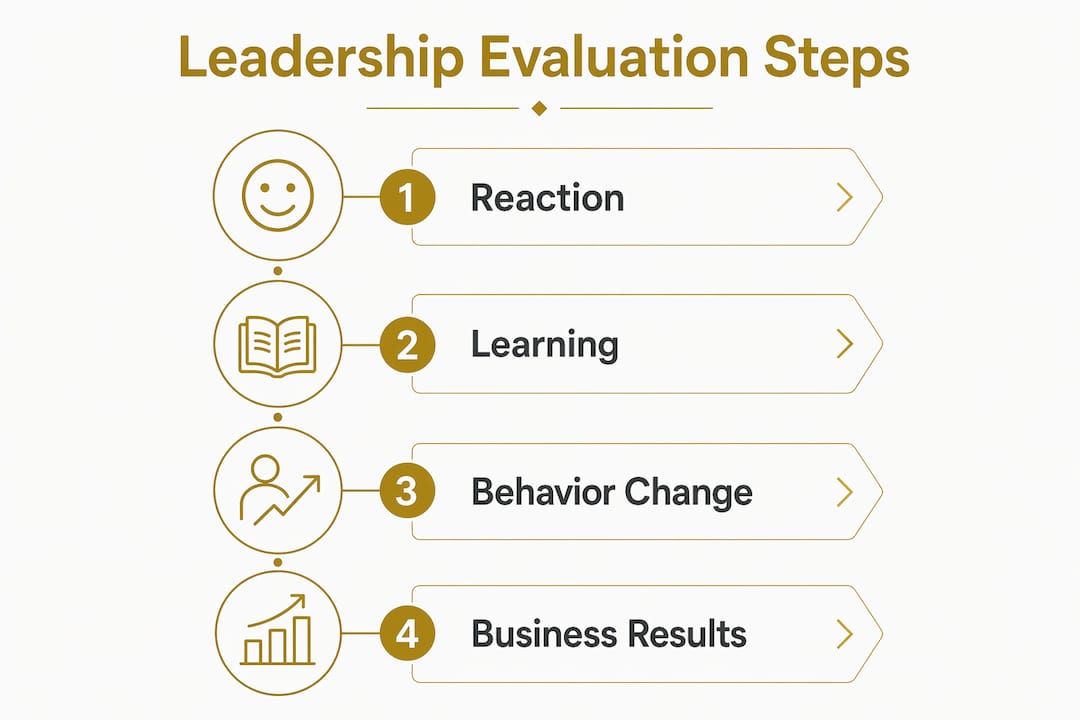
Levels three and four are where real value lives. Level three measures whether participants changed their behavior on the job. Level four measures whether those behavior changes produced business outcomes such as lower turnover, higher team performance, or faster promotion readiness. 80% of HR leaders consider behavior change the critical measure of program success, yet only 18% feel confident they can track it. That confidence gap exists because most organizations lack the measurement infrastructure to capture behavioral data after training ends.
Timing and methods that produce reliable data
Behavior change takes time to appear. Organizations should measure behavior change through 360-degree assessments or manager evaluations conducted 3–6 months after training, not immediately after the final session. Immediate post-training scores reflect enthusiasm, not lasting change.
Pre- and post-program assessments are the backbone of any credible evaluation. Programs with structured baseline assessments produce significantly more durable behavior change and stronger ROI than those measured only at the end. Without a baseline, there is no way to prove the program caused any improvement at all.
Multi-source feedback mechanisms, including peer ratings, direct report surveys, and manager observations, produce richer data than any single assessment. Combining these sources with business metrics such as retention rates and promotion velocity gives HR professionals the full picture they need to report with confidence.
Pro Tip: Link every evaluation metric to a specific business objective before the program begins. "Participants will improve their coaching conversation scores by X points, reducing voluntary turnover in their teams" is a testable claim. "Participants will become better leaders" is not.
What common pitfalls undermine leadership program audits?
Most audit failures trace back to four predictable mistakes. Recognizing them early saves organizations from wasting both time and money.
-
Treating evaluation as optional. Many organizations design a program first and ask "how will we measure this?" only after delivery. By then, baseline data is gone and the evaluation becomes guesswork. Embedding assessment checkpoints into the design phase, before participant enrollment, is the only way to capture the data that makes an audit credible.
-
Over-relying on expensive external vendors. High production value does not equal high impact. Meta-analyses show no correlation between vendor production quality and leadership training effectiveness. Programs that follow the 70-20-10 learning model, where 70% of development comes from on-the-job experience, 20% from coaching and feedback, and 10% from formal instruction, consistently outperform those built around polished classroom delivery alone.
-
Using training to fix structural problems. Leadership program audits often reveal that training is being applied to problems that training cannot solve. Poor organizational design, weak selection processes, and unclear role accountabilities are structural issues. Sending managers to a leadership workshop does not fix a broken org chart. Audits help HR leaders diagnose whether the root cause is a development gap or a design gap.
-
Ignoring reinforcement after the program ends. A two-day workshop with no follow-up produces a two-day behavior change. The 70-20-10 model exists precisely because formal learning alone rarely sticks. Programs overly dependent on formal instruction consistently fail audits because they cannot demonstrate sustained behavior change months later.
How can organizations implement audits that drive real improvement?
A well-run audit process follows a clear sequence. Each step builds on the last, and skipping any one of them weakens the final findings.
- Set clear objectives before the program starts. Define what success looks like in behavioral and business terms. Identify which metrics will prove the program worked and who will collect them.
- Capture baseline data at enrollment. Use 360-degree assessments, self-assessments, or manager ratings to establish a starting point. This data becomes the comparison point for every subsequent measurement.
- Integrate checkpoints during the program. Mid-program pulse surveys and skill demonstrations catch problems early enough to fix them. They also generate data that shows learning progression, not just final outcomes.
- Conduct follow-up assessments at 3–6 months. Behavior change that appears at this stage is far more meaningful than scores collected the day training ends. This is the data that answers the question executives actually care about.
- Communicate findings to stakeholders in business language. Audit reports that lead with retention rates, promotion readiness, and team performance metrics land better with senior leaders than reports that lead with participant satisfaction scores. Aligning audit findings with measurable organizational pain points builds credibility with skeptical executives.
Leaderlyapp supports this process by embedding personalized assessments and behavioral tracking directly into the learning experience. HR professionals can use the platform's data to generate the pre- and post-program comparisons that make audits credible. Internationally, data-driven approaches to leadership evaluation are gaining traction across education and enterprise settings alike, reinforcing that measurement is not optional. It is the standard.
Key Takeaways
Organizations that audit leadership programs convert development spending from an act of faith into a measurable, defensible business investment that improves both leader behavior and organizational outcomes.
| Point | Details |
|---|---|
| Audits justify investment | Only 25% of organizations rigorously evaluate programs despite $60 billion in annual global spend. |
| Behavior change is the target metric | Measure 360-degree feedback 3–6 months post-training, not immediately after the final session. |
| Baselines are non-negotiable | Programs without pre-program assessments cannot prove they caused any improvement. |
| Structural problems need structural fixes | Audits reveal when training is being misapplied to organizational design or selection failures. |
| Findings must speak business language | Reporting retention rates and promotion velocity builds executive credibility far better than satisfaction scores. |
What rigorous audits actually change
Most organizations treat leadership evaluation as a reporting exercise. The ones that get it right treat it as a diagnostic tool. That distinction matters more than any framework or methodology.
I have seen HR teams spend months designing a leadership program and then scramble to find any data that makes it look successful after the fact. The scramble is always a symptom of the same problem: evaluation was never part of the design. The result is a report full of smile-sheet scores and anecdotal quotes that convince no one in the finance meeting.
The organizations that build genuine evaluation cultures do something different. They ask hard questions before the program launches. What specific behavior do we expect to change? How will we know it changed? What business outcome will that behavior change produce? Those questions feel uncomfortable early in the design process, and that discomfort is exactly the point. It forces clarity that makes the program better and the audit credible.
The other thing I have learned is that audits often deliver their most valuable insight by revealing what training cannot fix. When a leadership program fails to move the needle on team performance, the honest audit does not blame the facilitator or the content. It asks whether the real problem is a selection issue, a role clarity issue, or a culture issue. That kind of diagnosis is worth far more than a polished post-program report. It tells the organization where to actually invest next. Understanding how leadership affects employee performance at the systemic level is what separates HR functions that earn a seat at the table from those that simply report to it.
— Drew
Leaderlyapp and the audit-ready leadership program
HR professionals who want to move beyond satisfaction surveys need a platform built for continuous measurement, not just content delivery.

Leaderlyapp embeds personalized microlessons, behavioral assessments, and progress tracking into a single experience that generates the pre- and post-program data audits require. The platform uses machine learning to adapt content to each leader's development stage, which means the data it produces reflects real behavioral progression rather than course completion rates. HR teams can use Leaderlyapp's assessment outputs to report directly to senior stakeholders in the business language that secures funding. For organizations ready to make leadership development a measurable investment, Leaderlyapp's platform provides the infrastructure to do it at any scale.
FAQ
Why do organizations audit leadership programs?
Organizations audit leadership programs to prove that development investments produce measurable behavior change and business results. Without audits, there is no way to distinguish effective programs from expensive ones that simply feel good.
What is the Kirkpatrick Model in leadership evaluation?
The Kirkpatrick Model is a four-level framework that measures reaction, learning, behavior change, and business results. Most organizations stop at level one; levels three and four provide the data that actually justifies investment.
When should organizations measure behavior change after training?
Behavior change should be measured 3–6 months after training using 360-degree assessments or manager evaluations. Scores collected immediately after a program reflect enthusiasm, not lasting behavioral shifts.
What is the 70-20-10 model and why does it matter for audits?
The 70-20-10 model holds that 70% of development comes from on-the-job experience, 20% from coaching, and 10% from formal learning. Programs that ignore this ratio often fail audits because they cannot demonstrate sustained behavior change beyond the classroom.
How do leadership program audits improve employee engagement?
Audits identify which program elements build real leadership capability, and stronger leaders consistently produce higher team engagement and lower voluntary turnover. The audit creates a feedback loop that makes each program iteration more effective than the last.