
Coaching students through leadership challenges is defined as the active facilitation of self-directed leadership growth across emotional intelligence, ethical decision-making, and teamwork. This is not mentorship by accident. Mentorship quality predicts leadership competency with a standardized coefficient of β = 0.642 (p < 0.001) in a study of 224 undergraduates. That number means the single biggest variable in whether a student develops real leadership capability is the quality of the adult guiding them. Educators and coaches who understand this carry a measurable responsibility, and this guide gives you the frameworks, steps, and pitfalls you need to act on it.
How to coach students through leadership challenges: the essential tools
Effective coaching starts before the first conversation. Coaches need a working toolkit, and the most effective tools fall into three categories: structured reflection methods, powerful questioning techniques, and trust-building strategies.
Structured reflection methods give students a repeatable process for examining their own decisions. Journaling prompts, after-action reviews, and guided debriefs all qualify. The goal is not to produce a written record. The goal is to build the habit of pausing before acting.

Powerful questioning techniques shift ownership from the coach to the student. Questions like "What would you do if I weren't here?" or "What does success look like to you in six months?" force the student to generate the answer. Faculty coaching practices from CTI Leadership show that this shift improves engagement, retention, and critical thinking more reliably than direct instruction.
Trust-building strategies are the foundation everything else rests on. Without psychological safety, students perform for the coach rather than growing for themselves. Consistency, confidentiality, and genuine curiosity from the coach build that safety over time.
Beyond individual tools, tiered leadership development frameworks give programs structure. One approach uses milestone levels at 25, 50, and 75 service hours combined with workshops. Tiered frameworks for student leaders scaled from 28 to 43 students in a pilot phase, showing that gamifying progress keeps students engaged across longer development timelines.
| Framework or tool | Primary benefit |
|---|---|
| Structured reflection journals | Builds self-awareness and accountability |
| Powerful open-ended questioning | Shifts ownership to the student |
| Tiered milestone tracking | Gamifies progress and sustains motivation |
| Peer mentoring pairs | Develops leadership in both mentor and mentee |
| Trust-building protocols | Creates psychological safety for honest growth |
What are the step-by-step strategies for guiding students in challenges?
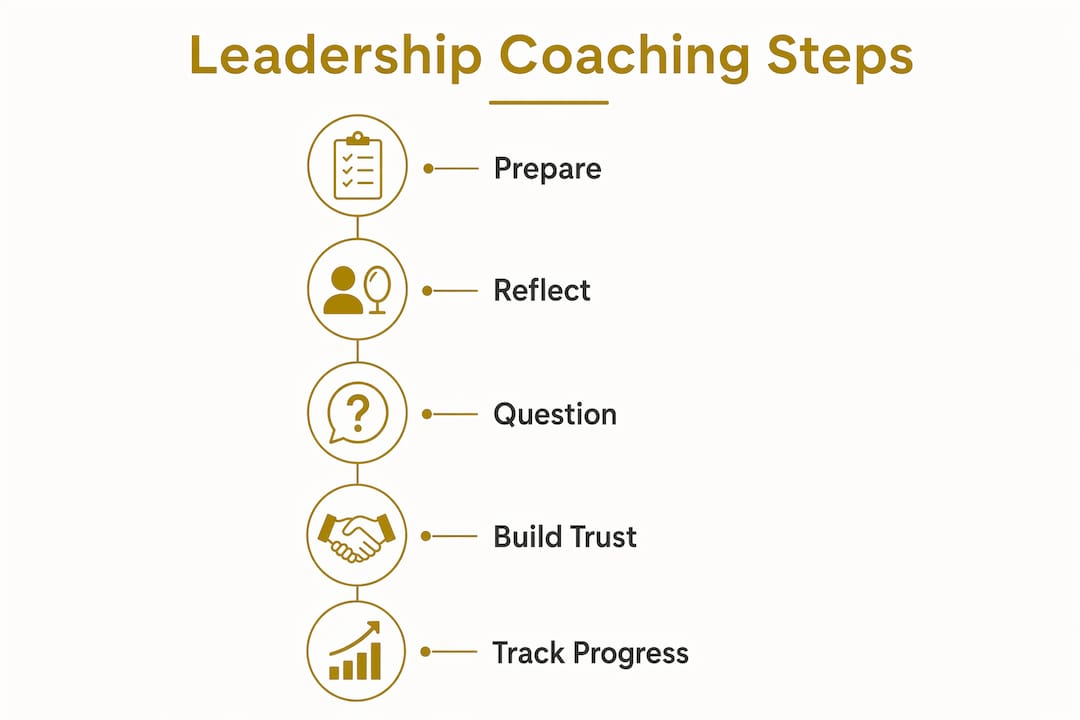
Evidence-based coaching follows a sequence. Skipping steps produces surface-level results. Here is the sequence that works.
-
Establish psychological safety first. A student who fears judgment will not share real struggles. Open with low-stakes conversations, honor confidentiality, and model vulnerability by sharing your own past mistakes.
-
Diagnose before prescribing. Ask the student to describe the challenge in their own words before offering any frame. Listen for what they are not saying as much as what they are.
-
Use open-ended questions to transfer ownership. Coaching that avoids over-advising and instead uses powerful questions builds genuine autonomy and resilience. Replace "Here is what you should do" with "What options have you already considered?"
-
Integrate peer mentoring roles. Peer mentoring programs lasting at least two months produce significant leadership gains in mentors and measurable self-efficacy gains in mentees. Assign students to mentor a peer one level behind them. The act of teaching consolidates their own leadership identity.
-
Build reflection and feedback loops. After every significant leadership moment, run a structured debrief. Ask what worked, what did not, and what the student would change. Pair this with peer evaluations so feedback comes from multiple directions.
-
Reinforce ethical decision-making explicitly. Leadership capability spans ethical decision-making, responsibility, and emotional intelligence beyond holding formal positions. Name ethics directly in coaching conversations rather than assuming students absorb it by osmosis.
Pro Tip: Keep a running log of the questions you ask each student. If you notice you are asking the same question repeatedly, that is a signal the student needs a new challenge, not more of the same prompt.
Developing emotional intelligence in leaders is not a soft skill add-on. It is the mechanism through which all other leadership behaviors become consistent under pressure.
What common obstacles do students face in leadership development?
The four most common obstacles are unclear goals, fear of failure, ethical confusion, and misuse of influence. Each requires a different coaching response.
Unclear goals produce students who work hard in the wrong direction. The fix is not to hand them a goal. Ask them what they care about most and what they want people to say about their leadership in five years. That question surfaces intrinsic motivation, which sustains effort far longer than any externally assigned objective.
Fear of failure is the obstacle coaches underestimate most. A student who avoids risk never builds the resilience that leadership demands. The coaching intervention here is reframing failure as data. When a student's initiative falls flat, the debrief question is "What did you learn that you could not have learned any other way?" That reframe is not cheerleading. It is a factual claim about how competence develops.
Ethical confusion shows up when students face situations where the right choice costs them socially. The Riley Institute frames leadership as purposeful influence with ethical implications, not just a title or a role. Coaches who name this explicitly give students a framework for the moment the pressure arrives.
Misuse of influence is the obstacle nobody wants to talk about. Some students already lead, but they lead through intimidation, exclusion, or social pressure. A strengths-based approach identifies existing influence patterns first, then pivots toward purposeful use rather than imposing a standard model from the outside. That approach works because it meets the student where they actually are.
Pro Tip: When a student comes to you with a problem, resist the urge to solve it in the first five minutes. Wait. Ask two questions before you offer any perspective. The pause alone often produces the student's own solution.
Coaches who want to understand the difference between coaching and leading will find that the boundary matters. Your job is to build the student's capacity, not to lead on their behalf.
How do you measure and track student leadership progress?
Measurement is where most coaching programs fall apart. Coaches collect anecdotes but not evidence, which makes it impossible to know whether the program is working or just comfortable.
Tiered milestone tracking solves this at the program level. Milestone levels at 25, 50, and 75 hours of combined service and workshops create clear checkpoints. Students know exactly where they stand, and coaches can see who is stalling and intervene before momentum is lost.
At the individual level, three complementary tools give the clearest picture.
- Self-assessments capture the student's own perception of growth. Use the same instrument at the start and end of a coaching cycle so change is visible.
- Peer evaluations surface behaviors the student cannot see in themselves. Structure these with specific behavioral anchors, not vague ratings like "good leader."
- Qualitative feedback from coaches documents the reasoning behind observed growth, not just the score. A written note explaining why a student's conflict resolution improved is more useful than a number.
Mentors gain leadership skills through curricular training, reflection, and long-term mentoring relationships. That finding means your measurement system should track mentor development alongside mentee development. Both groups are growing, and both deserve documentation.
A competency-based evaluation system provides the structural backbone for tracking leadership growth through practical service and workshops in educational settings.
| Evaluation tool | Best used for | Limitation |
|---|---|---|
| Self-assessment surveys | Tracking perceived growth over time | Subject to self-reporting bias |
| Peer evaluations | Surfacing blind spots in behavior | Requires structured behavioral anchors |
| Coach qualitative notes | Documenting reasoning behind growth | Time-intensive to maintain consistently |
| Milestone hour tracking | Program-level progress visibility | Does not capture quality of experience |
| Pre/post competency rubrics | Measuring specific skill gains | Requires clear rubric design upfront |
Key Takeaways
Coaching students through leadership challenges requires structured tools, evidence-based questioning, and consistent measurement to produce lasting leadership competency.
| Point | Details |
|---|---|
| Mentorship quality is the top predictor | Mentorship quality at β = 0.642 is the strongest driver of student leadership competency. |
| Questioning beats advising | Open-ended questions transfer ownership to the student and build genuine resilience. |
| Peer mentoring develops both sides | Mentors gain stronger leadership behaviors than mentees in structured two-month programs. |
| Tiered milestones sustain engagement | Milestone levels at 25, 50, and 75 hours gamify progress and keep students on track. |
| Measure behavior, not just effort | Combine self-assessments, peer evaluations, and coach notes for a complete picture. |
What I have learned from watching coaches get this wrong
Most educators who struggle to develop student leaders are not failing because they lack knowledge. They are failing because they cannot stop giving answers. I have watched experienced faculty sit across from a struggling student council president and spend 40 minutes solving every problem the student brought in. The student left nodding. Two weeks later, the same problems were back, slightly reworded.
The coach-as-facilitator model is not a soft alternative to real coaching. It is harder than giving answers. Sitting with a student's discomfort, asking a question instead of offering a solution, and trusting that the student will find their way requires more discipline from the coach than from the student.
The paradox that surprised me most is this: peer mentors develop stronger leadership capabilities than the students they mentor. The act of being responsible for someone else's growth forces a level of self-examination that no workshop replicates. If you want to accelerate a student's leadership development, give them someone to mentor before you think they are ready.
The other thing I would push back on is the obsession with leadership titles. Students who chase positions are often the least prepared for the influence that comes with them. The students worth investing in are the ones already shaping group behavior without any formal authority. Find those students. They are already leading. Your job is to make that influence purposeful.
— Drew
How Leaderlyapp supports student leadership development
Educators and coaches who want to scale what works need tools that keep pace with each student's growth.
Leaderlyapp delivers personalized microlessons built on behavioral science, so students receive targeted development between coaching sessions rather than waiting for the next scheduled meeting. The platform uses machine learning to adapt content as each student progresses, which means a student working through conflict resolution gets different material than one building strategic thinking. Coaches and educators can use Leaderlyapp's leadership resources to reinforce the frameworks covered in this article, track individual progress, and build a culture of continuous growth across an entire cohort. For mentors who want to deepen their own practice alongside their students, the mentor leadership resources on Leaderlyapp offer a direct path forward.
FAQ
What does it mean to coach students through leadership challenges?
Coaching students through leadership challenges means actively facilitating self-directed leadership growth by using structured reflection, powerful questioning, and trust-based relationships rather than delivering direct answers.
How long does a peer mentoring program need to run to show results?
Peer mentoring programs need at least two months to produce significant leadership gains in mentors and measurable self-efficacy improvements in mentees.
What is the most common mistake coaches make with student leaders?
Over-advising is the most common mistake. Coaches who provide answers instead of asking questions reduce student ownership and limit the resilience that real leadership requires.
How do you measure leadership growth in students?
Combine self-assessments, peer evaluations with behavioral anchors, and qualitative coach notes. Tiered milestone tracking at 25, 50, and 75 service hours adds program-level visibility.
Why does mentoring develop leadership skills in the mentor?
Mentors gain leadership capabilities because the responsibility of guiding another person forces self-examination, reflection, and organizational accountability that passive learning cannot replicate.