
Yes, microlearning can build student leadership competencies when each microlesson targets a measurable outcome, includes active practice and reflection, and is assessed against a rubric. The essential ingredients are a single objective per lesson, spaced retrieval, and alignment to a recognized competency framework. The fastest way to test this is a four to six week microlesson series embedded in an existing course or student-organization training cycle.
TL;DR:
- Microlearning for leadership relies on short, targeted lessons that remain focused on a single skill and include active practice, reflection, and assessment.
- Effective microlearning integrates with existing coursework or co-curricular programs, emphasizing embedding rather than adding as an optional layer.
- Research shows it improves soft skills like teamwork and communication, especially when designed with spaced retrieval and alignment to competency frameworks.
- Successful implementation requires clear objectives, ongoing sequencing, offline accessibility, and measurement through rubrics, participation, and self-efficacy reports.
- Pilot programs of four to six weeks with monitored rubric score improvements and retention checks can reliably indicate potential scale-up success.
Table of Contents
- What Leadership Microlearning Looks Like in Practice
- What the Evidence and Standards Say
- Designing Effective Microlearning Modules for Student Leadership
- Integrating Microlearning Into Course and Co-Curricular Pathways
- Measuring Outcomes: Rubrics, Metrics, and Evaluation Timeline
- Common Limitations and Mitigation Strategies
- How Leaderly AI Can Help Implement Leadership Microlearning at Scale
- A Practitioner's Take on Running the First Pilot
- Leaderly AI for Higher Education: How to Get Started
- FAQ
- Sources
What Leadership Microlearning Looks Like in Practice
Microlearning works when it stays small on purpose. A single microlesson targets one skill and usually takes under 15 minutes, and ends with the learner doing something rather than just watching or reading. For student leadership development, that means moving past generic slide decks and into short, structured practice.
A few formats cover most classroom and student-organization needs:
- Short videos a few minutes long that model a leadership behavior, such as redirecting a disagreement in a team meeting.
- Scenario prompts that present a realistic dilemma and ask the student to choose and justify a response.
- Micro-simulations where a student practices a conversation, like delivering critical feedback, in a low-stakes digital or peer setting.
- Reflection journals with a single guided question completed right after practice.
- Micro-project milestones that break a semester-long leadership project into weekly deliverables.
- Peer-feedback tasks where students exchange short written or verbal critiques using a shared rubric.
A workable sequence for teaching feedback skills might run across five microlessons: lesson one defines what effective feedback looks like through a short video; lesson two has students analyze a weak feedback example and identify what is missing; lesson three introduces a simple feedback structure; lesson four has students practice the structure with a partner and record a two-minute exchange; lesson five asks for a written reflection on what changed between their first and second attempt. Each lesson is self-contained but builds on the one before it.
Accessibility matters here as much as content design. Not every student has reliable broadband or a personal device during class hours, so pairing video-based lessons with printable scenario cards, voice-memo reflections instead of written ones, and offline worksheet versions keeps the series usable for a full cohort rather than just the most connected students.

What the Evidence and Standards Say
The research base for microlearning in leadership and soft-skill development has grown quickly, and the findings are consistent enough to guide design decisions rather than just inspire them. A 2025 peer-reviewed study on the impact of microlearning on developing soft skills found measurable gains in teamwork, leadership, communication, and time management among university students across multiple disciplines after structured microlearning interventions.
A 2025 meta-analytic synthesis found that microlearning significantly improves student engagement, retention, and self-efficacy when designs incorporate spaced repetition and active retrieval, supporting cognitive, behavioral, and affective learning outcomes simultaneously. That combination matters for leadership development specifically, because leadership growth depends on more than memorizing concepts: it requires confidence, behavioral change, and the ability to apply a skill under pressure.
Mapping microlearning activities to established frameworks gives program designers a defensible structure rather than an improvised one. The CAS leadership education and development standards identify core domains that programs should assess, including intrapersonal development, interpersonal competence, and practical competence, and require programs to name specific learning outcomes tied to those domains.
A few examples of how microlessons map onto CAS domains:
- Intrapersonal development: a reflection journal prompt asking students to identify a personal bias that affected a recent group decision.
- Interpersonal competence: a scenario prompt requiring students to navigate a conflict between two team members with competing priorities.
- Practical competence: a micro-project milestone where students draft and revise a one-page project charter for a student organization initiative.
Microlearning has real limits worth naming plainly. It reliably supports skill introduction, short-cycle practice, and self-awareness building, but it does not replace the sustained, high-stakes experience that complex leadership tasks require, such as managing a semester-long team project through conflict, setbacks, and changing priorities. Those outcomes still depend on macrolearning experiences like internships, capstone projects, or ongoing committee leadership, with microlearning serving as the scaffolding that prepares students for them.
Designing Effective Microlearning Modules for Student Leadership
A strong microlesson follows a repeatable pattern rather than reinventing the format every time. The structure below works for almost any leadership competency and keeps design time manageable for educators building a series from scratch.
- Name one measurable objective tied to a competency domain. Pick a single CAS or ACPA-NASPA competency rubric behavior, such as "initiates a difficult conversation using a structured opening," rather than a broad goal like "improve communication."
- Build the hook. Open with a short video, a real scenario, or a provocative question that takes no more than two minutes and creates a reason to care about the skill.
- Design the practice. Give students something to do, not just something to read: a short written response, a role-play exchange, a decision point in a branching scenario.
- Add a brief reflection prompt. One question is enough. "What made this harder than you expected?" works better than a five-question reflection form that nobody finishes honestly.
- Schedule retrieval. Bring the same skill back in a different context three to seven days later, since spaced retrieval is what converts short-term practice into retained skill.
- Scaffold toward an applied task. After three or four microlessons on a skill, assign a slightly bigger task that requires combining the skill with something learned earlier, such as leading a short team check-in using the feedback structure from the earlier sequence.
A sample rubric for a feedback-delivery microlesson might score students across three bands. A novice response states an observation without a clear request for change. A proficient response states the observation, explains the impact, and proposes a specific next step. An advanced response does all of that while checking for the other person's perspective before moving to a solution.
Pro Tip: Keep each microlesson's objective visible at the top of the activity. Students engage more honestly with reflection prompts when they know exactly what skill they are supposed to be practicing.
Sequencing matters more than any individual lesson. A series that jumps between unrelated skills week to week rarely builds competence, while one that revisits the same two or three skills with increasing complexity gives students a chance to notice their own growth. Review your plan for how to integrate leadership into an academic program if you are mapping this sequence against an existing syllabus rather than building a standalone module.
Integrating Microlearning Into Course and Co-Curricular Pathways
Microlearning rarely succeeds as a bolt-on extra. It works best when it sits inside something students are already doing, whether that is a credit-bearing course, a student organization's onboarding process, or a co-curricular leadership certificate.
Three integration models cover most institutional contexts:
- Embedded in coursework: a faculty member assigns two microlessons per week as low-stakes homework tied to course content, graded for completion rather than correctness, with a short in-class discussion anchoring the reflection.
- Co-curricular stacking: a student affairs office builds a twelve-week microlesson series that students complete alongside their existing involvement in a club, athletic team, or residence hall leadership role, often culminating in a digital badge or certificate.
- Micro-credentialing: an institution issues stackable micro-credentials for completed microlesson sequences, which students can later bundle toward a formal leadership minor or co-curricular transcript notation.
Each model works better with faculty and student affairs staff sharing ownership rather than one office running the whole thing alone. A faculty sponsor can anchor content to course outcomes, while a student affairs advisor can manage the co-curricular tracking and badge issuance.
Student co-creation improves uptake substantially. When students help write scenario prompts or select video examples, the content reflects situations they actually encounter rather than situations an administrator imagines they encounter. Giving a small group of student leaders editorial input on two or three microlessons per semester, with final review by staff, keeps the content both current and accurate.
Delivery logistics are worth settling early. A learning management system works well when the series ties to a credit-bearing course and needs gradebook integration, while a mobile-first platform works better for co-curricular programs where students need to complete short lessons between classes or during a commute. For practical facilitation ideas that translate well into either setting, our guide on facilitating a leadership skills workshop for students offers templates that adapt easily to a microlearning format. For a broader look at how different program structures compare, our overview of leadership development models for students is a useful reference point when deciding where microlearning fits alongside certificates and co-curricular programs.
Measuring Outcomes: Rubrics, Metrics, and Evaluation Timeline
A microlearning series without measurement is just a content library. Tying each lesson back to a rubric and a small set of metrics lets a program show real evidence of growth rather than relying on attendance numbers alone.
A rubric aligned to a CAS competency domain typically scores students across three to four levels per behavior:
- Novice: identifies the relevant skill or concept but cannot yet apply it without prompting.
- Developing: applies the skill with guidance or in a low-stakes practice setting.
- Proficient: applies the skill independently in a realistic scenario or peer interaction.
- Advanced: applies the skill flexibly across different contexts and can coach a peer through it.
| Metric type | What to track | Collection method |
|---|---|---|
| Participation | Completion rate per microlesson | Platform or LMS analytics |
| Skill growth | Rubric score change from first to last assessment | Pre- / post-scenario response scored by rubric |
| Self-efficacy | Student-reported confidence in the targeted skill | Short survey before and after the series |
| Engagement quality | Depth of reflection responses | Qualitative coding of a sample of journal entries |
| Retention | Performance on a delayed retrieval task | Scenario repeated 3 to 6 weeks after initial lesson |
A pilot evaluation timeline of several weeks is usually enough to see directional signals including microlesson delivery followed by a delayed retrieval check a few weeks later. Signals worth watching for before scaling a pilot include consistent completion rates above the program's own baseline, measurable rubric score improvement between the first and last assessment, and qualitative reflection responses that show students connecting the skill to situations outside the microlesson itself.
Common Limitations and Mitigation Strategies
Microlearning has real failure modes, and naming them up front saves wasted design effort later.
Fragmentation is the most common problem. A series of disconnected five-minute lessons with no shared thread rarely adds up to a competency, and students notice the lack of continuity quickly. The fix is a documented sequence map showing how each lesson builds on the last, reviewed before the series launches rather than assembled lesson by lesson.
Poor transfer to complex tasks is a related risk. Practicing a feedback structure in a two-minute role-play does not guarantee a student can use it during an actual high-stakes team conflict. Microlearning needs a bridge to applied practice, whether that is a supervised leadership role, a capstone project, or a longer simulation. Our comparison of microlearning and macrolearning breaks down which outcomes belong to each format and where the handoff between them should happen.
Inconsistent engagement shows up when microlearning is optional and competes with coursework deadlines. Embedding it into a graded assignment or a required co-curricular milestone, rather than leaving it as an elective add-on, keeps completion rates stable.
Equity and access gaps deserve direct attention. Students without reliable device or broadband access fall behind quickly in a mobile-first program, so offline alternatives and flexible completion windows matter as much as the content itself.
- Pair every microlearning sequence with at least one applied, supervised practice opportunity.
- Build completion into existing grading or co-curricular requirements rather than treating it as optional.
- Offer offline or low-bandwidth versions of every core microlesson.
- Review rubric scores at the midpoint of a series, not just at the end, to catch disengagement early.
Pro Tip: Treat the first pilot cohort's feedback as design data, not just a satisfaction check. Ask specifically what felt disconnected from their actual leadership role, not just whether they liked the format.
How Leaderly AI Can Help Implement Leadership Microlearning at Scale
Once a pilot shows promise, the next challenge is usually capacity: writing, sequencing, and maintaining enough microlessons to cover a full competency framework without burning out a small design team. This is where a platform built specifically for personalized microlearning can take over the heavy lifting.
Our microlessons are built around the same design patterns covered above: a single behavioral objective per lesson, grounded in behavioral science, with content that adapts as each learner progresses rather than staying static across a cohort. Personalization adjusts difficulty and content focus to an individual student's demonstrated strengths and gaps, which matters for a leadership cohort where students arrive with very different baseline skills.
For higher-education deployment, a typical pilot sequence looks like this:
- Define the pilot cohort (a single course section, a student organization, or an incoming leadership-fellows group) and the specific competencies to target.
- Set up the admin dashboard to track completion, engagement patterns, and skill-progress metrics across the cohort.
- Run the pilot for a defined window, then compare dashboard analytics against the rubric-based evidence described in the measurement section above.
- Use the resulting data (participation rates, rubric score changes, and self-reported confidence shifts) to decide whether to expand the program to additional cohorts.
A checklist of evidence worth collecting during any pilot, regardless of platform, includes participation and completion rates by lesson, rubric scores at the start and end of the sequence, and any change in students' self-reported confidence in the targeted skill. That evidence set gives program designers something concrete to bring back to faculty committees or student affairs leadership when deciding whether to scale.
A Practitioner's Take on Running the First Pilot
Start smaller than feels comfortable. One course section or one student organization, one competency, four to six weeks: that is enough to generate real data without overcommitting staff time. Involve a faculty member and a student affairs advisor from day one, since buy-in from both sides prevents the program from stalling when it needs a champion outside your own office.
Measure the three things that actually matter: completion, rubric score change, and whether students can describe a specific moment they used the skill. Skip vanity metrics like total time spent in the platform.
Share results even when they are mixed. A pilot that shows strong completion but weak transfer to real situations is still useful data, and it tells you exactly where the next design iteration needs to focus.
— Drew
Leaderly AI for Higher Education: How to Get Started
If the design work above sounds right but your team does not have the bandwidth to write and maintain a full microlesson library, that is exactly the gap we built Leaderly AI to close. We deliver personalized microlessons grounded in behavioral science, with machine-learning personalization that adjusts to each student's progress, plus analytics dashboards that give program administrators the completion and skill-growth data covered in the measurement section above without building a tracking system from scratch.
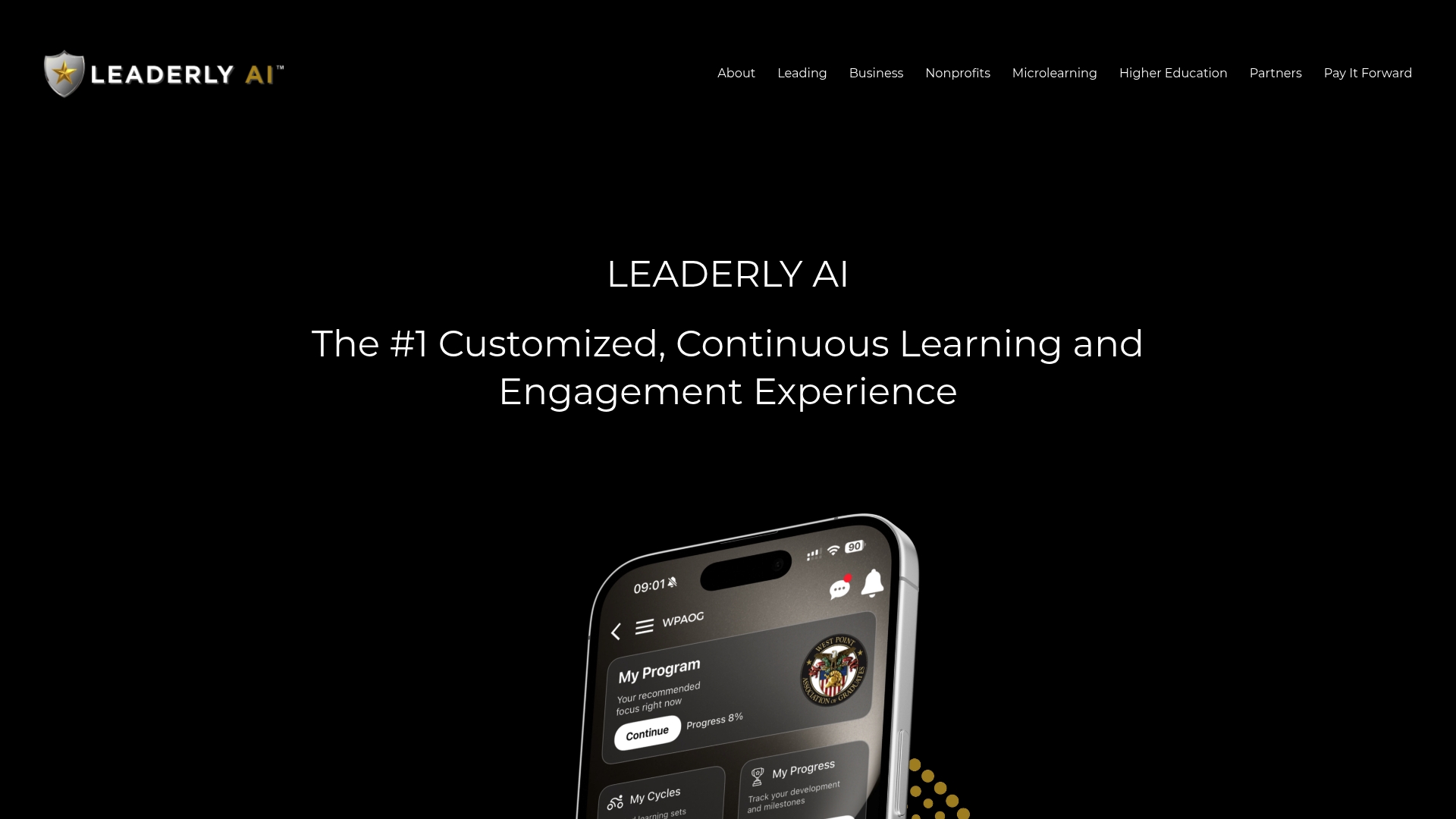
Before reaching out, it helps to have three things ready: the specific competency or competencies you want to target, a pilot cohort size (a single course section or one student organization is plenty to start), and a rubric, even a rough one, you can use to score skill growth before and after the pilot. With those three pieces in hand, a conversation about deployment moves quickly because we can map our existing microlesson library directly to your stated objectives rather than starting from a blank page.
We built Leaderly AI for Higher Education specifically for this kind of deployment, with scalable analytics designed for academic administrators who need to show rubric-based evidence to a department or a dean. If your leadership program sits closer to a nonprofit or student-run organization model, our Leaderly AI for Nonprofits offering follows the same personalization and analytics approach. Visit our main platform page to see the full range of how Leaderly AI supports continuous leadership development, or reach out directly to scope a pilot cohort for your next term.
FAQ
What are the 5 C's of leadership?
Definitions of the "5 C's" vary across leadership programs and are not tied to a single standardized framework, so treat any specific list as one practitioner's model rather than a universal standard. Common versions include traits like character, communication, commitment, competence, and courage, but educators should verify which version their institution or assessment framework uses before building rubrics around it.
What are the downsides of microlearning?
The most common downsides are content fragmentation, weak transfer to complex real-world leadership tasks, and inconsistent engagement when lessons are optional rather than embedded in required coursework. Equity gaps also appear when a program relies solely on mobile delivery without offline or low-bandwidth alternatives for students with limited device or internet access.
What are the 5 qualities of a good student leader?
Qualities most often emphasized across leadership competency frameworks, including the ACPA-NASPA professional competency rubrics, include self-awareness, effective communication, the ability to navigate conflict, accountability, and adaptability under changing circumstances. These map closely to the intrapersonal and interpersonal competence domains that CAS standards ask leadership programs to assess.
What are some examples of microlearning?
Examples include short instructional videos of three to seven minutes, scenario-based decision prompts, brief reflection journal entries, micro-simulations of difficult conversations, and peer-feedback exchanges scored against a shared rubric. A 2025 study on microlearning and soft skills found these formats produced measurable gains in teamwork, leadership, and communication skills among university students.
How long should a leadership microlesson pilot run before evaluating results?
A pilot of four to six weeks of active microlesson delivery, followed by a delayed retrieval check two to three weeks later, is generally enough to see directional evidence of skill growth. This window allows for both immediate rubric-based assessment and a retention check to confirm the skill held beyond the initial practice session.
Sources
The sources below informed the design guidance above and are worth reading directly for anyone building or defending a leadership microlearning program.
- Impact of microlearning on developing soft skills of university students across disciplines — PMC
- Publikasi
- Store