
The most effective way to facilitate a leadership skills workshop for students is a short, scaffolded, experiential session paired with AI-driven microlearning follow-up over an extended period. That combination produces measurable behavior change. A single lecture-heavy event does not.
Before you run anything, confirm these six elements:
- Objectives: two or three specific skills (active listening, delegation, constructive feedback)
- Learner profile: grade level, prior leadership experience, volunteer vs. enrolled student
- Duration: 90–180 minutes for a single session; multi-session for deeper scaffolding
- Core activities: role-plays, peer coaching triads, consensus challenges
- Assessment: pre/post survey plus a behavioral rubric
- Follow-up cadence: AI microlearning nudges at days 1, 3, 14, and 30
Programs like HOBY's State Leadership Seminars and the University of Florida Warrington's Leadership Development Program both treat leadership as a scaffolded journey embedded in ongoing experiences, not a standalone event. Leaderlyapp's AI platform extends that model into daily habit-building at scale.
Table of Contents
- What decisions do you need to make before you facilitate?
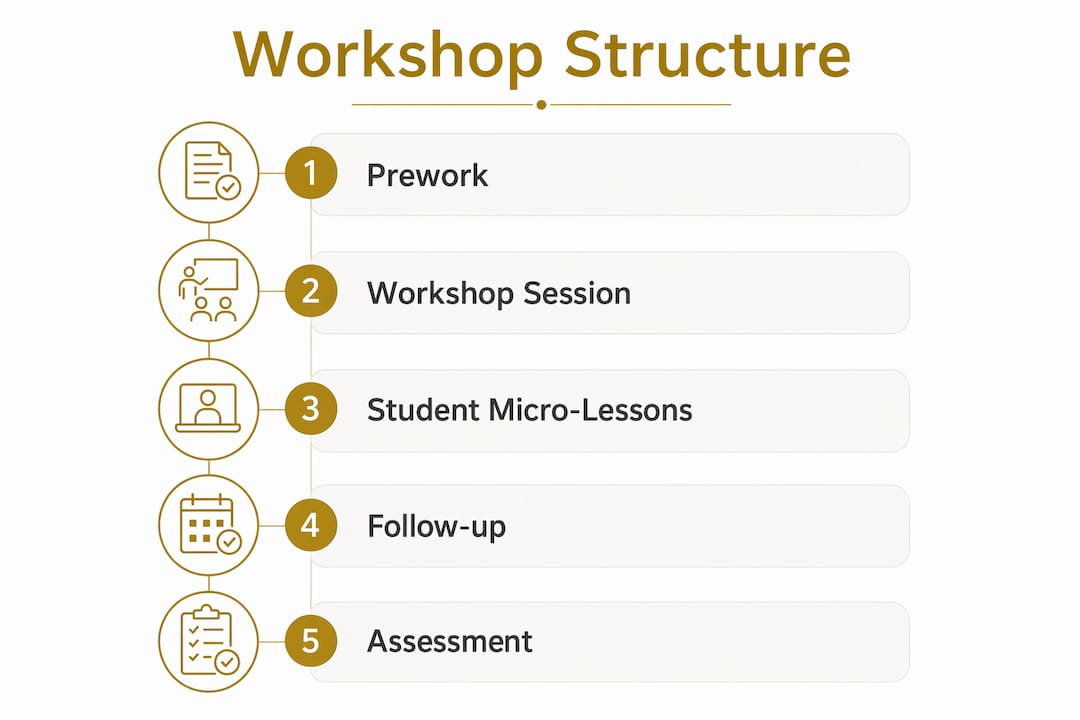
- How should you structure the workshop from prework to follow-up?
- Sample 3-hour agenda and eight ready-to-run activities
- What facilitation techniques make experiential learning actually stick?
- How do you assess impact and prove behavior change?
- How do you scale a workshop using AI-driven microlearning?
- How do you embed leadership training into existing student programs?
- What logistics and safety practices do you need in place?
- Key Takeaways
- Why the one-day workshop model keeps failing students
- Leaderlyapp makes student leadership development scalable
- Useful sources and templates
What decisions do you need to make before you facilitate?
Lock these down before you book the room.
- Skill targets: pick two or three observable competencies. "Leadership" is too broad; "delegates a task with clear success criteria" is assessable.
- Group size: 12–24 learners per facilitator is the practical range for experiential work. Above 30, add a co-facilitator or split into parallel cohorts.
- Format: a single 90–180 minute session works for an introduction; a three-session scaffold over three weeks builds transferable habits.
- Success metrics: decide before day one. Behavioral indicators (peer ratings, facilitator observation notes) outperform satisfaction scores for demonstrating ROI.
- Materials: printed reflection cards, role-play scenario sheets, a shared digital rubric, and a pilot-testing plan. Run the workshop with a small group of 8–12 first, collect rubric and survey data, then iterate before scaling.
Pro Tip: Assign a dedicated note-taker for the pilot session. Their observations on where students stall or disengage are worth more than any post-event survey.
How should you structure the workshop from prework to follow-up?
The three-phase scaffold below is repeatable and assessable.
- Prework (5–10 minutes, assigned 24–48 hours before): a single micro-lesson on the target skill plus a baseline self-assessment. This primes learners and gives you a pre-measure without eating session time.
- In-session (90–180 minutes): warm-up icebreaker, two experiential modules with deliberate practice and rapid reflection, one student-led micro-lesson, and a closing commitment card.
- Postwork (4–12 weeks): AI-personalized microlearning nudges, short reflection prompts, and peer coaching check-ins at weeks 2 and 4.
For a single-session format, compress prework into the first 10 minutes of the room. For a multi-session scaffold, pair each weekly meeting with a real organizational challenge, the way UF Warrington's Leadership-in-Action model does. Simulated leadership labs that pair action with reflection accelerate skill transfer to real settings faster than either element alone.
Pro Tip: Have students plan and deliver one micro-lesson during the session using a fixed template (objective, activity, debrief question). It shifts ownership to them, reduces your facilitation load, and the student-led approach measurably increases engagement.

Sample 3-hour agenda and eight ready-to-run activities
| Time | Activity | Objective | Materials | Success Signal |
|---|---|---|---|---|
| — | Check-in + norm setting | Psychological safety | Whiteboard, markers | Students name one group norm |
| 0:15–0:30 | Prework debrief | Activate prior knowledge | Reflection cards | Each student shares one insight |
| — | Role-play with rotating leaders | Practice delegation | Scenario sheets | Every student takes the lead role once |
| — | Rapid debrief | Consolidate learning | Rubric handout | Students identify one strength, one gap |
| 1:15–1:30 | Problem-solution sprint | Decision-making under pressure | Timer, sticky notes | Team reaches consensus in 20 minutes |
| 1:30–2:00 | Student-led micro-lesson | Peer teaching, ownership | Lesson template | Facilitator rates delivery on rubric |
| — | Peer coaching triads | Constructive feedback | Coaching prompt cards | Each triad completes one feedback cycle |
| 2:30–2:40 | Decision-by-consensus challenge | Group leadership | Scenario card | Group documents their decision rationale |
| 2:40–3:00 | Commitment card + close | Goal setting | Index cards | Every student writes one specific commitment |
Eight activities to pull from: rotating-leader role-play, problem-solution sprint, peer coaching triads, decision-by-consensus challenge, rapid debrief circles, values-card sort, communication relay, and a public speaking presence drill for students who need to build confidence before leading a group.
What facilitation techniques make experiential learning actually stick?
The core principle: facilitator as consultant, not lecturer. McGill University's leadership program documents that over-relying on lecture reduces skill uptake, while facilitator-as-consultant models improve both engagement and retention.
Do:
- Use small breakout groups (3–4 students) for practice rounds before full-group debrief
- Model the skill you are teaching in real time (meta-facilitation)
- Rotate roles so every student leads at least once
- Give immediate, specific feedback tied to rubric anchors
- Use reflection rubrics after every activity, not just at the end
Don't:
- Rescue a struggling team before they have had two minutes to work through it
- Run debriefs longer than the activity itself
- Skip the student-led micro-lesson slot to save time
Meta-facilitation, where the facilitator models facilitation behaviors live, teaches more than any explanation because students observe norms and micro-skills in context. Train your facilitators to coach student leaders using fixed lesson-plan templates for consistent, assessable delivery. The Leaderlyapp blog has practical coaching strategies and facilitator prompts built specifically for this.
How do you assess impact and prove behavior change?
Use a three-layer measurement approach: self-report, peer rating, and facilitator observation. Triangulating all three gives you reasonable confidence even with small cohorts of 15–25 students.
Rubric template (three competency levels):
| Competency | Developing | Proficient | Advanced |
|---|---|---|---|
| Active listening | Interrupts; minimal eye contact | Paraphrases accurately; asks one clarifying question | Synthesizes multiple viewpoints; redirects group productively |
| Delegation | Assigns tasks without context | Assigns with clear success criteria | Monitors progress and adjusts support without micromanaging |
| Constructive feedback | Vague or personal | Specific and behavior-focused | Specific, timely, and includes a forward-looking suggestion |
Pre/post survey items (map directly to the rubric):
- "I can clearly explain what success looks like when I delegate a task." (1–5 scale)
- "I give feedback that focuses on behavior, not personality." (1–5 scale)
- "I listen to understand before I respond." (1–5 scale)
Measurement timeline:
- Immediate: reaction survey at session close (5 items, 3 minutes)
- 4–6 weeks: behavioral check using the same rubric, rated by a peer and self
- 3 months: facilitator observation or manager/advisor rating on one real-world task
How do you scale a workshop using AI-driven microlearning?
A single workshop without follow-up produces a short-lived behavior spike. The fix is a structured nudge sequence tied to each student's in-session commitment.
- Day 1: a 3–5 minute micro-lesson on the skill they committed to, delivered via mobile
- Day 3: a reflection prompt ("What did you try? What happened?")
- Week 2: a practice assignment tied to a real task or meeting they are already attending
- Week 4: a peer check-in prompt and a self-rating on the rubric
Leaderlyapp's AI-driven platform handles this sequence automatically. It delivers personalized micro-lessons, tracks completion and self-assessment scores, surfaces analytics dashboards for program managers, and manages cohort progression. The adaptive recommendation engine adjusts content based on each learner's response patterns, so a student who struggles with delegation gets a different nudge sequence than one who needs work on feedback.
Pro Tip: Pilot with 20–30 learners before rolling out to a full cohort. Collect completion rates and rubric scores at week 4. That data is what gets budget approval for the next cohort.
On data privacy: use a platform that stores learner data in compliance with FERPA (for enrolled students) and your organization's data governance policy. Leaderlyapp's platform is built for organizational deployment with role-based access controls.
How do you embed leadership training into existing student programs?
The lowest-friction integration points are the ones already on the calendar.
- Advisory periods: schedule one student-led micro-lesson per week during an existing advisory block
- Club officer training: run the 90-minute workshop at the start of each academic term as officer onboarding
- Course project alignment: tie the delegation and feedback rubric to a project that already requires teamwork
- Co-curricular transcripts: credit micro-lesson completion toward program recognition, the way McGill's Student Experience Record does for its leadership workshops
To secure educator buy-in, pilot with one class or one club, track the rubric scores, and share a one-page impact report. Measurable outcomes convert skeptics faster than any pitch deck. The types of leadership development available for students range from single-session workshops to semester-long cohort programs, so you can match the format to what the institution already supports.
What logistics and safety practices do you need in place?
- Group size: 12–24 per facilitator; add a co-facilitator above 20
- Room setup: clusters of 4–5 chairs, no rows; tables optional but moveable
- Materials: printed scenario cards, rubric handouts, index cards, markers, a timer
- Time buffers: build 10 minutes of buffer per hour for transitions and extended debriefs
- Psychological safety norms: set three group agreements at the start (e.g., "speak from your own experience," "critique ideas not people," "opt out of any role-play without explanation")
- Opt-out protocol: any student can step back from a sensitive scenario and observe instead; no explanation required
- Escalation path: facilitator knows who to contact if a student discloses distress during a reflection exercise
On cost: a basic session runs on printed materials and a facilitator's time. If you add student leader stipends for those who plan and deliver micro-lessons, budget $25–$50 per student leader per session. Scaling to multiple cohorts with an AI platform replaces per-session facilitation costs with a subscription, which typically reduces per-learner cost as cohort size grows.
Key Takeaways
A scaffolded, experiential workshop paired with AI microlearning follow-up is the most reliable path to measurable, sustained leadership growth in students.
| Point | Details |
|---|---|
| Lock in objectives first | Pick two or three observable competencies before designing any activity or survey. |
| Use the three-phase scaffold | Prework, in-session experiential modules, and 4–12 weeks of postwork nudges produce lasting behavior change. |
| Measure with three data sources | Triangulate self-report, peer rating, and facilitator observation for credible results even with small cohorts. |
| Student-led micro-lessons scale delivery | Assigning students to plan and teach one activity reduces facilitator load and increases ownership. |
| Leaderlyapp extends the workshop | The platform automates nudge sequences, tracks rubric scores, and manages cohort analytics for scalable programs. |
Why the one-day workshop model keeps failing students
The conventional wisdom in student leadership development is that a well-designed single event is enough. Run a great workshop, send students home inspired, and trust that the energy carries forward. It rarely does, and the reason is mechanical, not motivational.
Behavior change requires repeated retrieval and application in context. A student who practices delegation once in a role-play and then returns to a school environment where no one follows up on that practice will revert within two weeks. The skill never gets consolidated. What looks like a motivation problem is actually a design problem.
The scaffolded model works because it treats the workshop as the starting line, not the finish line. The in-session experience creates the initial encoding. The day-1 micro-lesson triggers the first retrieval. The week-2 peer check-in forces application in a real context. By week 4, the behavior has been practiced enough times in enough contexts that it starts to feel automatic. That is the mechanism, and it is why programs that embed leadership into ongoing activities consistently outperform those that run disconnected single events.
The other thing most programs underestimate is the value of student-led delivery. When a student plans and teaches a micro-lesson, they are not just reinforcing their own learning. They are signaling to peers that leadership is something their cohort does, not something an outside expert performs at them. That shift in group identity is harder to measure than a rubric score, but it is what makes the culture stick.
Leaderlyapp makes student leadership development scalable
Running a great workshop once is a start. Running it consistently across 10 cohorts, tracking who is growing and who needs a different nudge, and doing it without hiring a full facilitation team is where most programs stall.
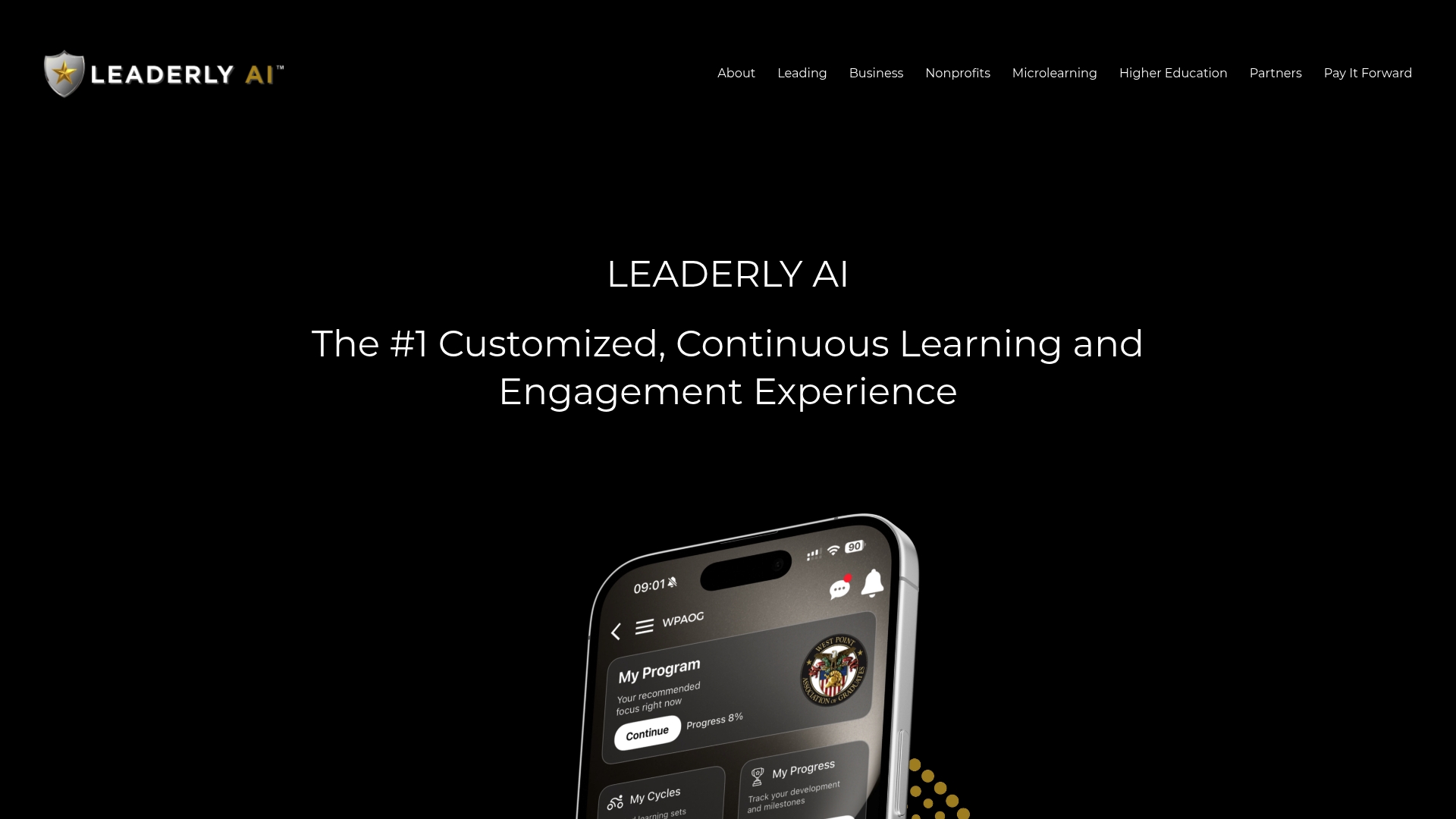
Leaderlyapp's AI platform is built for exactly that gap. Program managers can author micro-lessons tied to their workshop competencies, set automated nudge sequences for each learner, and monitor cohort progress through analytics dashboards, all from a mobile-first interface students actually use. The platform's adaptive engine adjusts content to each learner's pace, so a volunteer coordinator managing 200 students gets the same personalization quality as a one-on-one coach.
A practical pilot design: 50 learners, one target competency, six weeks of nudges, and rubric scores at weeks 1 and 4. That is enough data to build a business case for a full rollout. Start with people-centric leadership development on Leaderlyapp and see what sustained practice actually looks like at scale.
Useful sources and templates
- HOBY State Leadership Seminars — facilitated dialogue and abilities-based workshop model for high school students
- UF Warrington Leadership Development Program — scaffolded, project-based model with weekly team meetings
- McGill University Student Leader Program — student-facilitated workshops with co-curricular recognition
- Learning for Life Leadership Development Guidebook — full lesson plans, sample schedules, and session templates for high school groups
- Student-Led Leadership Skills Project Kit — editable lesson handouts, reflection rubrics, and planning sheets
- Leaderlyapp coaching strategies — facilitator prompts and step-by-step program design guidance
- Leaderlyapp leadership development resources — learning modules and frameworks for workshop follow-up and assessment
Templates to build or download:
- Facilitator prompt sheet (one page per activity: objective, setup, debrief questions)
- Student micro-lesson template (objective, 5-minute activity, one reflection question)
- Reflection exit ticket (three items: what I practiced, what I noticed, what I will do next)
- Rubric CSV with three competencies and three performance levels (downloadable from Leaderlyapp's resource hub)