
The most direct path to integrate leadership curriculum into an academic program is this: adopt a shared capability framework, map three to five core competencies to your program learning outcomes (PLOs), and embed those competencies across required courses using problem-based learning and experiential components, tailoring the competency selection and integration model to your program's context as detailed in the 'How do you integrate leadership curriculum into an academic program?' section below. That sequence works whether you are redesigning a single graduate concentration or rolling out leadership expectations across an entire college.
Before you spend a semester in committee, lock in three things:
- Adopt a capability framework. Choose 3–5 competencies (communication, systems thinking, ethical decision-making, teamwork, adaptive capacity) are a defensible starting set and write each as a measurable PLO.
- Pilot one PBL module. Embed it in a required course this term. Collect rubric scores, host feedback, and student self-assessments as your baseline evidence.
- Define evidence thresholds. Decide in advance what "transfer" looks like: a rubric score at the "proficient" level or above, a positive employer rating on a practicum evaluation form, or a portfolio artifact that maps to a stated PLO.
Success looks like measurable gains on authentic rubrics, positive workplace or host feedback, and curricular alignment that satisfies your relevant accreditor. For public health programs, that means CEPH competency alignment; for business programs, AACSB assurance of learning standards. Leaderlyapp can support the microlearning and assessment collection layers once the framework is in place.
Key Takeaways
Integrating leadership into an academic program requires a shared competency framework, mapped PLOs, experiential components with authentic assessment, and governance structures that embed leadership into institutional systems, not just syllabi.
| Point | Details |
|---|---|
| Choose the right model | The hybrid model (foundations course + infused content + experiential) balances reach and assessment rigor for most institutions. |
| Map 3–5 competencies to PLOs | Write PLOs as behavioral statements and align them to accreditor language before designing any course content. |
| Build in feedback and spacing | Meta-analysis found meaningful transfer improvements driven by needs analysis, feedback, practice, and spaced delivery, not content volume. |
| Use direct and indirect evidence | Combine rubric scores and employer ratings (Kirkpatrick Levels 2–3) with self-assessments and alumni surveys (Levels 1–4) for defensible program review data. |
| Leaderlyapp for pilot operations | Leaderlyapp provides microlearning, self-assessments, and analytics that map to PLOs and reduce the data-collection burden for curriculum teams. |
Table of Contents
- How do you integrate leadership curriculum into an academic program?
- What leadership competencies should you map to program learning outcomes?
- What design strategies work best for embedding leadership learning?
- How do experiential and co-curricular components strengthen leadership programs?
- What does a defensible leadership assessment strategy look like?
- What does a realistic implementation roadmap look like?
- Sample course modules and sequences you can adapt
- How do you make leadership curriculum culturally responsive?
- What does the research say about when leadership development actually transfers?
- What actually works, and what usually goes wrong
- Leaderlyapp supports your leadership curriculum pilot
- Sources
How do you integrate leadership curriculum into an academic program?
Four models dominate the field, and each fits a different institutional profile. Choosing the wrong one at the start is the single most common reason integration stalls after the pilot.
| Model | What it looks like | Best fit | Tradeoffs |
|---|---|---|---|
| Stand-alone major or certificate | A dedicated leadership degree or credit-bearing certificate with its own courses | Institutions with faculty capacity and student demand for a credential | Deep competency development; limited reach (only enrolled students) |
| Infused across general education | Leadership competencies embedded as learning outcomes in existing required courses | Institutions wanting exposure for every student | Broad reach; requires faculty buy-in and calibration across departments |
| Co-curricular pathway | Leadership learning happens through student organizations, service learning, and internships, tracked via portfolio | Institutions with strong student affairs infrastructure | Low credit-hour cost; harder to assess rigorously or satisfy accreditors |
| Hybrid | A foundations course plus infused content plus experiential components | Most postsecondary institutions; the model used by Cleveland State's Transformative Leadership Pathway and the ERIC Learning Leadership program | Balances reach and depth; requires coordination across academic affairs and student affairs |
The hybrid model is where most institutions land, and for good reason. Cleveland State embedded leadership into its Core Curriculum through core competencies and a Transformative Leadership Pathway, giving every student at least one structured leadership touchpoint while offering deeper engagement for those who want it. The ERIC Learning Leadership program uses the same logic: a Foundations of Leadership course anchors the sequence, then leadership content is infused across subjects, with internships and service learning completing the arc.
For a pilot, start with the infused model in one required course. It costs the least, produces evidence quickly, and gives you data to justify a broader hybrid rollout.
Pro Tip: Before choosing a model, map it to your institution's strategic plan and talent pipeline commitments. If your accreditor requires demonstrated competency attainment across the cohort, the co-curricular-only model will not give you the assessment evidence you need. The hybrid model is almost always the safer long-term bet.
What leadership competencies should you map to program learning outcomes?
Start with three to five competencies, not ten or more. Programs that try to assess too many leadership outcomes typically produce thin evidence across the board. Three to five competencies done well beats a larger set done poorly.
A defensible starting set: communication, systems thinking, ethical decision-making, teamwork, and adaptive capacity. These appear consistently across accreditor frameworks and translate into observable behaviors that faculty can actually assess.
The mapping process has four steps:
- Competency to PLO. Write the PLO as a behavioral statement: "Students will demonstrate ethical decision-making by analyzing stakeholder trade-offs in a real-world case and defending a course of action using a named ethical framework."
- PLO to assessment evidence. Identify what artifact proves the outcome: a written case analysis, a rubric-scored presentation, a supervisor evaluation form.
- Assessment evidence to accreditation language. Translate the PLO into your accreditor's vocabulary. For CEPH-accredited programs, the UNC Gillings PBL-based MPH leadership curriculum maps leadership competencies directly to CEPH foundational competencies, which gives you a template for phrasing.
- Accreditation language to program review. Drop the mapped PLO into your program review matrix with the assessment method and the evidence threshold.
A compact mapping template looks like this:
| Competency | Observable behavior | Assessment method | Rubric level for "proficient" |
|---|---|---|---|
| Communication | Presents a stakeholder analysis clearly and adapts message to audience | Oral presentation + peer rubric | 3 of 4 on clarity, structure, and audience awareness |
| Ethical decision-making | Applies a named framework to a real case and defends a position | Written case analysis | Identifies trade-offs and cites framework accurately |
| Systems thinking | Maps interdependencies in a complex problem | Concept map + reflection | Identifies at least three feedback loops |
Pro Tip: Write PLOs in action-verb language that mirrors your accreditor's own competency descriptors. Accreditors are not looking for creativity in outcome language; they are looking for alignment. Borrow their verbs.
What design strategies work best for embedding leadership learning?
Outcomes first, then modalities. Decide what students need to be able to do before you pick a delivery format. That sounds obvious, but most curriculum redesign projects start with "we'll add a leadership module" and work backward, which is why so many modules feel bolted on.
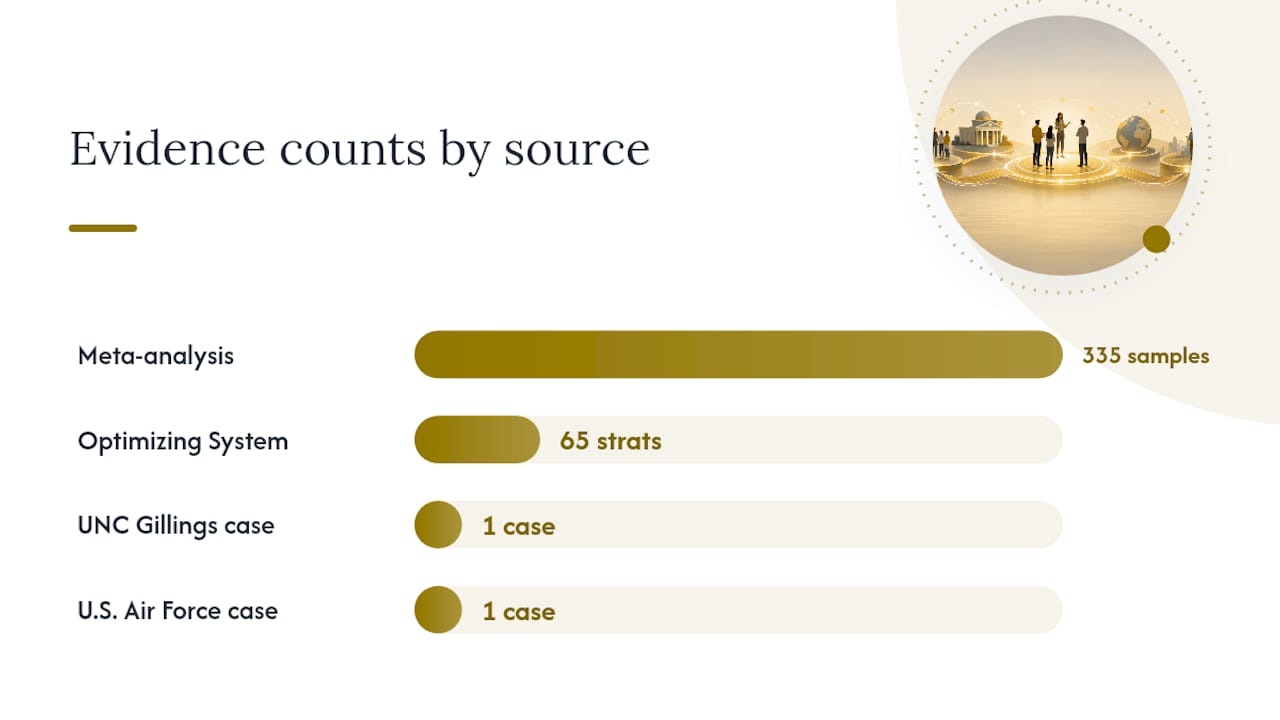
The meta-analysis of 335 independent samples on leadership training design found effect sizes showing meaningful improvement for reactions, learning, transfer, and results. The moderators that drove those numbers: needs analysis conducted before design, feedback built into the learning sequence, deliberate practice opportunities, and spaced sessions rather than one-time workshops. Those findings translate directly into curriculum design decisions.
Implementation steps for a course or sequence redesign:
- Conduct a needs analysis with faculty, students, and employer partners to identify the competency gaps that matter most.
- Scaffold skill progression across the course: introduce the concept in week 1–2, practice it in a low-stakes activity by week 4, apply it in a graded task by week 8, and reflect on transfer by week 12.
- Build in feedback loops at each stage: peer feedback, instructor rubric scores, and self-assessment against the PLO.
- Space leadership practice across multiple sessions rather than concentrating it in one unit.
- Calibrate faculty on rubric standards before the semester starts, not after the first round of grading.
For modality choices, project-based learning builds leadership skills at scale because it requires students to practice communication, decision-making, and teamwork in context, not in isolation. Microlearning paired with coached reflection works well for graduate and working-adult cohorts who cannot commit to long synchronous sessions. Simulations are high-value for ethical decision-making and systems thinking, where the cost of a real mistake is too high for a classroom setting.
A sample 6-week module outline:
- Week 1: Introduce the competency framework; students complete a self-assessment baseline.
- Week 2: Case study analysis in small groups; instructor models the rubric.
- Week 3: PBL problem launch; teams define the problem and map stakeholders.
- Week 4: Mid-project peer feedback using a structured protocol; instructor coaches on gaps.
- Week 5: Teams present interim findings; written reflection on adaptive capacity.
- Week 6: Final deliverable submitted; rubric-scored by instructor and one peer; self-assessment compared to baseline.
How do experiential and co-curricular components strengthen leadership programs?
Classroom learning alone rarely produces transfer. The Yale SOM EMBA model pairs classroom theory with practicums and workshops that advance in step with academic content, which is the structural principle worth borrowing: every experiential component should map back to a stated PLO, not float as a separate enrichment activity.
For internships and practicums, three design elements determine whether the experience produces usable assessment evidence:
- A learning agreement that names the specific competencies the student will practice, the tasks that will demonstrate them, and the feedback mechanism the host supervisor will use.
- A supervisor rubric aligned to the same behavioral anchors used in the classroom, so scores are comparable.
- A structured reflection submitted by the student after the placement, linking observed behaviors to the PLO and identifying gaps.
Peer learning structures reinforce what students practice in placements. Cohort debrief sessions, peer coaching pairs, and structured after-action reviews give students language for what they experienced and help faculty identify where the curriculum needs adjustment.
For community partnerships, keep the agreement simple: one page, naming the learning objectives, the supervisor's role, the feedback timeline, and how assessment data will be stored for program review. Complicated partnership agreements slow down employer participation. The goal is a durable relationship, not a legal document.
Sample learning agreement language: "During this 120-hour practicum, [Student Name] will practice the following competencies: [list 2–3 from the PLO map]. The host supervisor will complete a mid-placement and final rubric evaluation using the attached form. The student will submit a 500-word reflection within one week of placement completion."
What does a defensible leadership assessment strategy look like?
Assessment is where most leadership programs lose credibility with accreditors and curriculum committees. The problem is usually one of two things: rubrics that describe behaviors too vaguely to score reliably, or a data collection plan that produces evidence for one cohort but not the next.
A well-designed rubric for a teamwork or leadership task has three features: behavioral anchors at each level (not just adjectives like "excellent" or "developing"), multi-level criteria that distinguish between novice and proficient performance on a specific observable behavior, and inter-rater reliability built in through faculty calibration.
A compact sample rubric for a teamwork/leadership task:
| Criterion | Beginning (1) | Developing (2) | Proficient (3) | Exemplary (4) |
|---|---|---|---|---|
| Communication | Shares information only when prompted | Shares relevant information but does not adapt to audience | Communicates clearly and adjusts message for different stakeholders | Facilitates group communication and models active listening |
| Decision-making | Defers all decisions to others | Participates in decisions but does not apply a framework | Applies a named framework and defends a position | Synthesizes multiple frameworks and anticipates consequences |
| Adaptive capacity | Resists change when plans shift | Acknowledges change but struggles to adjust | Adjusts approach when new information emerges | Leads the group through ambiguity and reframes the problem |
For evidence collection, combine direct and indirect sources. Direct evidence: capstone projects, employer rubric ratings, e-portfolio artifacts. Indirect evidence: student self-assessments, alumni surveys, graduate exit interviews. Map each to a Kirkpatrick level: self-assessments and reactions surveys sit at Level 1; rubric-scored learning tasks at Level 2; supervisor ratings and practicum evaluations at Level 3 (transfer); employer outcome data and alumni career tracking at Level 4.
A simple data-collection plan for a curriculum committee report:
| Evidence type | Source | Kirkpatrick level | Collection point | Responsible party |
|---|---|---|---|---|
| Rubric scores | Capstone project | Level 2 | End of term | Course instructor |
| Supervisor ratings | Practicum evaluation form | Level 3 | End of placement | Practicum coordinator |
| Self-assessment | Pre/post survey | Level 1–2 | Week 1 and Week 12 | Assessment officer |
| Alumni outcome data | Annual alumni survey | Level 4 | 12 months post-graduation | Program director |
What does a realistic implementation roadmap look like?
Three phases, each with a clear go/no-go decision point.
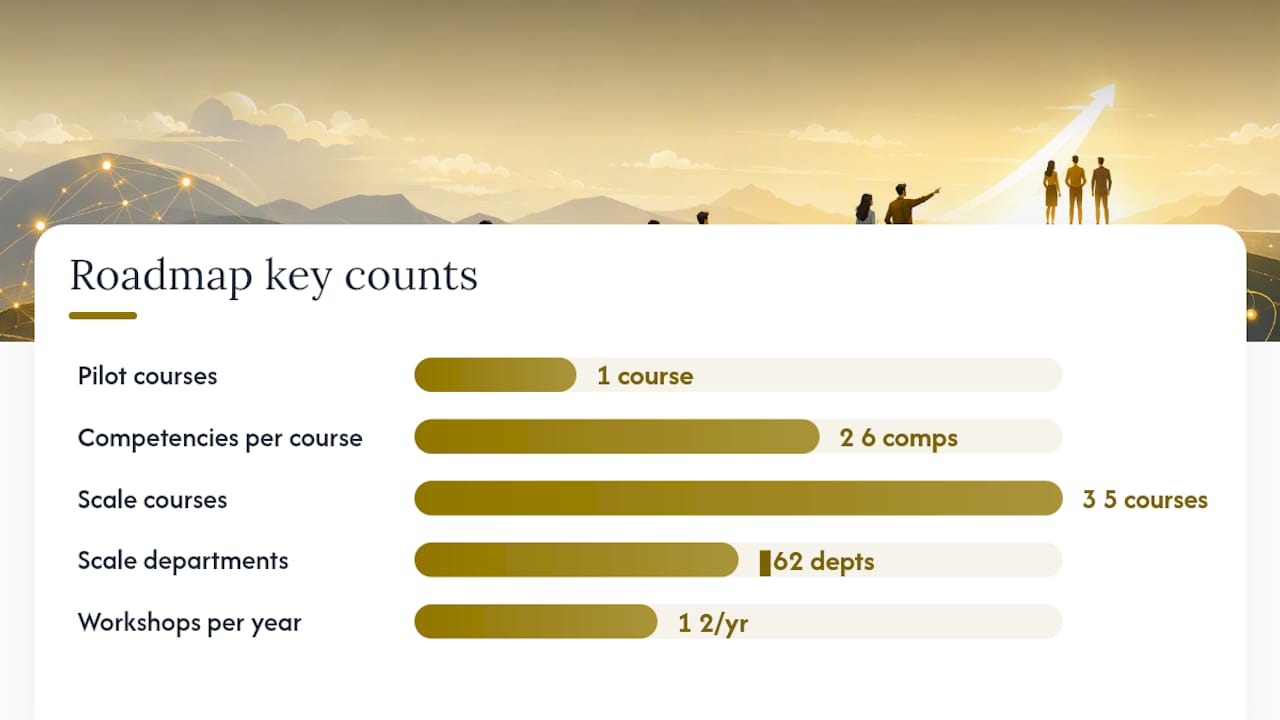
Phase 1: Pilot (one academic cycle)
- Form a curriculum task force: curriculum lead, two to three faculty, student affairs liaison, one employer partner, and an assessment officer.
- Select one required course for the pilot; embed two to three PLO-mapped leadership competencies.
- Train faculty on the rubric and the feedback protocol before the semester starts.
- Collect baseline data: rubric scores, student self-assessments, and one employer feedback form.
- Hold a mid-semester review to catch implementation problems early.
- At cycle end, present evidence to the curriculum committee: rubric score distributions, faculty reflections, and student feedback.
Phase 2: Scale (two to three cycles)
- Expand to three to five courses across at least two departments.
- Add co-curricular pathways: internships, service learning, student organization leadership roles.
- Develop a faculty peer-coaching structure so experienced faculty mentor those new to leadership pedagogy.
- Integrate assessment data into the program review cycle.
Phase 3: Institutionalize (policy and promotion criteria)
- Embed leadership competency expectations into faculty job descriptions and annual review criteria.
- Anchor leadership outcomes in the program's accreditation self-study.
- Allocate a recurring budget line for faculty development, partner stipends, and assessment systems.
The U.S. Air Force Academy's systems-based integration model shows what happens when boundary-spanning relationships across academic, mission, and co-curricular units are maintained persistently: leadership expectations become part of the institutional fabric rather than a departmental initiative that fades when the champion leaves.
Stakeholder roles matter as much as the timeline. The curriculum lead owns the framework and the evidence; department chairs own faculty buy-in; the student affairs liaison owns co-curricular alignment; the assessment officer owns data integrity; employer partners own practicum feedback. When those roles are fuzzy, the pilot stalls in Phase 2.
Budget line items to plan for: faculty course-redesign stipends (typically $1,000–$3,000 per course in small-grant programs), assessment platform costs, partner coordinator time, and one to two faculty development workshops per year. Improvement science practices applied to curriculum change, specifically networked, iterative redesign rather than one-off reforms, reduce the resource cost of Phase 2 significantly because teams learn from each other's pilots rather than starting from scratch.
Pro Tip: Protect faculty bandwidth explicitly. The single most common reason Phase 2 stalls is that faculty absorb the redesign work on top of existing loads with no compensation or time relief. A small course-redesign grant and a one-course release for the curriculum lead signal institutional seriousness.
Sample course modules and sequences you can adapt
Two ready-to-use templates, drawn from the program design principles in this guide.
6-week PBL leadership module (for a required course)
Module premise: Students work in teams to address a real organizational or community problem, applying leadership competencies at each stage. The problem is provided by a community or employer partner; the solution is presented to that partner at the end of week 6.
- Week 1: Problem framing. Teams receive the brief, map stakeholders, and identify the leadership competencies they will need. Individual baseline self-assessment submitted.
- Week 2: Research and systems mapping. Teams identify root causes and feedback loops. Instructor facilitates a systems thinking workshop.
- Week 3: Solution design. Teams draft an approach; peer feedback session using the communication rubric.
- Week 4: Stakeholder consultation. Each team conducts at least one interview with a real stakeholder. Reflection prompt: "What did you learn about adaptive capacity this week?"
- Week 5: Revision and rehearsal. Teams revise their solution based on feedback; instructor coaches on presentation and decision-making framing.
- Week 6: Final presentation to the partner. Rubric-scored by instructor, one peer team, and the partner representative. Individual reflection submitted within 48 hours.
Capstone prompt example: "Describe a decision your team made under uncertainty. Which ethical framework did you apply? What would you do differently, and why?" Deliverables: 800-word written reflection, team presentation deck, and completed peer rubric.
Faculty note: This module adds approximately two to three hours of facilitation per week above a standard lecture format. The partner relationship takes 30–60 minutes to set up but pays off in authentic assessment data that satisfies both accreditors and students.
- Align week-by-week activities to the PLO map before the semester starts.
- Calibrate the rubric with at least one co-instructor or peer before grading begins.
- Store all rubric scores and partner feedback in a shared folder for program review.
For a 3-credit leadership lab sequence, the MSLS program at National University offers a useful model: coursework in leadership theory, applied research, conflict resolution, and experiential projects culminates in a capstone that maps to career-relevant outcomes. That sequence can be adapted for any graduate program by substituting discipline-specific cases while keeping the competency framework constant.
How do you make leadership curriculum culturally responsive?
A leadership curriculum built entirely on Western, individualistic leadership models will not serve a culturally plural classroom, and it will not prepare graduates for cross-cultural professional environments. The PMC review on internationalizing academic leadership curriculum recommends embedding global perspectives and internationalization planning directly into the program design, not as an add-on unit.
Practical adaptations:
- Replace single-culture case studies with comparative cases that show how the same leadership challenge plays out differently across national or organizational contexts.
- Use cross-cultural team simulations where group norms, communication styles, and decision-making approaches vary by design.
- Build a global stakeholder mapping exercise into at least one required module, asking students to identify how different cultural contexts would affect a leadership decision.
- Recruit facilitators and guest speakers from diverse backgrounds, not just as representation but as sources of genuinely different leadership frameworks.
- Provide scaffolded language supports for international students in oral assessment tasks: pre-submission feedback, structured presentation templates, and rubric previews.
On assessment: keep the core competencies consistent across cultural contexts, but allow flexibility in how students demonstrate them. A student who demonstrates ethical decision-making through a collectivist framework is not performing the competency incorrectly; the rubric should be written to recognize multiple valid approaches.
Pro Tip: Before finalizing your competency framework, run it past a small group of international students and faculty from underrepresented backgrounds. Ask them: "Does this framework assume a particular cultural model of leadership?" Their answers will save you a redesign cycle later.
What does the research say about when leadership development actually transfers?
The evidence base is clearer than most practitioners realize. The meta-analysis of 335 independent samples found transfer effect sizes of δ = .82, the strongest of the four Kirkpatrick levels measured. The moderators that predicted transfer: needs analysis conducted before program design, feedback integrated throughout, deliberate practice opportunities, and spaced delivery. Face-to-face delivery outperformed online-only formats on transfer, which aligns with practitioner experience that online-only modules underdeliver when there is no synchronous feedback or peer community.
δ = .82 transfer effect size across 335 independent samples in leadership training research, with needs analysis, feedback, practice, and spaced delivery as the key moderators.
The Optimizing System framework synthesizes multiple systematic reviews into 65 evidence-informed strategies organized across before, during, and after program phases. Its core recommendation for academic programs: embed leadership into the institution's talent optimization systems, not just its course catalog. That means connecting leadership outcomes to hiring criteria, promotion decisions, and performance review language, not just to a syllabus.
| Evidence source | Key finding | Implication for curriculum |
|---|---|---|
| Meta-analysis (335 samples) | Transfer effect size strong; needs analysis and feedback are top moderators | Conduct needs analysis before design; build feedback into every module |
| Optimizing System (65 strategies) | Embedding in talent systems increases ROI | Connect PLOs to faculty and staff job descriptions |
| UNC Gillings PBL case | Alumni and employer feedback supports workplace readiness | Use employer rubrics as Level 3 evidence |
| U.S. Air Force Academy case | Boundary-spanning relationships sustain integration | Assign a boundary-spanning role to a named person |
Training transfer also depends heavily on organizational climate. Leadership development functions as an organizational intervention, not just an individual learning activity. If the institution does not signal that leadership matters through its hiring, promotion, and recognition systems, even a well-designed curriculum will produce graduates who cannot apply what they learned because the environment does not reward it.
Boundary-spanning leadership across academic departments, student affairs, and external partners is the structural mechanism that keeps climate aligned with curriculum. When those units share a common language for leadership competencies, students encounter consistent expectations across every context where they practice.
What actually works, and what usually goes wrong
Most leadership curriculum integration projects fail for the same three reasons, and none of them are about pedagogy.
The first is treating leadership as an add-on. When leadership competencies are grafted onto an existing course without changing the assessment structure, faculty treat them as optional enrichment and students treat them as extra work. The fix is simple but politically uncomfortable: leadership outcomes need to be in the grading rubric, not the course description.
The second is missing the accreditation hook. Curriculum committees approve new initiatives when they see a compliance benefit, not just an educational one. Mapping leadership outcomes to accreditor language, as the UNC Gillings PBL curriculum does with CEPH competencies, reframes leadership integration from "nice to have" to "required for program review." That framing changes the conversation in faculty senate.
The third is poor employer partnership design. Internships and practicums produce the strongest transfer evidence, but only when supervisors understand what they are assessing and why. A supervisor who receives a rubric with no orientation will either ignore it or complete it generically. Thirty minutes of onboarding per partner cohort, plus a one-page rubric guide, is enough to fix this.
What works: small pilots with clear evidence requirements, boundary-spanning relationships that keep academic and co-curricular units aligned, continuous measurement rather than end-of-program evaluation, and faculty development that is compensated and protected in the schedule. The improvement science approach to curriculum change applies directly here: networked, iterative redesign with shared data beats a one-time curriculum overhaul every time.
First governance meeting checklist:
- Attendees: curriculum lead, two to three department chairs, student affairs director, one employer partner, assessment officer.
- Decisions to approve: competency framework (3–5 competencies), pilot course selection, evidence thresholds for go/no-go at end of cycle.
- Pilot scope: one course, one cohort, one semester.
- Evidence required for go/no-go: rubric score distributions, faculty reflection, student feedback, and at least one employer rating.
Leaderlyapp supports your leadership curriculum pilot
Building a leadership curriculum from scratch is hard enough without also building the assessment infrastructure. Leaderlyapp gives academic programs a ready-made operational layer: personalized microlearning sequences students can complete between class sessions, self-assessments including DiSC, EQ, and MBTI that generate baseline competency data before the first module launches, and an analytics dashboard that tracks progress across a cohort in real time.
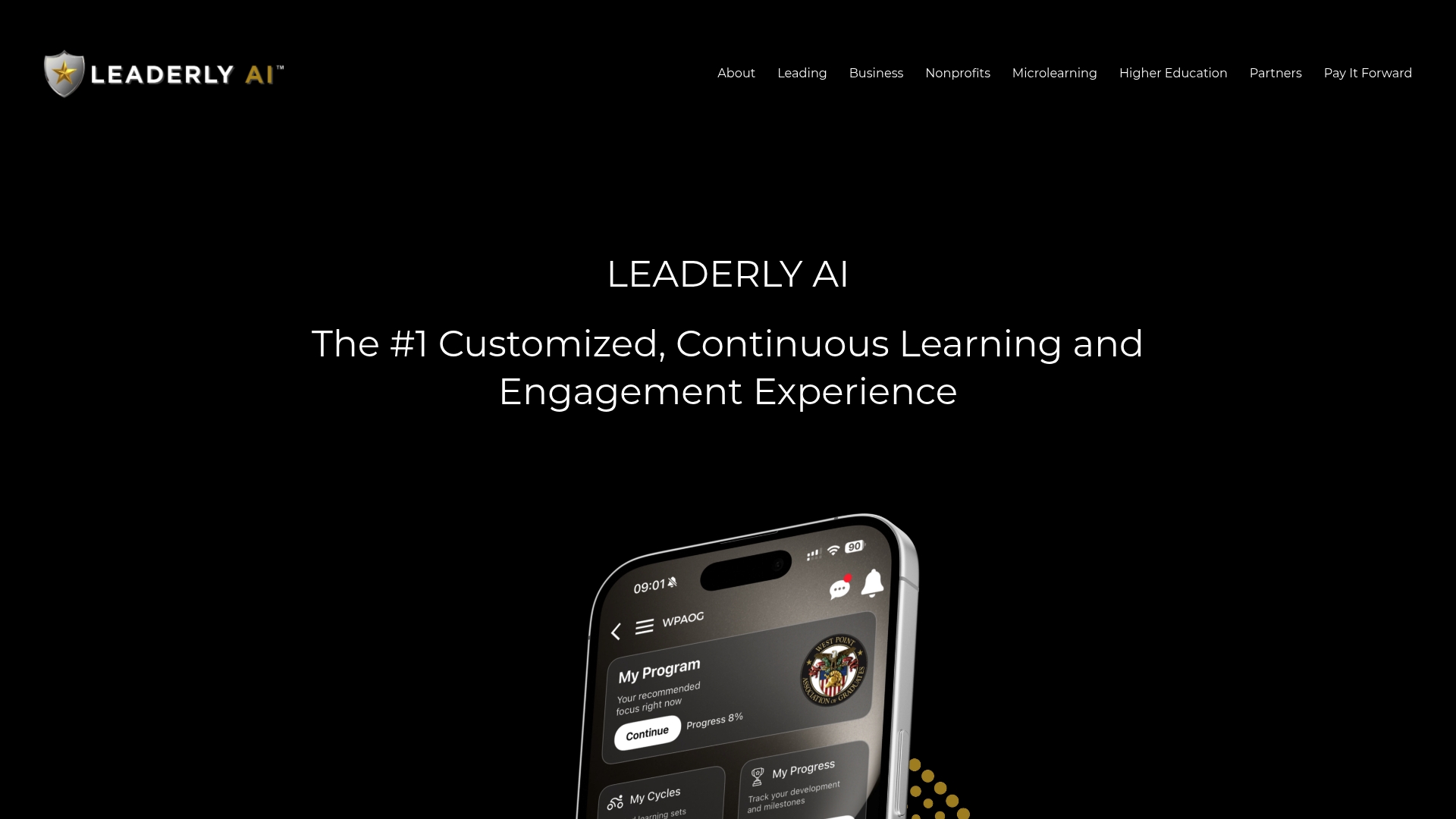
For a 90-day pilot, the setup is straightforward. Define your 3–5 target competencies, assign the relevant Leaderlyapp microlearning tracks to your student cohort, and use the platform's assessment collection tools to gather pre- and post-data that maps directly to your PLOs. The analytics dashboard gives your assessment officer exportable data for program review without manual aggregation. For programs building toward people-centric leadership development, the platform's behavioral habit-building exercises reinforce what students practice in class and in their experiential placements. Leaderlyapp scales from a single pilot cohort to an institution-wide rollout without a change in platform. Start your pilot at Leaderlyapp.
Sources
The sources below back the frameworks and examples in this guide. Each is linked directly to the claim it supports in the body text above.
- Maximizing the Impact and ROI of Leadership Development: A Theory- and Evidence-Informed Framework
- Leadership training design, delivery, and implementation: A meta-analysis
- Learning Leadership (program materials and curriculum examples) — ERIC
- Leadership for All at Cleveland State – Cleveland Teaching Collaborative
- Leadership development (Yale SOM EMBA curriculum)
- Aligning, Integrating, and Synthesizing Leadership Development Education at the U.S. Air Force Academy
- Internationalizing the Academic Leadership Curriculum - PMC