
The priority for 2026 is manager enablement paired with a clear AI roadmap. Global engagement dropped to roughly 20% in 2025, costing the world economy an estimated $10 trillion in lost productivity, and managers now explain about 70% of the variance in team-level engagement. Everything else in this guide, from microlearning to pulse surveys, works only when that manager layer is solid.
TL;DR:
- Managers influence 70% of team engagement, so focusing on their coaching, expectations, and recognition directly improves workforce motivation.
- Manager support and a clear AI integration plan significantly increase employee AI adoption, with visible use cases fostering trust and reducing anxiety.
- Continuous, microlearning sessions and layered pulse surveys enable faster, targeted action on engagement issues compared to annual surveys.
- Addressing silent burnout through workload audits and qualitative signals is essential to retain early-career and frontline employees.
- Building psychological safety through consistent manager behaviors and fostering belonging through DEI practices are fundamental to sustainable engagement growth.
Table of Contents
- Employee Engagement Trends 2026: The Short List HR Needs
- How Is AI Changing Employee Engagement in 2026?
- Why Are Managers the Real Engagement Lever in 2026?
- Does Personalized Development Actually Increase Engagement?
- What Metrics Replace the Annual Engagement Survey?
- What Is Silent Burnout and Why Does It Threaten Retention?
- How Should Hybrid Work Be Designed for Engagement in 2026?
- What Does a 90-Day Engagement Roadmap Look Like?
- How Leaderlyapp's Tools Support Manager-Driven Engagement
- Does DEI Still Move the Needle on Engagement in 2026?
- What Role Does Technology Beyond AI Play in Engagement?
- How Do You Build Psychological Safety and Trust at Work?
- How Are Gen Z Expectations Reshaping Engagement Strategy?
- How Does Engagement Actually Affect Business Outcomes?
- An Editorial Take: What Sets 2026's Winners Apart
- Scale Manager Enablement With Leaderlyapp
- Sources
Employee Engagement Trends 2026: The Short List HR Needs
Nine forces are reshaping workforce motivation this year, and they rank roughly in order of leverage:
- AI adoption led by managers, not IT — adoption sticks when a direct supervisor models and coaches it.
- Manager development and recognition — the single biggest lever for team-level engagement.
- Personalization and microlearning — short, targeted content beats generic annual training.
- Continuous listening — pulse surveys and eNPS replace the once-a-year engagement survey.
- Wellbeing and silent burnout — quiet disengagement is often invisible until someone resigns.
- Hybrid and work design — meeting norms and focus time now count as engagement policy.
- Frontline and early-career retention — the groups most at risk of quiet quitting.
- DEI-driven belonging — inclusion metrics increasingly track alongside engagement scores.
- Psychological safety — the precondition for every other trend on this list to function.
Each trend gets its own section below, with the practical steps behind it.
How Is AI Changing Employee Engagement in 2026?
AI is now a daily tool for a meaningful share of the workforce, but adoption depends almost entirely on manager behavior. Employees whose managers actively support AI use are roughly 2.1 times more likely to use it frequently, yet only about a quarter of employees say their organization has communicated a clear AI integration plan. That gap is where anxiety about job security festers.
Manager enablement should include:
- A live demo session where managers show, not tell, one AI use case tied to a real task.
- A short playbook connecting specific AI capabilities to specific role responsibilities.
- Simple adoption metrics tracked monthly, not buried in an annual review.
- IT-vetted tools provisioned before employees start sourcing their own, since unsecured personal AI tools create real data risk.
Microsoft's guidance on AI skilling treats upskilling as inseparable from adoption. You cannot bolt AI onto a workflow and expect trust to follow.
Pro Tip: Give managers one AI use case to master before rolling out five. A manager who can demonstrate a single win builds more trust than one reciting a long feature list.
Why Are Managers the Real Engagement Lever in 2026?
Managers account for roughly 70% of the variance in team engagement, which means two teams with identical pay, perks, and mission statements can land at opposite ends of the engagement scale based on one person. That is not a soft skills problem. It is a measurement and coaching problem that most HR functions still treat as an afterthought.
The behaviors that consistently move scores are unglamorous:
- Setting clear, written expectations at the start of each project, not just at annual review time.
- Running a real weekly one-on-one, not a status update disguised as a check-in.
- Recognizing specific contributions within days, not months. Recognition tactics that name the exact behavior work better than generic praise.
- Coaching toward growth rather than only correcting mistakes.
Measure manager effectiveness with a short skip-level pulse and correlate it against team turnover. Teams with strong manager scores retain people at a visibly different rate, and manager behavior research backs that connection directly.
Does Personalized Development Actually Increase Engagement?
Yes, and the evidence is specific: short, scheduled learning windows of 2 to 4 hours per month measurably increase participation when a manager signals which skills matter for that employee's next role. Generic, one-size-fits-all training does not produce the same lift.
To operationalize this:
- Block recurring learning time on the calendar instead of treating it as optional overflow work.
- Have managers nudge specific microlessons tied to a current project, not a random course catalog.
- Track participation and completion by team, and share the data back with managers monthly.
Qualtrics finds employees increasingly want clear career signals, and personalized microlearning is one of the few levers that delivers a visible signal in weeks rather than years.
What Metrics Replace the Annual Engagement Survey?
Annual surveys arrive too late to act on. The fix is a layered measurement cadence:
- Run a short pulse survey, three to five questions, every two to four weeks.
- Track eNPS monthly as an early warning indicator of morale shifts.
- Keep one annual Q12-style survey as a longer baseline for year-over-year comparison.
- Break results down by team and tenure, since new hires and five-year veterans disengage for different reasons.
- Share findings directly with managers within days, not quarters.
- Test one intervention, measure the shift in the next pulse, then iterate.
The cadence matters more than the tool. A monthly eNPS number that nobody acts on is worse than no number at all.
What Is Silent Burnout and Why Does It Threaten Retention?
Silent burnout is disengagement that never shows up as a complaint. Employees keep their output steady while quietly disconnecting, and resignation often arrives with no warning signs in the usual dashboards. Industry trend reports point to this pattern rising sharply among early-career and frontline employees, the groups with the least visibility into leadership and the fewest growth signals.
Practical countermeasures:
- Run a workload audit by team, not just by individual, since burnout often clusters around understaffed shifts.
- Build a recognition cadence that catches quiet contributors, not just loud ones.
- Train managers to ask specific questions in one-on-ones rather than a generic "how are you doing."
- Watch qualitative signals: shorter pulse survey comments, declining voluntary participation in optional events, and reduced peer recognition activity.
How Should Hybrid Work Be Designed for Engagement in 2026?
Hybrid policy is now engagement policy, not just a logistics decision. The flexibility shifts of the past few years reshaped what employees expect from where and how they work, and vague "come in when it makes sense" policies tend to erode trust faster than a strict schedule would.
Concrete design choices that work:
- Set meeting-free focus blocks at the team level, not just individually.
- Designate specific in-office days for collaboration, not attendance for its own sake.
- Build role-level hybrid policies instead of one blanket company rule, since frontline and desk roles need different treatment.
- Run a 90-day experiment on one team's schedule before rolling changes company-wide.
What Does a 90-Day Engagement Roadmap Look Like?
A phased, 90-day cadence produces evidence fast enough to keep leadership funding the next phase:
- Days 1 to 20, diagnose: run a baseline pulse survey and eNPS check, segmented by team and tenure.
- Days 21 to 40, quick wins: launch a recognition cadence and fix the most visible workload imbalance.
- Days 41 to 70, pilot manager enablement: train one group of managers on AI use cases and coaching behaviors.
- Days 71 to 90, measure and scale: compare pulse results against baseline and decide what expands company-wide.
Prioritize initiatives by combining reach (how many employees touched) with speed (how fast the metric can move). Sample KPIs: eNPS delta, manager pulse score, voluntary turnover by team, and microlearning completion rate. Report results as before-and-after numbers, since proven strategy examples tend to land better with leadership than abstract frameworks.
How Leaderlyapp's Tools Support Manager-Driven Engagement
Manager enablement sounds simple until you have to scale it across dozens of teams. Leaderlyapp's behavioral science approach to development breaks manager coaching into small, repeatable habits rather than one long training day that fades within a week.
A workable pilot structure:
- Run one team's microlesson pilot focused on a single manager behavior, like weekly recognition.
- Pair the microlesson with live coaching from that manager's own supervisor.
- Measure the pulse survey shift for that team against a control group over 30 days.
The goal is not a training event. It is a habit loop that shows up in the next pulse score, not the next annual review.
Does DEI Still Move the Needle on Engagement in 2026?
Belonging metrics and engagement scores move together more tightly than most leadership teams assume. When employees report feeling excluded from decisions or informal networks, their pulse survey scores drop even when pay and workload stay constant, and that gap tends to widen for employees who are the only person of their background on a team.
DEI work in 2026 looks less like one-off training and more like structural checks: who gets stretch assignments, who gets airtime in meetings, and whose ideas get credited. A manager who assigns visible projects unevenly across a team creates a belonging gap no engagement survey will fix on its own, because the problem lives in daily behavior, not policy language.
Practical steps that connect DEI to engagement rather than treating them as separate initiatives:
- Audit who receives stretch assignments and promotions by demographic group, not just by intent.
- Add a belonging-specific question to the regular pulse survey instead of relegating it to a separate annual DEI survey.
- Train managers to notice airtime imbalances in team meetings and correct them in real time.
- Tie recognition program data to participation equity, checking whether recognition clusters around the same few employees.
Values-aligned hiring also plays a role here. Bringing in people who share a genuine commitment to the team's working norms, not just a matching resume, tends to reduce the friction that erodes belonging later. A values-based hiring approach built into the recruiting process pays off months later in retention data, particularly for early-career hires who are still forming their sense of whether they fit.
DEI initiatives that stall usually share one trait: they live in a training module instead of a manager's daily habits. The fix is the same fix that runs through this entire piece. Give managers a specific, repeatable behavior to practice, and measure whether it moves the numbers.
What Role Does Technology Beyond AI Play in Engagement?
AI gets most of the 2026 headlines, but collaboration tools, virtual reality training, and augmented reality simulations are quietly reshaping how engaged people feel at work, particularly in distributed and frontline roles.
Collaboration platforms matter less for their feature lists than for how they're configured. A tool that floods employees with notifications erodes focus and, over time, engagement. A tool configured around asynchronous updates and fewer, better meetings tends to protect the focus time that hybrid work design depends on.
VR and AR training is moving past the novelty phase into practical use, especially for frontline and manufacturing roles where hands-on practice is expensive or risky to simulate physically. A warehouse team practicing a new safety procedure in a VR simulation gets repeatable practice without real-world stakes, and that repetition builds the kind of confidence that shows up later in pulse survey comments about feeling prepared.

The trap is treating any of these tools as an engagement fix on their own. A VR training module without a manager reinforcing the skill afterward fades the same way a one-time workshop fades. The tools that move engagement scores share one trait: they connect back to a manager or a peer who reinforces the behavior in the following days.
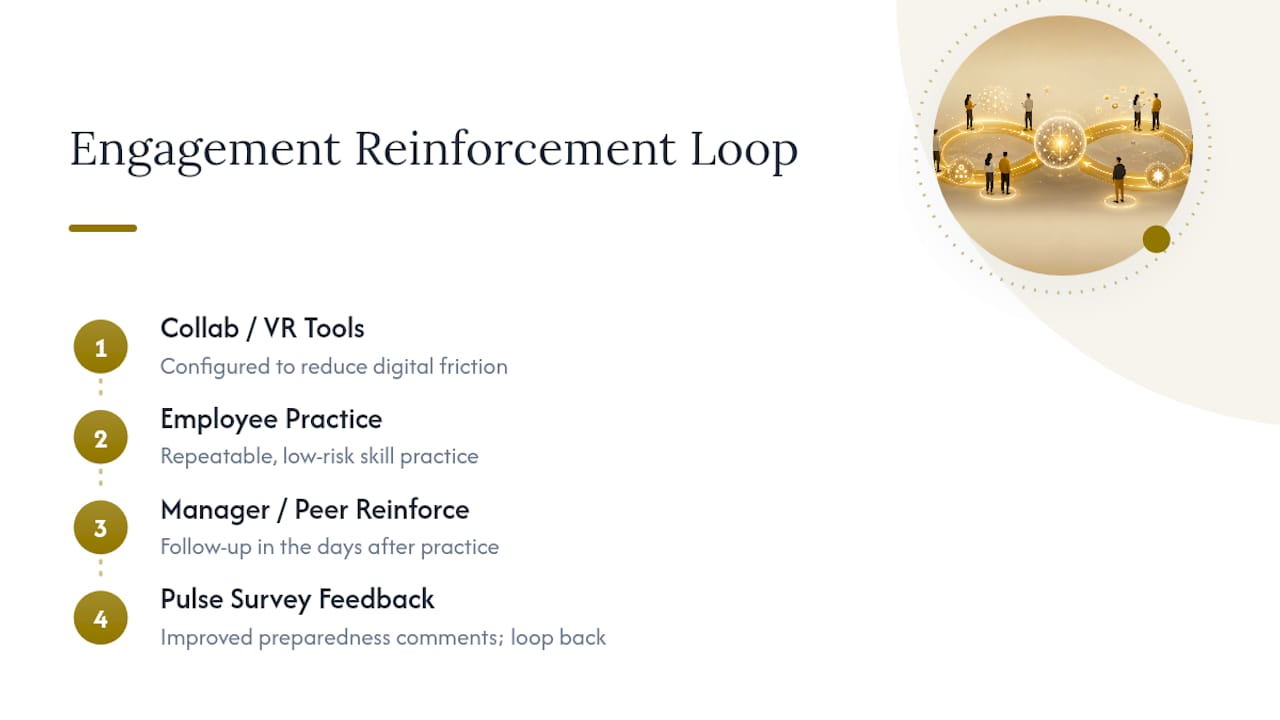
For most organizations in 2026, the practical move is smaller than a VR rollout. It's auditing whether current collaboration tools are adding friction or removing it, then fixing the configuration before adding anything new. A cluttered digital workspace undermines the same trust that a good manager spends months building.
How Do You Build Psychological Safety and Trust at Work?
Psychological safety is the precondition, not a nice add-on, for every other trend on this list. Employees who fear consequences for speaking up will not flag a broken process, will not admit they need help with a new AI tool, and will not tell a pulse survey the truth about their workload. Every measurement strategy in this guide depends on people trusting that honest answers won't be held against them.
The clearest sign an organization has a psychological safety problem is a gap between pulse survey scores and what managers hear directly. If scores are consistently more negative than what employees say out loud, people don't trust the channel, or they don't trust what happens after they speak.
Building trust comes down to a short list of manager behaviors, repeated consistently rather than performed once:
- Responding to bad news without visible frustration, since a defensive reaction to one mistake teaches a whole team to hide the next one.
- Admitting their own mistakes openly, which gives employees permission to do the same.
- Closing the loop on feedback, even when the answer is "we can't fix that right now," rather than letting suggestions disappear into silence.
- Separating performance conversations from blame, focusing on the process that failed rather than the person.
Trust erodes fastest during change, which is exactly why the AI rollout question matters so much here. An employee asked to use a new AI tool without a clear plan for what it means for their role isn't just confused. They're testing whether leadership will tell them the truth about their own job security, and how that test resolves shapes whether they trust the next initiative too.
How Are Gen Z Expectations Reshaping Engagement Strategy?
Generational shift is less about age and more about what a growing share of the workforce now treats as table stakes: fast feedback, visible growth paths, and tools that don't feel a decade behind what they use outside of work.
Gen Z employees, now a growing share of the workforce, tend to disengage faster than older cohorts when growth feels stalled or when feedback only arrives once a year. That's less a generational quirk than a rational response. Someone early in their career has the most to gain from clear signals about what skill to build next, and the least patience for a system that makes them wait twelve months to find out.
This shows up directly in the frontline and early-career retention risk covered earlier in silent burnout. Younger employees are more likely to leave quietly, without escalating a complaint first, because they've watched peers raise issues and get nothing back.
Practical adjustments that address this without treating an entire generation as a monolith:
- Shorten feedback cycles specifically for early-tenure employees, not just as a company-wide policy.
- Make career paths visible and concrete rather than implied, since ambiguity reads as a red flag to newer employees.
- Let managers assign stretch work early rather than waiting for tenure milestones that feel arbitrary to someone six months into a role.
The organizations getting this right aren't the ones with the flashiest perks. They're the ones whose managers can answer, specifically, what an early-career employee needs to do next to grow. That answer, delivered consistently, matters more than any single benefit on offer.
How Does Engagement Actually Affect Business Outcomes?
Engagement is not a soft metric that HR tracks in isolation. It correlates directly with the productivity losses Gallup attributes to the current global engagement decline, and that $10 trillion figure represents the aggregate cost of disengaged and actively disengaged employees producing less, making more errors, and disengaging customers along the way.
At the team level, the connection runs through the same manager lever discussed throughout this guide. Teams with stronger manager scores show lower voluntary turnover, which reduces the direct cost of rehiring and the indirect cost of lost institutional knowledge. A team that churns through new hires every year never builds the kind of process fluency that shows up in output quality.
Linking engagement to business metrics requires picking KPIs that leadership already tracks, rather than inventing new engagement-specific numbers nobody else cares about:
- Voluntary turnover by team, tracked against manager pulse scores.
- Customer satisfaction scores for teams with direct customer contact, compared against team-level engagement trends.
- Error rates or rework volume, where available, compared against workload audit findings.
- Time-to-productivity for new hires, which tends to shorten when onboarding includes clear manager check-ins.
The organizations that successfully defend engagement budgets internally are the ones that report these numbers in the same language finance already uses. A pulse score alone rarely secures a next-phase budget. A pulse score paired with a turnover trend and its dollar cost usually does.
An Editorial Take: What Sets 2026's Winners Apart
Most organizations will treat AI as a tools problem this year, and most will get it wrong. The winners will treat it as a manager problem first, tools second. Gallup's own data backs that order, not the reverse. Start there: fix manager enablement, build the AI roadmap around it, then let the microlearning and pulse surveys do their quieter work underneath.
— Drew
Scale Manager Enablement With Leaderlyapp
Most of what this guide recommends, manager coaching, microlearning tied to real tasks, measurable behavior change, is exactly what Leaderlyapp was built to deliver at scale. Instead of a one-time training rollout that fades within weeks, The platform delivers personalized microlessons and behavioral exercises that adapt to each manager's actual growth path, backed by assessments like DiSC and EQ that pinpoint where coaching should focus first.
If the 90-day roadmap in this guide sounds right but the idea of building it manually across dozens of managers sounds like a second full-time job, that's the gap Leaderlyapp closes. The platform's approach to continuous learning and leadership development gives HR teams a way to run manager enablement as an ongoing habit loop rather than a quarterly event, with analytics dashboards that show whether coaching is actually changing behavior. Start by piloting it with one team of managers this quarter, and use the built-in metrics to decide what scales next.
Sources
- State of the Global Workplace 2026 | Employee Engagement Data & Trends - Gallup
- Employee Experience Trends Reframing Work in 2026 - Qualtrics
- Transforming the future of learning and work with AI skilling - Microsoft