
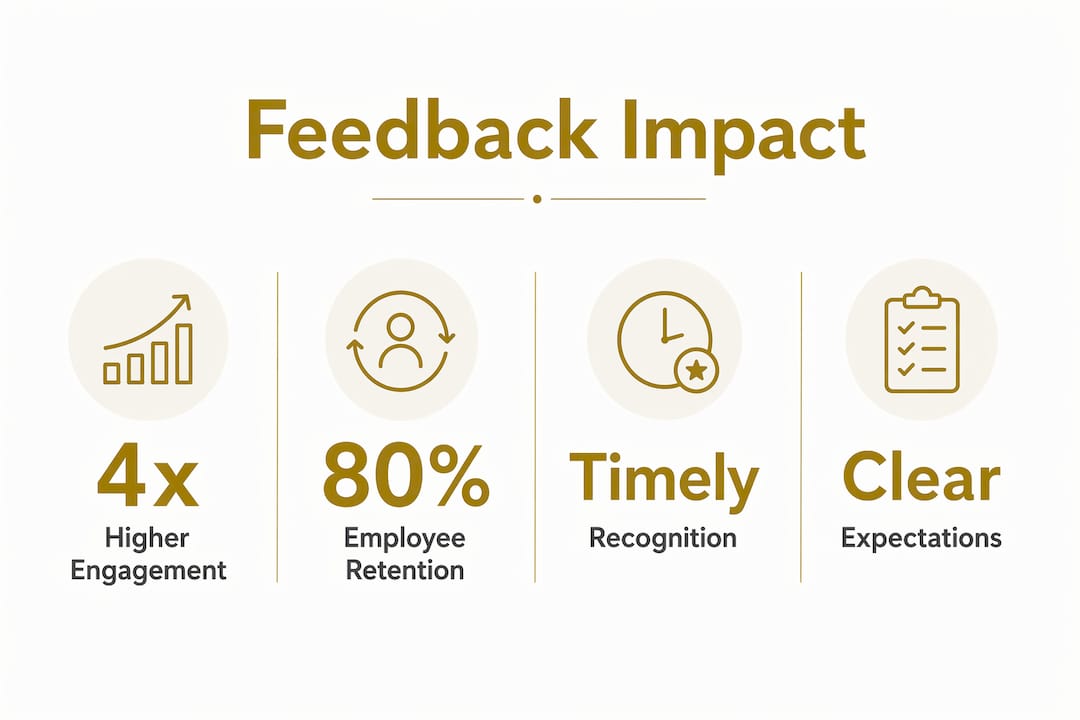
Continuous feedback is defined as the practice of delivering real-time or near-real-time performance input to employees rather than waiting for scheduled reviews. It is the single most direct driver of employee engagement available to HR leaders today. Employees who receive daily feedback are 4 times more likely to be engaged than those who receive none, and 80% of employees who get weekly meaningful feedback report full engagement. Those numbers come from Gallup's 2023 survey, and they make the case plainly. The importance of continuous feedback is not a management trend. It is a measurable, research-backed lever that HR professionals and organizational leaders can pull right now.
Why continuous feedback improves engagement: the core mechanisms
Continuous feedback works because it removes the guesswork that kills motivation. When employees know exactly where they stand and what to do next, they direct their energy toward the right work. When they do not, they fill the gap with anxiety or disengagement.
Motivation through timely recognition
Recognition loses its power when it arrives months after the fact. Timely feedback ties effort directly to outcome, reinforcing the behaviors that drive results. A manager who acknowledges a strong client call the same day it happens creates a clear cause-and-effect loop in the employee's mind. That loop is what builds sustained motivation.
Clarity on performance expectations
Vague expectations are one of the top drivers of disengagement. Continuous feedback replaces ambiguity with specifics. Employees who strongly agree their manager involves them in goal-setting with regular check-ins are 3.6 times more engaged, according to Gallup 2024 data. Clarity is not a soft benefit. It is a multiplier.

Accountability and ownership through two-way dialogue
One-way evaluation creates passive employees. Two-way feedback dialogue creates owners. When employees can push back, ask questions, and contribute to the conversation, they take responsibility for outcomes rather than waiting to be told what to do. Moving feedback from evaluation to dialogue increases employee ownership and psychological safety, which are both critical for engagement and creativity.
Retention through connection
Employees who feel seen and heard stay longer. Organizations with strong continuous feedback practices report higher engagement scores, more accurate promotions, and fewer legal issues related to attrition. That combination of outcomes is not coincidental. Frequent feedback builds the manager-employee relationship that makes people want to remain.
Pro Tip: Schedule a brief five-minute weekly check-in with each direct report. Ask one question: "What's one thing I can do to help you this week?" That single habit shifts the dynamic from evaluation to partnership.
| Engagement driver | What continuous feedback does |
|---|---|
| Motivation | Ties recognition to specific behaviors in real time |
| Clarity | Replaces vague expectations with concrete direction |
| Accountability | Converts one-way evaluation into two-way dialogue |
| Retention | Builds manager-employee trust that reduces voluntary exits |
How does continuous feedback differ from traditional performance reviews?
The annual performance review was designed for a slower world. It made sense when work moved in annual cycles and documentation was paper-based. Neither of those conditions applies today.
Traditional reviews create two specific problems. First, they delay feedback by months, which means employees spend most of the year operating without clear signals. Second, they create cognitive overload. Receiving a year's worth of feedback in a single conversation is overwhelming for both the giver and the receiver. Frequent feedback reduces performance uncertainty and anxiety compared to infrequent reviews, resulting in sustained motivation and clear action paths, according to a 2026 Frontiers in Psychology study.
The critical distinction is that continuous feedback does not replace formal reviews. Formal reviews remain necessary as strategic check-ins for compensation, career progress, and documentation. The best-performing organizations treat quarterly or annual reviews as summative checkpoints, not as the primary feedback mechanism.
| Characteristic | Continuous feedback | Traditional annual review |
|---|---|---|
| Timing | Real-time or weekly | Once or twice per year |
| Direction | Two-way dialogue | Primarily top-down |
| Employee anxiety | Low, due to predictability | High, due to infrequency |
| Behavior change | Immediate and specific | Delayed and often forgotten |
| Documentation role | Ongoing data trail | Single-point summary |
The table above shows why the two approaches work best together, not as substitutes for each other. Continuous feedback handles the day-to-day course corrections. Formal reviews handle the big-picture decisions.
What are best practices for implementing continuous feedback?
Getting continuous feedback right requires more than adding calendar invites. Culture, structure, and communication style all determine whether feedback lands as growth or as criticism.
-
Build psychological safety first. Employees will not engage honestly with feedback if they fear punishment for speaking up. Leaders who model vulnerability by asking for feedback themselves normalize the culture and reduce the risk of misinterpretation. The Salesforce Engineering team documented this directly: when leaders solicited feedback openly, teams adopted continuous feedback practices far more readily.
-
Keep feedback behavior-focused and future-oriented. A meta-analysis by Kluger and DeNisi found that feedback interventions fail when they shift employee focus from tasks to the self, causing defensiveness. Effective feedback names a specific behavior, explains its impact, and points toward a concrete next step. "You interrupted the client twice in that call, which cut off their concern. Next time, try pausing for three seconds before responding" works. "You need to be a better listener" does not.
-
Make it two-way. Ask employees for feedback on your own leadership regularly. This is not just good practice. It signals that feedback flows in every direction and that no one is exempt from growth.
-
Set clear guardrails. Frequency without structure creates noise. Establish a shared understanding of what feedback looks like, how often it happens, and what channels it uses. Weekly check-ins, monthly development conversations, and quarterly formal reviews form a practical cadence for most teams.
-
Use technology to maintain consistency. Digital tools improve scalability and practicality of frequent feedback without reducing human credibility. Platforms that capture real-time coaching notes, track development goals, and prompt regular check-ins remove the friction that causes feedback cultures to stall.
Pro Tip: After every feedback conversation, send a one-sentence follow-up message summarizing the agreed next step. This closes the loop and creates a lightweight documentation trail without bureaucracy.
Avoid the most common pitfall: vague, personality-based criticism. Over one-third of feedback interventions can reduce performance if they direct focus to personal traits rather than concrete behaviors and future improvements. The structure of the feedback matters as much as the frequency.
What measurable outcomes does continuous feedback produce?
The organizational case for continuous feedback is well-documented. The impact of feedback on productivity, retention, and decision quality shows up consistently across research and real-world examples.
- Engagement multiplier effect: Gallup data shows employees receiving daily feedback are 4 times more likely to be engaged. Weekly meaningful feedback produces full engagement in 80% of recipients. These are not marginal gains.
- Reduced voluntary attrition: Adobe's shift to frequent check-ins supported by digital tools produced a 30% reduction in voluntary attrition alongside higher engagement scores. That reduction translates directly into lower recruiting and onboarding costs.
- More accurate promotion decisions: Organizations with continuous feedback practices build richer, more current data on employee performance. That data leads to more accurate promotions and fewer legal challenges related to perceived unfair treatment.
- Substantiated HR documentation: Continuous feedback creates an ongoing record of performance conversations. That record protects organizations in termination disputes and supports fair, defensible compensation decisions.
- Improved leadership communication: Leaders who practice regular feedback develop stronger communication skills over time. The habit of giving clear, specific, timely input makes managers more effective across every dimension of their role.
The benefits of ongoing feedback extend beyond individual performance. They reshape how teams operate, how leaders lead, and how organizations make decisions about their people.
Key Takeaways
Continuous feedback is the most direct and research-supported method HR leaders have for improving employee engagement, reducing turnover, and building a culture where people perform at their best.
| Point | Details |
|---|---|
| Frequency drives engagement | Daily feedback produces 4x higher engagement; weekly feedback produces full engagement in 80% of employees. |
| Behavior-focused feedback works | Feedback tied to specific actions and future steps changes behavior; personality-based criticism causes defensiveness. |
| Formal reviews stay relevant | Continuous feedback complements annual reviews as summative checkpoints, not replaces them. |
| Psychological safety is the foundation | Leaders who ask for feedback themselves create cultures where continuous feedback takes hold. |
| Technology sustains consistency | Digital tools remove friction from frequent feedback, making the practice scalable across large teams. |
The part most organizations get wrong
I have watched continuous feedback programs launch with genuine enthusiasm and collapse within six months. The failure point is almost never the concept. It is the assumption that frequency alone is enough.
The organizations that get this right treat feedback as a communication skill, not a process. They invest in training managers to give specific, behavior-focused input. They build psychological safety before they roll out any new cadence. And they start with leaders who are willing to be uncomfortable, to ask their teams "What am I doing that makes your job harder?" and mean it.
The organizations that get it wrong send a memo announcing weekly check-ins and wonder why nothing changes. Feedback culture is not a policy. It is a set of habits that leaders model first and teams adopt second. The research from Salesforce Engineering makes this plain: when leaders visibly solicited feedback, adoption followed. When they only mandated it, resistance followed.
My honest advice is to start smaller than you think you need to. Pick one team, one leader, and one clear feedback habit. Run it for 90 days. Measure engagement and have honest conversations about what is working. Then scale what you learn. Continuous feedback is not a program you install. It is a culture you build, one conversation at a time.
— Drew
How Leaderlyapp supports a continuous feedback culture
Building a feedback culture requires leaders who know how to have real conversations, not just managers who follow a process. That is exactly what Leaderlyapp is designed to develop.
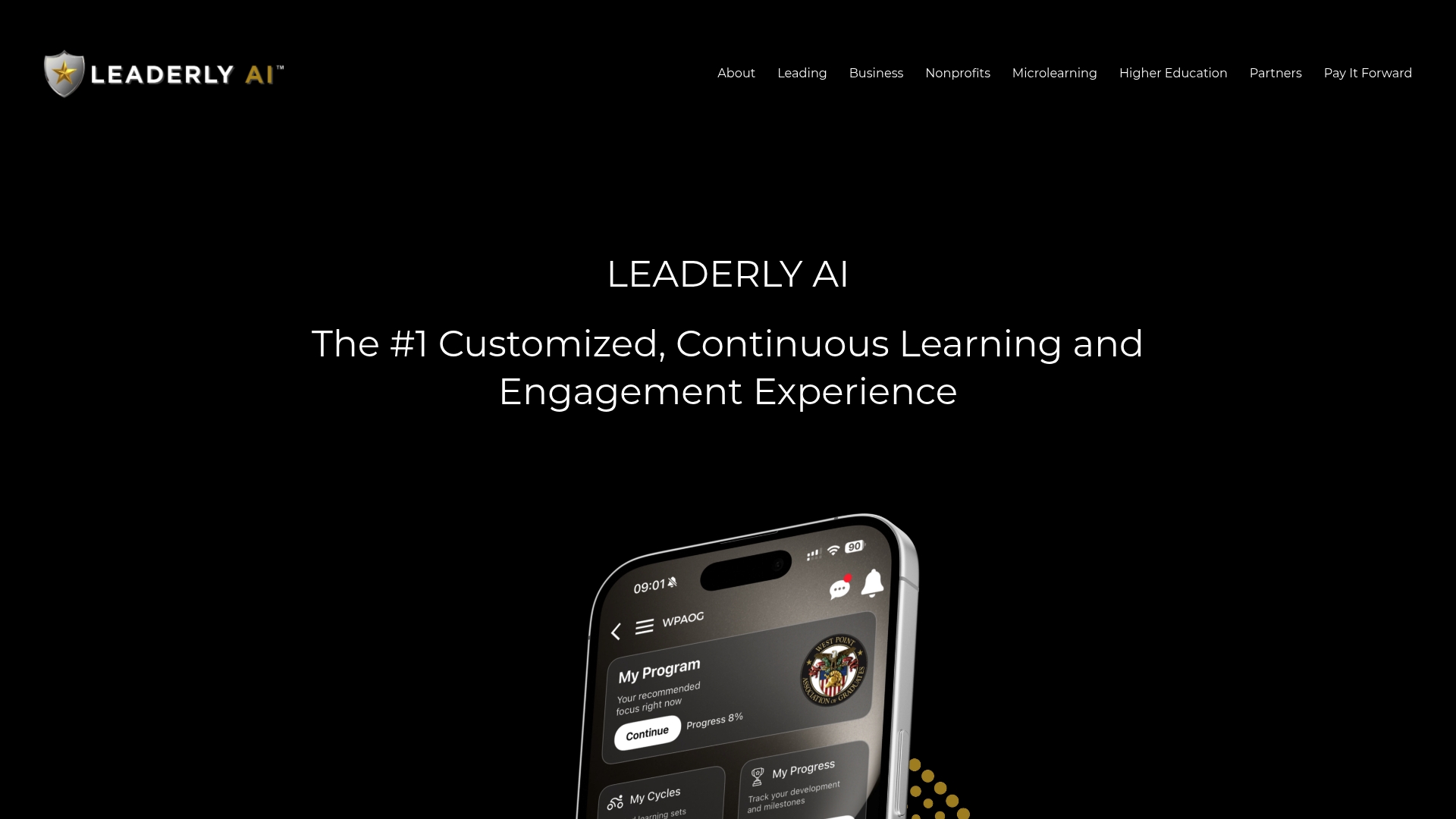
Leaderlyapp delivers personalized microlessons grounded in behavioral science, helping leaders at every level build the communication habits that make continuous feedback work. The platform uses machine learning to tailor content to each leader's growth stage, so a first-time manager and a senior director each get what they actually need. For HR leaders looking to improve organizational culture through better leadership, Leaderlyapp provides the practical skill development that makes feedback conversations land. Explore Leaderlyapp's leadership development platform to see how it supports the habits your teams need.
FAQ
What is continuous feedback in the workplace?
Continuous feedback is the practice of delivering real-time or near-real-time performance input to employees on an ongoing basis, rather than waiting for scheduled annual or quarterly reviews. It includes upward, downward, and peer-to-peer feedback across all levels of an organization.
How does feedback frequency affect employee engagement?
Employees who receive daily feedback are 4 times more likely to be engaged than those who receive none, and 80% of employees who get weekly meaningful feedback report full engagement, according to Gallup 2023 data.
Does continuous feedback replace annual performance reviews?
No. Continuous feedback complements formal reviews by providing timely course corrections, while annual or quarterly reviews serve as strategic checkpoints for compensation, career planning, and documentation.
What makes feedback effective rather than harmful?
Effective feedback is specific, behavior-focused, and future-oriented. Research by Kluger and DeNisi shows that feedback directed at personal traits rather than concrete behaviors causes defensiveness and can reduce performance.
How can HR leaders build a continuous feedback culture?
Start by building psychological safety, training managers to give behavior-focused input, and establishing a clear cadence of weekly check-ins and formal quarterly reviews. Leaders who visibly ask for feedback themselves accelerate adoption across their teams.