
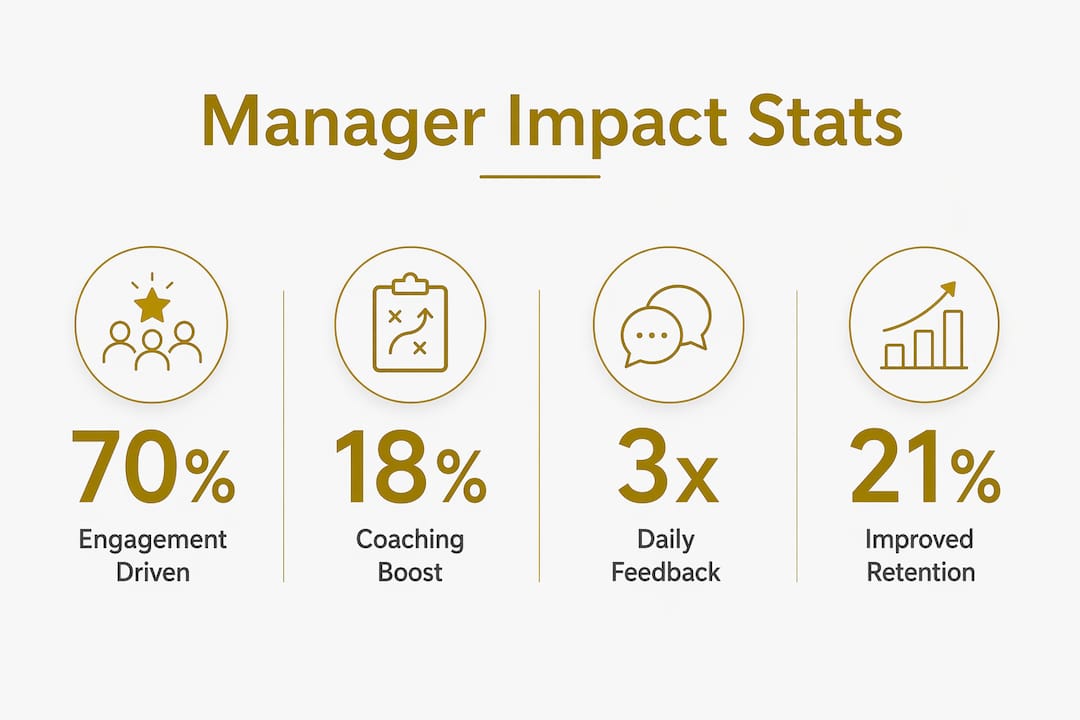
Manager behavior is the single greatest driver of employee engagement, accounting for approximately 70% of the variance in team engagement scores across organizations. That figure comes from Gallup's analysis of 2.7 million workers, and it dwarfs the effect of compensation, office environment, or company culture programs. The formal term for this dynamic is "managerial influence on employee engagement," and understanding why manager behavior affects engagement is the first step toward fixing it. Managers are the lens through which employees experience work every single day. What they do between Monday and Friday shapes motivation, morale, and retention far more than any annual survey or company-wide initiative.
Why manager behavior affects engagement more than any other factor
The 70% figure is not a rounding error. Gallup's analysis consistently places the manager-level effect between 67% and 72% across industries, team sizes, and geographies. That means the majority of your team's engagement is within your direct control as a manager, not HR's, not the CEO's.
The reason is simple: employees do not experience the organization abstractly. They experience their manager. A strong company mission means little when a manager ignores feedback, cancels one-on-ones, or assigns work without context. Conversely, a mediocre company with a great manager can produce a highly engaged team. The manager translates organizational intent into daily reality.

This also explains why broad engagement programs so often fail. Perks, surveys, and town halls address the surface. They do not change what happens in a Tuesday afternoon check-in or how a manager responds when an employee raises a concern. Engagement is shaped by what managers do in small, repeated moments, not by periodic programs.
What specific manager behaviors most strongly influence engagement?
Research points to a clear set of behaviors that either build or destroy engagement. The good news is that all of them are learnable.
Behaviors that build engagement:
- Frequent, meaningful feedback. Employees who receive daily feedback from managers are 3x more likely to be engaged than those receiving feedback annually. Annual reviews are too infrequent to change behavior or sustain motivation.
- Strengths-based conversations. Managers who focus on what employees do well, rather than cataloging weaknesses, produce higher morale and better performance. Strengths-based feedback gives employees a reason to invest in their work.
- Involving employees in goal setting. Only about 30% of employees are involved in setting their own goals, yet those who are become nearly four times more engaged. Participation creates ownership.
- Psychological safety. Teams where employees feel safe raising concerns, admitting mistakes, and disagreeing with their manager consistently outperform those where silence is the norm.
- Clear expectations and autonomy. Employees need to know what success looks like and have enough room to achieve it their own way. Micromanagement kills both.
Behaviors that destroy engagement:
- Ignoring or dismissing employee feedback
- Overloading team members without acknowledging capacity limits
- Canceling or skipping regular one-on-ones
- Communicating inconsistently under pressure
- Treating all employees identically, regardless of individual needs
Pro Tip: Ask your team one question each week: "What's one thing I could do differently to make your work easier?" The answers will tell you more than any engagement survey.
Learning how to coach your employees effectively is the fastest way to shift from a task-focused manager to one who genuinely builds engagement.
How does leadership style affect engagement through goal focus and coaching?
A 2026 empirical study of over 9,000 tech employees found that goal-focused leadership combined with coaching produces a measurable increase in work engagement. The mechanism is person-job fit: when managers set clear goals and actively coach employees toward them, employees feel better aligned with their roles. That alignment drives engagement.
This is not simply about setting targets. Goal-focused leadership provides both challenge and resources. It tells employees what matters and gives them the support to get there. Coaching behavior then strengthens that alignment by helping employees connect their personal strengths to organizational objectives.
The table below shows how different leadership approaches compare on key engagement outcomes:
| Leadership approach | Effect on person-job fit | Effect on engagement |
|---|---|---|
| Goal-focused only | Moderate improvement | Moderate increase |
| Coaching only | Moderate improvement | Moderate increase |
| Goal-focused + coaching combined | Strong improvement | Significant increase |
| Neither | Minimal | Low or declining |
The practical implication is clear. Managers who set goals without coaching leave engagement on the table. Those who coach without clear goals create effort without direction. The benefits of coaching multiply when paired with goal clarity, and that combination is what separates high-engagement teams from average ones.
What common manager mistakes reduce engagement, and how can they be fixed?
Most managers do not disengage their teams on purpose. They fall into predictable traps, usually because no one ever taught them what good management actually looks like.
-
Focusing on tasks over people. Managers promoted for technical skill often default to tracking deliverables rather than developing their team. The result is a team that hits short-term targets but gradually loses motivation. The fix is simple: spend at least 20% of your one-on-one time on the person, not the project.
-
Running meetings as status updates. High-engagement managers shift meeting time away from reporting and toward decision-making and removing blockers. A meeting where everyone recites their progress is a meeting that wastes everyone's time and signals that the manager does not trust the team to work independently.
-
Ignoring burnout signals. The World Health Organization classifies burnout as a syndrome caused by chronic, unmanaged workplace stress. Managers who treat employee overload as dedication accelerate disengagement and turnover. Watch for declining output, shorter responses, and withdrawal from team conversations. These are early signals, not performance problems.
-
Inconsistency under pressure. Managers who are supportive in calm periods but become controlling or dismissive under pressure teach their teams that psychological safety is conditional. Conditional safety is no safety at all. Employees disengage to protect themselves.
-
Skipping the small stuff. Most engagement programs fail because they overlook the daily, small behaviors managers must consistently perform. Clarifying priorities, recognizing effort, and following through on commitments are not glamorous. They are the actual work of engagement.
Pro Tip: Before your next team meeting, remove every agenda item that is purely a status update. Replace it with one decision that needs to be made and one blocker that needs to be removed. Notice the difference in energy.
Managers who want to prioritize their team effectively need to audit their own habits before redesigning any team process.
How can managers practically improve their behavior to boost team engagement?
The research on how to empower managers to improve team engagement points to specific, repeatable practices rather than broad attitude shifts.
Start with weekly one-on-ones that have a clear structure. The best managers use these conversations to identify what to repeat, what to improve, and what to stop. That three-part frame turns a routine check-in into a high-yield engagement practice. Keep them to 30 minutes, hold them consistently, and let the employee set most of the agenda.
Invest in targeted manager development. Managers trained in coaching show up to 18% higher team engagement and 21–28% less turnover. Generic leadership training does not produce these results. Development programs need to focus specifically on coaching skills, feedback delivery, and strengths-based conversations. Leaderlyapp builds these skills through personalized microlessons that adapt to each manager's development stage, making consistent practice achievable without pulling managers out of their day jobs.
Separate the management track from the technical track. Forcing brilliant individual contributors into management roles because there is no other promotion path is a reliable way to create disengaged teams. Separating these career tracks lets strong contributors thrive without managing people they are not suited to lead. It also puts the right people in management roles.
Build recognition into your routine. Recognition does not require a formal program. It requires noticing what employees do well and saying so specifically and promptly. "Good job" is not recognition. "The way you handled that client objection on Thursday showed real judgment" is recognition. Specificity is what makes it land.
Use strengths-based feedback regularly. Employees who know their strengths and use them daily are more productive and more engaged. You can find practical guidance on building an effective coaching program that integrates strengths-based approaches into everyday management. For additional perspective on motivating employees through consistent behavioral practices, external research reinforces the same core principles.
Key Takeaways
Manager behavior is the primary driver of employee engagement, and small, consistent daily actions produce larger results than any company-wide program.
| Point | Details |
|---|---|
| Managers drive 70% of engagement | Gallup's analysis of 2.7 million workers shows manager quality explains most engagement variance. |
| Frequent feedback triples engagement | Employees receiving daily feedback are 3x more likely to be engaged than those reviewed annually. |
| Goal focus plus coaching works best | Combining goal-focused leadership with coaching produces the strongest gains in person-job fit and engagement. |
| Small daily habits matter most | Clarifying priorities, recognizing effort, and holding consistent one-on-ones drive sustained engagement. |
| Manager development reduces turnover | Teams with coached managers show up to 18% higher engagement and 21–28% less turnover. |
The uncomfortable truth about why engagement keeps failing
Most organizations know that managers drive engagement. The research has been clear for over a decade. And yet, the majority of companies still invest more in engagement surveys than in manager development. That gap is the real problem.
What I have seen consistently is that organizations treat engagement as a measurement challenge when it is actually a behavior change challenge. You do not fix engagement by tracking it more carefully. You fix it by changing what managers do on Tuesday morning.
The other thing that surprises me is how much resistance there is to separating management and technical career tracks. Companies keep promoting their best engineers and analysts into management because it feels like a reward. Then they wonder why engagement drops. The role requires a completely different skill set, and most organizations still do not treat it that way.
The good news is that manager behavior is genuinely changeable. Small, repeated habits, a structured one-on-one, a specific piece of recognition, a question asked instead of a directive given, compound over time. The managers I have seen produce the most engaged teams are not the most charismatic or the most experienced. They are the most consistent. They show up the same way every week, and their teams know exactly what to expect from them. That predictability is itself a form of psychological safety.
— Drew
Building better managers with Leaderlyapp
The research is clear: the fastest path to higher engagement runs directly through manager behavior. Leaderlyapp is built for exactly this challenge. The platform delivers personalized microlessons grounded in behavioral science, helping managers build people-centric leadership skills through daily practice rather than one-off training events. Each lesson adapts to where a manager is in their development, so the content stays relevant and the habits actually stick. Whether you are an HR leader looking to scale manager development across a large organization or a manager who wants to improve your own coaching skills, Leaderlyapp gives you a practical, measurable path forward. Explore the full platform at Leaderlyapp and see what consistent manager development looks like in practice.
FAQ
Why does manager behavior affect engagement so strongly?
Managers control the daily conditions of work, including feedback, clarity, recognition, and workload. Gallup's research across 2.7 million workers shows manager quality explains approximately 70% of the variance in team engagement.
What is the single most impactful behavior a manager can change?
Increasing feedback frequency produces the clearest results. Employees who receive daily feedback are 3x more likely to be engaged than those who receive it only during annual reviews.
How does coaching improve team engagement?
Coaching helps employees connect their strengths to their role, improving person-job fit. When combined with goal-focused leadership, this effect is strong enough to produce measurable engagement increases, as shown in a 2026 study of over 9,000 tech employees.
How long does it take for manager behavior changes to affect engagement?
Consistent behavioral changes, such as weekly one-on-ones and regular recognition, typically produce noticeable engagement shifts within one to three months. Broader cultural change takes longer, but individual team engagement responds quickly to manager behavior.
Can HR improve engagement without changing manager behavior?
HR programs alone cannot sustain engagement gains. Because managers account for the majority of engagement variance, any program that does not change daily manager behavior will produce only short-term improvements.