
Behavioral science in employee development is the study of how observable behaviors, cognitive drivers, and environmental design shape whether employees actually grow at work. Good intentions alone rarely produce lasting change. Intentions predict behavior only 30% of the time, meaning 70% of employees who genuinely want to develop a skill will fail without structured support. Frameworks like Self-Determination Theory and the SUE Influence Framework give HR leaders a way to close that gap. The shift from knowledge transfer to behavior design is the most consequential upgrade most organizations have not yet made.
How behavioral science explains the gap between training and real behavior
Most training programs are built on a flawed assumption: that knowing something leads to doing something. Cognitive psychology has disproved this repeatedly. Habitual, automatic behavior drives most of what employees do each day, and conscious intentions rarely override it without deliberate support structures.
The 30% intention-to-behavior rate is not a motivation problem. It is a design problem. Employees leave workshops energized and return to unchanged environments that pull them straight back into old patterns. The environment wins almost every time.

Implementation intentions, also called if-then planning, directly address this gap. Instead of setting a goal like "I will give better feedback," an employee commits to a specific trigger: "If I finish a project debrief, then I will ask one open question about what the team would do differently." If-then planning can double or triple follow-through rates on development goals compared to standard goal-setting. That difference is not marginal. It is the difference between a program that changes behavior and one that generates a post-training survey score.
Cognitive-behavioral interventions add another layer by targeting the beliefs that block action. When employees hold dysfunctional beliefs about their ability to learn, anxiety rises and performance drops. Structured behavioral experiments help employees test those beliefs against reality, which builds self-efficacy and reduces learning-related anxiety.
- Habitual behavior runs on autopilot and resists conscious override without environmental cues.
- Implementation intentions attach new behaviors to specific triggers, making follow-through far more likely.
- Cognitive-behavioral techniques address the beliefs that block learning before training even begins.
- Environmental design removes friction from the path to the desired behavior.
Pro Tip: Before launching any development program, ask each participant to write one if-then plan for the first behavior they want to change. This single step measurably increases follow-through without adding program cost.
Designing development that changes behavior, not just knowledge
Leadership development programs fail mostly because organizations treat them as knowledge-transfer problems rather than behavior-change problems. Less than 10% of training content transfers to actual workplace behavior. That number should end the debate about whether traditional learning design works.
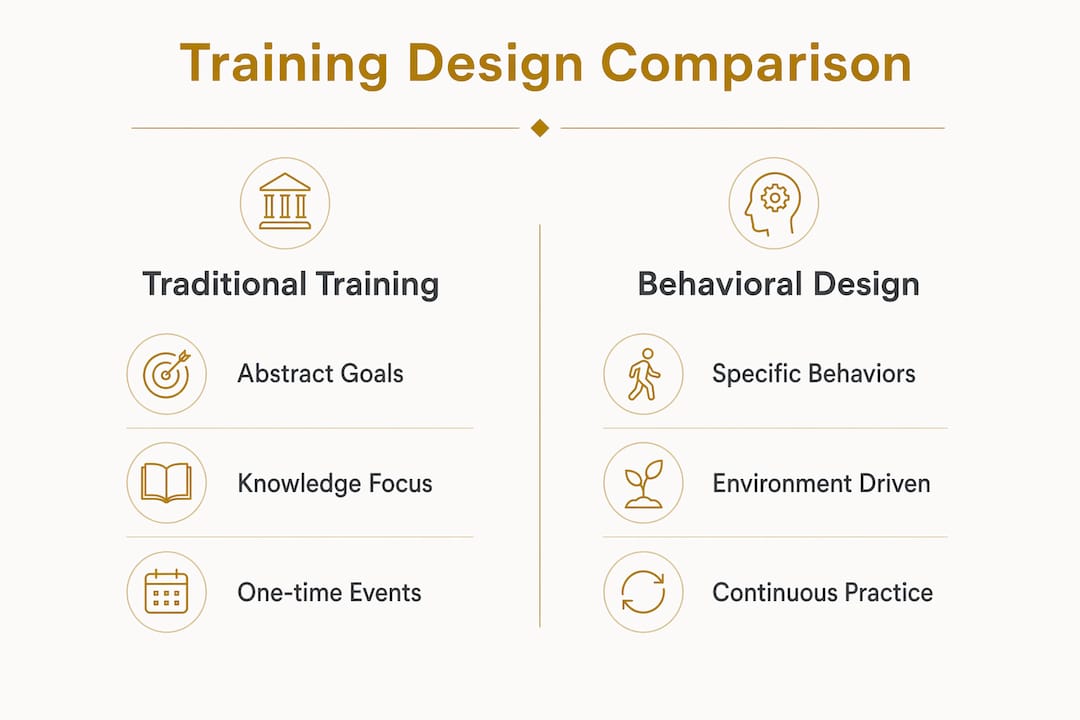
Effective behavioral design starts with decomposing abstract goals into specific, observable behaviors. "Be a better communicator" is not a behavior. "Ask one clarifying question before responding in every team meeting" is. The more specific the behavior, the easier it is to practice, measure, and reinforce.
- Define observable behaviors. Translate every development goal into a specific action that a third party could observe and count.
- Build implementation intentions. Pair each behavior with a situational trigger so the action becomes automatic over time.
- Design the environment. Remove barriers that make the desired behavior harder than the default. Add cues that prompt it.
- Create reinforcement loops. Schedule weekly check-ins rather than quarterly reviews. Behavioral change requires continuous reinforcement; annual check-ins are insufficient for habit formation.
- Use social learning. Managers who model target behaviors and provide immediate positive reinforcement dramatically increase the likelihood that employees adopt those behaviors.
The table below compares traditional training design with a behavioral design approach across four dimensions.
| Dimension | Traditional training | Behavioral design |
|---|---|---|
| Goal format | Abstract competency | Specific observable action |
| Reinforcement schedule | Quarterly or annual | Weekly or daily |
| Environment role | Ignored | Actively redesigned |
| Success measure | Knowledge test score | Behavior frequency count |
Pro Tip: Piggybacking new behaviors onto existing team rituals, such as adding a two-minute reflection to a standing Monday meeting, lowers cognitive barriers and increases adoption without requiring extra time on anyone's calendar.
How does behavioral science improve employee engagement?
Engagement is not a feeling. It is a pattern of repeated behaviors shaped by context, relationships, and the design of daily work. Engagement programs have kept global scores around 20–23% for more than 20 years because they address attitudes while leaving the work environment unchanged. Changing how employees feel without changing what they experience each day produces no lasting shift.
The SUE Influence Framework maps four forces that either facilitate or block engagement behaviors: Pains, Gains, Comforts, and Anxieties. Most programs focus on Gains, the benefits of being engaged, while ignoring Comforts, the existing habits that feel safe, and Anxieties, the fears that make new behaviors feel risky. Mapping these four forces before launching any program is the diagnostic step most organizations skip entirely.
Psychological safety is the environmental condition that makes engagement behaviors possible. Google's Project Aristotle identified psychological safety as the strongest predictor of team performance, outperforming individual talent, experience, and every other team quality measured. Without it, employees will not speak up, take risks, or invest discretionary effort, regardless of how well the training was designed.
"The most effective engagement strategies do not ask employees to feel differently. They redesign the moments, routines, and relationships that make engaged behavior the path of least resistance."
Measuring engagement through behavioral indicators rather than annual surveys gives HR leaders real-time data. Track behaviors like voluntary knowledge sharing, frequency of peer feedback, and participation in development activities. These signals are more predictive of retention and performance than any attitude survey score. For a structured approach to hiring for behavioral fit, the same behavioral indicators used in development programs can inform how organizations select for engagement-prone candidates from the start.
What does the evidence say about behavioral interventions at work?
A 2026 study on cognitive-behavioral interventions in workplace training produced results that should change how HR designs programs. The intervention group showed a sustained gain of approximately +2.4 scale points in training self-efficacy compared to the control group. Self-efficacy, the belief that one can successfully perform a task, is one of the strongest predictors of actual skill transfer.
The same study found that behavioral experiments reduced learning anxiety and improved knowledge test performance in the intervention group versus the control. Anxiety is a behavior blocker that most training designs ignore entirely. Addressing it directly, through structured practice and belief-testing exercises, produces measurable gains in both learning outcomes and job satisfaction.
Implementation intentions show similarly strong results in field settings. When employees write specific if-then plans for development goals, follow-through rates increase dramatically compared to groups that set goals without situational triggers. The mechanism is straightforward: the trigger does the cognitive work of remembering, so the employee only has to execute.
Environment redesign produces the most durable results of all three intervention types. When organizations change the physical or social context in which a behavior is supposed to occur, such as placing feedback prompts in project management tools or building reflection into meeting agendas, behavior transfer from training to the job improves significantly. The future of leadership development depends on organizations treating environment design as a core competency, not an afterthought.
Practical steps for embedding behavioral science in your programs
HR leaders and organizational leaders can apply behavioral science principles without a psychology degree. The methods are practical, repeatable, and measurable.
- Run a behavioral diagnosis first. Map the four forces (Pains, Gains, Comforts, Anxieties) for the target behavior before designing any intervention. Most programs fail because they skip this step and design for the behavior they wish employees had, not the one they actually have.
- Write behavior goals in observable terms. Every development objective should pass the "video test": if you recorded someone doing it, would you see it clearly? If not, the goal is too abstract.
- Assign implementation intentions in the first session. Have participants identify the specific situation that will trigger the new behavior. This takes five minutes and measurably increases follow-through.
- Redesign at least one environmental cue. Add a prompt to an existing tool, meeting, or routine that makes the desired behavior easier to remember and execute.
- Build weekly reinforcement into manager workflows. Managers who coach employees to greatness check in on specific behaviors weekly, not quarterly. Brief, frequent feedback loops outperform long, infrequent reviews for behavior change.
- Track behavioral indicators, not just attitudes. Count observable behaviors: feedback conversations held, development activities completed, peer learning sessions attended.
Pro Tip: Self-Determination Theory shows that autonomy, competence, and relatedness drive sustained motivation. Give employees real choice in how they pursue development goals, and watch follow-through improve without any additional incentive.
Key Takeaways
Behavioral science in employee development works because it targets the environment, triggers, and reinforcement loops that drive actual behavior, not just the intentions behind it.
| Point | Details |
|---|---|
| Intentions are unreliable | Good intentions predict behavior only 30% of the time without structured environmental support. |
| If-then planning works | Implementation intentions can double or triple follow-through on development goals versus standard goal-setting. |
| Environment beats motivation | Redesigning cues and reducing friction produces more durable behavior change than any motivational intervention. |
| Engagement is behavioral | Sustained engagement requires redesigning daily routines and moments, not just improving attitudes. |
| Measure behaviors, not feelings | Tracking observable behaviors gives HR leaders more predictive data than annual engagement surveys. |
What most HR leaders still get wrong about behavior change
The field has known for decades that knowledge transfer does not equal behavior change. Yet the majority of corporate development budgets still fund one-day workshops, e-learning modules, and competency frameworks that measure what employees know rather than what they do. I find this gap genuinely puzzling, and I think it comes down to one thing: behavior change is harder to design and harder to measure than a training completion rate.
What I have seen work, consistently, is the combination of specific behavioral goals, situational triggers, and weekly manager reinforcement. None of those three elements is expensive. All three require discipline. The organizations that treat development as an ongoing behavioral practice rather than a periodic event see compounding returns. Employees build habits. Managers build coaching skills. The culture shifts because the daily environment shifts.
The uncomfortable truth is that most engagement and development programs are designed to make HR look active rather than to make employees behave differently. Mapping the four forces before designing a program, writing if-then plans in the first session, and tracking behavioral indicators instead of survey scores are all things any team can do starting next week. The science is not the barrier. The willingness to measure what actually matters is.
— Drew
How Leaderlyapp supports behavioral science in leadership development
Leaderlyapp is built on the premise that leadership development works only when it changes behavior, not just knowledge. The platform delivers personalized microlessons that apply behavioral science frameworks directly to daily leadership practice, with content that adapts as each leader's habits evolve.
HR leaders and organizational leaders who want to move beyond one-time training events can use Leaderlyapp to build the reinforcement loops, behavioral cues, and progressive coaching check-ins that the research consistently supports. The platform's people-centric leadership development resources give teams a structured path from abstract competency goals to specific, measurable behaviors. For organizations ready to find and grow leaders from within, Leaderlyapp's internal leadership training tips offer a practical starting point grounded in behavioral design.
FAQ
What is behavioral science in employee development?
Behavioral science in employee development is the application of psychology and behavioral research to design workplace learning that changes what employees actually do, not just what they know. It uses techniques like implementation intentions, environmental design, and reinforcement loops to close the gap between training and on-the-job behavior.
Why do most employee training programs fail to change behavior?
Less than 10% of training content transfers to workplace behavior because most programs treat development as a knowledge problem rather than a behavior-design problem. Without environmental cues, implementation intentions, and frequent reinforcement, employees return to existing habits within days of any training event.
What is an implementation intention and how does it help?
An implementation intention is an if-then plan that links a specific situation to a specific behavior, such as "If I finish a meeting, then I will share one piece of feedback." Research shows this approach can double or triple follow-through rates compared to standard goal-setting alone.
How does psychological safety relate to employee engagement?
Psychological safety is the environmental condition that makes engagement behaviors possible. Google's Project Aristotle found it outperforms every other team quality as a predictor of performance, meaning no development program will produce full engagement without it.
How should HR measure the impact of behavioral science programs?
HR leaders should track observable behavioral indicators such as feedback conversations held, peer learning sessions attended, and development activities completed, rather than relying solely on attitude surveys. Behavioral data is more predictive of retention and performance than self-reported engagement scores.