
Practical, practice-based training that pairs core people-management modules with compliance basics and real on-the-job application builds competent managers faster than any lecture series. The fastest route runs through spaced microlearning platforms like Leaderly AI, live role-play, and a structured 30-60-90 plan that turns lessons into habits. Pick one behavior to practice this week. A scripted one-on-one is a good start, and build from there.
TL;DR:
- Training must emphasize behavior change through repetition, practice, and real on-the-job application rather than relying solely on single workshops or lectures.
- Effective programs include live role-plays, microlearning, cohort-based scenarios, and ongoing coaching, which sustain growth beyond initial training.
- Focus on critical modules such as leadership mindset, delegation frameworks, feedback skills, and compliance to prevent costly mistakes and performance gaps.
- A structured 30-60-90 plan helps new managers build rapport, deliver quick wins, and set measurable goals within their first three months.
- Prioritize immediate compliance training, ongoing reinforcement, and behavior measurement to ensure lasting skill development and team impact.
Table of Contents
- What Should First Time Manager Training Cover?
- Which Training Formats Actually Change Behavior?
- A Practical 30-60-90 Plan New Managers Can Use Now
- How Do You Choose the Right Manager Training Program?
- What Evidence Backs This Approach?
- Time Management and Prioritization for New Managers
- Common Challenges First Time Managers Face
- Building Team Culture and Trust From Day One
- Why Ongoing Development Beats a One-Time Course
- Getting Started With Leaderly AI
- Sources
What Should First Time Manager Training Cover?
Good first time manager training isn't a single workshop. It's a curriculum built around the specific behaviors that separate someone who supervises from someone who leads. Skip any of these modules and you leave a gap someone on the team will eventually fall through.
Leadership mindset and the role shift. New managers keep doing the job they were promoted out of, because that's where they feel competent. Training has to name this pattern directly and replace it with a new definition of success: your output is now your team's output.
Delegation and empowerment. This means teaching a real decision framework, not just "let go more." A useful checklist covers task complexity, the employee's current skill level, the cost of a mistake, and how much oversight the task actually warrants. A guide on how to delegate effectively breaks this into ten concrete tips rather than abstract principles.
Feedback and difficult conversations. Structured frameworks measurably increase the odds a manager addresses a performance problem instead of avoiding it, according to Champlain College's guidance on constructive feedback. Role-play matters here more than almost anywhere else in the curriculum: reading a feedback script silently and delivering it under mild social pressure are two different skills entirely.
Coaching and development. New managers need a repeatable one-on-one rhythm, weekly or biweekly, with a simple template covering wins, blockers, and growth.
Performance management. Goal setting, tracking outcomes, and calibrating expectations across a team.
Emotional intelligence and psychological safety. Regular one-on-ones and specific listening behaviors increase team openness and performance, according to SHRM research on leadership practices.
Change communication. Especially now, as AI tools reshape workflows, managers need concise scripts for explaining "what's changing and why" without triggering panic.
Compliance and operational basics. New managers must know enough about harassment prevention, leave management, and wage and hour rules to spot a risk before it becomes a legal problem. This is often the most neglected module and the one with the highest downside if skipped.
Which Training Formats Actually Change Behavior?
Format matters as much as content. A brilliant curriculum delivered as a single all-day workshop mostly evaporates within two weeks. Behavior change requires repetition, spaced over time, with chances to apply the skill and get corrected.
- Microlearning. Short, spaced lessons, five to ten minutes, delivered over weeks rather than crammed into a day. This format works because it matches how skill actually forms: small repeated exposures beat one large dose.
- Blended learning. E-learning modules combined with live workshops. Effective new manager programs combine people-management fundamentals with operational topics and spaced reinforcement rather than relying on a single event.
- Cohort-based workshops. Groups of new managers working through scenarios together, which normalizes the awkwardness of learning to lead.
- Mentoring and coaching. Ongoing support from someone senior. Peer-cohort and mentoring relationships are what sustain growth after the formal training ends.
Pro Tip: Front-load compliance and harassment-prevention training in the first week after promotion, before anything else. A new manager who doesn't know the basics of a leave request or a harassment complaint is one incident away from a serious mistake.
Rollout timing follows a pattern regardless of format: compliance basics immediately, fundamentals by day 30, applied quick wins by day 60, and full operational fluency by day 90, with reinforcement continuing well past that. Small organizations can pilot a program in two to four weeks; enterprise rollouts with multiple cohorts typically need six to twelve weeks to sequence properly. Live practice and instructor feedback, not passive video-watching, is what separates programs that stick from ones that don't.
A Practical 30-60-90 Plan New Managers Can Use Now
Training only matters once it hits the job. A 30-60-90 plan bridges the gap between what you learned and what you actually do on a Tuesday morning, and structured versions of this framework consistently outperform vague "get to know your team" advice.
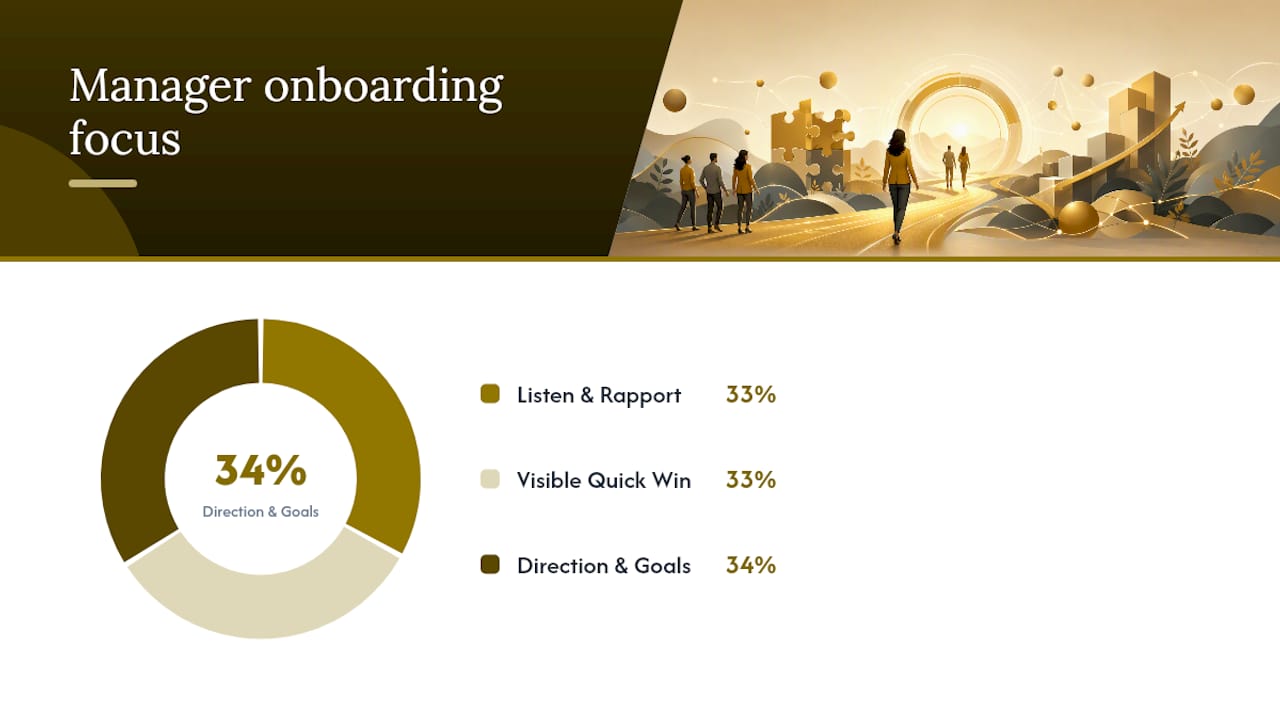
Days 1 to 30: listen and build rapport. Run individual one-on-ones with every direct report. Ask: "What's working well right now?" "What's slowing you down?" "What do you need from me that you're not getting?" How you introduce yourself in these early conversations shapes how quickly the team accepts your leadership.

Days 31 to 60: land one visible quick win. Pick a small process fix your team has complained about, something fixable in two weeks, and announce it publicly. This buys credibility faster than any speech about your vision.
Days 61 to 90: set direction and measurable goals. Establish team metrics, a regular check-in cadence, and start handing off tasks you've been holding onto.
Delegation checklist for week one:
- List every task currently sitting only on your plate.
- Flag which ones a direct report could own with light coaching.
- Assign one this week and set a specific check-in date.
Pro Tip: Your micro-practice exercise for this week: script one difficult feedback conversation you've been avoiding, and deliver it before Friday.
A breakdown of managing your time as a manager pairs well with this plan for readers who want deeper guidance on the delegation piece specifically.
How Do You Choose the Right Manager Training Program?
HR leaders evaluating vendors or building an internal program need a short list of hard questions, because glossy course catalogs rarely reveal whether a program changes behavior.
- Does it include live practice, not just content? Role-play and reinforced scenarios are what separate programs that stick from ones that don't, as noted above. Ask for a sample agenda and confirm role-play is built in, not optional.
- Does it cover compliance and operational basics? A program that skips harassment prevention, leave rules, and wage and hour basics leaves a real gap. SHRM's certification resources are a useful benchmark for what HR-aligned compliance coverage should look like.
- Is there mentoring or coaching after the formal sessions end? Ask specifically how reinforcement happens in week 6, week 10, week 16.
- Can outcomes be measured? Push vendors past "completion rates." Ask about changes in one-on-one consistency, feedback frequency, and team engagement scores, the kind of behavior-level metrics that actually indicate change.
- Does it flex to role and industry? A retail supervisor and a software team lead need overlapping but not identical training.
Track early success signals over the first quarter: are one-on-ones happening consistently, is feedback frequency rising, and has voluntary turnover on the new manager's team held steady or improved.
What Evidence Backs This Approach?
The design principles behind effective first time manager training aren't guesswork. Blended delivery with spaced reinforcement outperforms one-off workshops because skill retention depends on repeated, spaced exposure rather than a single dose of content. Programs mixing microlearning with live role-play and coaching produce faster, measurable behavior change than lecture-based courses alone, and mentoring sustains that growth long after the formal sessions wrap.
Some platforms build around these same principles: microlessons delivered on a spaced schedule, behavioral exercises tied to real scenarios, and assessments that adapt as a manager's skills develop. Readers looking for a concrete rollout example can review a remote leadership pilot plan, which walks through applying these principles over a single quarter.
Time Management and Prioritization for New Managers
New managers lose more hours to reactive firefighting than almost any other habit. The fix isn't a better to-do list, it's a different filter for deciding what deserves your attention today.
Start with a simple triage: urgent-and-important tasks get done now, important-but-not-urgent tasks get scheduled (this is where coaching and planning live and where most new managers under-invest), and everything else gets delegated or dropped. The trap most first-time managers fall into is treating every request from a direct report as urgent, because saying "later" feels like poor leadership. It isn't. It's the only way to protect time for the coaching and planning work that actually defines the role.
Block calendar time for one-on-ones before anything else fills the week. If they're the first thing to get bumped when a deadline hits, they'll eventually stop happening altogether, and that's exactly when problems start surfacing too late to fix cheaply.
Batch similar tasks. Approvals, status updates, and email responses eat time in small interruptions throughout the day; grouping them into two fixed windows protects the rest of your schedule for actual decision-making. Leaderlyapp's guide to managing your time as a manager walks through a fuller version of this system, and Clock-Me's manager training guide offers additional frameworks for applying prioritization to performance conversations specifically.
Common Challenges First Time Managers Face
Most new managers hit the same handful of walls, and knowing them in advance cuts the time it takes to climb over.
The most common one: peer relationships get complicated. Someone who was a friend yesterday now reports to you today, and pretending nothing changed usually backfires. Address it directly in a private conversation rather than letting the awkwardness linger unspoken.
Second: the urge to keep doing the old job. Especially in the first month, when the new responsibilities feel unfamiliar and the old ones still feel comfortable. This is where a mentor or coach earns their value, by calling out the pattern before it calcifies into a habit.
Third: avoiding hard conversations. New managers often let a performance problem slide for months because confrontation feels riskier than tolerance. It's the opposite. Delayed feedback almost always costs more, in team morale and in the eventual conversation's difficulty, than an early, direct one would have.
Fourth: decision paralysis under ambiguity. No one hands a new manager a manual for every judgment call. Build a habit of making a reasonable decision with available information rather than waiting for certainty that never arrives. An overview of common challenges in new leadership roles covers several more patterns worth reading before, not after, they show up on your team.
Building Team Culture and Trust From Day One
Culture isn't a poster on the wall or a values statement in the employee handbook. It's the sum of what a manager tolerates, rewards, and models every single day, and new managers shape it faster than they realize, for better or worse.
Trust builds through consistency more than through any single grand gesture. A manager who follows through on small commitments, showing up to the one-on-one, remembering what someone said last week, closing the loop on a promised fix, earns more credibility over three months than one who makes a big speech about "open doors" and then disappears into back-to-back meetings.
Psychological safety is the specific ingredient that lets a team surface problems early instead of hiding them until they explode. Concretely, that means responding to a mistake with curiosity ("walk me through what happened") instead of blame, and it means a manager admitting their own mistakes out loud, not just tolerating other people's. Leaders who build psychological safety see measurably higher team openness and performance as a result.
For a fuller framework on the specific behaviors that build this kind of trust, a guide on cultivating people centricity is worth a closer read.
Why Ongoing Development Beats a One-Time Course
The biggest mistake organizations make with new managers is treating training as a checkbox, one workshop, one certificate, done. That's backwards. The managers who actually improve team retention and performance are the ones who keep practicing, keep getting coached, and keep revisiting the fundamentals months after the initial course ends.
Measured behavior changes, feedback frequency, one-on-one consistency, delegation follow-through, are what predict whether a team thrives under a new manager. Course completion certificates predict almost nothing on their own. If you're an HR or L&D partner reading this, the honest question to ask isn't "did they finish the course." It's "did their team's engagement scores move six months later."
Pilot a blended program with a small cohort, measure what actually shifts in manager behavior, and expand from there.
— Drew
Getting Started With Leaderly AI
Some leadership development platforms are built around the same principles this article just laid out: spaced microlessons instead of one-off workshops, behavioral exercises instead of passive slides, and assessments including DiSC, EQ, and MBTI that adapt as a manager's skills develop. Where a traditional training vendor hands you a static course catalog, some platforms provide content that evolves with each person's actual progress, so a manager struggling with delegation gets different reinforcement than one struggling with feedback conversations.
The platform maps directly onto the curriculum in this article: microlearning for the core modules, tailored journeys for individual skill gaps, and analytics dashboards so HR can see which behaviors are actually shifting, not just who finished a module. If you're an HR or L&D leader trying to build the program described here without building it from scratch, start by reviewing an approach to developing leadership skills and people centricity and requesting a walkthrough for your organization.
Sources
- 8 elements of first-time manager training in 2026
- New Manager Training Programs That Work | Vekuri
- A Practical Guide to New Manager Training in 2026
- 4 ways leaders can build psychological safety
- Introducing yourself as the new manager | HBR