
Adaptive learning personalizes training to each employee's existing knowledge and pace, which shortens time-to-competency and improves what people actually retain and apply on the job. One example of this approach built for the workplace pairs machine-driven personalization with short practice exercises. The move that matters most for managers is starting small: a pilot tied to one measurable performance indicator, with a manager actively reading the signal data, not a platform rollout left on autopilot.
TL;DR:
- Adaptive learning's effectiveness depends on carefully selecting a pilot cohort based on data, not reputation, to ensure measurable productivity or performance gains.
- Content must be properly tagged, with regular model updates and transparency in recommendations, to prevent errors or unfair biases in adaptive pathways.
- The success of microlearning modules relies on short, skill-mapped cycles and consistent coaching integration, not just platform participation or completion rates.
- Managers need to own and reinforce adaptive training outcomes through ongoing feedback and targeted micro-practices, rather than relying solely on platform automation.
- Using a platform like Leaderly AI can streamline implementation and provide analytics for tracking progress, but human oversight remains essential for meaningful results.
Table of Contents
- What adaptive learning is and how it works in corporate settings
- Benefits and measurable outcomes managers can use to justify adaptive learning
- Practical, staged implementation plan: pilot to scale
- Technology and ethical considerations managers must assess
- What the evidence says: key studies and actionable implications
- Managers should own adaptive learning outcomes, not just approve the budget
- Leaderly AI: a practical way to run adaptive leadership development
- Primary sources and recommended reading
- Sources
- FAQ
What adaptive learning is and how it works in corporate settings
Adaptive learning is a training method that adjusts content, pacing, and difficulty to each learner based on what they already know and how they perform along the way. Instead of pushing every employee through the same fixed course, the system runs a loop: it assesses a learner, builds a model of their current skill level, applies rules to select or sequence content, delivers that content, then updates the model based on what the learner does next.
That loop shows up in corporate training as a few concrete behaviors. A new hire who aces a diagnostic quiz on customer objections skips straight to advanced scenarios, while a struggling colleague gets a remediation module before moving forward. Pacing flexes too: some employees move through a leadership module in one sitting, others spread it across a week of short sessions. Mastery gates stop a learner from advancing until a quiz or practical task confirms they've actually absorbed the material, rather than simply clicking through slides.
If you're evaluating a vendor or scoping an internal build, expect these technical building blocks:
- Diagnostic assessment: a short pretest or skills check that places each employee at an appropriate starting point.
- Content tagging: every lesson, video, or exercise is labeled by skill, difficulty, and format so the system can match content to need.
- Learner model: a continuously updated profile of each person's strengths, gaps, and pace, refined after every interaction.
- Analytics layer: dashboards that show completion, time-to-competency, and performance trends by team or cohort.
Formative assessment, the small check-ins that happen during learning rather than at the end, is what makes the feedback loop work. Practical guidance on designing these checkpoints treats them as diagnostic tools managers can use to spot gaps before they show up in performance reviews. Without that loop, a platform labeled "adaptive" is really just a content library with a search bar.
Benefits and measurable outcomes managers can use to justify adaptive learning
The business case for adaptive learning rests on a few outcomes you can actually track: faster time-to-competency, better retention of material, less wasted cognitive effort, and in some cases measurable productivity gains.
A recent quasi-experimental study found that adaptive microlearning significantly improved learning adaptability while reducing unnecessary cognitive load compared with conventional microlearning, according to research on adaptive microlearning for in-service personnel. In plain terms, employees learned to adjust faster and expended less mental effort fighting with the format of the material itself, leaving more capacity for the actual skill being taught.
On the allocation side, a randomized controlled trial on managerial training found that supervisors who were not initially recommended by middle managers saw a substantial productivity increase relative to controls once trained, according to NBER's working paper on managerial training allocation. Supervisors who were already highly recommended showed retention gains instead, with treated supervisors being notably less likely to quit than controls, but no additional productivity lift. The lesson for managers running a pilot: who you select for training determines what outcome you'll see, and nomination bias can quietly erase measurable ROI.
To turn these findings into a business case, map each outcome to a KPI you already track:
- Completion and time-to-competency: compare how long it takes pilot participants to hit a defined skill benchmark versus the prior cohort.
- Performance metrics: tie specific skills (objection handling, delegation, feedback delivery) to measurable changes in output or quality scores.
- Retention and turnover: track whether trained employees, especially those overlooked for past opportunities, stay longer.
- Engagement signals: monitor voluntary completion rates as a proxy for whether the content feels relevant.
Practical, staged implementation plan: pilot to scale
A pilot that proves nothing wastes everyone's time, so the sequence matters as much as the content.
- Pick a narrow objective and a cohort likely to show real movement. The NBER findings suggest looking past the obvious high performers: supervisors who haven't been flagged as stars often have the most room to show a productivity gain.
- Baseline everything before you start. Run a diagnostic assessment and record current performance metrics so you have a true before-and-after comparison, not a guess.
- Build or select short, mapped content cycles. Tie each micro-module to one skill and one assessment checkpoint rather than a sprawling curriculum. Guidance on structuring microlearning covers how to size these cycles so they fit into a workweek instead of competing with it.
- Set a coaching cadence. Managers should reference pilot progress in existing one-on-ones rather than treating the platform as a separate obligation.
- Communicate the why before launch. Resistance drops when employees understand what's in it for them, not just that participation is mandatory.
- Define scale criteria up front. Before expanding beyond the pilot, settle who owns the data, how content gets refreshed, and whether a vendor's service agreement covers the support level you'll need at full scale.
Pro Tip: Run the pilot for one full performance cycle, not just until completion rates look good, since completion without a performance signal tells you nothing about transfer.
The build-versus-buy question usually comes down to content pipeline capacity. An internal team can tag and maintain content for a narrow use case, but scaling adaptive paths across departments requires a steady stream of fresh, properly tagged material, which is where most homegrown efforts stall. A platform with an established microlearning library and analytics removes that bottleneck, though the governance questions (who approves content, who owns the data, how performance gets reported to leadership) still need answers regardless of who builds the system.

Technology and ethical considerations managers must assess
Before approving any adaptive learning tool, whether built internally or bought, a manager needs answers to a short list of hard questions.
- How is content grounded? Ask whether the system anchors its recommendations to verified material or lets a generative model free-associate, since ungrounded sequencing in technical subjects risks confidently wrong answers.
- How often is the model updated, and based on what signal? A learner model that only refreshes weekly will lag behind someone who's clearly stuck or clearly ready to advance.
- Can the vendor explain why a given employee got a given recommendation? If the answer is a shrug, you have no way to audit fairness or catch a broken rule.
- What data does the system collect, and who can see it? Require data minimization and clear access controls before any personal performance data leaves your team.
- What's the human oversight model? No system should run unsupervised changes to an employee's development path without a manager able to review and override it.
The risk of grounding shows up most sharply in technical domains. Research on an intelligent tutoring architecture called LEARNERCOMPASS found that combining multiple models with a structured knowledge graph reduced hallucination rates in adaptive sequencing, compared with relying on a single generative model alone. For a manager, that translates to a concrete vendor question: ask what grounding mechanism prevents the system from inventing plausible-sounding but wrong guidance in a technical module.
Ethical guidelines from the European Commission recommend transparency, ongoing monitoring, fairness checks, and incremental rollout for any AI system used in teaching and learning, with a willingness to step back if unintended consequences appear. Treat that as a floor, not a ceiling, for any workplace deployment.
What the evidence says: key studies and actionable implications
Three bodies of evidence point in the same direction: personalize the content, target the right people, and keep a human checking the machine's work.
The clearest mechanism comes from the quasi-experimental study on adaptive microlearning, which tied real-time feedback and adaptive content paths directly to lower cognitive load and higher learning adaptability. The practical implication is straightforward: build pilots around short adaptive modules with frequent, immediate feedback rather than long-form content with a single end-of-course quiz.
Treated supervisors who were not top-recommended by middle managers saw a 12% productivity increase relative to controls, while highly recommended supervisors saw retention gains instead.
NBER working paper on the allocation and impacts of managerial training
That finding is a warning against letting nomination bias quietly drive who gets access to training, since the people managers assume need it least may be the ones who show the clearest productivity gain.
| Source | Finding | Manager implication |
|---|---|---|
| PMC quasi-experimental study | Adaptive microlearning reduced cognitive load and raised learning adaptability | Use short, adaptive modules with real-time feedback |
| NBER working paper | Less-recommended supervisors gained 12% productivity; highly recommended ones gained retention | Select pilot cohorts with data, not reputation |
| LEARNERCOMPASS (ACL 2026) | Multi-model, graph-grounded design reduced hallucination in adaptive sequencing | Require grounding evidence from any AI-driven vendor |
Each of these points to the same operating principle: the technology can personalize the path, but a manager still has to choose who walks it and verify the machine isn't guessing.
Managers should own adaptive learning outcomes, not just approve the budget
Adaptive learning platforms can personalize content, but they can't run a one-on-one, notice when someone's stuck, or reinforce a habit in the middle of a real meeting. That part is still the manager's job, and treating the software as a replacement for coaching is where most programs quietly fail.
The fix is simple to describe and harder to practice: fold micro-practice into rituals you already run. A two-minute module on giving direct feedback means nothing without a manager asking about it in the next one-on-one. Frequent, specific feedback is what turns a completed module into an actual habit, and that reinforcement has to come from a person, not a notification.
Own the outcome, not just the enrollment number.
— Drew
Leaderly AI: a practical way to run adaptive leadership development
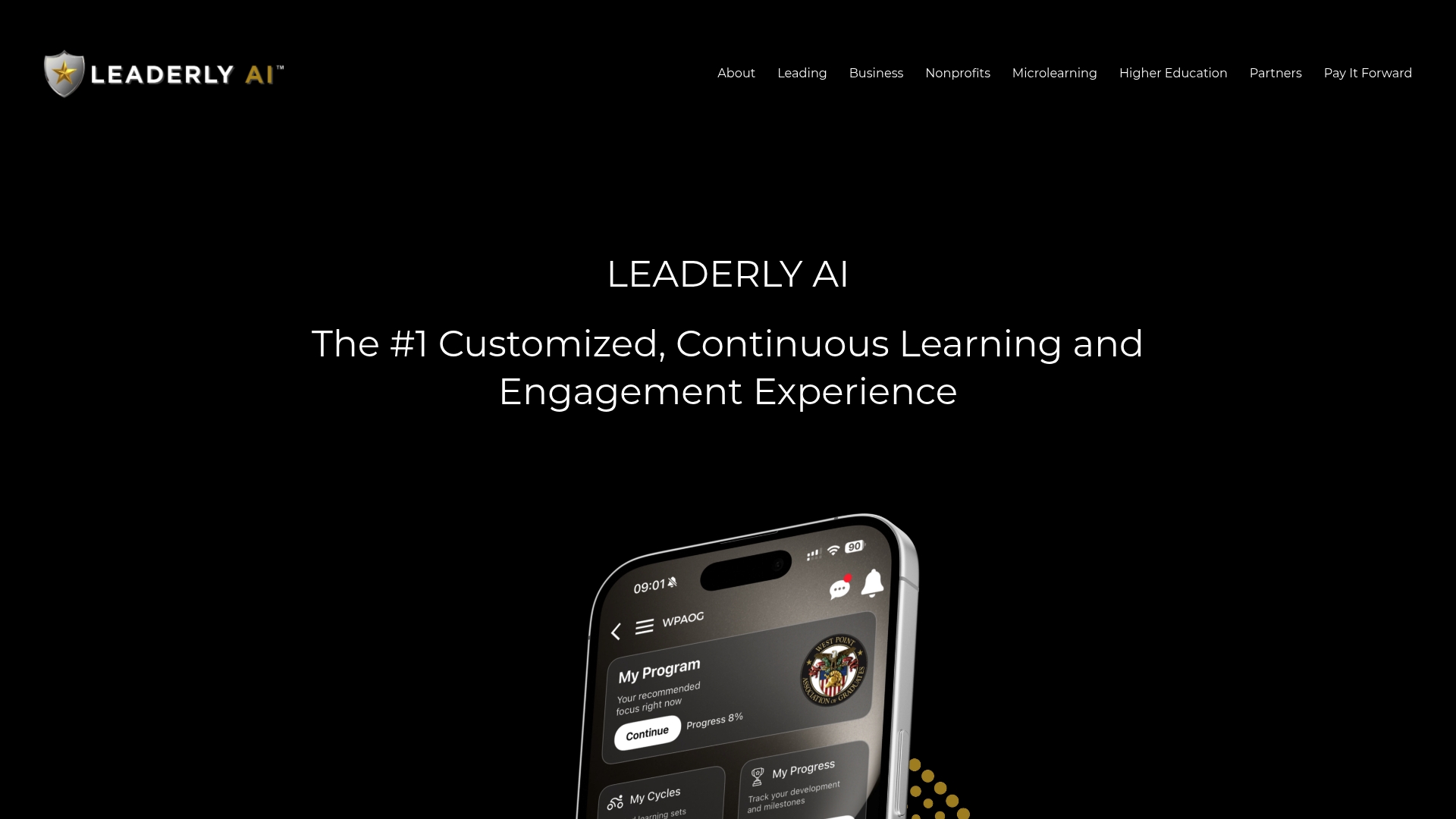
Running the playbook above from scratch, diagnostics, content tagging, an analytics layer, and a feedback loop, is a lot to build in-house for most HR teams. Leaderly AI packages those pieces into a single platform: personalized microlessons that adjust to each employee's pace, machine learning driven pathways instead of a fixed curriculum, and behavioral practice exercises built to turn a lesson into a repeatable habit.
For managers ready to test the approach, the same pilot structure from this guide applies directly:
- Start with one cohort and one measurable KPI, such as time-to-competency on a specific skill.
- Use the platform's analytics dashboard to track completion and performance trends against your baseline.
- Fold weekly progress into existing one-on-ones rather than treating it as a separate task.
Organizations scaling this across a workforce can review enterprise deployment options, while nonprofits and higher education institutions have dedicated program pages built around their specific staffing and budget realities. The next step is a direct look at the platform itself, not another spreadsheet of vendor claims.
Primary sources and recommended reading
For managers who want to verify the claims above: the PMC study on adaptive microlearning, the Scientific Reports article on cognitive load, the NBER working paper on managerial training, European Commission ethical AI guidelines, and the LEARNERCOMPASS paper on grounded AI sequencing. For a manager-enablement angle on AI adoption, see this analysis on AI manager enablement.
Sources
- Optimizing cognitive load and learning adaptability with adaptive microlearning for in-service personnel (PMC)
- On the allocation and impacts of managerial training (NBER working paper)
- Ethical guidelines on the use of artificial intelligence (AI) and data in teaching and learning
- LEARNERCOMPASS: Intelligent Tutoring System with Dynamic Cognitive Diagnosis and Multi-Model Path Planning (ACL 2026)
- Optimizing cognitive load and learning adaptability with adaptive microlearning for in-service personnel (Scientific Reports / Nature)
FAQ
Can you give me an example of adaptive learning?
A common example is a training module that gives an employee a short diagnostic quiz, then routes them to advanced material if they score well or to a remediation lesson if they don't. Platforms built around adaptive microlearning use this pattern with short sessions and real-time feedback rather than one long fixed course.
What is the 70-20-10 rule for employee development?
The 70-20-10 model is a common framework suggesting that people develop roughly through on-the-job experience, learning from others, and formal training, though exact proportions vary by source, so treat it as a rough allocation guide rather than a fixed formula.
What are the three main components of adaptive learning?
Most adaptive systems rely on an assessment step to place the learner, a learner model that tracks their skill and pace over time, and a content engine that selects or sequences material based on that model. A feedback loop then updates the learner model after each interaction, which is what separates adaptive systems from a static course.
What are some examples of adaptive skills in the workplace?
Adaptive skills in the workplace include adjusting communication style to a given audience, shifting priorities when a project scope changes, and applying feedback quickly to correct a mistake. These skills are often the target of adaptive training programs because they're hard to teach with a single fixed lesson and benefit from repeated, personalized practice.