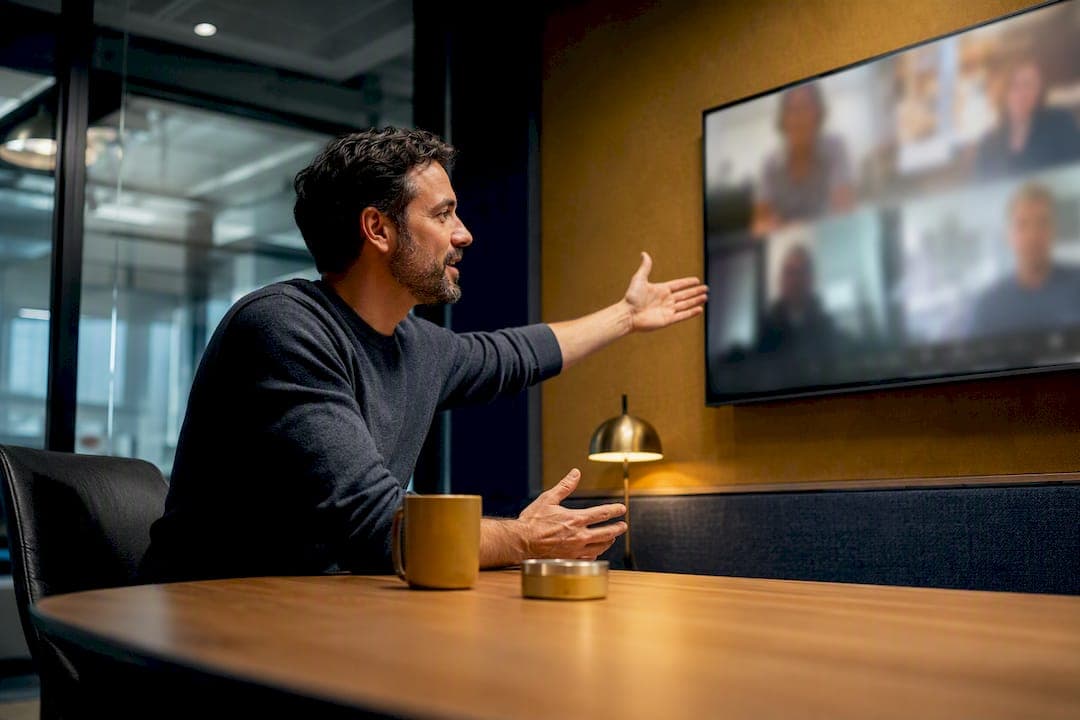
Remote leadership training teaches managers to build trust without proximity, set clear operating norms, diagnose engagement problems before they become resignations, and run decisions and meetings that respect distributed schedules. The best programs pair short lessons with applied projects, cohort feedback, or coaching so the skills stick. Managers leading hybrid or fully remote teams, and the HR leaders who select training for them, benefit most.
TL;DR:
- Effective remote leadership training emphasizes trust building, communication norms, clear accountability, and early diagnosis of engagement issues.
- Programs vary from short microlearning to intensive cohort courses, with applied projects and measurable behaviors as key success indicators.
- Addressing ongoing challenges like time zone differences, virtual fatigue, and technology barriers is crucial for sustained behavior change.
- Reinforcing training through continuous habits, peer accountability, and regular content updates improves long-term behavioral adoption.
- Internal programs like Leaderly enable organizations to tailor, scale, and measure leadership development beyond generic courses.
Table of Contents
- What Does Remote Leadership Training Actually Teach?
- Formats and Time: What Should You Budget For?
- What Modules Should the Curriculum Cover?
- How to Launch Internal Remote Leadership Training
- Choosing a Program: The Checklist Managers Actually Need
- The Challenges That Make Remote Leadership Different
- How Do You Keep Remote Leadership Training From Fading Out?
- What Metrics Actually Prove Training Worked?
- Why Applied, Team-Based Training Beats Solo Courses
- Leaderly: A Practical Way to Run This Internally
- Where to Go Deeper
- Sources
What Does Remote Leadership Training Actually Teach?
Good programs don't just cover "communication tips." They target four competencies that break down specifically when a team stops sharing a physical room.
Trust and psychological safety top the list because remote teams lose the small, constant signals (a nod, a raised eyebrow, someone lingering after a meeting) that build trust in person. Programs from eCornell frame this as an explicit design problem: managers have to create trust deliberately instead of letting it accumulate.
Communication norms and meeting design come next. Faculty at Harvard Business School Online describe this as shifting from managing by presence to managing by purpose, which means deciding on purpose which conversations happen live, which happen async, and how often. That shift also requires balancing candor with empathy, since a blunt message lands differently in a Slack thread than it does across a desk.
Accountability and decision routines matter because remote teams need explicit agreements about who decides what, and by when, or work stalls waiting on unclear approvals.
Diagnosing engagement rounds out the list. A manager who only sees a flat Zoom grid loses the visual cues that usually flag burnout early.
- Trust and psychological safety exercises for distributed teams
- Meeting and async communication frameworks
- Decision rights and accountability structures
- Engagement diagnostics and early burnout signals
Pro Tip: Ask any program you're evaluating what artifact a manager walks away with. Vague "awareness" is forgettable. A team charter or communication protocol survives the training and shapes real behavior.
The strongest programs pair each topic with an applied assignment. Instead of a quiz, participants draft an actual team charter or run a live decision-making exercise with their own reports.
Formats and Time: What Should You Budget For?
Program length and structure vary more than most managers expect, and picking the wrong format wastes both money and goodwill from your team.
- Microlearning: short daily or weekly lessons, often 5 to 15 minutes, built for habit change rather than credentialing.
- Self-paced modules: flexible, usually a few hours total, good for a single skill gap.
- Cohort-based certificates: structured, weeks-long programs with peer discussion and instructor feedback.
- Executive/specialization programs: the deepest option, often with a capstone project tied to your own team.
Program lengths run from a few hours of short modules up to 12-week executive-style courses requiring roughly 2 to 6 hours a week. That range matters when you're planning around a manager's actual workload, not just their calendar availability.
Credential weight tracks depth. A short certificate signals you completed a curriculum; a cohort program with a capstone and peer review signals you demonstrated the behavior under observation. Employers and internal promotion committees read those differently, so match the format to what you actually need to prove.
What Modules Should the Curriculum Cover?
A remote leadership curriculum earns its price tag when each module maps to something a manager will actually do on Monday morning. Here's what that looks like in practice.
- Trust and psychological safety. Objective: design one recurring ritual (a rotating check-in, an async wins channel) that surfaces problems before they fester.
- Communication norms. Objective: draft a team charter specifying which topics go live, which go async, and expected response windows.
- Accountability and decision rights. Objective: map out a decision log so nobody wonders who has final say on a given call.
- Engagement diagnosis. Objective: build a simple pulse-check routine that flags disengagement before it shows up in exit interviews.
- Remote decision making. Objective: run a live case study deciding a real, current team problem, not a hypothetical one.
- Feedback and coaching skills. Objective: practice a difficult conversation via video, with peer or facilitator critique.
Modules 3 through 6 typically require cohort interaction, applied projects, or 1:1 coaching to work. A self-paced certificate can cover trust and communication basics solo, but decision making and coaching skills need another human in the room, even a virtual one, to give feedback that lands.
How to Launch Internal Remote Leadership Training
You don't have to outsource this entirely. A tight internal pilot, run over one quarter, often beats a generic external course because it's built around your actual team's friction points.
- Assess needs. Survey managers and their direct reports separately. The gaps rarely match.
- Set goals. Pick two or three measurable outcomes, not five vague ones.
- Choose format. Combine microlearning for daily habit reinforcement with a short cohort component for applied practice.
- Run a pilot cohort. Limit it to 8 to 12 managers so feedback stays personal.
- Measure outcomes. Track pulse survey shifts and manager self-assessments before and after.
Personalized microlessons and behavioral habit-building tools help this scale past the pilot without losing the personal feel, since each manager's learning path adjusts based on their own gaps rather than a one-size curriculum. Analytics dashboards then show which teams are actually applying the training, not just clicking through it.
Training doesn't stop at the manager. Organizations that train managers alongside their teams see better adoption, because the whole group co-owns the new norms instead of one person trying to impose them.
Pro Tip: Run the pilot with your most skeptical managers first, not your most enthusiastic ones. If it survives their pushback, it's ready for a wider rollout.
Choosing a Program: The Checklist Managers Actually Need
Skip the marketing copy and ask these questions before you sign a contract or greenlight a vendor.
- Does the program apply to a real team problem, or only hypothetical case studies?
- Is there an applied project, capstone, or deliverable, not just video lectures?
- Is there facilitator or cohort interaction, or is it entirely self-paced?
- Does it include an assessment (360, DiSC, EQ) or coaching component?
- Are outcomes measurable, tied to specific behaviors, not vague "better leadership"?
- What's the actual weekly time commitment, and does it match your managers' bandwidth?
- What happens after the program ends? Is there follow-up or is it one-and-done?
Red flags: lecture-only formats with no application, outcome language so vague it could describe any program, and no mention of assessment or coaching anywhere in the curriculum. Programs that include 360 assessments paired with coaching consistently surface blind spots that self-paced content alone misses.
The Challenges That Make Remote Leadership Different
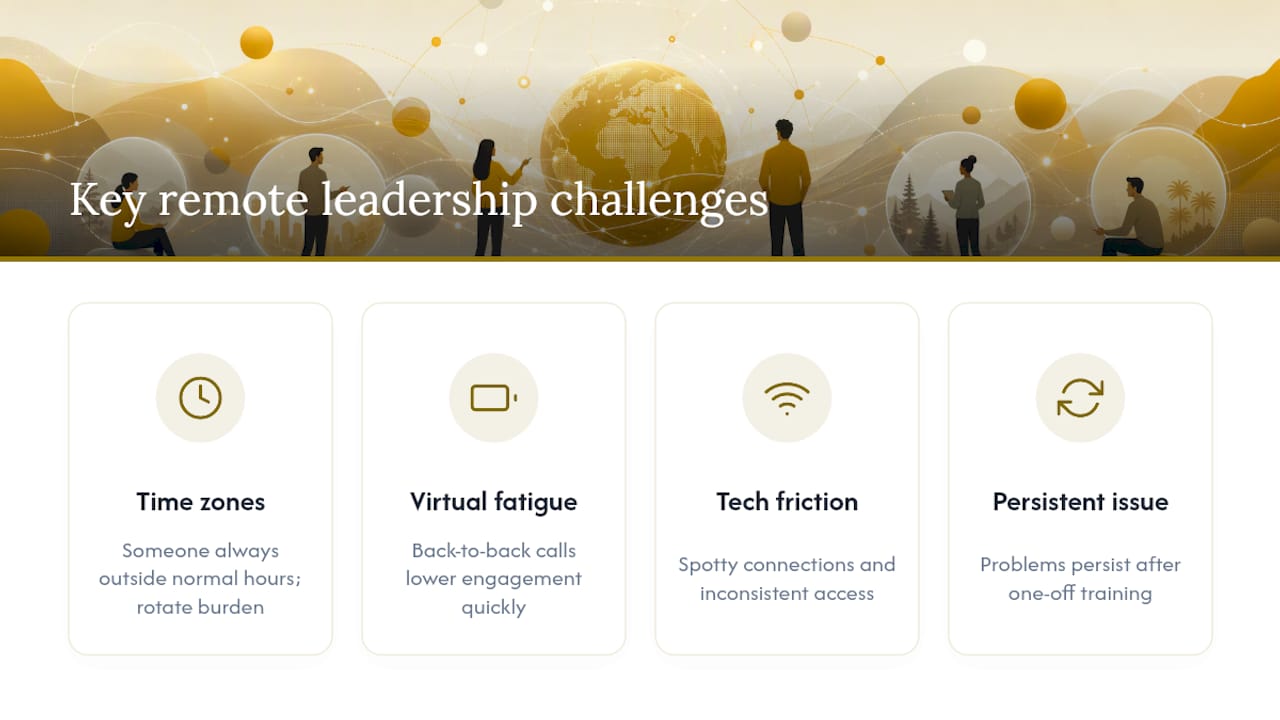
Time zone spread is the most mundane and most underestimated problem. A team split across three or four zones means someone is always attending a meeting outside normal hours, and leaders who don't rotate that burden fairly breed quiet resentment. The fix isn't more meetings. It's fewer, better ones, with async updates carrying the rest.
Virtual fatigue is real and measurable in how people show up. Back to back video calls remove the recovery time a walk to a conference room used to provide, and managers who schedule wall to wall calls without noticing the toll usually see engagement drop within weeks, not months. Training that covers meeting design directly addresses this by teaching managers when a call is actually necessary versus when a written update does the job better.
Technology barriers sound minor until they derail a whole session. Spotty connections, unfamiliar tools, and inconsistent access across regions or devices create friction that has nothing to do with leadership skill but everything to do with whether the training or the team function actually works. Programs that ignore this and assume flawless infrastructure set managers up to blame themselves for problems that are actually logistical.
None of these challenges disappear after one course. They're ongoing conditions of remote work, which is exactly why one-time training rarely holds up on its own.
How Do You Keep Remote Leadership Training From Fading Out?
Most training fails not because the content was wrong but because nobody reinforced it after week one. The fix is treating leadership development as an ongoing habit loop, not a course with an end date.
Spacing lessons out matters more than cramming them in. A manager who gets one dense eight-hour workshop retains far less than one who gets short, spaced lessons reinforced over months, because behavior change needs repetition across real situations, not a single exposure.
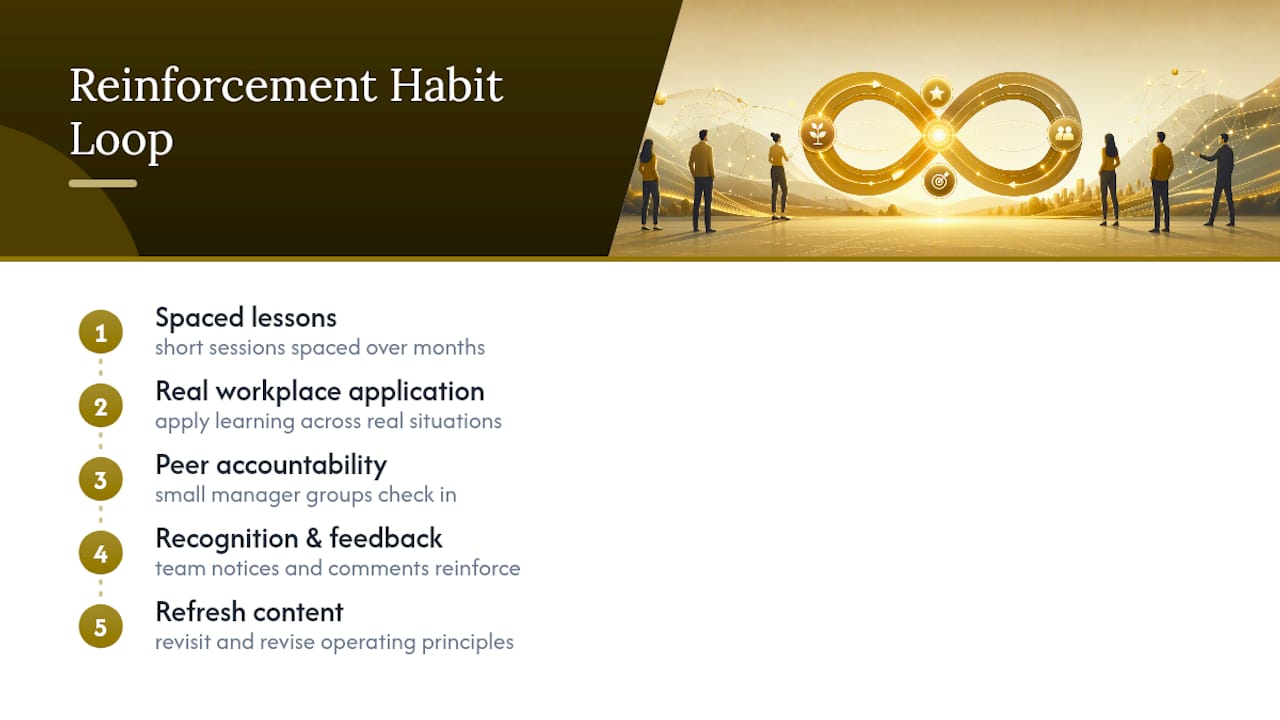
Peer accountability keeps momentum alive between formal sessions. Small groups of managers who check in on each other's operating principles, even briefly, catch drift before it becomes a full reversion to old habits. Tying training to visible recognition helps too. When a manager's team notices and comments on a new behavior (clearer decision making, better meeting hygiene) that feedback loop reinforces the change faster than any instructor ever could.
Finally, refresh the content. Operating principles set in a program's first month should get revisited and revised as the team's needs shift, treating them as living documents rather than a one-time deliverable that gets filed away and forgotten.
What Metrics Actually Prove Training Worked?
Completion rates tell you almost nothing. A manager can finish every module and still run the same meetings the same way. Effectiveness measurement has to look at behavior, not attendance.
Pulse surveys comparing engagement scores before and after training give you a directional signal, especially when segmented by team rather than averaged across the whole organization. Manager self-assessments, paired with a peer or direct-report rating, catch the gap between how a manager thinks they're doing and how their team experiences it, which is often the entire point of the training in the first place.
Retention and internal mobility numbers are lagging but telling. If trained managers' teams show lower voluntary turnover or more internal promotions six to twelve months out, that's a stronger signal than any survey. Application of specific artifacts (did the team charter actually get used, did the decision log get referenced) is the most direct proxy available, since it shows the training changed a concrete work habit rather than just awareness.
Track a small number of these consistently rather than a large dashboard of vanity metrics. Two or three well chosen indicators, watched over two quarters, beat ten metrics nobody revisits.
Why Applied, Team-Based Training Beats Solo Courses
Solo, lecture-only courses feel efficient but rarely change behavior, because a manager alone with a video can absorb a concept without ever testing it against a real team dynamic. Applied projects and cohort feedback are what actually transfer learning into changed habits. If budget is tight, skip the executive program and start with a focused microlearning pilot involving a small manager cohort. Momentum matters more than polish.
— Drew
Leaderly: A Practical Way to Run This Internally
If you'd rather build this capability inside your own organization than send managers off to a one-time external course, Leaderly gives you the infrastructure to run it continuously instead of once.
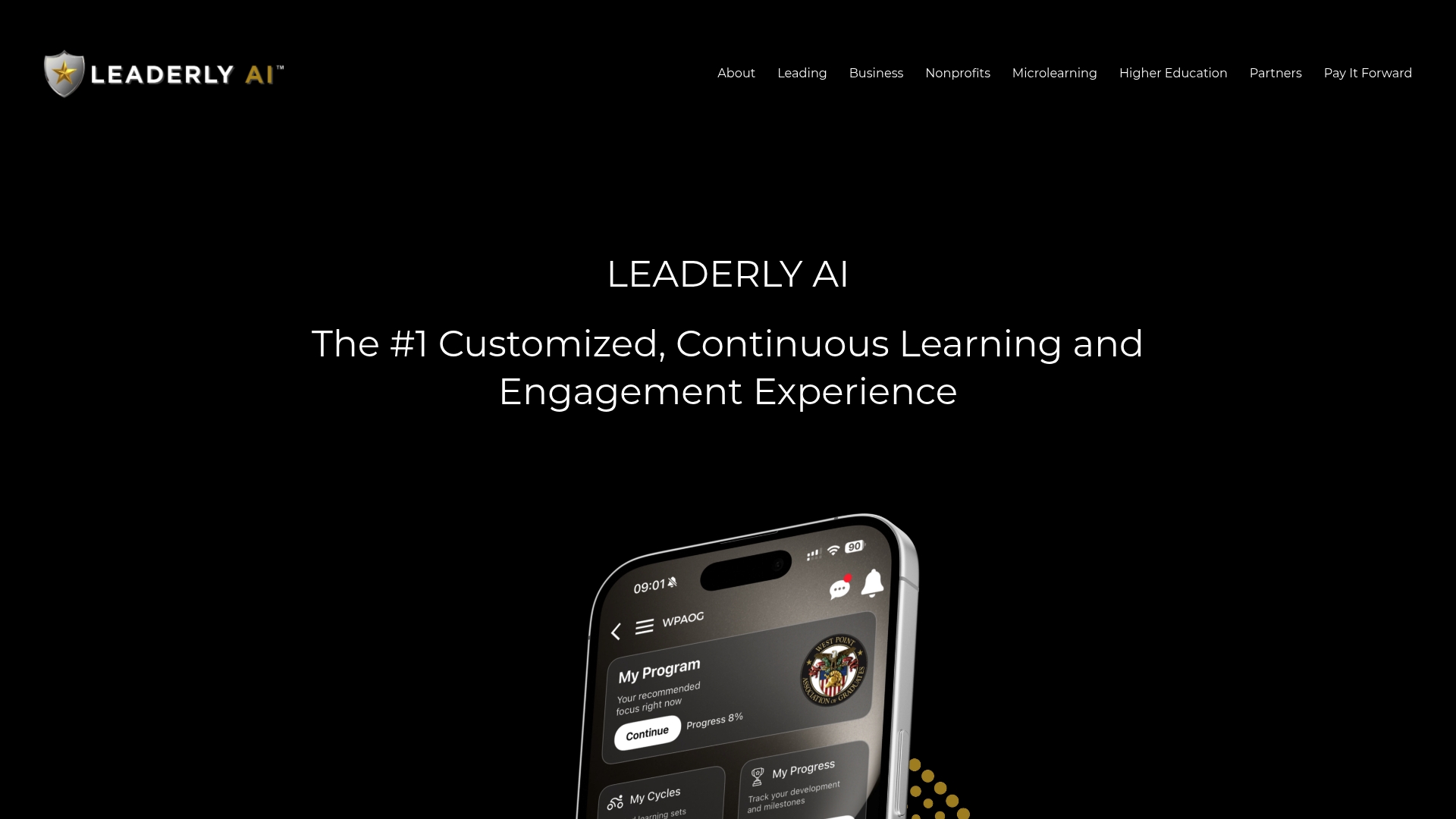
Where a traditional certificate program hands you a static curriculum, Leaderly adapts. Personalized microlessons adjust to each manager's actual gaps, behavioral habit-building exercises turn concepts like trust-building and decision routines into daily practice rather than a one-week module, and analytics dashboards show you, team by team, whether the training is actually changing behavior. Built-in assessments, including DiSC and EQ, give managers the self-awareness piece that standalone video courses usually skip.
This fits organizations that want the applied, team-based rigor the best executive programs offer, without the price tag or the calendar disruption of a 12-week external commitment. It also scales past a single pilot cohort to an entire management layer, which most external programs simply aren't built to do.
Explore what continuous leadership development actually looks like day to day, or start with a practical breakdown of how to cultivate leaders internally before you commit to a format.
Where to Go Deeper
- Leading Remote Teams (eCornell): certificate curriculum built around trust, engagement, and operating principles.
- Management Essentials (HBS Online): core framework for managing by purpose rather than presence.
- Management Development Program (Wharton Executive Education): example of a cohort-based, applied-project format with realistic time commitments.
- Virtual Duke Leadership Program (Duke Fuqua): illustrates how 360 assessments and coaching drive behavior change.
- Zoom as the New Classroom (Japanese Explorer): practical look at running structured learning through everyday video platforms.
Sources
- Leading Remote Teams | eCornell
- Management Essentials | HBS Online
- Management Development Program | Wharton Executive Education
- Virtual Duke Leadership Program | Duke Fuqua