
Leadership theory meets the practice gap because knowing what good leadership looks like and actually doing it under pressure are two completely different cognitive tasks. The core problem is execution: leaders absorb frameworks, pass assessments, and leave workshops with notebooks full of models, then return to their organizations and revert to old habits within weeks. Research from the Academy of Management confirms this pattern, finding that motivation, prioritization, and confidence, not knowledge, are the primary factors that determine whether a leader acts on what they know.
The highest-impact causes, in order of how often they derail implementation:
- Academic incentives misalign with practitioner needs. Research is rewarded for rigor and generalizability, not usability, so the frameworks that reach leaders are often too abstract to apply in a specific team on a specific Tuesday.
- Contextual complexity defeats universal prescriptions. A model that works in a Fortune 500 tech company rarely transfers cleanly to a 200-bed hospital or a K–12 school district without significant adaptation.
- Habit and skill transfer fail without scaffolding. Attending a training event does not build a habit. Without deliberate repetition, feedback, and cue-routine-reward loops, new behaviors fade.
- Organizational constraints block execution. Competing priorities, inadequate resources, and measurement gaps mean that even motivated leaders cannot sustain new practices.
- Motivation and prioritization collapse under daily pressure. When the urgent crowds out the important, leadership development gets deprioritized, even by leaders who genuinely believe in it.
The first practical step you can take today: pick one leadership behavior from a framework you already know, write it as a specific observable action ("I will ask one clarifying question before responding in my next team meeting"), and schedule a 5-minute reflection at the end of that meeting to check whether you did it.
Table of Contents
- What is the leadership theory–practice gap, exactly?
- Why the gap matters: real consequences for leaders and organizations
- What actually drives the gap? The core mechanisms
- How the gap shows up in healthcare and education
- Practical strategies that actually help close the gap
- Step-by-step playbook: from pilot to scale
- How do you know if you're actually closing the gap?
- Key Takeaways
- The gap is a design problem, not a motivation problem
- Leaderlyapp makes the pilot easier to run
- Useful sources and further reading
What is the leadership theory–practice gap, exactly?
The knowing–doing gap, the standard term in organizational research for what most people call the theory–practice gap, describes the persistent disconnect between what leaders understand conceptually and what they actually do in practice. It is not a knowledge problem. Most leaders in developed organizations have access to leadership frameworks, whether transformational, servant, situational, or adaptive. The gap lives between comprehension and consistent behavioral execution.
A systematic literature review found that the gap is not a single fissure but a set of interacting sub-gaps, each requiring its own intervention:
- Learning gap: — Organizations do not build feedback loops that let practice inform theory, or theory refine practice.
The scope of this guide is organizational leadership in U.S. workplaces, with sector examples drawn from healthcare and K–12 education, as those fields have the most documented evidence. The lessons transfer to corporate, nonprofit, and higher education contexts with modest adaptation.
One clarification worth making: the theory–practice gap is bilateral. It is not only practitioners failing to apply research. Scholars also fail to engage with the messy realities practitioners face, which means the gap widens from both ends simultaneously.
Why the gap matters: real consequences for leaders and organizations
The gap is not an academic inconvenience. When leaders cannot translate theory into practice, the effects show up in performance data, retention numbers, and team health metrics.
At the organizational level, poor leadership execution drives lower employee engagement, higher voluntary turnover, and missed performance targets. When managers lack the behavioral skills to give effective feedback, run productive meetings, or model psychological safety, teams underperform, and the costs compound over time. The connection between leadership quality and employee retention is well-documented: people leave managers, not companies.
At the individual level, the consequences are equally concrete. A leader who knows the theory but cannot execute it loses credibility with their team faster than one who never learned the theory at all. Visible inconsistency between stated values and actual behavior is one of the fastest ways to erode trust. Beyond credibility, the gap contributes to burnout: leaders who feel they should be performing differently but cannot figure out how to change their behavior carry that cognitive dissonance as a chronic stressor.
"Managers often possess conceptual leadership knowledge that does not predict their applied behavior." — Academy of Management Learning & Education, drawing on 65 critical incidents from interviews with 22 managers across organizational levels.
The stakeholders who must own the response are not just individual leaders. HR and L&D professionals are responsible for designing development systems that go beyond one-off training. Senior sponsors must create the psychological safety and structural space for leaders to experiment. Researchers and educators have a responsibility to produce and disseminate findings in formats practitioners can actually use.
What actually drives the gap? The core mechanisms
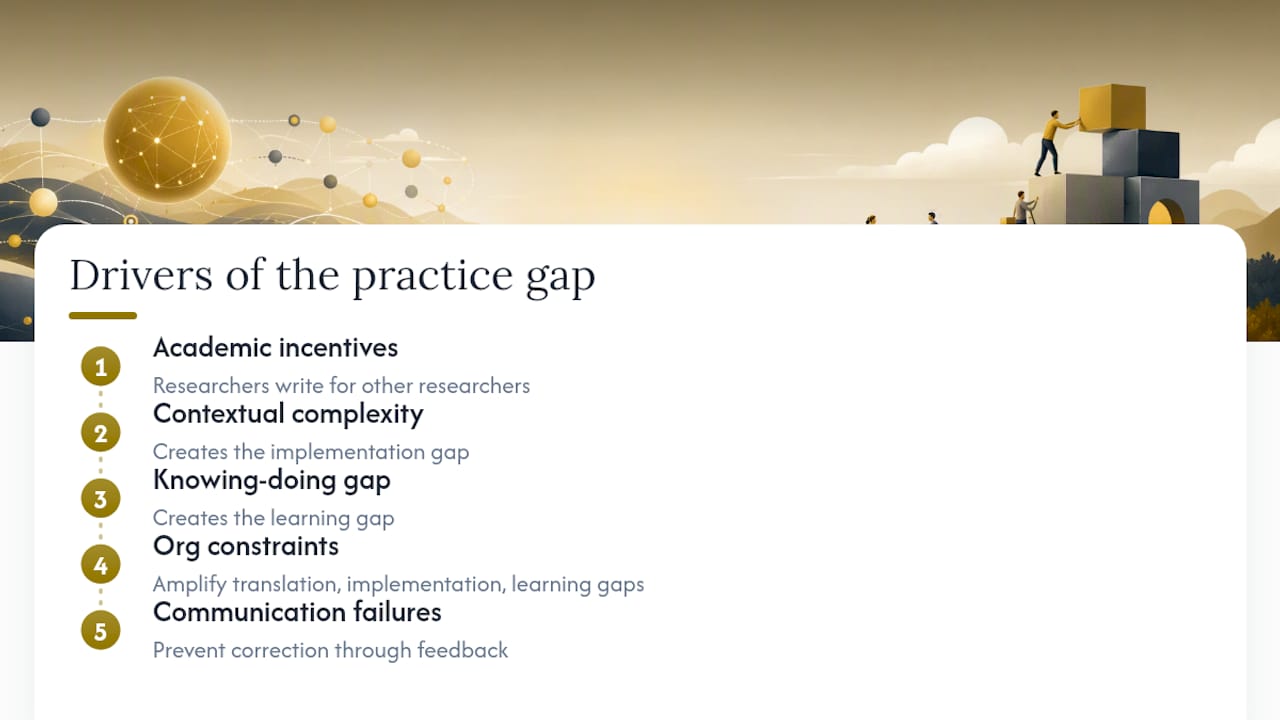
Understanding why theory fails in practice requires looking at the mechanisms, not just the symptoms. There are five distinct drivers, and they interact.
Academic incentives and accessibility
Universities and journals reward research for methodological rigor and theoretical contribution, not practical usability. Publication metrics favor studies that advance theory; applied work is often treated as less prestigious. The result is a body of leadership knowledge that is internally consistent and methodologically sound but written in language that most practitioners cannot parse, published behind paywalls they cannot access, and structured around constructs that do not map cleanly onto the decisions a manager faces at 9 AM on a Monday.
Parkhe's epistemological analysis argues that management should adopt translational practices similar to engineering and medicine, fields where the gap between research and application is treated as a solvable engineering problem, not an inherent feature of the discipline.
Contextual complexity and contingency
Leadership frameworks are built from aggregated data across many organizations. They describe what tends to work on average. But your organization is not average. It has a specific culture, a specific history, specific power dynamics, and specific constraints that no framework was designed to address. Situational leadership theory acknowledges this explicitly: the right leadership behavior depends on the follower's readiness level. But even situational models require a layer of contextual judgment that no training program fully develops.
"Scholars and practitioners hold different worldviews: scholarship favors generalizable truth and methodological rigor; practitioners need usable, context-dependent guidance." — Strategic Management Review
This is why leadership adaptability is not a soft skill. It is the meta-competency that determines whether any framework gets applied correctly.
Knowing–doing barriers: motivation, confidence, and habit
The Academy of Management study identified three behavioral drivers that predict whether a leader acts on what they know: motivation to lead in a particular way, prioritization of leadership behavior over competing demands, and confidence that the behavior will work in their specific context. All three can be present at the end of a workshop and absent three weeks later when the real pressure hits.
Habit formation is the missing link. A behavior practiced once or twice in a training environment has not been encoded as a habit. It requires repetition in context, with feedback, over time. Without deliberate scaffolding, the new behavior competes with deeply ingrained old patterns and loses.
Organizational constraints
Structure matters. A leader who wants to give more developmental feedback cannot do so effectively if their organization's performance management system only supports annual reviews. A manager who wants to model psychological safety cannot sustain it in a culture where senior leaders punish mistakes publicly. Organizational constraints are often invisible to the leaders experiencing them because they feel like "just how things work here." Surfacing those constraints is a prerequisite for any implementation effort.
Communication and translation failures
Even when research is relevant and practitioners are motivated, the translation layer is often missing. Researchers write for other researchers. Practitioners read trade publications, attend conferences, and rely on consultants who may or may not be current with the literature. The result is a dissemination gap: good evidence sits in journals while practitioners make decisions based on frameworks that are 20 years old or were never empirically validated.
The mapping is direct: academic incentives create the translation gap; contextual complexity creates the implementation gap; knowing–doing barriers create the learning gap; organizational constraints amplify all three; and communication failures prevent any of them from being corrected through feedback.
How the gap shows up in healthcare and education
Abstract drivers become concrete when you look at specific sectors. Healthcare and K–12 education are the two fields with the most documented evidence of the theory–practice gap in leadership, and the lessons transfer broadly.
K–12 education: resource constraints and contextual mismatch
The education administration research identifies a different but equally persistent pattern. School principals and district administrators are often trained in leadership models developed in corporate or military contexts, then expected to apply them in environments with fundamentally different incentive structures, resource levels, and accountability mechanisms.
The specific drivers in K–12 are resource constraints (principals often lack time, budget, and staff capacity to implement new practices), contextual mismatch (models built for hierarchical organizations do not map onto the distributed, consensus-driven culture of most schools), and dissemination gaps (research on educational leadership is rarely packaged in formats that working principals can use).
Two practical lessons from the education evidence:
- Knowing but Not Enacting Leadership: Navigating the Leadership Knowing–Doing Gap | Academy of Management Learning & Education
- Across the Great Divide: A Systematic Literature Review to Address the Gap Between Theory and Practice
- Epistemology of bridging the theory–practice gap in strategic management | Strategic Management Review
- Navigating healthcare leadership: Theories, challenges, and practical insights for the future | PMC
- Reasons for the Theory-Practice Gap in Education Administration
- The Ultimate Guide to Leadership Theory | SMU Cox School of Business
- Leaderly AI | Enhance Leadership Skills Today
Practical strategies that actually help close the gap
The research points to five strategies that consistently produce results. They are ordered here by impact and ease of adoption for most organizations.
1. Knowledge translation: make theory usable
The first step is converting abstract frameworks into specific, observable behaviors. "Practice transformational leadership" is not an instruction. "Ask one question that connects this task to the team's larger purpose before assigning it" is. Every theory you want to implement needs to be translated into behavioral specifications at this level of concreteness.
2. Action learning: learn by doing, not by listening
Action learning sets, small groups of leaders working on real organizational problems with structured reflection, are one of the most evidence-supported approaches to closing the gap. The key features are a real problem (not a case study), a structured reflection process, and a peer group that provides challenge and support. The learning happens in the doing, not in a classroom.
3. Coaching and microlearning: sustain behavior change
Microlearning paired with manager coaching reduces regression to old behaviors after training ends. The mechanism is straightforward: short, frequent practice keeps the new behavior salient; coaching provides the contextual feedback that generic training cannot. A 5-minute daily microlesson followed by a weekly manager check-in is more effective than a two-day annual workshop, not because the content is better, but because the repetition and feedback loops are built in.
4. Habit-building: design the environment for the behavior
Habits form when a specific cue reliably triggers a specific routine and produces a consistent reward. Leadership habit-building means identifying the cue (a team meeting starting, a performance conversation beginning), designing the routine (the specific behavior to practice), and making the reward visible (a brief self-assessment, a peer acknowledgment). Leadership habits for emerging managers follow the same architecture: small, specific, repeated.
5. Scholar–practitioner partnerships: close the feedback loop
Organizations that partner with researchers to co-design and evaluate leadership interventions get two benefits: more usable research and faster iteration. The model is similar to clinical trials in medicine, where practitioners and researchers work together from design through evaluation. This is not feasible for every organization, but HR and L&D professionals can approximate it by building structured feedback channels between their development programs and the academic literature.
Pro Tip: Design your habit-building around the smallest possible version of the behavior. If the target behavior is "give developmental feedback," the micro-practice version is "name one specific thing a team member did well in today's meeting." That takes 30 seconds and builds the neural pathway. Scale from there.
Who to involve in a pilot: a senior sponsor (for air cover), a project lead (for coordination), two to four volunteer managers (for the pilot cohort), and an L&D or HR partner (for design and measurement). Minimal resources required: a defined behavior, a feedback mechanism, and a 30-minute weekly reflection slot.
Step-by-step playbook: from pilot to scale
Moving from strategy to execution requires a structured process. The following playbook is designed for a 3–9 month pilot with a small cohort of leaders, with a scale phase following a successful evaluation.
Timeline and roles
| Phase | Timeline | Key Activities | Roles |
|---|---|---|---|
| Design | Weeks 1–3 | Needs assessment, behavior selection, content design | Project lead, L&D, sponsor |
| Pilot launch | Week 4 | Cohort onboarding, baseline measurement | Project lead, coach |
| Short-cycle learning | Weeks 4–12 | Microlessons, check-ins, pulse surveys | Cohort, manager, data owner |
| Evaluation | Weeks 12–13 | Data analysis, iteration decisions | Project lead, L&D, sponsor |
| Scale | Months 4–9 | Expanded cohort, refined content | All roles plus HR |
Cost bands
Low (under $5,000): Internal facilitation, free or low-cost microlearning tools, manager coaching using existing staff. Fits small teams or nonprofit organizations with limited budgets.
Medium ($5,000–$25,000): A dedicated microlearning platform subscription, external coaching for the pilot cohort, and basic analytics. Fits mid-size organizations running a 20–50 person pilot.
High ($25,000+): Enterprise platform licensing, external facilitation, custom content development, and rigorous pre/post measurement. Fits large organizations scaling across multiple business units.
The integration of leadership development into broader organizational strategy consistently produces better ROI than standalone training programs, regardless of cost band.
How do you know if you're actually closing the gap?
Measurement is where most leadership development programs are weakest, and it is the single most important factor in whether a program improves over time.
Leading vs. lagging indicators
Leading indicators tell you whether behavior is changing now. Lagging indicators tell you whether outcomes improved later. Most organizations measure only lagging indicators (engagement scores, retention rates, performance ratings) and wonder why they cannot connect their development programs to results. The fix is to measure leading indicators, specifically behavior adoption and confidence, at 2–4 week intervals during the pilot.
Combine quantitative pulse data with qualitative check-ins. A 2-question weekly survey tells you what is happening; a 15-minute bi-weekly conversation with two or three cohort members tells you why. Both are necessary. High-performing leaders share a common trait: they treat their own development as a measurable process, not a feeling.
Pro Tip: Run your first measurement cycle at week 2, not week 8. Early data lets you fix design problems before they compound. If behavior adoption is below 50% at week 2, something in the design is wrong, and you still have time to fix it.
Key Takeaways
The knowing–doing gap in leadership closes only when organizations replace one-off training with continuous, context-specific habit-building supported by measurement, coaching, and short-cycle feedback loops.
| Point | Details |
|---|---|
| Knowledge is not the bottleneck | Motivation, prioritization, and confidence predict whether leaders act on what they know, not knowledge scores. |
| The gap has four interacting sub-gaps | Translation, implementation, knowledge, and learning gaps each require a distinct intervention; no single fix addresses all four. |
| Context defeats universal models | Frameworks must be adapted to specific workflows, cultures, and constraints before they produce behavior change. |
| Measure leading indicators early | Track behavior adoption and confidence at weeks 2 and 4, not just lagging outcomes at month 6. |
| Leaderlyapp supports scalable habit-building | Personalized microlessons, manager check-ins, and analytics dashboards give HR teams the infrastructure to run and measure a pilot without building it from scratch. |
The gap is a design problem, not a motivation problem
Most organizations treat the theory–practice gap as a motivation problem. Leaders are not applying what they learned, so the assumption is that they do not care enough, or the training was not engaging enough, or the facilitator was not inspiring enough. That framing leads to better workshops, more charismatic speakers, and the same behavior change outcomes six months later.
The research tells a different story. The leaders in the Academy of Management study were not unmotivated. They knew what good leadership looked like. What they lacked was a system that made the new behavior easier to do than the old one. That is a design problem. And design problems have design solutions.
The conventional wisdom in leadership development is that insight drives change. If you can just get leaders to see themselves clearly, the behavior will follow. But insight without scaffolding is just awareness, and awareness without practice is just guilt. The leaders who actually change their behavior are the ones who have a specific, small action to take, a cue that triggers it, a feedback signal that tells them whether it worked, and a social context that makes the practice feel normal rather than performative.
That is what the research supports. Not more theory. Not better frameworks. A system that makes practice the default.
Leaderlyapp makes the pilot easier to run
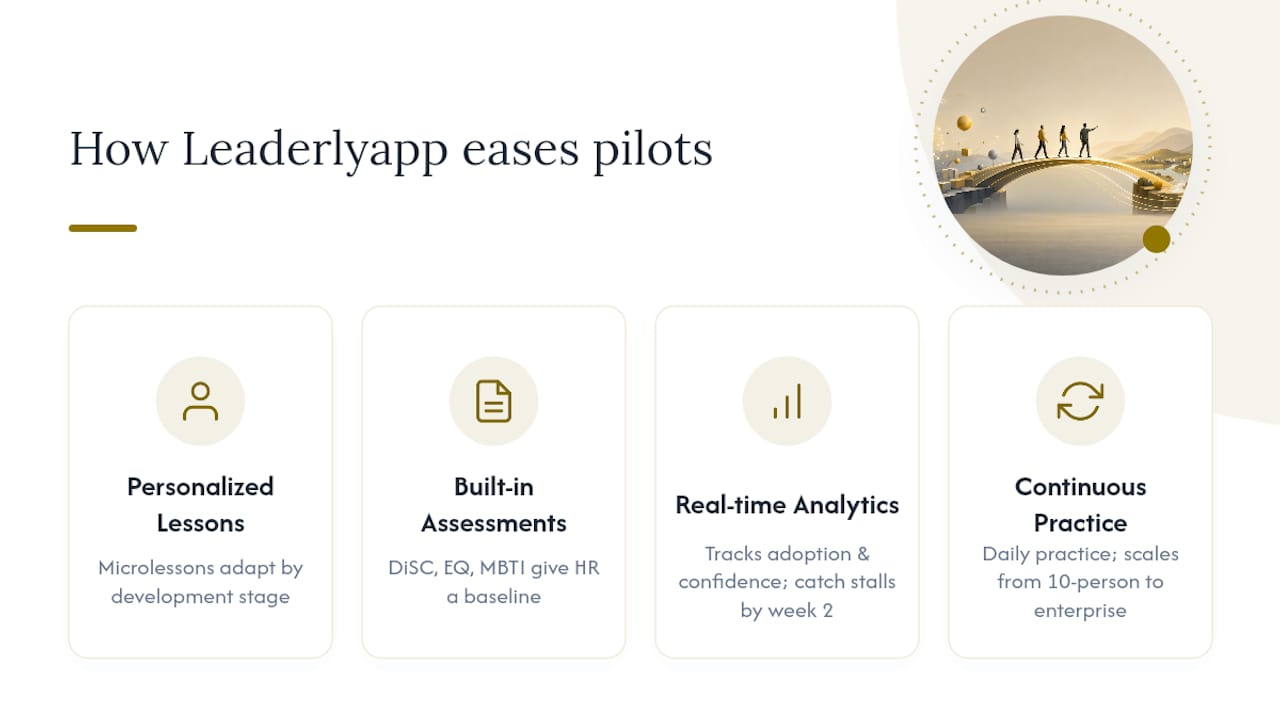
Knowing what to do and having the infrastructure to do it consistently are two different problems. Leaderlyapp addresses the second one directly.
The platform delivers personalized microlessons that adapt to each leader's development stage, so a first-time manager and a senior director are not working through the same generic content. Built-in behavioral assessments, including DiSC, EQ, and MBTI, give HR teams a baseline before the pilot starts. Analytics dashboards track behavior adoption and confidence scores in real time, which means you can catch a stalling pilot at week 2 instead of discovering it at month 6. Gamified recognition and manager check-in prompts keep the habit loop active between lessons.
For organizations that have tried one-off training and seen the results plateau, Leaderlyapp offers a different architecture: continuous, people-centric leadership development built around daily practice rather than periodic events. It scales from a 10-person pilot to an enterprise rollout without requiring a rebuild of the program design.
HR professionals, L&D teams, nonprofit directors, and educational administrators can start with a focused pilot on one behavior, measure adoption over 8 weeks, and use that data to make the case for broader investment. Visit Leaderlyapp to explore how a pilot would work for your organization's size and context.
Useful sources and further reading
The sources below are the primary evidence base for this guide, along with annotations on what each one contributes.
-
Knowing but Not Enacting Leadership: Navigating the Leadership Knowing–Doing Gap — Academy of Management Learning & Education. The most directly relevant empirical study. Analyzes 65 critical incidents from 22 managers to identify motivation, prioritization, and confidence as the key behavioral drivers. Essential reading for anyone designing a leadership development intervention.
-
Across the Great Divide: A Systematic Literature Review to Address the Gap Between Theory and Practice — SAGE Open. Cross-disciplinary systematic review that identifies four interacting sub-gaps and proposes a cyclical integrated model. The most comprehensive synthesis of the field available in open access.
-
Epistemology of Bridging the Theory–Practice Gap in Strategic Management — Strategic Management Review. Parkhe's theoretical argument for scholar–practitioner collaboration and knowledge co-production. Particularly useful for understanding why the gap is bilateral and how organizations can build feedback loops with researchers.
-
Navigating Healthcare Leadership: Theories, Challenges, and Practical Insights for the Future — PMC. Narrative and empirical review of how theory–practice mismatches appear in clinical and administrative healthcare settings. The sector-specific examples are directly applicable to hospital and health system leaders.
-
Reasons for the Theory-Practice Gap in Education Administration — Western Kentucky University Digital Commons. Review paper examining the specific drivers of the gap in K–12 and education administration contexts. Useful for school principals, district administrators, and education policy professionals.
-
Putting Leadership Theory into Practice — SMU Cox School of Business. Applied commentary linking leadership learning with microlearning and reflective practice. A practitioner-friendly entry point to the continuous development literature.
-
Leaderlyapp: Enhance Leadership Skills Today — Leaderlyapp. The platform's landing page, with resources on microlearning, habit-building, and analytics for organizations running leadership development pilots. Practical next step for readers ready to move from reading to implementation. Also see the leadership hiring best practices resource for organizations thinking about how talent acquisition connects to leadership capability building.