
What is a leadership development journey?
A leadership development journey is the lifelong, deliberate process through which individuals build the competencies, self-awareness, and influence needed to lead effectively at every career stage. It is not a single training event or a one-time certification. It is a continuous, systemic process that cycles through learning, application, reflection, and adaptation across an entire career.
The journey moves through four progressive stages: Leading Self, Leading Others, Leading Leaders, and Leading the Enterprise. Each stage demands new skills and, critically, the unlearning of habits that worked at the previous level. A first-time manager who excels at individual execution often struggles to delegate. A senior executive who mastered team leadership must now think in systems and strategy. The competency shift is real at every transition.
Core elements that define the journey include:
- Self-awareness: Understanding your strengths, blind spots, and default leadership style
- Competency development: Building specific skills like communication, decision-making, and emotional intelligence
- Experiential learning: Applying new skills to real, high-stakes work challenges
- Mentorship and coaching: Gaining perspective and accountability from experienced guides
- Formal training: Structured programs, courses, and leadership seminars
- Reflection and feedback: Ongoing evaluation that refines your approach over time
The 70-20-10 framework from the Center for Creative Leadership captures how this learning actually distributes: 70% comes from on-the-job stretch experiences, 20% from developmental relationships like mentoring and coaching, and 10% from formal education. That ratio matters because it tells you where to invest most of your attention. Classroom time alone will not build a leader.
Leadership growth is also not purely personal. When individual development aligns with organizational strategy, it drives measurable outcomes across the business. The two cannot be separated if the investment is going to pay off.


Key steps that make a leadership development journey work
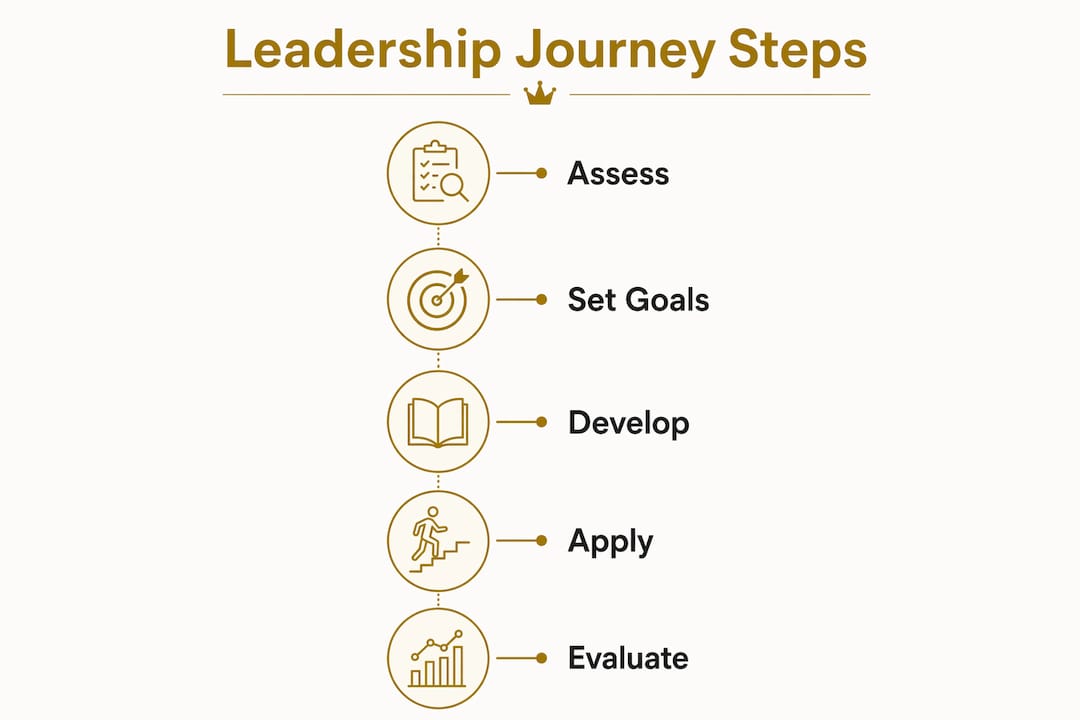
Effective leadership growth follows a structured, cyclical sequence. Each phase builds on the previous one, and the cycle repeats as leaders advance to new challenges.
-
Self-assessment. Start by mapping your current strengths, gaps, and leadership style. Use 360-degree feedback tools, behavioral assessments, or structured reflection to get an honest baseline. A leadership self-assessment done rigorously at the start shapes everything that follows.
-
Competency identification. Not every skill gap deserves equal attention. Identify the two or three competencies most critical to your next leadership level and to your organization's priorities. Trying to improve everywhere at once produces shallow results across the board.
-
Goal setting. Translate competency gaps into specific, measurable development goals. Vague goals like "become a better communicator" do not drive behavior change. "Conduct structured one-on-ones with each direct report weekly and request feedback after each" does.
-
Blended learning. Draw from all three tiers of the 70-20-10 model. Enroll in relevant leadership training programs for the formal 10%. Build coaching and mentoring relationships for the relational 20%. Then put the bulk of your energy into stretch assignments, cross-functional projects, and real leadership challenges for the experiential 70%.
-
Accountability and measurement. Growth without accountability stalls. Identify a learning partner, a coach, or a peer group that holds you to your commitments. Track progress against your goals at regular intervals, not just at annual review time.
-
Reflection and iteration. After applying new skills, reflect on what worked and what did not. Adjust your approach and cycle back. The 4-D leadership development process treats this iteration as the engine of sustained growth, not a one-time debrief.
Pro Tip: Focus each development cycle on one or two specific competencies rather than attempting a broad overhaul. Narrowing your focus produces measurable progress you can actually see and apply to real leadership challenges within weeks, not years.
Why leadership development matters for people and organizations
Leadership development directly improves business outcomes, not just individual careers. Research from Bersin by Deloitte and the Center for Creative Leadership confirms that organizations with strong leadership development practices outperform those without them on key performance indicators. The competitive advantage is real and measurable.
Developing leadership skills increases employee retention and engagement, making it one of the highest-return investments an organization can make in its people.
The benefits stack across multiple dimensions:
- Stronger talent pipeline: Leaders developed from within carry institutional knowledge and cultural alignment that external hires rarely match
- Higher employee engagement: Teams led by well-developed managers report stronger motivation and lower turnover
- Better decision-making: Leaders with broader competency sets navigate ambiguity and complexity more effectively
- Strategic agility: Organizations that align development with strategy respond faster to market shifts, digital transformation, and competitive pressure
- Leadership resilience: Continuous development builds leaders who adapt rather than freeze when conditions change
- Improved culture: Development-focused organizations signal that growth is valued, which attracts and retains high-potential employees
The importance of the leadership growth process also shows up in retention data. When employees see a credible path for their own advancement, they stay. When they do not, they leave. Leadership development is one of the clearest signals an organization can send about whether it invests in its people.
Alignment with organizational goals is not optional. A development program disconnected from business priorities produces capable leaders who are growing in the wrong direction. The most effective programs start with a clear answer to one question: what business outcome does this development need to support?
How to plan and manage your leadership development effectively
A Leadership Growth Plan is the practical tool that turns development intentions into structured progress. Building one starts with honest self-assessment and external feedback, then moves into deliberate design.
- Start with data, not instinct. Combine self-assessment with 360-degree feedback from peers, direct reports, and managers. Your own perception of your gaps and others' experience of your leadership rarely match perfectly. Both perspectives are necessary.
- Anchor goals to organizational strategy. Identify which of your development priorities directly support a business priority, whether that is building a more inclusive culture, accelerating innovation, or improving team performance. Development that connects to real stakes gets taken seriously.
- Select learning methods intentionally. Match the method to the competency. Emotional intelligence develops through coaching and feedback, not lectures. Strategic thinking grows through exposure to senior decision-making and cross-functional projects. Not every gap needs a course.
- Build stretch assignments into the plan. Real work is the best classroom. Assign yourself or your leaders to projects that require new skills, create productive discomfort, and have visible outcomes. Learning sticks best when it is applied immediately to high-stakes challenges.
- Set measurable milestones. Define what progress looks like at 30, 60, and 90 days. Use behavioral indicators, not just completion metrics. "Completed three coaching sessions" is a completion metric. "Direct reports report feeling more heard in one-on-ones" is a behavioral indicator.
- Schedule regular check-ins. Monthly reviews with a coach or learning partner keep development from being crowded out by operational demands.
Pro Tip: Use the FIRE framework (Facts, Interpretation, Reaction, End result) when giving or requesting feedback. Behavior-focused feedback delivered within 48 hours of an observed behavior drives significantly stronger growth than delayed or generalized performance reviews.
How do you measure progress in leadership development?
Measuring leadership growth requires tracking both leading indicators (behaviors changing now) and lagging indicators (business outcomes improving over time). Relying only on end-of-program satisfaction surveys tells you almost nothing about whether development actually worked.
Effective measurement operates at three levels. At the learner level, track engagement with development activities, self-reported confidence shifts, and behavioral changes observed by peers and direct reports. At the performance level, assess whether leaders are applying new skills on the job, which a follow-up survey two to three months after a program typically captures well. At the business level, connect development to outcomes like retention rates, team performance scores, and promotion rates from within.
Balanced scorecards work well here. They force you to define success across multiple dimensions before the program starts, not after. Harvard Business Publishing Impact recommends collecting data before, during, and after a program to track genuine change rather than just measuring a final snapshot.
One practical approach: run a 360-degree feedback assessment at the start of a development cycle, then repeat it six to twelve months later. The delta between the two assessments shows you exactly where growth occurred and where it did not. That data also informs the next cycle of development planning.
Real-world examples of leadership development done well
The most instructive examples of effective leadership development share a common structure: they connect learning directly to real work, they involve senior leaders actively, and they treat development as ongoing rather than episodic.
The Center for Creative Leadership (CCL) model asks participants to identify a real, existing leadership challenge before entering any development program. That challenge becomes the focal point for learning throughout the program. Participants work with an in-class accountability partner and an at-work learning partner, creating two layers of support for applying new skills. The result is that formal coursework connects directly to live strategic work rather than sitting in a separate "training" silo.
Harvard Business Publishing Impact structures its organizational partnerships around a nine-step process that begins with business alignment and ends with a culture of continuous learning. One of its core findings: programs that target a specific business priority, such as increasing revenue or improving retention, consistently outperform generic leadership curricula. The specificity of the goal shapes everything from content selection to measurement.
The 70-20-10 approach in practice looks like this at a mid-size company: a high-potential manager spends 10% of development time in a structured leadership course, 20% in monthly coaching sessions with a senior leader, and 70% leading a cross-functional product launch that stretches her well beyond her current skill set. Six months later, her 360-degree feedback scores on strategic thinking and stakeholder influence have moved measurably. The course alone would not have produced that result.
These examples share one insight worth holding onto: adult learners in leadership training retain and apply what they learn when it connects to problems they are already trying to solve.
Tools and resources that support leadership growth
The right tools reduce friction and keep development visible between formal learning events. No single tool does everything, but a well-chosen set covers assessment, learning, feedback, and accountability.
Assessment tools like 360-degree feedback platforms give leaders a data-driven baseline and a way to track change over time. The Leadership Circle Profile is one widely used instrument that maps both competencies and underlying assumptions that drive behavior.
Coaching and mentoring platforms connect leaders with experienced guides who provide perspective outside the immediate team. The International Coaching Federation (ICF) sets professional standards for coaching practice and offers a directory of credentialed coaches across the United States.
Microlearning platforms deliver short, focused lessons that fit into a leader's actual workday rather than requiring them to step away from it. Leaderlyapp uses machine learning to personalize microlessons based on each leader's development stage and behavioral patterns, so the content evolves as the leader does. For organizations trying to continuously learn to lead at scale, that kind of adaptive delivery closes the gap between formal training and daily practice.
Peer learning cohorts are underused and highly effective. Groups of leaders at similar career stages who meet regularly to discuss real challenges create the relational 20% of the 70-20-10 model without requiring a formal coaching budget.
Feedback frameworks like FIRE (Facts, Interpretation, Reaction, End result) give both managers and HR professionals a structured way to deliver behavior-focused feedback that actually changes behavior, rather than vague praise or criticism that leaders cannot act on.
Stretch assignment tracking through a simple shared document or project management tool keeps experiential learning visible and accountable. When leaders log what they are learning from each assignment and share it with a coach or manager, reflection becomes a habit rather than an afterthought.
Key Takeaways
A leadership development journey works best when it combines structured stages, real-world application, and alignment with organizational strategy across every phase of a leader's career.
| Point | Details |
|---|---|
| Four progressive stages | The journey moves through Leading Self, Leading Others, Leading Leaders, and Leading the Enterprise, each requiring new skills. |
| 70-20-10 model | 70% of leadership learning comes from on-the-job experience, 20% from relationships, and 10% from formal training. |
| Focus on fewer competencies | Targeting one or two specific competencies per cycle produces measurable progress faster than broad improvement efforts. |
| Feedback timing matters | Behavior-focused feedback delivered within 48 hours drives stronger growth than delayed or generalized performance reviews. |
| Align development to strategy | Leadership growth tied to a specific business priority consistently outperforms generic development programs. |