
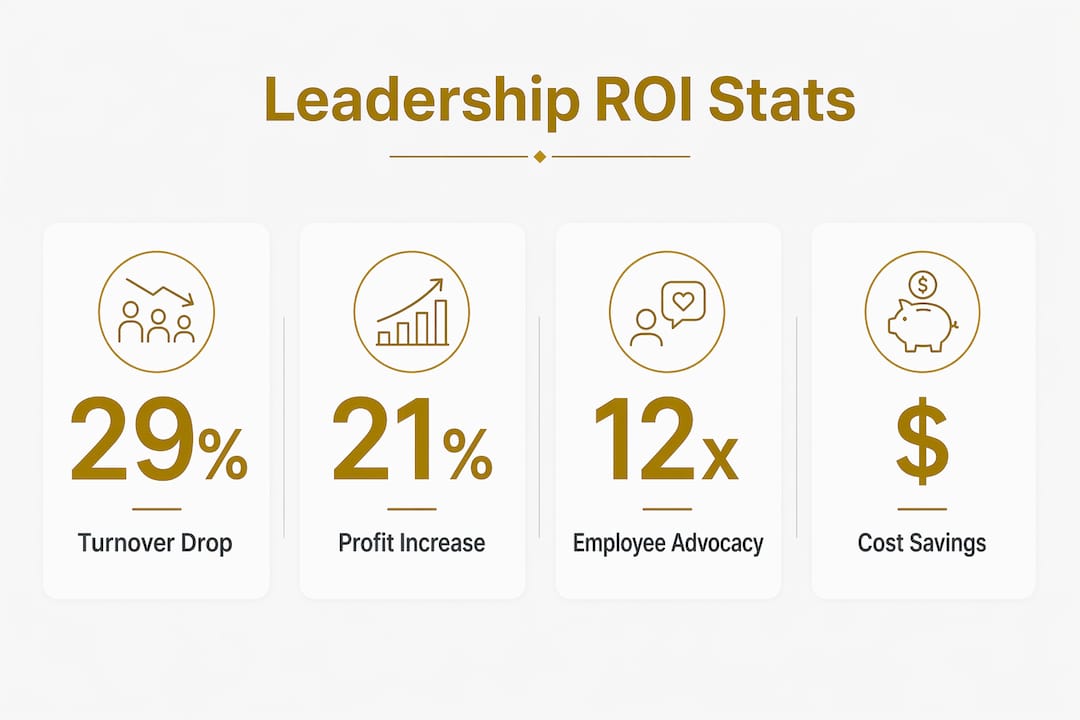
Leadership development is defined as a structured investment in building the skills, behaviors, and judgment of people who guide others at work. HR invests in leadership programs because the returns are measurable and direct: organizations that run these programs see turnover drop by up to 29 percentage points over three years. That is not a soft benefit. That is a hard cost reduction that shows up in recruiting budgets, onboarding time, and team stability. Strong leadership also connects directly to 21% higher profitability and 17% higher productivity compared to organizations with weak leadership. For HR leaders and organizational decision-makers, understanding why HR invests in leadership programs is the foundation for building a workforce that performs and stays.
Why HR invests in leadership programs: the business case
The business case for leadership development rests on three pillars: retention, performance, and employer brand. Each one has a direct line to the bottom line.
Retention and cost savings
Employee turnover is one of the most expensive problems an organization faces. Recruiting, onboarding, and lost productivity from a single departure can cost well above a full year's salary for mid-level roles. A 29-point reduction in turnover over three years, driven by leadership programs, means fewer open roles, lower recruiting spend, and more stable teams. The savings compound over time.
Performance and profitability

Leadership quality shapes how teams work every day. Organizations with strong leadership achieve 21% higher profitability and 17% higher productivity. Those numbers reflect what happens when managers set clear expectations, give useful feedback, and remove obstacles for their teams.
Employer brand and loyalty
Employees led by trained leaders who respond constructively are 12 times more likely to recommend their company as a great place to work. That kind of endorsement reduces recruiting costs and attracts stronger candidates. The impact of leadership training on engagement and loyalty is one of the most underrated benefits HR leaders can point to when making the case for investment.
How does leadership program design impact effectiveness and ROI?
Most leadership programs underperform. The reason is almost always the same: poor design, not poor intent. Programs that lack needs analysis and rigorous evaluation consistently fail to produce lasting behavior change. HR leaders who understand design quality will get far more from their investment than those who simply buy the most expensive off-the-shelf program.
What the research says about program structure
A meta-analysis of 812 healthcare professionals found that multi-component programs yield significantly stronger results than single-method approaches. The effect size for multi-component programs was Hedges' g=0.68, compared to g=0.39 for single-method programs. That gap means a well-structured program with multiple learning methods produces nearly twice the behavior change of a one-day workshop or a lecture series alone.
The most effective programs share four design features:
- Needs analysis first. Identify specific skill gaps before selecting any content or format. Generic programs applied without diagnosis waste time and money.
- Spaced learning over time. Short sessions spread across weeks or months produce more durable behavior change than intensive one-time events.
- Practice and feedback loops. Participants need opportunities to apply skills and receive structured feedback. Observation and coaching between sessions accelerate development.
- Multi-level evaluation. Measure learning, behavior change, and business results. Satisfaction surveys alone tell you almost nothing about whether the program worked.
Well-designed internal programs with practice and feedback consistently outperform expensive external lecture-based programs. Design quality matters more than production value or price tag.
Pro Tip: Before signing any contract for a leadership program, ask the vendor to show you their evaluation methodology. If they only measure participant satisfaction, that is a signal the program is not built to produce real behavior change.
Which leadership levels should HR prioritize?
The most common mistake in leadership development is concentrating investment at the top. Senior executives get the coaching, the offsites, and the development budgets. Middle managers get a two-day workshop every few years, if that. This is a structural vulnerability.
Developing middle managers is critical because they are the primary drivers of team engagement and retention. A senior leader's decisions shape strategy. A middle manager's behavior shapes how every team member feels about coming to work on Monday. Gallup's research makes this point directly: limiting development to senior executives leaves the layer of the organization with the most daily contact with employees largely unprepared.
Mid-level managers are the linchpin of organizational performance and retention. Neglecting their leadership development creates a vulnerability that impacts long-term company agility. Organizations that invest broadly across leadership levels build deeper pipelines and recover faster from disruption.
The experiences that build leadership readiness at the middle-manager level include:
- Stretch assignments that require managing through ambiguity and cross-functional collaboration
- Mentoring relationships with senior leaders who model decision-making and communication
- Peer learning cohorts where managers share challenges and solutions in a structured format
- 360-degree feedback that surfaces blind spots before they become team-level problems
Cultivating leaders internally at multiple levels builds the kind of pipeline that makes succession planning predictable rather than reactive. Organizations that invest broadly across leadership levels recover faster from disruption and adapt more quickly to change.
How can HR implement leadership development programs effectively?
Knowing the benefits of leadership programs is not enough. Implementation is where most organizations lose the return on their investment. The following steps reflect what the research shows actually works.
- Conduct a needs analysis. Survey managers and their teams. Identify the specific behaviors and skills that are missing or underdeveloped. Use this data to define the curriculum, not the other way around.
- Design for multiple methods. Combine workshops, mentoring, peer coaching, and on-the-job practice. Single-method programs produce weaker results regardless of content quality.
- Align with organizational goals. Leadership programs that connect to real business priorities get more executive support and produce more relevant behavior change. Tie each learning objective to a measurable outcome the organization already cares about.
- Measure at multiple levels. Use Kirkpatrick's four levels: reaction, learning, behavior, and results. Evaluation beyond satisfaction surveys is what separates programs that improve over time from those that stagnate.
- Build in continuous learning. Formal programs create a foundation. Ongoing microlearning, coaching check-ins, and peer accountability sustain behavior change between cohorts.
| Implementation stage | What to focus on |
|---|---|
| Needs analysis | Identify skill gaps through surveys and performance data |
| Program design | Combine at least three learning methods for stronger results |
| Delivery | Space sessions over time with practice between each one |
| Evaluation | Measure behavior change and business results, not just satisfaction |
| Continuous learning | Use microlearning and coaching to sustain development between programs |
Pro Tip: Align your leadership program launch with a business cycle where results are measurable, such as the start of a fiscal year or a major product cycle. This makes it far easier to connect program outcomes to business metrics when you report back to leadership.
Finding and cultivating leaders internally requires a deliberate system, not just good intentions. HR leaders who treat leadership development as a process rather than an event see compounding returns over time.
Key Takeaways
HR investment in leadership programs delivers measurable returns through reduced turnover, higher profitability, and stronger employer brand, but only when programs are designed with needs analysis, multi-method delivery, and rigorous evaluation.
| Point | Details |
|---|---|
| Turnover reduction | Leadership programs can reduce employee turnover by up to 29 percentage points over three years. |
| Profitability and productivity | Strong leadership correlates with 21% higher profitability and 17% higher productivity. |
| Program design quality | Multi-component programs produce nearly twice the behavior change of single-method approaches. |
| Middle manager priority | Developing mid-level managers is the highest-leverage investment HR can make for team performance. |
| Evaluation depth | Measuring behavior change and business results, not just satisfaction, separates effective programs from ineffective ones. |
The uncomfortable truth about leadership development budgets
Leadership development is often treated as a discretionary line item. When budgets tighten, it gets cut first. That is exactly backwards.
I have seen organizations spend significant money on senior leadership retreats while their middle managers received no structured development at all. The result was predictable: high engagement scores at the top, high turnover in the middle, and a leadership pipeline that looked strong on paper but collapsed the moment a few key people left.
The research is unambiguous. Leadership development as a strategic intervention directly impacts organizational resilience. It is not a feel-good activity. The organizations that treat it as a core function, not a perk, build the kind of bench strength that makes them genuinely hard to disrupt.
The other misconception I keep encountering is that expensive programs equal effective programs. They do not. A well-designed internal program with real practice, structured feedback, and longitudinal evaluation will outperform a prestigious external program that delivers content through lectures and sends participants home with a binder. The shift HR leaders need to make is from procurement thinking to design thinking. Stop asking "which program should we buy?" and start asking "what behavior change do we need, and how do we build a system to produce it?"
That reframe changes everything about how you allocate budget, select vendors, and measure success.
— Drew
How Leaderlyapp supports leadership development at every level
HR leaders who want to move from one-off programs to a continuous development culture need tools that work at scale without sacrificing personalization.
Leaderlyapp delivers personalized microlessons built on behavioral science, designed to develop leadership habits in emerging managers and seasoned professionals alike. The platform uses machine learning to adapt content to each person's development stage, so mid-level managers get the specific skills they need rather than a generic curriculum. For HR leaders building a people-centric leadership culture, Leaderlyapp provides the structure, consistency, and measurement that formal programs alone cannot sustain. Explore how Leaderlyapp supports continuous leadership learning across your organization.
FAQ
What are the main reasons HR invests in leadership programs?
HR invests in leadership programs to reduce employee turnover, increase profitability, and build a stronger leadership pipeline. Research shows these programs can reduce turnover by up to 29 percentage points over three years.
How does leadership training affect employee retention?
Employees led by trained leaders who respond constructively are 12 times more likely to recommend their company as a great employer, which directly supports retention and recruiting.
Why do so many leadership programs fail to deliver results?
Most programs fail because they lack a needs analysis before design and rely on satisfaction surveys instead of measuring behavior change and business outcomes.
Should HR develop middle managers or focus on senior leaders?
HR should prioritize middle managers. They have the most direct daily influence on team engagement and retention, making them the highest-leverage group for leadership development investment.
How should HR measure the effectiveness of a leadership program?
Use Kirkpatrick's four levels: reaction, learning, behavior change, and business results. Measuring only participant satisfaction produces no useful data about whether the program actually worked.