
Leadership self-assessment for growth is the disciplined practice of evaluating your own leadership behaviors and their real impact on others, so you can identify development priorities and advance your career with purpose. Most professionals treat self-assessment as a one-time event tied to a performance review. That approach misses the point entirely. Routine self-assessment is the primary differentiator between leaders who stagnate and those who achieve significant, measurable growth. The industry term for this practice is behavioral self-evaluation, and it works at the level of observable actions, not intentions or personality traits.
What tools and practices are essential for leadership self-assessment?
The right tools measure behavior, not personality. A personality test tells you how you tend to think. A behavioral assessment tells you what you actually did last Tuesday when a project hit a wall. That distinction drives real growth.

Assessment formats worth knowing
The most widely used format in 2026 is the 360-degree feedback framework. Professional 360-degree tools analyze 13 essential skills through 78 behavioral items, comparing your self-perception with ratings from direct reports, peers, and managers to surface alignment gaps. That gap data is where growth lives. A 1.5-point discrepancy between your self-rating and your direct reports' ratings is a concrete, actionable signal. It tells you exactly where your intent and your impact have separated.
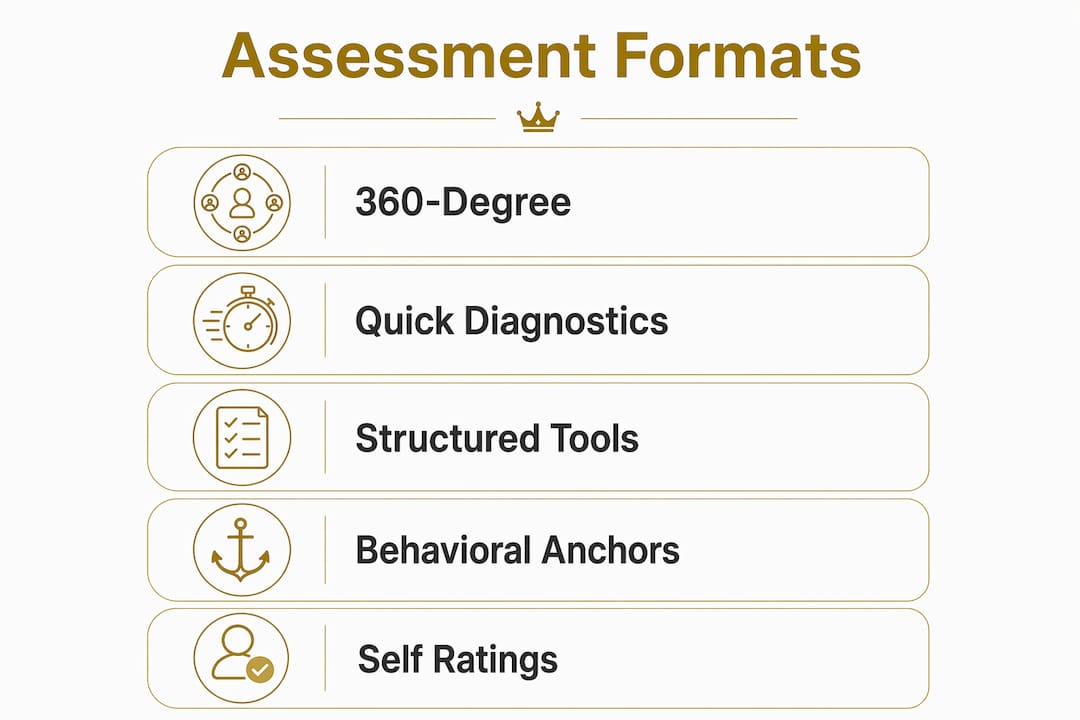
Quick diagnostic tools offer a faster entry point. Structured self-assessment tools typically require about 5 minutes to complete and deliver an immediate diagnostic profile across core leadership disciplines. These are useful for weekly check-ins, not deep quarterly reviews.
| Assessment method | Typical use case | Time required |
|---|---|---|
| 360-degree feedback | Quarterly deep review with external raters | 30–60 minutes |
| Quick diagnostic | Weekly self-check across core dimensions | 5 minutes |
| Weekly reflection journal | Ongoing behavior pattern tracking | 15–30 minutes |
| Pulse survey | Team feedback on specific leadership behaviors | 10 minutes |
Pro Tip: Use behavioral anchors when rating yourself. Instead of asking "Am I a good communicator?" ask "In my last three team meetings, did I confirm understanding before moving to the next agenda item?" Specific, observable questions produce accurate ratings.
Most leaders fail self-assessments because they focus on intent rather than observable behavior. Behavioral anchors bypass that bias by forcing you to recall specific actions, not general impressions.
How do you conduct a structured leadership self-assessment?
A repeatable process beats a one-time effort every time. The six steps below form a complete personal leadership evaluation cycle you can run quarterly, with weekly check-ins built in.
-
Select your leadership dimensions. Choose four to six areas to assess: decision-making, communication, delegation, people development, energy management, and composure under pressure. Composure under pressure is a critical but often overlooked dimension that separates effective leaders in high-stakes situations. Do not try to assess everything at once.
-
Rate yourself with behavioral questions. Use a 1–10 scale. For each dimension, write one specific behavioral question. "In the past 30 days, how consistently did I delegate decisions to the appropriate level?" is far more useful than "Am I a good delegate?" Rate each dimension honestly before gathering any external input.
-
Validate your ratings with external evidence. Pull in data from your last 360-degree review, recent team feedback, or a quick pulse survey. Compare external ratings to your own. A gap of two or more points on any dimension signals a priority area. This step is where a leadership self-assessment checklist becomes especially useful.
-
Identify your lowest accurate rating. Your lowest score with external validation behind it is your development priority. Not your lowest self-rating. The word "accurate" matters because self-ratings without external confirmation can reflect blind spots in either direction.
-
Build a 90-day growth plan. Target one dimension per 90-day cycle. Define one to three specific behavioral changes, set weekly reminders, and name at least one measurable outcome. Converting assessment outputs into 90-day protocols yields higher growth returns than isolated assessments. Attach your plan to your calendar, not just a document.
-
Run weekly reflection sessions. Spend 15–30 minutes each week reviewing your behavior against your plan. Weekly self-assessment sessions detect behavioral patterns that one-time assessments miss and reduce self-rating distortion over time. Treat this session like a standing meeting with yourself.
Pro Tip: Schedule your weekly reflection for the same day and time each week. Friday afternoons work well because the week's events are fresh. Consistency matters more than the specific time you choose.
What challenges will you face in leadership self-assessment?
Every professional who commits to personal leadership evaluation runs into the same obstacles. Knowing them in advance cuts the time you spend stuck.
The biggest obstacle is rating by intent rather than behavior. You remember what you meant to do, not always what you did. This is not dishonesty. It is how human memory works. Behavioral anchors, as described above, are the direct fix.
- Recall bias: Infrequent, retrospective assessments pull from memory that fades and distorts. Weekly reflection captures patterns while they are still accurate.
- Perception gaps: Seeing a large gap between your self-rating and your team's feedback feels uncomfortable. That discomfort is the signal, not the problem.
- Assessment as gatekeeping: When leaders fear that honest self-assessment will be used against them in evaluations, they inflate their ratings. Leadership assessments must function as development catalysts, not gatekeeping tools.
- Trait fixation: Assessing personality traits instead of behaviors produces insight without traction. True leadership assessment measures behavioral shifts over time and their impact on team engagement, not static personality profiles.
"Leaders who treat assessments as personality tests without behavioral follow-up miss the opportunity for real growth. The assessment is not the destination. The behavior change that follows is."
Share your assessment results with one trusted peer or mentor each quarter. External accountability increases candor and makes it harder to rationalize inflated self-ratings. You can also explore self-awareness strategies that complement this process by sharpening your ability to observe your own patterns accurately.
How do you embed self-assessment into ongoing leadership growth?
A single assessment changes nothing. A consistent practice changes everything. The goal is to make personal leadership evaluation as automatic as your weekly team meeting.
-
Set a fixed schedule. Run a quick 5-minute diagnostic weekly and a full 360-degree review quarterly. Put both on your calendar now, not after you finish this article.
-
Link every assessment to a 90-day protocol. Each quarterly review should produce one updated growth focus. Carry it forward until the behavior shifts, then move to the next priority.
-
Use external feedback loops. Pulse surveys sent to two or three team members monthly give you real-time behavioral data between formal reviews. Behavior-level feedback drives leadership growth more reliably than annual performance conversations.
-
Track progress with repeatable metrics. Use the same behavioral questions each cycle so your ratings are comparable over time. A rating that moves from 5 to 7 on delegation over two quarters is evidence of real growth.
| Growth habit | Frequency | Purpose |
|---|---|---|
| Quick behavioral diagnostic | Weekly | Capture fresh patterns, reduce recall bias |
| Pulse survey to team | Monthly | Validate self-ratings with external data |
| Full 360-degree review | Quarterly | Deep gap analysis and priority reset |
| 90-day growth protocol update | Quarterly | Translate assessment into focused action |
The discipline of self-leadership, which means managing your energy, attention, and behavior consistently, is the foundation of sustained growth. Platforms like Leaderlyapp support this cycle with personalized microlessons and behavioral assessments that adapt as your leadership evolves. The people-centric skill development resources on Leaderlyapp connect assessment results directly to targeted learning content, so your 90-day plan has real material behind it.
You can also use 360-degree assessment insights to benchmark your leadership behaviors against external standards, which adds a layer of objectivity that pure self-review cannot provide.
Key Takeaways
Leadership self-assessment for growth works only when it measures observable behaviors, runs on a consistent weekly and quarterly schedule, and connects directly to a 90-day development plan.
| Point | Details |
|---|---|
| Behavior over intent | Rate what you did, not what you meant to do, using specific behavioral anchor questions. |
| Weekly reflection habit | Spend 15–30 minutes weekly to capture fresh patterns and reduce recall bias. |
| 90-day growth protocols | Link every quarterly assessment to one focused behavioral change with measurable outcomes. |
| External validation | Use 360-degree feedback or pulse surveys to confirm self-ratings and surface blind spots. |
| Assessment as catalyst | Treat every assessment as the start of a development cycle, not a judgment of your current worth. |
Why most leaders get self-assessment wrong
I have worked with professionals across industries who treat self-assessment as a box to check. They complete a personality inventory, read the report, nod at the parts that confirm what they already believed, and file it away. Six months later, nothing has changed. That pattern is not a character flaw. It is a design flaw in how they approached the process.
The shift that actually produces growth is moving from "what kind of leader am I?" to "what did I do this week, and what should I do differently next week?" That sounds simple. Sitting with a specific behavioral question after a difficult conversation, and answering it honestly, is harder than it sounds. The vulnerability required to admit that your intent and your impact diverged is real work.
What I have found is that small, consistent practice beats occasional deep dives every time. A leader who spends 15 minutes every Friday reflecting on three specific behaviors will outgrow a leader who completes one comprehensive assessment per year. The frequency is what builds the muscle. Start with one dimension, one behavioral question, and one weekly session. Commit to that for 90 days before adding complexity. The soft skills and self-awareness that make great leaders visible to others are built through exactly this kind of repeated, honest reflection.
— Drew
Leaderlyapp and your leadership development practice
Leaderlyapp is built for professionals who want their leadership development to keep pace with their careers.
The platform delivers personalized microlessons grounded in behavioral science, so each session connects directly to the leadership dimensions you are actively working on. Assessment results feed into tailored content that evolves as your ratings improve, which means your learning stays relevant rather than generic. Leaderlyapp also supports accountability through community features and coaching resources that give you the external feedback loop every serious leader needs. If you are ready to put a real structure behind your growth, cultivating people-centric leadership skills through Leaderlyapp is a practical next step. You can also explore the full range of leadership development resources available on the platform.
FAQ
What is leadership self-assessment for growth?
Leadership self-assessment for growth is a structured practice of evaluating your own leadership behaviors, identifying gaps between self-perception and actual impact, and using those findings to drive targeted development. It differs from personality testing by focusing on observable actions rather than fixed traits.
How often should you complete a leadership self-assessment?
The most effective schedule combines a 5-minute weekly diagnostic with a full 360-degree review each quarter. Weekly sessions capture fresh behavioral patterns and reduce recall bias that distorts less frequent assessments.
What dimensions should a leadership self-assessment cover?
Core dimensions include decision-making, communication, delegation, people development, energy management, and composure under pressure. Composure under pressure is frequently overlooked but consistently differentiates effective leaders in high-stakes situations.
How do you reduce bias in leadership self-assessment?
Use behavioral anchor questions that reference specific, recent actions rather than general impressions. Validate your self-ratings with external data from pulse surveys or 360-degree feedback to surface blind spots you cannot see alone.
How do you turn assessment results into real growth?
Convert your lowest validated rating into a 90-day growth protocol with one to three specific behavioral targets and at least one measurable outcome. Assessments linked to focused short-term action plans produce significantly higher growth returns than assessments treated as standalone reports.