
Leadership development budget planning is the process of allocating financial resources to grow leadership capabilities across an organization in a way that ties directly to measurable business outcomes. Organizations that treat this as a structured discipline, rather than an annual guessing exercise, consistently outperform those that copy industry benchmarks without examining their own unit economics. The IRS Section 127 provision, which allows up to $5,250 per employee in tax-free educational assistance, makes the financial case for formal budget planning even stronger. Getting this right requires understanding spending norms, legal incentives, and a first-principles allocation method tailored to your organization.
What are typical spending benchmarks for leadership development budgets?
Organizations allocate 15–20% of their total learning and development budget to leadership development annually. That figure gives you a starting point, but the per-leader number tells a sharper story.
Spending by company size
The gap between mid-market and enterprise spending is significant:
- Mid-sized companies invest $5,000–$8,000 per leader per year on average.
- Fortune 500 companies average $22,000 per senior leader annually.
- Digital platforms captured approximately 38% of total leadership development budgets in 2024–2026, reflecting a clear shift away from in-person-only delivery.
That spread exists because enterprise organizations layer in executive coaching, high-potential programs, and global delivery costs that mid-market teams rarely budget for. Knowing where your organization sits on that spectrum prevents both underspending and unrealistic expectations.
Trends shaping current budgets
Leadership development budgets increased year-over-year for 60% of organizations in 2025. That growth signals broad recognition that leadership capability is a business asset, not a training expense. Still, 57% of those same organizations remained unsure about their 2026 plans. Uncertainty at the planning stage is exactly where a structured budgeting process pays off.

| Company type | Typical per-leader spend | Common delivery mix |
|---|---|---|
| Small business | Under $3,000 | Workshops, online courses |
| Mid-market | $5,000–$8,000 | Blended, coaching, digital |
| Enterprise | $15,000–$22,000+ | Executive programs, global cohorts |
How does the IRS tax provision affect budget planning for leaders?
IRS Section 127 permanently allows employers to provide up to $5,250 per employee annually in tax-free educational assistance. Starting in 2027, that cap will be indexed to inflation, meaning the benefit grows automatically over time. This provision converts what finance teams often classify as a discretionary expense into a partially deductible investment.
The practical implication is real. If you invest $5,250 per leader in qualifying programs, neither the employer nor the employee pays tax on that amount. For an organization developing 50 leaders, that tax treatment represents meaningful savings that can be reinvested into the program itself.
Here is how to structure your budget to capture this benefit:
- Identify which program types qualify under Section 127 (courses, certifications, and degree programs typically do).
- Separate qualifying expenses from non-qualifying ones such as meals, travel, and entertainment.
- Work with your finance or tax team to document the educational assistance plan formally, which is required for the exemption.
- Apply the $5,250 threshold per employee as a floor, not a ceiling. Spending above it is still deductible as a business expense in many cases.
Pro Tip: Structure your leadership training budget so that the first $5,250 per leader goes toward IRS Section 127-qualifying programs. This alone can reduce your effective cost per leader by a material amount, freeing funds for coaching or applied learning experiences.
What is the first-principles approach to allocating your leadership development budget?
First-principles budget allocation calculates what an organization can profitably spend from its unit economics, then distributes funds by role and proven return. This method replaces benchmark copying with a calculation grounded in your own revenue, margin, and talent data. It is the most defensible approach when presenting a leadership training budget to a finance committee.
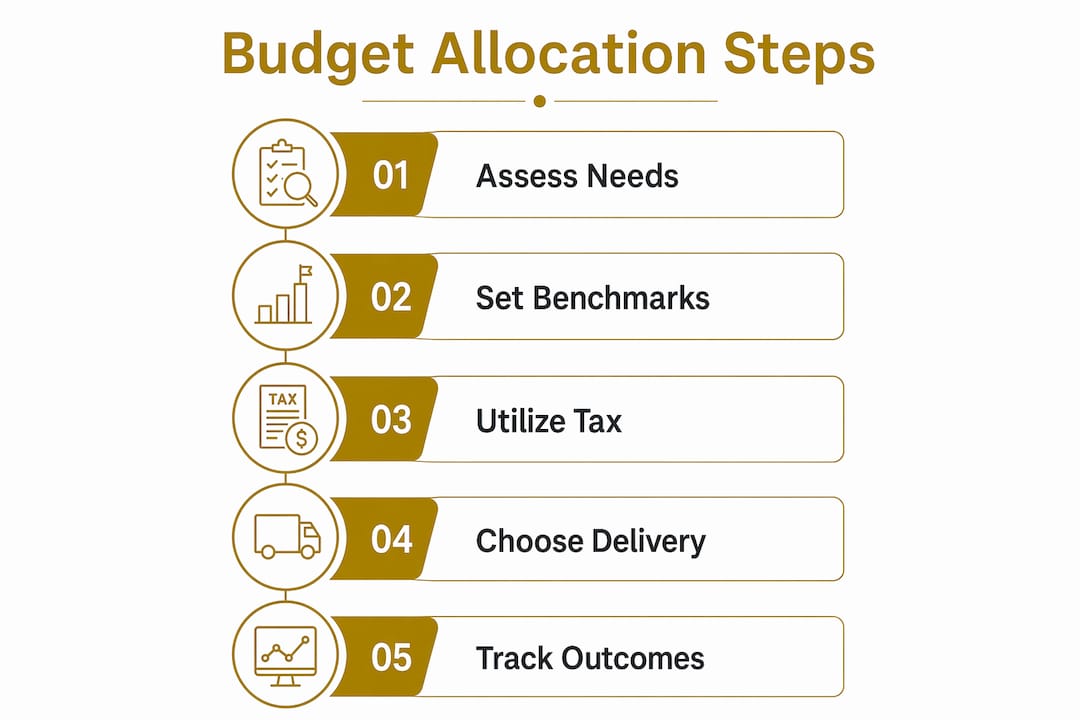
The process works in four steps:
- Calculate your leadership ROI baseline. Identify the revenue or productivity output tied to your current leaders. Use this to estimate what a 10% improvement in leadership effectiveness would generate.
- Set a profitable spend ceiling. Determine what percentage of that projected gain you can reinvest in development without eroding margin. This becomes your budget ceiling, not an industry average.
- Distribute by role and impact. Allocate more to roles with the highest organizational leverage. A frontline manager leading 15 people has a different ROI profile than a senior director leading three.
- Reallocate continuously. Review program performance quarterly. Shift funds from low-impact initiatives to those with demonstrated results.
"Budget allocation by first-principles ensures spending fits the organization's unique financial reality, rather than copying industry benchmarks not tailored to their unit economics." — 2026 Budget Allocation Guide
Copying a benchmark percentage without this analysis is how organizations end up overspending on programs that do not move the needle and underspending on the roles that matter most. The first-principles method forces you to connect every dollar to a business outcome before you commit it.
How can you manage leadership development costs without losing program quality?
Cost management in leadership development is not about cutting programs. It is about choosing delivery modes and planning horizons that get more from every dollar spent.
Virtual vs. in-person delivery
Virtual leadership training reduces delivery costs by up to 40% while maintaining effectiveness. That is not a marginal difference. For a mid-market organization running quarterly leadership cohorts, switching from in-person to virtual delivery can free enough budget to add coaching or peer learning components that in-person programs often cut for cost reasons.
The trade-off is real but manageable. Virtual delivery works best for skill-building content, frameworks, and assessments. In-person formats still outperform for trust-building, complex team dynamics, and senior leadership alignment sessions. A blended model captures the cost savings of virtual delivery while preserving in-person time for moments that require it.
Planning for the full cost picture
Leadership development costs regularly include program fees, travel, lodging, implementation support, and evaluation, sometimes doubling the base program fee. Planning an additional 20–30% above program fees for these indirect costs prevents budget shortfalls mid-year. A $100,000 program budget that ignores travel and evaluation costs can easily become a $140,000 actual spend.
Pro Tip: Build your leadership development budget checklist to include five line items beyond program fees: travel, lodging, technology or platform costs, internal facilitation time, and measurement. Missing any one of these is the most common reason leadership budgets run over.
Multi-year investment commitments yield 2.8x better succession outcomes than annual budgets. Locking in a two or three-year development plan also gives vendors a reason to negotiate better rates, which reduces per-leader costs further.
What tools and processes support effective leadership development budget planning?
The right tools do not replace judgment, but they do make the data visible enough to act on. Budget planning for leaders requires three categories of support: tracking tools, ownership structures, and integration with organizational strategy.
Tracking and dashboards
Effective budget allocation requires a system that connects spending to outcomes in near real time. Spreadsheet-based tracking works at small scale but breaks down when managing programs across multiple business units or geographies. Purpose-built learning management systems and HR analytics platforms provide dashboards that show cost per leader, program completion rates, and performance changes over time.
Integrated business and leadership planning improves budget utilization efficiency by 44%. That gain comes from visibility. When HR leaders can see which programs are producing results and which are not, reallocation decisions become faster and better supported by data.
Ownership and process
Clear ownership prevents budget drift. Assign one person or team as the budget owner for leadership development, with authority to approve, pause, or redirect spending based on performance data. Without a named owner, programs continue by default rather than by merit.
Key process elements for a working budget include:
- An annual planning cycle tied to the broader HR and business planning calendar.
- Quarterly reviews that compare actual spend to planned spend and program outcomes.
- A formal approval process for any program above a defined cost threshold.
- Documentation of the educational assistance plan required for IRS Section 127 compliance.
Leaderlyapp supports this process by delivering personalized microlessons that track individual progress and surface data HR leaders can use to evaluate program impact without adding administrative overhead.
Key takeaways
Effective leadership development budget planning combines industry benchmarks, IRS tax incentives, first-principles allocation, and continuous performance review to maximize every dollar invested in leader growth.
| Point | Details |
|---|---|
| Use benchmarks as a starting point | Allocate 15–20% of your L&D budget to leadership development, then adjust by role and company size. |
| Capture the IRS Section 127 benefit | Structure the first $5,250 per leader in qualifying programs to reduce your effective cost. |
| Apply first-principles allocation | Base your budget ceiling on unit economics and ROI, not industry averages. |
| Budget for indirect costs | Add 20–30% above program fees to cover travel, technology, and evaluation expenses. |
| Commit to multi-year planning | Multi-year investment commitments produce 2.8x better succession outcomes than annual budgets. |
Where I think most organizations get leadership budgeting wrong
Most HR leaders I have seen build leadership budgets start with last year's number and add a percentage. That approach feels safe, but it is actually the riskiest method available. It assumes last year's allocation was correct, which is rarely true.
The organizations that get the most from their leadership training budget are the ones that ask a different question first: which roles in this organization have the highest leverage on business outcomes? The answer is almost never the C-suite. It is almost always mid-level managers, the people leading the teams that produce the work. Yet budget allocations consistently skew toward senior leaders because senior leaders control the budget conversation.
Virtual delivery has changed the cost math enough that this is now a solvable problem. Cutting delivery costs by up to 40% through virtual formats means you can reach three times as many mid-level leaders for the same spend. The data on succession outcomes from multi-year commitments reinforces this. You do not need a bigger budget. You need a better allocation strategy and the discipline to review it quarterly rather than annually.
The organizations I respect most in this space treat their leadership development budget like a portfolio. They diversify across roles and delivery modes, measure returns, and reallocate without sentiment. That mindset, more than any specific tool or program, is what separates organizations that develop leaders from those that just train them.
— Drew
Leaderlyapp: built for budget-conscious leadership development
HR leaders who need to do more with a defined leadership development budget will find Leaderlyapp worth a close look.

Leaderlyapp delivers AI-driven, personalized microlessons that adapt to each leader's growth path, removing the need for expensive one-size-fits-all programs. The platform's virtual delivery model keeps per-leader costs well below traditional in-person formats, and its machine learning engine continuously refines content based on individual progress data. For organizations managing leadership development across multiple teams or business units, Leaderlyapp scales without proportional cost increases. Visit Leaderlyapp to see how the platform fits your budget structure and development goals.
FAQ
What percentage of the L&D budget should go to leadership development?
Organizations typically allocate 15–20% of their total learning and development budget to leadership development. The right percentage for your organization depends on company size, growth stage, and the ROI tied to leadership roles.
How much does leadership development cost per leader?
Mid-sized companies invest $5,000–$8,000 per leader per year on average, while Fortune 500 companies average $22,000 per senior leader. Always budget an additional 20–30% above program fees to cover travel, technology, and evaluation costs.
What is IRS Section 127 and how does it affect leadership training budgets?
IRS Section 127 allows employers to provide up to $5,250 per employee annually in tax-free educational assistance. Starting in 2027, that cap will be indexed to inflation, making it a growing financial incentive for formal leadership development investment.
Why do multi-year leadership budgets outperform annual ones?
Multi-year commitments yield 2.8x better succession outcomes than annual budgets because they allow programs to build on each other over time rather than restarting from scratch each year. They also give organizations leverage to negotiate better program rates.
What is the first-principles method for leadership budget allocation?
The first-principles method calculates a profitable spend ceiling from your organization's unit economics, then distributes funds by role and proven return rather than copying industry benchmarks. Continuous reallocation based on performance data keeps the budget aligned to actual outcomes.