
The single change that improves any scenario is this: build it around one real, observable decision the learner has to make on the job, not around the policy you want them to remember. Use scenarios when judgment is the gap and mistakes are costly. This article gives you a decision-first process, a trigger checklist, a worksheet, and a one-decision prototype workflow you can run this week.
TL;DR:
- Use scenario-based training only for judgment gaps involving conflicting priorities, tense conversations, or de-escalation, not for straightforward fact recall.
- Start scenario design by identifying the exact decision employees must make and then build context around that choice, rather than creating a story first.
- Construct strong triggers by grounding them in real incidents and ensuring they include role, context, stakes, and clear decision points before writing choices.
- Develop plausible choices that reflect real employee mental models, with consequences that naturally influence behaviors relevant to workplace trust, compliance, or efficiency.
- Scale recurring decision practice with AI-driven platforms that offer personalized microlearning, tracking decision patterns, and reinforcing judgment over time.
Table of Contents
- When Should You Use Scenario-Based Training?
- Decision-First Design: Start With the Decision, Not the Content
- How to Write Triggers and Decision Points
- Writing Plausible Choices and Consequences That Teach
- How Much Branching Do You Actually Need?
- Your Scenario-Writing Quick Checklist
- Scaling Scenario Practice Without Losing the Decision
- How Leaderlyapp Helps You Scale Scenario Practice
- Sources
- FAQ
When Should You Use Scenario-Based Training?
Scenarios earn their cost when the performance gap is about judgment, not information. If an employee needs to weigh conflicting priorities, read a tense room, or choose between two defensible actions, a scenario forces the same kind of decision they will face at their desk. If the gap is a fact people can't recall, you don't need a story. You need a shorter answer.
Skip scenario writing for training when the real problem is a broken process. A confusing approval form isn't fixed by role-play; it's fixed by redesigning the form or building a job aid. Scenarios also waste time on pure lookup tasks like "what's the current mileage rate," where a reference card does the job faster.
Cases where scenarios genuinely pay off:
- Compliance topics that require judgment calls, not just rule memorization (reporting a gray-area conflict of interest)
- Difficult leadership conversations, like delivering critical feedback without damaging trust
- De-escalation moments where tone and timing matter more than the script
Decision-First Design: Start With the Decision, Not the Content
Most scenario failures start the same way: someone writes a story first, then bolts a quiz onto it. The better approach, sometimes called decision-first design, reverses that order. You start with the exact decision a person on the job has to make, then build only enough context to make that decision feel real.
Getting there means mapping backward from a business result:
- Name the business goal in plain terms ("fewer safety incidents on the loading dock").
- List the observable actions that actually move that goal (checking a harness, calling out a hazard, stopping unsafe work).
- Pick the single decision point where employees currently get it wrong or hesitate.
- Write the learning objective at the Apply or Analyze level, not Remember: not "list the safety steps" but "decide whether to halt a task when a coworker skips a safety check."
That last step is where most training scenarios development goes wrong. "Understand the harassment policy" is a knowledge goal. "Decide how to respond when a peer makes a borderline comment in a meeting" is a decision goal, and it's the only one a scenario can actually train.
How to Write Triggers and Decision Points
The trigger is the moment that forces a choice. Weak triggers describe a situation; strong ones drop the learner into it mid-action, with something already at stake.
Run every trigger through this checklist before you write the choices:
- Role: Who is the learner in this moment (supervisor, new hire, team lead)?
- Context: What just happened, in one or two sentences?
- Immediate event: What is happening right now that demands a response?
- Stakes: What gets worse if they choose poorly?
- Clear fork: Is there an obvious point where two or more defensible actions diverge?
A reusable trigger template looks like this: "You're [role], and [immediate event] just happened while [context]. [Stakes statement]. What do you do?" Follow it with a decision stem such as "Do you address it now in front of the team, or pull the person aside afterward?"
Ground every trigger in a real incident. Interview a supervisor about the last time this situation actually happened, then borrow the specific details, according to TrainerCentric's scenario guide, which points out that real transcribed incidents make dialogue and choices far more believable than invented ones.
Pro Tip: Read the trigger out loud before you build anything else. If it sounds like a policy summary instead of something a person would actually say or experience, rewrite it until it does.
Writing Plausible Choices and Consequences That Teach

Bad distractors ruin scenarios faster than anything else. If one option is obviously wrong, you're testing reading comprehension, not judgment. Every choice should represent a real mental model, something a reasonable, well-intentioned employee might actually pick, usually because it worked in a different situation or feels safer in the moment.
Consequences do the real teaching, and they need to feel earned, not assigned. Effective scenario-based learning uses natural consequences rather than arbitrary penalties: the outcome should shift something the learner already cares about, like a coworker's trust, a client's confidence, time lost to rework, or a compliance exposure that now needs reporting.
Sequence the feedback carefully:
- Show the natural consequence first, in-scene, before any explanation.
- Only after that, name the underlying principle the choice violated or honored.
- Build a recovery path into at least one wrong branch so learners practice fixing a mistake, not just avoiding it.
Pro Tip: If you can't articulate a believable reason someone would pick the "wrong" answer, cut it. A distractor nobody would choose isn't testing anything.
How Much Branching Do You Actually Need?
Overbuilding is the most common way scenario projects die. Teams draft a sprawling branching tree, run out of time, and ship something that only covers the easiest path well.
- Default to limited branching with paths that converge back to a shared narrative point. A routine compliance decision might only need decision, consequence, and a short debrief. A layered leadership conversation may warrant two or three forks before converging.
- Increase complexity only when the actual skill demands true divergence, for instance when tone and sequencing change what a "correct" response even looks like.
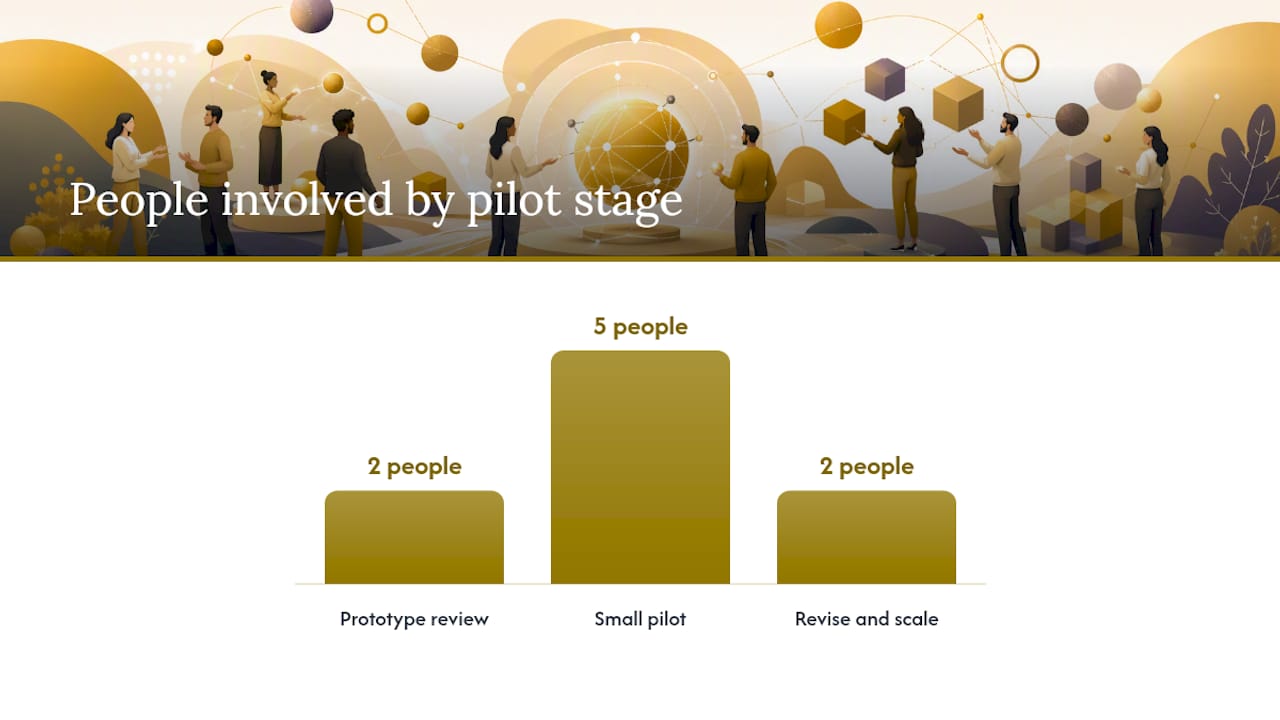
- Before writing the full branch structure, prototype exactly one decision point: the trigger, the choices, and the consequences, with nothing else built yet.
- Test that single prototype with a subject-matter expert and a handful of real learners. Watch where they hesitate or pick an option for the wrong reason.
- Use what you learn, confusion points, unexpected choice patterns, feedback that lands flat, to revise the pattern before you scale it into a full scenario. Cathy Moore's four-step scenario process (analyze, prototype, test, build) follows this exact sequence for good reason: it catches expensive mistakes while they're still cheap to fix.
Generative AI tools can help draft variations on choices or dialogue once your prototype is solid, but human review from an SME still catches nuance an algorithm misses, according to research on AI-assisted scenario development.
Your Scenario-Writing Quick Checklist
Keep a working action map next to your draft with three columns: the business goal, the observable actions tied to it, and which action is the priority for this scenario. That single table keeps you from writing a scenario about the wrong decision.
Beyond that, a decision-point worksheet should carry these fields for every scenario you build:
- Trigger details (role, context, immediate event, stakes)
- Two to four plausible choices, each with a stated rationale for why someone would pick it
- The natural consequence tied to each choice
- The principle the feedback will teach, written before you write the feedback text
- A pre-build QA question: "Would a real employee ever face this exact fork?"
| Pilot stage | Who's involved | What you're checking |
|---|---|---|
| Prototype review | One SME, one instructional designer | Does the trigger feel real? Are choices defensible? |
| Small pilot | 5 learners | Where do they hesitate? Which choice do they pick and why? |
| Revise and scale | Designer, SME feedback loop | Fix confusion points before building remaining branches |
Scaling Scenario Practice Without Losing the Decision
The hardest part of scenario writing for training isn't the first scenario. It's the fiftieth, delivered consistently enough that judgment actually changes. Spaced, repeated practice through short microlearning cycles tends to stick better than a single long workshop, because the decision gets rehearsed more than once under slightly different conditions.
Measurement matters more as you scale. Tracking which choice path learners actually pick, and where hesitation or wrong answers cluster, tells you which decision points need revision long before a manager notices the behavior hasn't changed. Pairing that data with manager check-ins closes the loop between a scenario and the real workplace decision it was built to train.
— Drew
How Leaderlyapp Helps You Scale Scenario Practice
Building one strong scenario is doable in-house. Keeping fifty of them fresh, measured, and reinforced across a growing organization is a different problem, and it's the one Leaderlyapp is built to solve. An AI-driven platform can deliver personalized microlessons and behavioral-science-based exercises that turn a one-time scenario into repeated, spaced practice, with analytics that show which decisions employees are struggling with, not just course completion.
If you're an HR team weighing whether to keep building scenarios by hand or bring in a platform, the deciding factor is usually scale and reinforcement. A single workshop scenario tests a decision once. A platform built for continuous practice tests it repeatedly, tracks the pattern, and adjusts content to the individual over time. Leaderlyapp's business platform is built for exactly that kind of ongoing leadership development, and organizations weighing a nonprofit or higher-education rollout can see how the same approach applies on the nonprofits page. Start by reviewing the Leaderly AI platform overview and requesting a walk-through for your team.
Sources
- Scenario Based Learning: The Complete Guide to Designing Training That Changes Behaviour + 1 Free Checklist - Devlin Peck
- Branching Scenario Design: Start With The Decision - eLearning Industry
- Scenario Design: The Process - Cathy Moore
FAQ
What Is Decision-First Design in Scenario Writing?
Decision-first design means you start by identifying the exact judgment call a learner must make on the job, then build the trigger and story around that single decision. It reverses the common mistake of writing a story first and attaching a quiz, an approach detailed in eLearning Industry's branching scenario guide.
How Long Should a Training Scenario Be?
Length depends on the decision's complexity, not a fixed word count. A routine judgment call might resolve in one trigger, one choice, and one consequence, while a layered leadership conversation may need two or three converging branches.
How Do You Test a Scenario Before Building the Full Branch?
Prototype a single representative decision point, the trigger, choices, and consequences, and test it with a subject-matter expert and a small group of real learners before writing anything else. This prototype-first approach catches confusing wording or implausible choices while they're still cheap to fix.
What Makes Scenario Feedback Effective?
Effective feedback shows the natural consequence of a choice first, something the learner already cares about like trust or time, and only afterward names the underlying principle. Devlin Peck's scenario-based learning guide recommends avoiding arbitrary penalties in favor of outcomes that mirror what would actually happen on the job.
Can a Platform Like Leaderlyapp Support Ongoing Scenario Practice?
Yes. Leaderly AI delivers scenario-style microlessons on a recurring basis and tracks which decisions employees struggle with over time, which is difficult to sustain with one-off, hand-built training alone. Current pricing and plan details are available directly on the Leaderly AI site.