
The fastest way to build leadership capacity on campus is a scaffolded cohort program that pairs weekly facilitated learning with an applied project and real measurement. One-off workshops fade within weeks; multi-tier cohorts with mentorship and a deliverable at the end produce leaders who stick around and administrators who can point to results. Start by auditing what already exists on your campus, then pilot a short cohort before scaling.
TL;DR:
- Cohort-based leadership programs with applied projects and measurement methods lead to lasting development and institutional results.
- Effective programs are scaffolded into stages, from emerging skills in a semester to high-performance leadership over 8 to 12 months, depending on the audience.
- Using standardized models like Harvard’s executive certificates or UF’s leadership pathways accelerates design and ensures sustainability.
- Digital platforms like Leaderly AI streamline reinforcement and assessment, reducing facilitator workload and supporting scalable, personalized learning.
- Inclusive design should prioritize transparent recruitment, varied curriculum, and diverse cohort composition to promote equitable leadership development.
Table of Contents
- What Does Leadership Development in Higher Education Actually Look Like?
- What Do Flagship Leadership Programs in Higher Education Look Like?
- How Do You Design a Leadership Program That Actually Works?
- How Do You Measure the Impact of a Leadership Program?
- How Can Leaderly AI Support Leadership Development at Scale?
- How Do You Build Inclusive Leadership Programs?
- How Do You Fund and Scale a Leadership Program Long Term?
- How Do You Integrate Leadership Development Into Existing Structures?
- What Role Does Technology Play in Leadership Development?
- How Do Different Institutions Adapt Leadership Programs?
- The Sector Is Moving Toward Relational, Evidence-Linked Programs
- Pilot a Leaderly Cohort in the Next Academic Term
- Sources
- FAQ
What Does Leadership Development in Higher Education Actually Look Like?
Leadership development in higher education spans a wide range of commitment levels, and picking the wrong one wastes both budget and goodwill. A senior administrator needs something different than a sophomore student government officer, and matching format to audience matters more than picking the "best" program type in the abstract.
- Short workshops (2 to 8 hours): best for broad exposure. Low administrative overhead, minimal follow-up, useful for orientation weeks or staff development days.
- Semester courses (12 to 16 weeks): fit student leadership development well. Case Western Reserve's Emerging Leaders Program runs on this model, giving students structured content without the year-long commitment.
- Multi-month cohorts (8 to 12 months): the standard for faculty leadership initiatives and middle-management tracks, where applied projects need time to mature.
- Executive certificates (modular, often spread over a year or more): designed for senior and mid-level leaders who need flexibility around existing job demands.
Workshops need almost no infrastructure. Cohorts and certificates need a facilitator, a curriculum calendar, and someone tracking outcomes. Budget for staffing before you budget for content.
What Do Flagship Leadership Programs in Higher Education Look Like?
Borrowing structure from established programs beats designing from scratch. Three models cover most institutional needs.
- Executive certificate model: Harvard's Executive Certificate in Higher Education Leadership combines seminars with specialized institutes, letting mid- and senior-level leaders build a learning path over time rather than in one intensive block. The modular structure signals institutional investment in a person's leadership career, which matters for retention at the senior level.
- Student leadership pathway: the University of Florida's LeadUF uses a multi-day pre-semester immersion combining reflection, mentorship, and skill practice before new students even attend their first class. Lead4Change takes a different angle, using team-based service projects that have reached over 2 million students through a deliverable-driven model.
- Campus cohort program: UF Warrington's Leadership Development Program runs weekly team meetings alongside an applied "Leadership in Action" project, with participants progressing through tiers from team member to team leader to executive roles.
Smaller institutions can adapt any of these by trimming cohort size and running the applied project as a single semester deliverable rather than a year-long initiative. What matters is keeping the applied project and the peer cohort, even when you cut everything else.
How Do You Design a Leadership Program That Actually Works?
Scaffolding is the difference between a program people remember and one they forget by finals' week. Structure participants through three tiers: emerging (self-awareness, foundational skills, roughly one semester), developing (collaborative projects, peer facilitation, one to two semesters), and high-performance (applied leadership in institutional contexts, often 8 to 12 months). Old Dominion University's Comprehensive Leadership Program demonstrates this progressive-complexity approach directly.
Follow these steps when building the cohort itself:
- Set cohort size at 12 to 20 participants. Larger groups dilute facilitator attention; smaller groups limit the peer learning that makes cohorts valuable.
- Fix a facilitator ratio of roughly one facilitator per 15 participants, with weekly meetings as the baseline cadence.
- Select applied projects with a real institutional stakeholder attached, not a hypothetical case study. A project without a sponsor rarely survives contact with a busy semester.
- Build an assessment rubric before the cohort starts, scored by both faculty and the project's stakeholder.
- Recruit mentors and train facilitators separately. A great mentor is not automatically a great cohort facilitator, and conflating the two roles burns people out.
Faculty-facing cohorts benefit from the full 8 to 12 month run because applied projects tied to teaching or program improvement need a full academic cycle to show results, while student-facing programs can run shorter as long as peer mentorship continues after the formal sessions end.
Pro Tip: Give every applied project a one-page charter signed by the sponsor before the cohort starts. It forces clarity on scope and gives participants something concrete to point to when asking busy stakeholders for time.
How Do You Measure the Impact of a Leadership Program?
Impact measurement should split into two timeframes, and most programs only track the easy one. Short-term measures include pre and post self-assessments, skill checklists, and participant satisfaction surveys taken right after the cohort ends. These are cheap to collect and useful for tweaking curriculum, but they say nothing about whether the program changed anything six months later.
Medium-term measures matter more to provosts and boards: applied project outcomes, promotion and pipeline data, and retention rates for program alumni. A recent study on structured leadership development links well-designed programs to improved promotability and long-term talent sustainability inside institutions, which is the argument that actually moves budget conversations.
- Baseline competency checklist at intake
- Mid-program formative feedback from the facilitator
- Final project rubric scored by internal stakeholders
- Follow-up at 6 to 12 months on role changes, retention, or promotion
Report these numbers as a simple before-and-after narrative to campus leadership, tied directly to whatever talent management system your institution already runs. A dashboard nobody outside HR ever sees is a wasted dashboard.
How Can Leaderly AI Support Leadership Development at Scale?
Running scaffolded cohorts by hand across multiple departments gets unwieldy fast, which is where a platform like Leaderly AI earns its place. It delivers personalized microlessons and behavioral-science prompts that reinforce whatever a facilitator covers in the weekly session, plus built-in assessments and analytics dashboards that make the pre/post measurement described above far less manual.
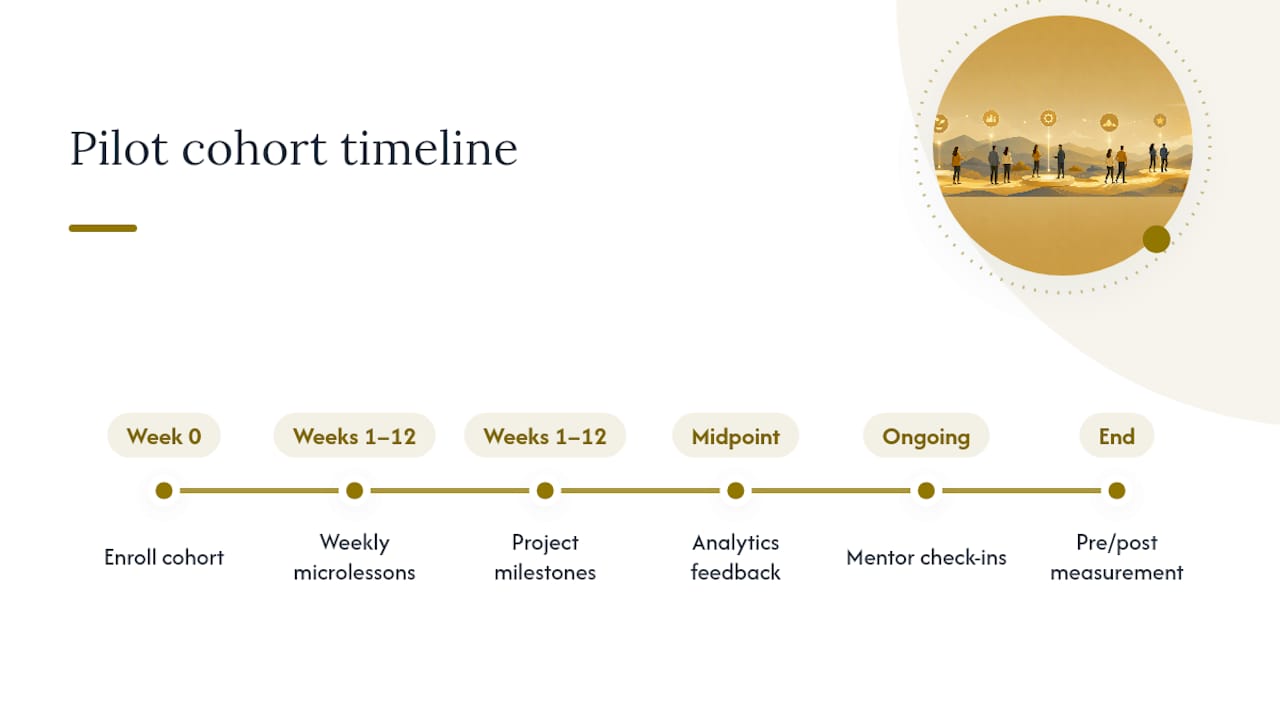
For a pilot, an 8 to 12 week structure works well: enroll one cohort, assign microlessons that map to your applied project milestones, and use the analytics dashboard as the mid-program feedback loop instead of building one from scratch. Facilitators get a lighter workload because the platform handles the between-session reinforcement that usually falls through the cracks. The main operational requirement is deciding upfront what data the pilot needs to capture, participant self-assessment scores, project milestone completion, mentor check-in notes, so the dashboard reflects what your assessment rubric actually measures rather than generic engagement metrics.
How Do You Build Inclusive Leadership Programs?
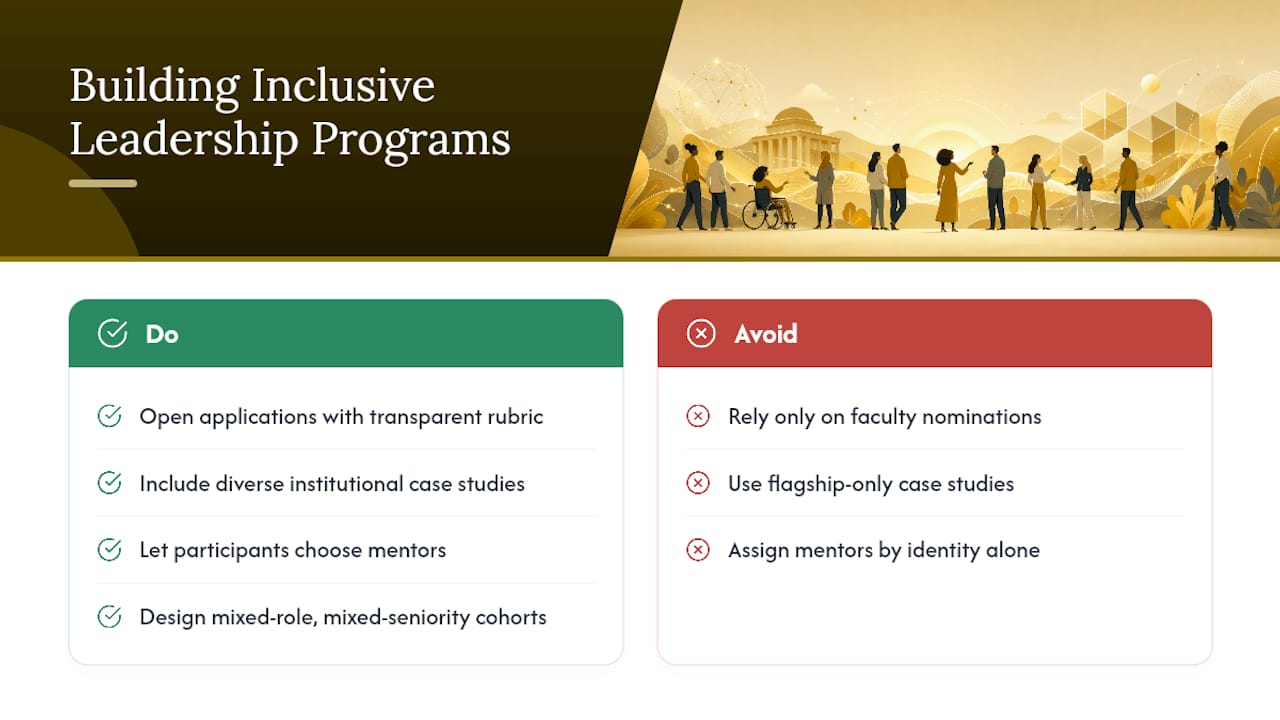
Inclusive design starts at recruitment, not curriculum. Programs that rely on faculty nomination alone tend to reproduce whoever already has visibility with senior staff, which usually skews toward the same departments and demographics year after year. Open applications with a transparent rubric fix this faster than any diversity of statement in a program brochure.
Curriculum content matters just as much as who gets in. Case studies and applied projects should reflect a range of institutional contexts, not just the flagship research-university examples that dominate most leadership literature. A community college administrator gets little value from a case study built entirely around a large research university's budget and staffing realities.
Mentor and facilitator pairing deserves deliberate attention too. Participants from underrepresented groups often benefit from mentors who share some relevant background, but forcing every pairing along identity lines alone ignores the functional expertise a mentor also needs to offer. The better approach is offering participants a say in mentor selection rather than assigning matches purely by demographic category.
Cohort composition itself should be a design decision, not an accident of who applied. A cohort mixing academic and administrative staff, or mixing seniority levels, surfaces perspectives that a homogeneous group misses entirely. Advance HE's framework for leading in higher education treats collaboration and adaptability as core competencies precisely because leadership in a diverse institution requires working across difference, not around it.
Finally, track completion and outcome data by demographic group where privacy rules allow. A program that admits a diverse cohort but sees uneven completion or promotion rates afterward has an inclusion problem hiding downstream of admissions.
How Do You Fund and Scale a Leadership Program Long Term?
Grant funding launches most programs and kills most programs, because a three-year grant cycle rarely aligns with the multi-year commitment a good cohort program needs to prove itself. Institutions that sustain leadership development past the initial grant tend to build a hybrid funding model from the start: a modest recurring line item from the provost's office, cost-sharing with departments that send participants, and philanthropic or grant money reserved for expansion rather than core operations.
Scaling works best in stages rather than all at once. Pilot with one department or one student cohort, prove the applied-project model produces deliverables stakeholders actually value, then expand to a second unit using the same facilitator training materials rather than reinventing curriculum each time. This keeps per-cohort cost predictable as enrollment grows.
Cost control comes largely from facilitator capacity, not curriculum licensing. Training internal staff as facilitators, rather than hiring external consultants for every cohort, cuts recurring cost significantly once the first one or two cohorts establish the model. UF Warrington's tiered progression, where participants advance into team leader and executive roles, effectively builds a facilitator pipeline the program can staff itself, which is one of the more overlooked cost advantages of tiered design.
Technology platforms that handle microlearning and analytics also reduce the staffing load per cohort, since a facilitator spending less time on manual tracking can support more participants without a proportional increase in hours. That efficiency is often what makes the difference between a program that scales to a second department and one that stays a single pilot forever.
How Do You Integrate Leadership Development Into Existing Structures?
Leadership development that lives entirely outside the academic calendar tends to get treated as optional by everyone involved, including the people running it. Embedding it into structures that already carry institutional weight, like credit-bearing courses, new-employee onboarding, or annual performance review cycles, changes that.
For students, the cleanest integration point is tying leadership coursework to existing credit requirements or co-curricular transcripts that already get reviewed by advisors. For faculty and staff, linking program completion to promotion or tenure-track review criteria signals that the institution treats leadership skill as a real factor in career advancement, not a nice extra.
Administrative buy-in also depends on who owns the program. A leadership initiative that reports solely to student affairs will struggle to recruit faculty, and one that lives only in academic affairs will struggle to reach staff. A joint governance structure, even a lightweight steering committee with representation from academic affairs, HR, and student life, keeps the program from being seen as one office's pet project.
Scheduling integration matters more than most administrators expect. Weekly cohort meetings that compete with existing committee schedules or class times get deprioritized fast. Programs that succeed long term usually protect a fixed calendar slot the way departments protect faculty meeting times, treating it as non-negotiable rather than reschedulable around everything else.
What Role Does Technology Play in Leadership Development?
Digital platforms solve a problem cohort-based programs have always struggled with: reinforcement between sessions. A weekly meeting delivers content, but the six days between meetings are where habits either form or evaporate, and most traditional programs have no mechanism for that gap.
Microlearning platforms fill it with short, spaced content, often five to ten minutes, that reinforces whatever the facilitator covered without requiring another scheduled meeting. Behavioral-science-based prompts and nudges tend to work better here than static reading assignments because they push participants toward small, repeatable actions rather than passive review.
Assessment tools built into these platforms, including instruments like DiSC, EQ, or MBTI, give facilitators baseline data before the cohort starts and comparison data at the end, without the manual survey administration that used to eat a coordinator's week. Analytics dashboards turn that data into something a facilitator can act on mid-cohort rather than discovering only in a post-program report.
None of this replaces the facilitator or the applied project. Technology's real value is compressing the administrative overhead around measurement and reinforcement, freeing facilitators to spend their limited hours on the parts of leadership development, mentorship, live discussion, project coaching, that software still cannot do.
How Do Different Institutions Adapt Leadership Programs?
A research university and a community college face different constraints, and copying a program wholesale rarely works across that gap. Research universities typically have dedicated staff, existing leadership centers, and enough student volume to run multiple parallel cohorts by class year or college. That scale supports the tiered, multi-year model UF Warrington runs, where participants progress through team member, team leader, and executive roles over several years of enrollment.
Community colleges usually lack that staffing depth and often serve a more part-time, working student population with far less discretionary time. A viable adaptation compresses the tiered model into a single semester, trims cohort size to what one part-time coordinator can realistically facilitate, and swaps a multi-month applied project for a shorter deliverable tied to a campus event or a department improvement task. The core elements, cohort structure, an applied project, some form of mentorship, survive the compression even when the timeline does not.
Faculty-facing programs at both institution types face a different adaptation problem: faculty schedules resist fixed weekly meetings far more than staff or student schedules do. Programs that succeed with faculty tend to shift toward asynchronous microlearning between a smaller number of in-person sessions, rather than insisting on the weekly cadence that works for student cohorts. The applied project stays central either way, but the delivery format has to bend to whoever the audience actually is.
The Sector Is Moving Toward Relational, Evidence-Linked Programs
The center of gravity in leadership development has shifted. A decade ago, most campuses ran isolated workshops and called it professional development. Now the programs that survive budget reviews are the ones with cohorts, mentorship, and a deliverable that outlives the training itself.
If you can fund only one thing this year, fund sustained cohorts tied to applied work over a single flashy speaker series. A cohort with a real project attached produces evidence you can bring to a provost. A one-time keynote produces a satisfaction score and nothing else.
— Drew
Pilot a Leaderly Cohort in the Next Academic Term
A platform like Leaderly provides administrators with a faster path to the microlearning and measurement layer that many leadership programs add manually after some time. Instead of building an assessment system, a content calendar, and an analytics dashboard from scratch, programs can use platforms that handle personalized microlessons, behavioral prompts, and several styles of assessments out of the box.
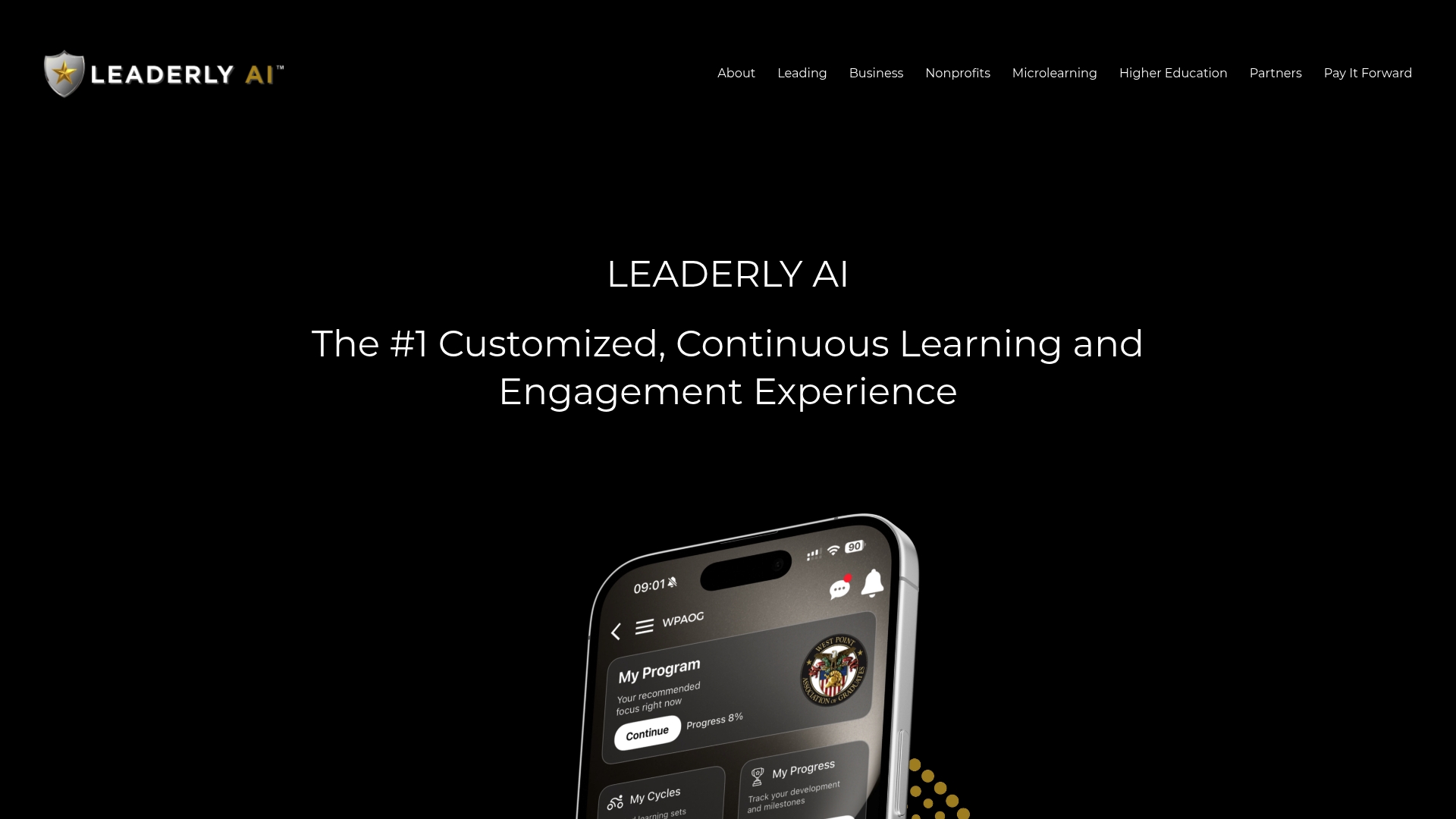
A workable pilot runs 8 to 12 weeks: enroll one cohort of 12 to 20 participants, set two or three success metrics up front (project milestone completion, a pre/post competency checklist, participant satisfaction), and let the platform's analytics dashboard carry the reporting load your facilitator would otherwise track by hand. Explore how the platform approaches leadership habit-building for a sense of the curriculum style, then reach out through Leaderly's homepage to scope a pilot conversation for your next term.
Sources
Advance HE's leadership framework and program pages like Harvard's ECHE offer ready templates, competency lists, and curriculum timelines worth borrowing directly.
- Leadership Development Program — UF Warrington College of Business
- Executive Certificate in Higher Education Leadership (ECHE) — Harvard Graduate School of Education
- Emerging Leaders Program — Case Western Reserve University
FAQ
What Are the 5 C's of Leadership Development?
Definitions vary across programs, but a common version covers character, competence, commitment, connection, and courage as the traits development programs aim to build over time.
What Are the 7 C's of Leadership?
Like the 5 C's, this list varies by source; most versions extend the core traits with communication and confidence alongside character, competence, and commitment.
Why Is Leadership Development Important in Higher Education?
Structured programs are linked to stronger promotability and talent retention, giving institutions a pipeline of leaders instead of relying on ad hoc promotion decisions.
What Are the 7 Leadership Styles in Education?
Common frameworks reference styles such as instructional, transformational, distributed, transactional, servant, situational, and laissez-faire leadership, though terminology differs by researcher.
How Long Should a Leadership Cohort Program Run?
Student-facing cohorts often work well as a single semester, similar to Case Western's Emerging Leaders Program, while faculty-facing cohorts typically need 8 to 12 months to complete a meaningful applied project.