
An employee development program (EDP) is a structured, organization-wide strategy designed to build employee capability and advance career progression over time. It differs from an individual development plan (IDP) in one key way: the program is the organizational framework; the plan is one person's tailored roadmap inside that framework. OECD quasi-experimental evidence shows firm-provided training raises sales, productivity, and exports, though benefits typically appear one to two years after training begins. Targeted training links to roughly 17% productivity gains and about 21% profitability improvements. Leaderlyapp is one platform built specifically to scale this kind of personalized leadership development across organizations.
- An EDP sets the organizational structure, resources, and pathways.
- An IDP is the employee's specific roadmap within that structure.
- Both are necessary. Neither works well without the other.
Table of Contents
- What goes into an effective employee development program?
- How to design and roll out a development program
- How do you measure whether a development program is working?
- Where individual development plans fit inside the program
- How platforms can scale personalized development without losing the human element
- What you should do right now if you want personalized development
- Key Takeaways
- What actually makes development programs work
- Leaderlyapp makes personalized leadership development practical
- Useful sources and further reading
What goes into an effective employee development program?
A well-built EDP has seven core components. Each one serves both the organization and the emerging leader inside it.
- Skills assessment: Baseline measurement of current competencies against role requirements and future needs. Without this, development is guesswork.
- Competency frameworks: Defined, measurable behaviors tied to each role level. These make promotion criteria visible and defensible.
- Curated learning paths: Sequenced content, not a course catalog. Paths should connect directly to the competency gaps the assessment identified.
- Coaching and mentoring: One-on-one support from experienced leaders. Peer learning and cohort models add a social layer that reinforces transfer into daily work.
- Stretch assignments: Real projects slightly beyond current skill level. These accelerate growth faster than classroom learning alone.
- Career and succession pathways: Documented routes from current role to future roles. This is what separates a development program from a training event.
- Measurement and reporting: KPIs tracked at cohort and individual level, reviewed on a regular cadence.
- Governance and access rules: Written criteria for who enters the program, how selections are made, and how disputes are handled. Transparent selection criteria are what prevent perceived favoritism from undermining the whole effort.
Pro Tip: Publish your selection criteria before nominations open. A one-page document explaining eligibility, the selection process, and appeal steps cuts bias complaints and builds trust in the program before it launches.
How to design and roll out a development program
Rollout works best in three phases: pilot, expand, embed. Trying to launch organization-wide on day one is the most common reason programs stall.

Phase 1: Pilot. Align key stakeholders on the business case, conduct a skills gap analysis, and select a cohort of 10–20 participants. Keep the scope tight. The goal is to learn what works before scaling. Capability mapping at this stage prevents the program from drifting away from actual workforce needs.
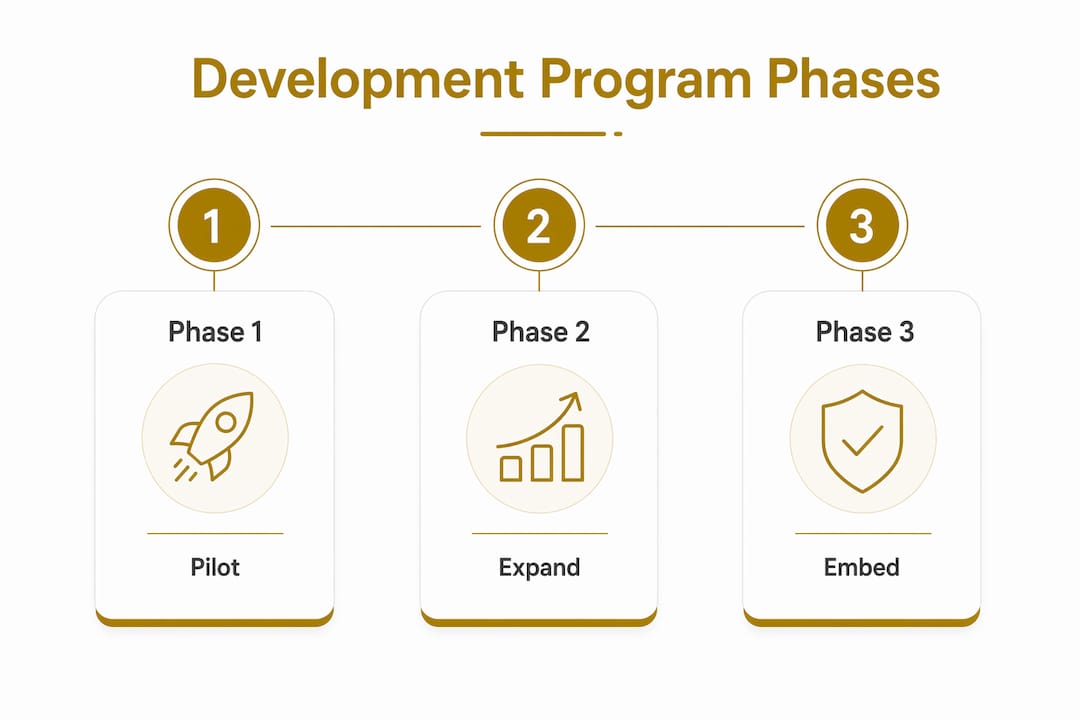
Phase 2: Expand. Use pilot feedback to refine learning paths, governance documents, and manager enablement materials. Add cohorts by department or function. Document everything: role expectations, manager commitments, and participant obligations.
Phase 3: Embed. Integrate the program into performance management cycles, succession planning, and onboarding. At this point, development is a business process, not a special initiative.
| Stage | Owner | Duration | Cost Band |
|---|---|---|---|
| Needs assessment and stakeholder alignment | HR / L&D lead | 4–6 weeks | Low |
| Pilot cohort design and launch | HR + line managers | 12 weeks | Low to moderate |
| Feedback review and path refinement | HR / L&D lead | 4 weeks | Low |
| Full rollout and manager enablement | HR + senior leadership | 18 months | Moderate |
| Embed into performance cycles | HR + HRIS team | Ongoing | Low (maintenance) |
Pro Tip: Have a cross-functional panel, not a single manager, run cohort selection. A panel with documented scoring criteria is far harder to challenge on fairness grounds than a manager's informal recommendation.
How do you measure whether a development program is working?
Start with five KPIs that connect directly to business outcomes, then add the metrics that matter for your specific context.
- Retention rate for program cohort vs. baseline — the clearest signal that development is reducing voluntary turnover.
- Promotion and internal mobility rate — tracks whether the program is actually building the pipeline it promised.
- Performance improvement scores — pre/post assessment data tied to the competencies the program targets.
- Engagement scores — cohort participants compared to non-participants in the same survey cycle.
- Time-to-proficiency for new role transitions — how quickly promoted employees reach full productivity.
Statistic to know: OECD research shows training-led gains in sales, value added, and employment often persist for years, but also cautions that poaching risk is real. The mitigation is career-pathing: employees with a visible internal future are less likely to take that developed skill set to a competitor.
One finding organizations consistently undercount: managerial spillover. Up to 45% of total program benefits in one study came from managers gaining time when frontline workers needed less supervision. Track manager time-saved as a line item in your ROI calculation. It is often the largest single source of value, and almost no one measures it.
Short-term window (0–6 months): engagement lift, early skill application. Many learners apply new skills within six weeks of targeted training; research suggests up to 86% of participants apply new learning in that timeframe. Medium-term (6–18 months): performance scores, promotion rates. Long-term (18 months and beyond): retention delta, productivity per role, succession pipeline depth.
Where individual development plans fit inside the program
The EDP provides the roads; the IDP tells each person which road to take and when. Without the program, an IDP is just a wish list. Without the IDP, the program is a generic course catalog that nobody owns.
A practical IDP has six sections: a strengths assessment, 12–18 month objectives, identified skill gaps, at least one stretch assignment, success criteria, and explicit manager commitments. That last item is the one most IDPs skip. If the manager has not committed to specific support, the plan will stall the moment work gets busy.
SMART goals make the difference between an IDP that gets reviewed quarterly and one that gets filed and forgotten. A strong example for an emerging leader: "Lead the Q3 cross-functional project kickoff meeting independently, with a post-meeting stakeholder satisfaction score of 4/5 or higher, by September 30." That is specific, measurable, achievable, relevant to a leadership competency, and time-bound. Vague goals like "improve communication skills" give managers nothing to coach against.
Governance note: HR should review IDPs across a cohort at least once per cycle to check that stretch assignments and resources are distributed equitably, not just flowing to the most visible employees.
How platforms can scale personalized development without losing the human element
Technology should amplify coaching, not replace it. The features that actually matter when evaluating a leadership development platform:
- Competency mapping engine that ties content to your specific framework, not a generic library.
- Personalized learning paths that adapt based on assessment results and progress data.
- Microlearning delivery for busy professionals. Short, habit-forming modules fit into a workday in ways that hour-long courses do not. Behavioral science shows spaced repetition and small daily habits outperform intensive one-time training for long-term retention.
- Manager dashboards showing cohort progress without exposing individual development details.
- Cohort analytics to identify which learning paths are producing the strongest performance outcomes.
- Privacy controls that separate individual development data from performance management records.
Machine learning personalization can increase content relevance significantly, but it can also encode existing biases if the training data reflects historical promotion patterns that favored certain groups.
Pro Tip: Audit your platform's recommendation engine annually. Pull a report showing which content is recommended to which demographic groups. If the pattern mirrors your existing promotion gaps, the algorithm is reinforcing the problem, not solving it.
Remote teams need formats that match their reality: asynchronous assessments, virtual cohort sessions, and microlearning that works on mobile. A platform that only supports synchronous, in-person delivery will see engagement drop sharply in distributed organizations.
What you should do right now if you want personalized development
You do not need to wait for your organization to launch a formal program. Here is a concrete sequence.
- Run a self-assessment. Identify your top three strengths and two skill gaps relative to the next role you want.
- Gather evidence of impact. Pull three to five concrete examples of results you have driven in the past 12 months, with numbers where possible.
- Identify one stretch assignment you could propose that would close one of those gaps while delivering real value to the team.
- Request a development conversation with your manager. Frame it around business impact, not personal ambition.
- Propose a draft IDP at that meeting. Come with a one-page outline, not a blank page.
A simple script for that meeting: "I've been thinking about where I want to grow in the next 12 months and how that connects to what the team needs. I'd like to walk you through a draft development plan and get your input on whether a stretch assignment on [specific project] makes sense. Can we set aside 30 minutes this week?"
Bring to the meeting: your self-assessment summary, your evidence of impact, your three growth priorities, a proposed stretch assignment with a time estimate, and a draft success criterion for each goal. An effective coaching program depends on this kind of preparation from both sides.
Key Takeaways
An employee development program only delivers lasting results when governance, measurement, and individual plans work together inside a single organizational framework.
| Point | Details |
|---|---|
| EDP vs. IDP | The program is the organizational framework; the individual plan is each person's roadmap inside it. |
| Governance prevents bias | Transparent, documented selection criteria are what make programs defensible and fair. |
| Measure managerial spillover | Up to 45% of program value can come from managers gaining time; track it explicitly. |
| OECD timeline reality | Training-led gains in productivity and sales typically appear one to two years after the program begins. |
| Leaderlyapp for scaling | Leaderlyapp uses machine learning and behavioral-science microlessons to personalize development at scale across organizations. |
What actually makes development programs work
The conventional wisdom says the biggest obstacle to a successful development program is budget. After looking closely at how organizations actually run these programs, the real obstacle is almost always governance, not money.
Programs fail when selection feels arbitrary, when managers are not held to their commitments in IDPs, and when measurement stops at completion rates. A program that tracks who finished a module but not whether anyone got promoted or improved their performance is measuring the wrong thing entirely.
The insight most organizations miss: manager behavior is both the biggest lever and the biggest bottleneck. When managers actively coach, refer to the IDP in one-on-ones, and advocate for stretch assignments, development compounds. When they treat the program as an HR initiative that runs parallel to "real work," it withers. The managerial spillover finding matters here because it reframes the conversation: development is not a cost center for managers, it is a time-recovery mechanism. That argument lands differently in a budget meeting than "investing in people."
For emerging leaders specifically: do not wait to be selected. Build the case, propose the IDP, and make it easy for your manager to say yes.
Leaderlyapp makes personalized leadership development practical
Most organizations know what a good development program looks like on paper. The gap is execution at scale, especially for emerging leaders who do not yet have a seat at the table.
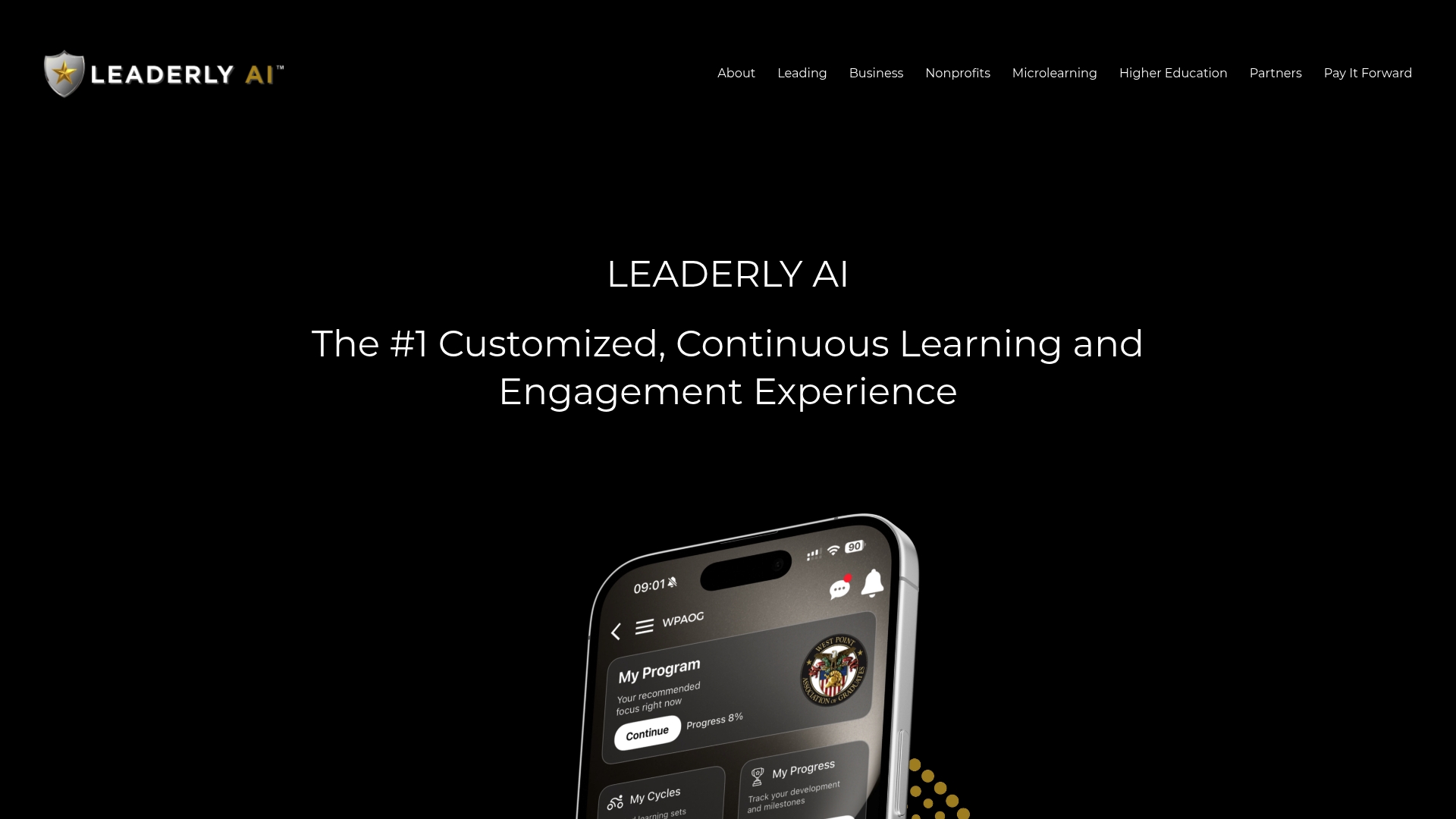
Leaderlyapp delivers personalized microlessons grounded in behavioral science, adapting to each leader's unique development journey through machine learning. Manager dashboards give HR and team leads visibility into cohort progress without compromising individual privacy. IDPs connect directly to the platform's learning paths, so development stays aligned to real organizational competencies rather than generic content.
The platform is built for organizations that need to develop leaders at every level, not just the top tier. If you are ready to move from a development plan on paper to one that actually runs, explore Leaderlyapp's leadership development resources or visit Leaderlyapp to learn more about getting started.
Useful sources and further reading
For HR partners focused on governance and program design:
- OECD: Employee Training and Firm Performance — quasi-experimental evidence on training-led firm gains and poaching risk.
- Davidson Morris: What Is Employee Development in the Workplace? — practitioner guidance on governance, selection criteria, and fairness.
- HBS Working Knowledge: Why Employee Training Pays Off for Companies Twice — the managerial spillover research.
For emerging leaders building their own development case:
- HBS Online: 5 Benefits of Corporate Employee Training and Development — research-backed productivity and engagement findings.
- Matterapp: What Is an Employee Development Program? — practical overview of program structure and skill application timelines.