
Curating leadership content means choosing a small set of credible, relevant resources, explaining why each one matters, and arranging them so learners can find them and use them at work. The selecting is the easy half. The harder half is adding context and practice, so that people change what they do on Monday morning. This guide walks through a process HR teams, nonprofit leaders and educators can follow, from defining the audience to measuring results.
TL;DR
- Start with the learner and the behavior you want to see, not with the library of content you already have.
- Vet every resource for credibility, fit, accessibility and rights before it goes in.
- Add your own context: why this resource, for whom, and what to try afterward.
- Keep pieces short, repeat them over time, and pair each with a practice step.
- Measure reaction, learning, on-the-job application and results, and plan that before you launch.
Table of Contents
- What curating leadership content actually means
- Step 1: Define who the content is for and what it should change
- Step 2: Find credible sources and vet them
- Step 3: Add the context that makes it learnable
- Step 4: Chunk it, space it and build in practice
- Step 5: Make it accessible and mobile-ready
- Step 6: Respect copyright and give credit
- Step 7: Measure whether it works
- Common curation mistakes to avoid
- Perspective: curation is the start, habits are the finish
- Where a platform helps
- A 30-day plan to get started
- FAQ
- Sources
What curating leadership content actually means
Curating is not collecting. A folder of 300 links is a storage problem. A curated path of 12 well-chosen pieces, each introduced with a reason and followed by an exercise, is a learning experience.
In practice, curation has four parts:
- Search and select. Find material that is credible and relevant to a specific need.
- Explain. Say why you chose it and how it connects to the skill at hand.
- Organize. Make it easy to find, searchable and stored somewhere stable.
- Apply. Attach a question, a scenario or a small action so the idea leaves the page.
The third and fourth parts are where most programs stall. Leadership writer Kevin Kruse argued in Forbes in 2023 that because content is now widely available online, the real value of a learning professional has moved from being a content curator to being a "guide on the side" who helps leaders build new habits. That is a useful frame: curation is the starting point, and behavior change is the goal.
Step 1: Define who the content is for and what it should change
Before you open a single article, write down three things.
The audience. "All employees" is not an audience. New managers, experienced directors, volunteer coordinators, student officers and veterans moving into civilian supervisory roles need different material. Bayer's internal-communications guidance on target audience analysis makes the same point in a corporate setting: separate newcomers from established staff so content is pitched at the right level, without patronizing experienced people or overwhelming new ones.
The skills. Name them in observable terms. "Better communication" is vague. "Gives specific feedback within 48 hours of an event" can be watched and counted.
The situation. Where will people learn? A manager on a warehouse floor, a nonprofit board member on a phone between meetings and a sophomore in a campus leadership program all have different windows of time.
A simple planning table keeps this honest:
| Audience | Skill to build | Observable behavior | Time window |
|---|---|---|---|
| New managers | Delegation | Hands off one task per week with clear outcome and deadline | 5 minutes, twice a week |
| Experienced directors | Coaching | Asks open questions in one-on-ones instead of giving answers | 10 minutes, weekly |
| Volunteer leads | Running meetings | Sends agenda and actions in writing | 5 minutes before each event |
| Student leaders | Team accountability | Sets and reviews group commitments | 10 minutes, weekly |
| Transitioning veterans | Translating command experience to civilian teams | Explains decisions and invites input | 5 to 10 minutes, a few times a week |
If you cannot fill in the third column, the content has no target yet.
Step 2: Find credible sources and vet them
The internet will give you endless leadership content. Your job is to filter. Good places to look depend on your setting.
- Higher education and student leadership. The University of Maryland's National Clearinghouse for Leadership Programs hosts resource lists on program and course design, assessment and research, and continuing leadership education. It says plainly that the lists are community-submitted, not exhaustive and not necessarily endorsed, so treat them as a starting point for your own review.
- Public sector. The U.S. Office of Personnel Management keeps a catalogue of Federal Leadership Development Programs that can be searched by agency, pay level, keywords and audience scope. It is meant as a reference for employees and learning professionals, and it is a good model for how to describe your own programs.
- Corporate and nonprofit. Peer-reviewed research, books by practitioners with a track record, your own leaders' stories and internal case studies often beat generic articles.
A five-point vetting check
Run each candidate through the same questions:
- Who wrote it, and what is their basis? Experience, research or opinion?
- Is it current? Leadership basics last, but examples, tools and rules age.
- Is it right for your audience level? See Step 1.
- Is it accessible? Captions, transcripts, readable on a phone, usable with a screen reader.
- Can you use it? Check licensing and attribution before you copy, embed or excerpt.
Reject anything that fails two or more. A short, solid library is more useful than a long, mixed one.
Step 3: Add the context that makes it learnable
This is the part that turns a link list into a program, and it is the part only you can do. Each resource needs a short frame from you:
- Why it is here: one sentence tied to the skill.
- What to look for: two or three things to notice while reading or watching.
- What to try: a specific action within the next few days.
- How it connects: a pointer to the previous and next piece.
For example, a ten-minute talk on giving feedback becomes far more useful with this note: "Watch for how the speaker separates the observation from the interpretation. This week, give one piece of feedback to a colleague using that split, and jot down how it landed."
Good curation also brings in more than one viewpoint. A path built on a single author's model teaches that model, not leadership. Pair a classic framework with a contrasting one and ask learners which fits their team. Programs designed for particular communities show how much the framing matters; for instance, this cohort-based leadership curriculum combines online modules, field manuals and selective cohorts built around the experience of professionals in the African diaspora, a reminder that context and lived experience shape how leadership content lands.
Step 4: Chunk it, space it and build in practice
Long courses are easy to publish and easy to ignore. Short, repeated pieces are easier to finish and easier to apply.
India's government framework for its iGOT Karmayogi learning platform recommends breaking content into bite-sized modules of ideally no more than 10 minutes. It is a national program in a different context, but the principle travels well to any workplace where people learn between tasks. The same framework lists common curation mistakes: overwhelming learners, neglecting accessibility, and using content that breaks copyright or lacks proper credits and references.
A workable rhythm looks like this:
- Two to three touches a week, each under ten minutes.
- One practice action per touch, small enough to do that week.
- A weekly reflection prompt, such as "What did you try, and what happened?"
- A monthly review with a manager or peer.
If you want ideas for what short lessons look like, our guide to leadership microlessons managers can deliver in 2 to 7 minutes gives twelve examples, and our piece on microlearning versus macrolearning explains how to combine short lessons with deeper sessions.
Practice is also where team activities help. Exercises that get people applying a skill together, such as the change management activities for teams collected by one team-engagement platform, can turn a concept from a lesson into something people have actually tried.
Step 5: Make it accessible and mobile-ready
If learners cannot open it, hear it or read it, it does not exist for them. Accessibility is a design requirement, and in some settings a legal one.
A useful reference point is a 2015 settlement between the U.S. Department of Justice and edX, which required the provider's website, mobile applications and learning management system to conform at minimum to WCAG 2.0 AA. The agreement also noted that videos carry rolling transcripts or captions for deaf or hard-of-hearing participants and that the text discussion board is accessible to them. It applied to one provider, not to every organization, but it shows what a baseline looks like: captions, transcripts, accessible discussion tools and a conforming mobile experience.
For your curated library, that means:
- Caption every video and offer a transcript.
- Prefer text that reflows on a small screen over PDFs built for print.
- Write descriptive link text so screen-reader users can scan.
- Test the path on a phone before you launch. Our notes on mobile learning design cover why shrinking desktop lessons does not work.
Mobile access matters for exactly the people leadership programs often miss: frontline supervisors, volunteers, shift workers and students who are rarely at a desk.
Step 6: Respect copyright and give credit
Curating means using other people's work, so handle it carefully.
- Link rather than copy wherever possible. A link with your commentary is the safest form of curation.
- Credit authors and publishers clearly, with titles, dates and links.
- Excerpt sparingly and only where you are confident the use is permitted. U.S. fair use is a case-by-case question. In a 2027 renewal petition for a related exemption, educators argued that some uses of motion-picture excerpts for criticism and comment in nonprofit online courses likely qualify as fair use, but that is an argument made to the Copyright Office, not a blanket permission.
- Ask when in doubt. For anything you plan to reproduce in full, such as a chart, a video or a workbook, get written permission or use a licensed alternative. If the stakes are high, talk to your organization's counsel.
Step 7: Measure whether it works
Watching completion rates tells you who clicked. It does not tell you who changed. The U.S. Office of Personnel Management's guide to evaluating leadership development programs recommends assessing four things: learner reaction, learning, application in the workplace, and results or business impact. It also advises aligning evaluation objectives with program objectives and involving key stakeholders in planning the evaluation.
Turn that into a practical scorecard:
| Level | Question | Example measure |
|---|---|---|
| Reaction | Did learners find it relevant? | Short rating after each lesson |
| Learning | Did they understand the idea? | Quick scenario check or self-assessment |
| Application | Are they doing something different? | Manager observation, peer feedback, practice logs |
| Results | Did team outcomes move? | Engagement survey items, retention, internal mobility |
Set the baseline before launch. If you cannot measure "before," you cannot claim "after." And be realistic: results lag behavior, which lags learning. Look for application signals first, then outcomes a quarter or two later.
Common curation mistakes to avoid
- Volume over value. Fifty resources signal that nobody made a choice.
- No owner. Someone has to review the library on a schedule and retire what is stale.
- One audience, one path. New and experienced leaders need different entry points.
- Content without action. Information that ends in nothing rarely changes anything.
- No feedback loop. Ask learners what helped and drop what did not.
Perspective: curation is the start, habits are the finish
We build Leaderly AI on a simple belief: leadership development should not be limited to managers or to the people whose employers can afford a large training budget. Everyone who influences others, from a first-time team lead to a volunteer coordinator, benefits from practice.
When we talk with HR teams and educators, the same pattern comes up. They can find content. What they struggle to do is keep it relevant for each person, keep it short enough to fit a real day, and see whether anything changed. That is why our platform pairs microlessons with behavioral science, practical exercises, self-assessments and analytics, and why our approach to personalization is designed to adapt as each learner's journey unfolds.
Our advice to anyone curating leadership content: choose less, explain more, and attach an action to every piece. Curate for the habit you want to see, not for the topic you want to cover.
Drew
Where a platform helps
Doing all this by hand is possible for a small group. It gets heavy when you serve hundreds of people with different roles. That is the gap Leaderly AI is built for: a mobile-first platform where HR teams, educators and program leaders can customize learning journeys, deliver short lessons, include assessments such as DiSC, EQ and MBTI, run surveys and see analytics on engagement.
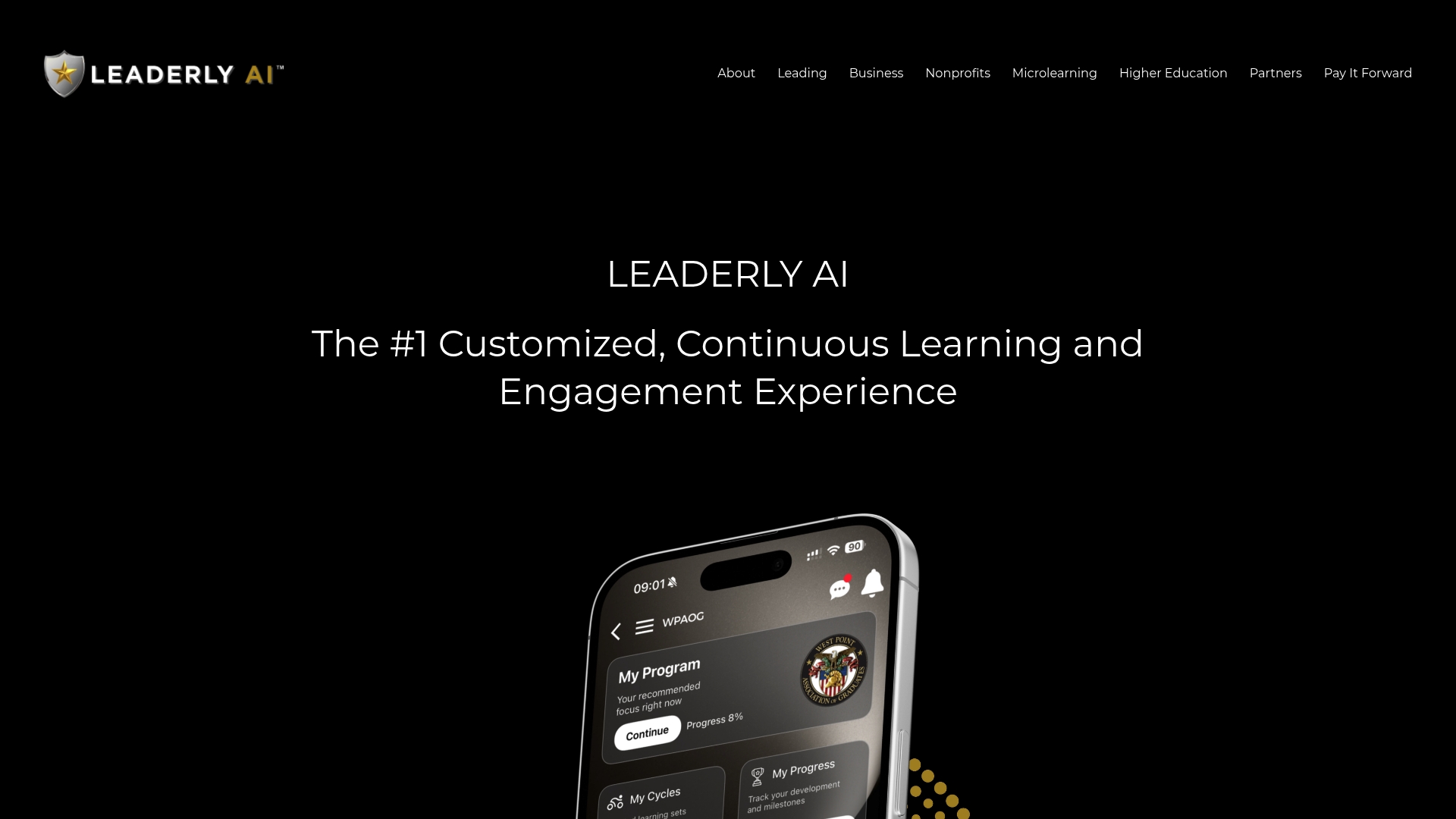
If you run leadership development for a company, see Leaderly AI for organizations. Nonprofits can look at Leaderly AI for Nonprofits, and campus teams at Leaderly AI for Higher Education. For more on turning long material into short lessons, read how AI microlearning can convert a large body of content into a set of two-minute lessons, or how to build student leadership with microlearning.
A 30-day plan to get started
Week 1: Scope. Pick one audience and two skills. Write the observable behaviors and the time windows.
Week 2: Source and vet. Gather 20 candidates, apply the five-point check, and keep the best 8 to 12.
Week 3: Frame and sequence. Write the "why, look for, try" note for each. Order the pieces from simple to complex and add a reflection prompt.
Week 4: Pilot and measure. Launch with a small group, collect reaction data weekly, and note early application signals. Adjust before scaling.

For a fuller design framework, our walkthrough of 8 steps to an effective leadership development program covers the program-level decisions that sit around the content.
FAQ
What does it mean to curate leadership content?
It means selecting credible resources for a defined audience, explaining why each matters, organizing them so they are easy to find, and linking each to a practice action. It differs from collecting links because the editorial judgment and the application step are part of the work.
How many resources should a curated leadership path include?
There is no fixed number, but fewer is usually better. A focused path of 8 to 12 pieces for one skill area, each short enough to finish in about 10 minutes, is easier to complete and apply than a large library. Start small, check what learners use, and add only what fills a clear gap.
How do I know if a leadership resource is credible?
Check the author's experience or research basis, the publication date, whether the level fits your audience, whether it is accessible, and whether you have the right to use it. Lists from university programs or government agencies are good starting points, but review them yourself, since some, like the NCLP's, state that they are not endorsements.
How do I measure whether curated content works?
Track four levels: learner reaction, learning, application at work, and business results. Set a baseline before you launch, involve stakeholders in planning, and look for behavior changes, such as managers coaching differently, before expecting movement in engagement or retention.
Can I reuse articles and videos in our internal program?
Linking with your own commentary is the safest approach. For copying, embedding or excerpting, check the license or terms, credit the source, and get permission for full reproduction. Fair use depends on the specific facts, so ask your organization's counsel when you are unsure.
Sources
- A New Era Of Leadership Development: From Content Curator to Guide on the Side (Forbes)
- Target audience analysis (Bayer Identity Net)
- Resources (National Clearinghouse for Leadership Programs)
- Federal Leadership Development Programs (U.S. OPM)
- Framework for iGOT Karmayogi Platform content quality
- Settlement Agreement between the United States and edX (ADA.gov)
- Petition to renew a 17 U.S.C. § 1201 exemption (U.S. Copyright Office)
- Evaluating Leadership Development Programs (U.S. OPM)