
AI microlearning is short, AI-driven lessons that adapt and sequence content to boost retention and on-the-job skill use. We see it work best for just-in-time training, skill reinforcement, and leadership habit building, where a quick push at the right moment beats a long course nobody finishes. Success depends less on the technology than on pedagogy, subject-matter review, and governance baked in from day one.
TL;DR:
- Keep units to two or three minutes; combine video, text, and an interactive question with retrieval practice, interleaving, and spaced review.
- Pilot one role and behavior for four to twelve weeks, then measure retention after a week and job transfer rather than relying on completion rates.
- Require subject matter expert approval before publication, and log each lesson’s source, prompt, model version, and timestamp while auditing for bias.
- Leaderly’s benchmarks estimate monthly costs of $4 to $12 per learner and custom builds at $40,000 to $80,000, but rates vary by project.
Table of Contents
- Core AI capabilities: adaptive sequencing, content generation, and chunking
- Pedagogical design: what actually makes a microlesson work
- Implementation checklist: from pilot to scale
- Costs and timelines: realistic benchmarks for pilots and scaling
- Instructional governance: keeping AI accountable
- Personalization beyond adaptive sequencing
- Fitting microlearning into leadership development frameworks
- Engagement techniques built for leadership microlearning
- Measuring impact on leadership behaviors and outcomes
- Where AI microlearning shows up in leadership development
- Where to start if you're building this now
- How Leaderly supports AI microlearning programs
- FAQ
- Sources
Core AI capabilities: adaptive sequencing, content generation, and chunking
Adaptive sequencing uses a learner model built from quiz results, time-on-task, and prior completions to decide what a person sees next. Instead of a fixed course order, the system reroutes someone who misses two retrieval questions on a topic toward a remedial micro-unit before letting them advance. A systematic review of AI-powered adaptive learning technologies found that techniques like reinforcement learning and transformer models already support this kind of dynamic sequencing and learner profiling in production systems.
Content generation and chunking turn longform material into usable microlessons. Automated video and speech splitters identify topic boundaries in a recorded training session or webinar and cut it into two-to-three-minute segments, each tagged to a single learning objective. Text summarization tools do the same for policy documents or manuals, producing short explainer cards an SME can then verify.
Micro-assessments close the loop. A well-built AI microlearning unit checks understanding immediately after the content, branches a struggling learner into remediation, and surfaces a quick win for someone who already knows the material. None of this works in isolation, so integration matters:
- Authoring tools feed generated drafts into a review queue before anything reaches learners.
- LMS or learning platform connections use xAPI or SCORM to track completions and feed data back into the learner model.
- Mobile push notifications deliver the lesson at the moment of need, such as before a performance review or a difficult conversation.
- Analytics dashboards surface which microlessons are skipped, repeated, or failed, so designers can revise rather than guess.
The practical outcome: a 500-page onboarding manual becomes a sequence of 40 adaptive microlessons, each two minutes long, that reorders itself based on what a new hire already demonstrates.
Pedagogical design: what actually makes a microlesson work
The technology only pays off when the design follows how memory works. A conceptual paper on microlearning as a vehicle for Rosenshine's principles of instruction argues that mapping Rosenshine's principles onto micro-units is what separates real learning from "bite-sized" content that just feels efficient. Small steps, modeling, guided practice, and spaced review all translate directly into a two-minute unit: show one concept, demonstrate it once, let the learner try it with feedback, then resurface it a week later.
Inside each microunit, three techniques do most of the work:
- Retrieval practice: end every lesson with a quick question that forces recall rather than rereading.
- Interleaving: mix related skills across sessions instead of grouping them, so learners practice telling them apart.
- Desirable difficulty: make the retrieval question slightly harder than the lesson content, which strengthens the memory trace more than an easy recap would.
Length and format matter too. A unit longer than two or three minutes starts competing with working memory limits, and mixing a short video with a text prompt and one interactive question tends to outperform any single format alone. Three templates cover most use cases, drawn from the same Rosenshine-aligned research: a 60-second concept explanation followed by two retrieval questions, a 90-second scenario with a reflection prompt and one branched remediation path, and a 120-second micro-simulation with immediate feedback.
Pro Tip: Write the retrieval question before you write the lesson content: it forces you to define the one thing the learner actually needs to remember.

Implementation checklist: from pilot to scale
Moving from idea to working pilot follows a predictable sequence, and skipping steps is the most common reason programs stall.
- Define scope and metrics. Pick one job role and one behavior to change, and set a measurable target such as faster time-to-competency or fewer repeated errors.
- Assign roles. A subject-matter expert, an L&D lead, an IT or LMS administrator, and a data steward responsible for privacy and access controls all need a defined stake in the pilot.
- Build the authoring workflow. Source existing content, draft prompt templates for generation, and route every AI-generated draft through an SME review gate before publication.
- Test before wide release. Run a small sample against a control group where possible, and measure retention a week out and transfer to actual job tasks, not just completion rates.
- Roll out and monitor. Launch to the full cohort, watch dashboards for drop-off points, and treat the first version as a draft that improves on a monthly cycle.
- Protect learner data. Confirm what personal and performance data the platform stores, who can access it, and how long it is retained before scaling beyond the pilot group.
Teams that treat this as a one-time build rather than a recurring loop tend to see engagement fall off after the initial launch. The relationship between microlearning and macrolearning also matters here: microlessons work best as reinforcement for a larger learning journey, not as a replacement for it.
Costs and timelines: realistic benchmarks for pilots and scaling
Budget planning gets easier with a reference point. Leaderly's own cost benchmarks put typical per-user monthly costs for AI microlearning programs in the $4 to $12 range, with full custom builds running $40,000 to $80,000, figures we share as a planning reference rather than a universal rate. A pilot typically runs four to twelve weeks, long enough to gather a few review cycles of data without delaying a decision on scaling.
Cost drivers break down fairly consistently:
- SME review hours usually cost more over time than the AI generation itself.
- Integration work with an existing LMS or HR system adds setup cost but is mostly one-time.
- Ongoing moderation and bias audits are a recurring line item, not a one-off expense.
- Content refresh cycles need a recurring budget as job roles and policies change.
ROI shows up in time-to-competency, sustained engagement after the novelty wears off, and a measurable drop in hours instructors spend on repeat training for the same material.
Instructional governance: keeping AI accountable
Governance is not a compliance afterthought, it is what keeps AI-generated content trustworthy enough to put in front of learners. IMS Global's guidance on AI-generated content recommends maintaining provenance records for every piece of generated material, including the model, version, prompt, source chunks, and timestamp, alongside regular bias audits and a human reviewer in the loop before anything reaches an LMS.
A few practices make this workable day to day:
- Log provenance automatically so every microlesson can be traced back to its source content and the prompt that generated it.
- Ground outputs with retrieval-augmented generation, which IMS Global notes reduces hallucination risk by tying generated text to validated source material rather than open-ended model output.
- Run periodic bias audits on generated content and assessment questions, with a defined remediation step when an issue surfaces.
- Build a governance profile for each activity type, specifying how much authority the AI has and where a human sign-off is required. A framework for AI governance in instruction frames this across six dimensions, including pedagogical grounding and human accountability, and argues that these evaluation traces should stay visible and revisable, not locked away in a vendor dashboard.
Pro Tip: Treat every AI-generated microlesson as a draft until an SME has signed off, no matter how polished the output looks.
Personalization beyond adaptive sequencing
Adaptive sequencing adjusts content based on quiz performance, but it is only one layer of personalization. Behavioral profiling adds another: tracking when a learner actually engages (early morning versus end of day), which formats they finish versus abandon, and how they respond to reminders versus ignoring them. A learner who consistently skips video but completes text-based scenarios is telling you something a quiz score never will.
Preference settings matter too. Letting a learner choose pacing, notification frequency, or even which leadership competency to prioritize first increases the odds they finish a program rather than let it lapse. Combining stated preferences with observed behavior, rather than relying on either alone, tends to produce a more accurate picture of what will actually keep someone engaged. This matters more in leadership development than in compliance training, since leadership habits form through repeated practice over months, not a single completion event, and a program that respects how someone actually works is more likely to survive that stretch.
Fitting microlearning into leadership development frameworks
Microlearning works best as a delivery mechanism inside a broader leadership framework, not as a standalone initiative competing with it. Most organizations already have some structure, whether that is a competency model, a succession pipeline, or a set of core leadership behaviors tied to performance reviews. The question is how short AI-generated lessons reinforce that structure rather than duplicate it.
A practical approach ties each microlesson to a specific competency in the existing framework, so a lesson on giving difficult feedback maps directly to a "communication" competency already tracked in performance conversations. This also makes measurement easier, since progress on microlessons can roll up into the same competency scores leadership already reviews. Organizations building this out often start with a continuous leadership development approach that treats microlearning as an ongoing layer rather than a one-time course, which fits better with how leadership behaviors actually develop over time.
Engagement techniques built for leadership microlearning
Leadership content faces a harder engagement problem than compliance training: there is no mandatory deadline forcing completion, so the content has to earn attention on its own. Gamification helps, but only when it rewards behavior change rather than just clicking through lessons. Points for completing a reflection exercise or a peer feedback request tend to hold attention longer than points for simply finishing a video.
Social learning adds another layer. Letting a cohort of managers see (anonymized or named, depending on culture) how peers are progressing through the same leadership habits creates light accountability without a formal mandate. Discussion prompts attached to a microlesson, where a small group reflects on how a concept applied in their own week, also tend to deepen the learning more than the lesson content alone. The combination of short AI-generated content with a human layer of peer discussion addresses a real gap: AI can personalize the lesson, but it cannot replace the social reinforcement that makes a habit stick.
Measuring impact on leadership behaviors and outcomes
Completion rates tell you almost nothing about whether leadership actually improved. The more useful measures track behavior change: did a manager's team report more frequent feedback conversations, did turnover on that manager's team shift, did 360-degree review scores move on the specific competencies the microlessons targeted. These signals take longer to show up than a quiz score, often three to six months, which is why leadership programs need a longer measurement window than a typical compliance course.
Linking microlearning data to existing HR systems makes this tractable. If a manager completes a series of lessons on delegation and the team's engagement survey scores on autonomy shift in the following quarter, that correlation is far more meaningful than a completion certificate. Organizations that build this link between microlesson activity and existing performance or engagement data get a much clearer picture of whether the program is changing behavior or just generating completions.
Where AI microlearning shows up in leadership development
Different organization types apply AI microlearning to leadership development in distinct ways, shaped by who needs the training and what constraints they operate under. Corporate HR teams tend to use it for manager enablement at scale, pushing short lessons to every new people manager rather than reserving leadership training for a small cohort heading to an in-person program. Nonprofit organizations, often working with volunteer or part-time leadership structures, use short AI-generated lessons to extend leadership development to staff who could never attend a multi-day workshop.
Higher education applies the same approach differently again, often folding leadership microlearning into student leadership programs or staff development for department chairs, where governance and data privacy carry extra weight given the institutional and sometimes regulatory context. Across all three settings, the common thread is the same: short, adaptive content reaches people that a traditional classroom-based leadership program would have excluded by cost or scheduling, and the AI layer is what makes a personalized version of that content affordable to deliver at scale rather than only to a management cohort.

Where to start if you're building this now
If you're planning a pilot, start narrow: one role, one behavior, retrieval practice baked into every unit, and an SME in the review loop before anything ships. Log provenance and governance decisions from the first lesson rather than retrofitting it later, since that record becomes the evidence you need when a stakeholder asks how a piece of content was generated. For teams building out the design side further, Leaderly's resources on microlearning design and cost benchmarks are a useful next stop, and the 30% rule heuristic, which suggests reserving roughly a third of the workflow for human oversight and creative judgment, is a reasonable starting ratio for how much review time to budget against AI-generated drafts.
— Drew
How Leaderly supports AI microlearning programs
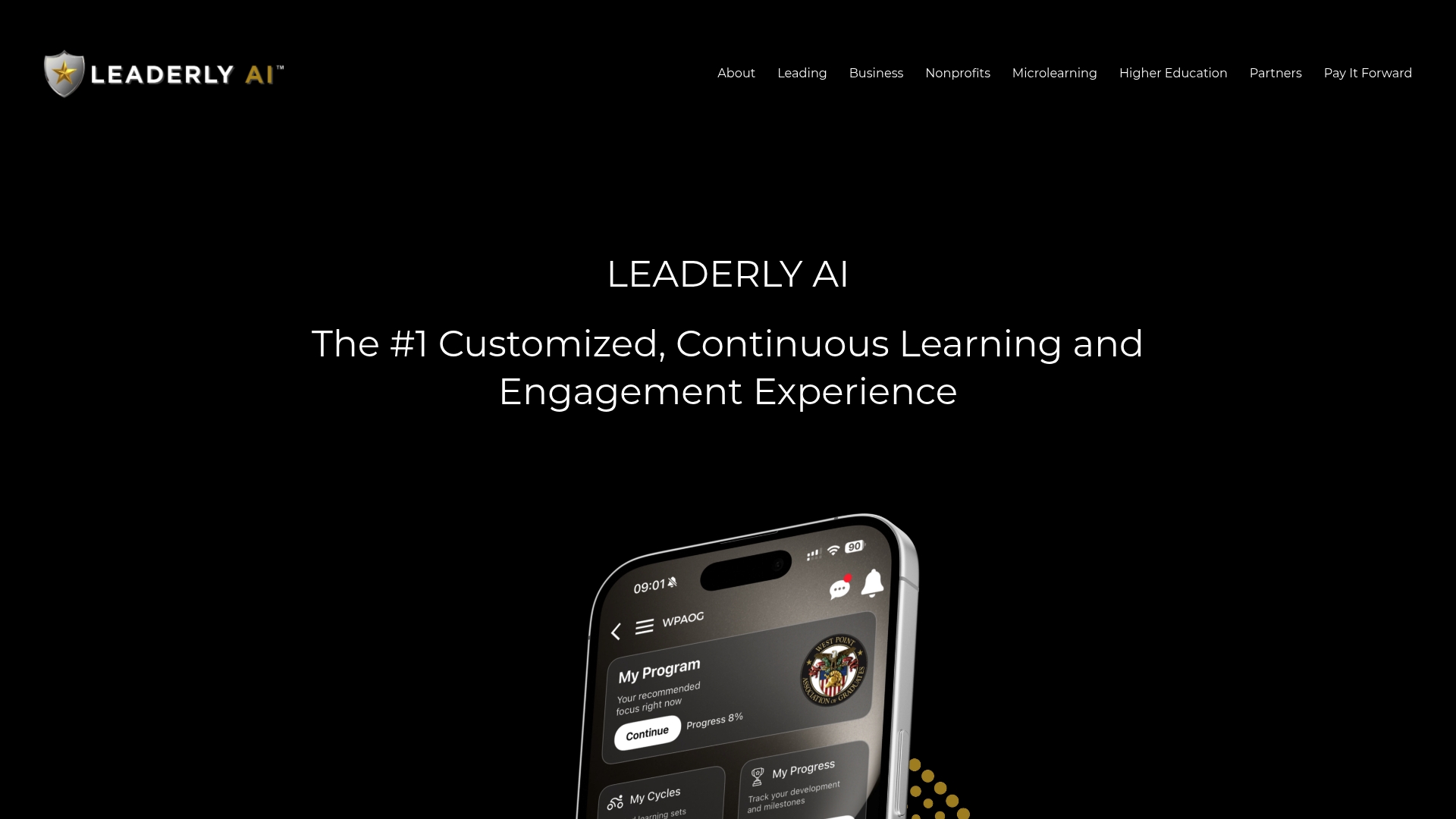
We built Leaderly AI around the same principles this guide covers: personalized microlessons that adapt to each person's progress, built-in assessments like DiSC, EQ, and MBTI, and analytics dashboards that show what is actually changing behavior, not just completion counts.
A sensible pilot outline looks like this:
- Start with one team or department and a single leadership competency.
- Use our business solutions for continuous professional development if you're planning across a full organization.
- Review our higher education offering or nonprofit programs if those fit your setting better.
Reach out to see how a pilot could fit your team's leadership goals.
FAQ
What is the 30% rule for AI?
The 30% rule is a heuristic suggesting AI handle roughly 70% of a routine workflow while humans retain about 30% for creative judgment and oversight, according to recent coverage of the concept. In microlearning, this translates to letting AI draft and sequence content while SMEs keep review and approval authority over what ships.
Does microlearning actually work?
Microlearning that adds structure, such as retrieval practice and personalized prompts, often improves immediate retention and sometimes delayed retention, according to a systematic review of AI's impact on learner memory. The effect depends heavily on design quality rather than format alone, so a poorly structured short lesson performs no better than a poorly structured long one.
What is the best free app for microlearning?
There is no single verified ranking of free microlearning apps in the research reviewed here, and claims about a specific "best" free tool vary by source and change often. For organizations evaluating a leadership-focused option, Leaderly AI offers personalized microlessons and built-in assessments, though pricing details are available on request.
What should you not ask an AI?
Avoid asking an AI tool to generate content on topics outside its grounded source material, since outputs not tied to verified sources carry higher hallucination risk, a concern IMS Global's guidance addresses through retrieval-augmented generation. It is also worth avoiding over-reliance on AI-generated assessments of sensitive performance or behavioral data without human review, given the risk of algorithmic authority bias leading to unwarranted trust in fluent but ungrounded outputs.
Sources
- AI-Generated Content: Best Practices (IMS Global)
- The impact of artificial intelligence on learners’ memory: a systematic review
- Instructional governance by design: a framework for AI in computing education