
Leadership microlessons are short, spaced microlearning modules that improve on-the-job leadership behavior by focusing practice and manager reinforcement rather than overwhelming learners with long sessions. The main payoff is better transfer and retention: brief, repeated practice beats one-off workshops because it works with the spacing effect and gives managers natural checkpoints to reinforce what's learned, the way platforms specialized in microlearning build habit-forming leadership routines.
TL;DR:
- Microlearning modules should be under five minutes and paired with a follow-up practice task within 24 hours for maximum impact.
- Spaced repetition and ongoing reinforcement from managers significantly improve leadership skill transfer and retention.
- Adaptive microlearning, guided by brief diagnostics, reduces cognitive load and tailors content to individual learning needs.
- Implementing microlessons in phases with manager champions and integrating them into routine activities boosts adoption and effective behavior change.
- Leadership microlessons are most effective when they focus on specific, high-impact topics like onboarding, feedback, and meeting leadership.
Table of Contents
- Why microlessons work for leadership development
- Practical microlesson topics and short formats for managers
- Design rules: how to build effective leadership microlessons
- Scaling microlessons inside organizations: rollout and ROI basics
- Leaderly's perspective: how Leaderly designs microlessons to form leadership habits
- Author perspective: how to prioritize microlessons that move the needle
- Leaderly for teams: build leadership habits that actually stick
- FAQ
- Sources
Why microlessons work for leadership development
Leadership training works best when it combines a few specific ingredients, not sheer duration. A meta-analysis of leadership training programs found that training is substantially more effective when it includes needs analysis, feedback, practice-based methods, and spaced sessions, rather than a single intensive event. Separate meta-analytic evidence from Frontiers in Psychology backs this up: spacing, needs analysis, feedback, and hands-on practice all act as moderators that raise training effectiveness across reactions, learning, transfer, and results.
Microlessons fit this evidence because they break content into small enough pieces to avoid overloading working memory, then space that content over days or weeks instead of cramming it into a single session.
- Short units reduce cognitive overload and support better recall over time.
- Spaced repetition strengthens memory more reliably than one long session.
- Built-in practice and feedback loops turn passive content into applied skill.
A 2026 meta-analysis found that leadership training effectiveness depends on spacing and practice, which means a well-spaced five-minute lesson can outperform an hour-long seminar that skips reinforcement.
Adaptive microlearning adds another layer. A quasi-experimental study on adaptive microlearning found that adaptive systems significantly reduced cognitive load and improved learning adaptability compared with fixed-format microlearning, which matters for managers juggling leadership development alongside a full workload.
Practical microlesson topics and short formats for managers
A good microlesson has one goal, a short core lesson, and a task you actually do before the next one arrives. Here are formats that fit most leadership programs.
- One-minute 1:1 prep: a 2-minute prompt listing three questions to ask before a check-in.
- Three-step corrective feedback: a 5-minute video model, then a practice script for your next tough conversation.
- Delegation checklist: a 4-minute interactive card sorting tasks by who should own them.
- Psychological safety prompt: a 3-minute reflection asking you to recall a moment you shut down an idea.
- Meeting opener habit: a 2-minute tip plus a one-line agenda framing to try in your next meeting.
- Active listening drill: a 5-minute audio lesson with a paraphrase-back exercise.
- Conflict de-escalation: a 6-minute scenario walkthrough with a choose-your-response quiz.
- Recognition in the moment: a 3-minute prompt to send one specific, behavior-based compliment today.
- Setting clear expectations: a 5-minute template for a one-paragraph role brief.
- Coaching questions over advice: a 4-minute video contrasting two manager responses to the same problem.
- Time-boxing priorities: a 3-minute worksheet for a weekly top-three list.
- Giving upward feedback: a 7-minute scenario with a scripted opening line.
A typical sequence spaces these naturally: a daily two-minute prompt builds awareness, a weekly five-minute module adds a practice task, and a short reflection at the end of the week closes the loop.
- Daily prompts build small habits without demanding extra calendar time.
- Weekly modules add depth and a concrete task tied to real meetings.
- End-of-week reflections surface what worked and what to adjust.
Design rules: how to build effective leadership microlessons
Strong microlessons share a structure, regardless of topic. Before writing content, lock in these basics.
- Define a single, specific objective per lesson, not three loosely related ideas.
- Keep the core teaching to 3 to 5 minutes; anything longer splits into two lessons.
- Attach one micro-practice task the learner does within 24 hours.
- Add an accountability prompt, such as a manager check-in or a self-report nudge.
Spacing matters as much as content. Daily or every-other-day micro-doses work well for habit-building topics like active listening or recognition; escalate to a longer, structured session (a workshop or a guided discussion) when a skill requires layered practice, such as negotiation or crisis communication. Our comparison of microlearning and macrolearning covers when to make that jump.
Adaptive personalization keeps lessons from feeling generic. A short diagnostic (two or three questions) can route a learner toward feedback-focused content if they struggle there, or delegation content if that's the gap. Keeping each diagnostic brief avoids adding the cognitive load the whole format is meant to reduce, a balance the adaptive microlearning research found central to improving learning adaptability.
Managers are the reinforcement mechanism. A study on goal-oriented leadership apps found that app-based prompts improve self-reported transfer to the workplace, but the same research points to lack of manager reinforcement as the most common reason microlessons fail to change behavior. Track completion rates alongside behavior indicators (did the manager actually try the script?) and a short post-practice self-assessment.

Pro Tip: Pair every microlesson with one specific "try this in your next meeting" task, not a general encouragement to "apply what you learned."
Scaling microlessons inside organizations: rollout and ROI basics
Rolling out microlessons works best as a phased effort, not an all-at-once launch. Start with a small pilot group, recruit a manager champion who models the behavior publicly, then expand in phases once early feedback is in.
- Pilot with one team or department before a company-wide rollout.
- Recruit manager champions who demonstrate the practice tasks themselves.
- Integrate microlessons into existing routines: pre-meeting prompts, 1:1 prep, or mobile nudges through your LMS.
- Watch for pitfalls: no manager buy-in, scattered one-off lessons with no sequence, or treating microlearning as a single event instead of an ongoing habit.
Early ROI signals don't require a formal study. Manager-observed behavior changes, outcomes from small team projects, and participant self-reports all give usable early evidence. Our guide to leadership training ROI metrics breaks down simple ways to track this without building a research department. Organizations focused on public safety or other high-stakes fields can find applied rollout examples through groups like the Public Safety Consulting Group, which works through similar phased implementation challenges.
Leaderly's perspective: how Leaderly designs microlessons to form leadership habits
We build our AI around the idea that leadership habits form through frequent, personalized practice rather than annual workshops. Our platform uses machine learning to adjust each person's learning pathway as they progress, pairing behavioral-science-based microcoaching with practical exercises and self-assessments.
- We route learners through personalized pathways based on short diagnostics and ongoing progress.
- We deliver brief practice prompts tied to real workplace moments, not abstract theory.
- We provide managers dashboards to see engagement and self-reported application.
- We pair microlearning with built-in assessments, including options like DiSC, EQ, and MBTI, so content adapts to how each person actually leads.
This structure mirrors what the research above recommends: short units, spacing, adaptive routing, and a mechanism for managers to stay involved.
Author perspective: how to prioritize microlessons that move the needle
Pick microlessons by scoring impact, frequency of use, and manager feasibility, not by what looks novel. Three bundles consistently earn their spot: new manager onboarding, feedback and coaching, and meeting leadership. Run each as a two to four week pilot and judge success by what managers actually observe changing, not by completion rates alone.
— Drew
Leaderly for teams: build leadership habits that actually stick
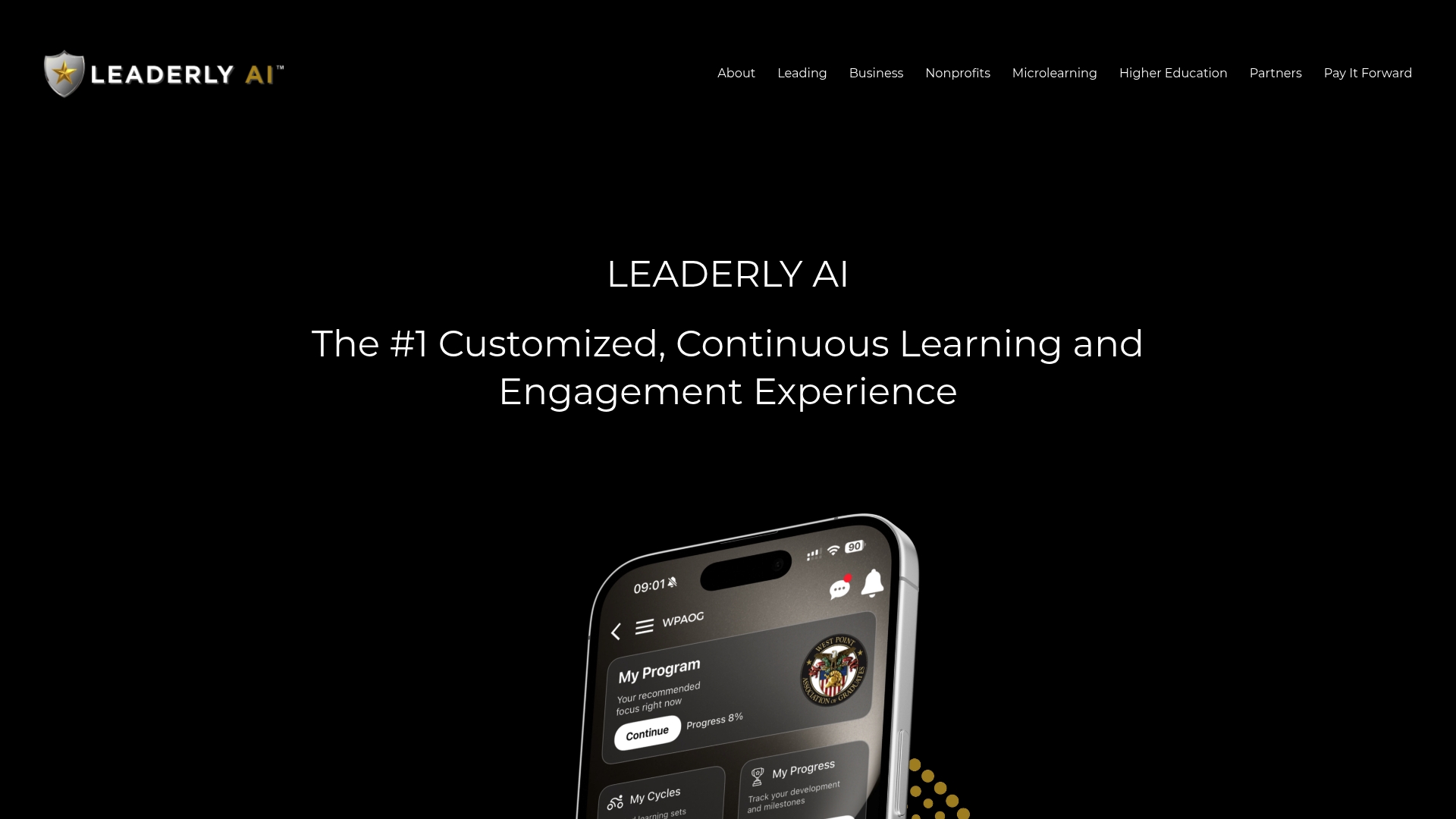
We combine personalization, behavioral science, and scalable delivery so organizations can roll out leadership microlessons without building a learning program from scratch. Whether you're developing new managers, supporting volunteers, or training faculty, Leaderly AI adapts each learning path as people grow.
- Start with a pilot for one team and expand once you see manager-observed changes.
- Explore our business platform if you're scaling across a company, our higher education programs for campus settings, or our nonprofit offering for mission-driven teams.
- Reach out through our co-branded impact programs if you want a partnered rollout.
Get in touch to see how a pilot could look for your team.
FAQ
What are leadership microlessons?
Leadership microlessons are short, focused learning modules, usually 2 to 7 minutes, that teach one specific leadership skill and pair it with a small practice task. They work best when spaced over days or weeks rather than delivered all at once, which supports better retention and transfer.
How long should a leadership microlesson be?
Most effective microlessons keep their core teaching to 3 to 5 minutes, followed by one practice task completed within a day. Longer skills, like negotiation, often need a short series of microlessons or a longer session rather than a single module.
Does microlearning actually improve leadership skills?
Microlearning improves leadership behavior when it includes spacing, feedback, and practice, not just short content. Meta-analytic evidence shows these elements raise training effectiveness across learning, transfer, and results, and app-based prompts have been shown to improve self-reported transfer to the workplace.
What makes microlessons fail to change behavior?
The most common failure is a lack of manager reinforcement: even well-designed microlessons rarely change behavior if managers don't observe or coach around the practice. Fragmented, one-off lessons without a sequence or spacing also undercut results.
How does Leaderly personalize leadership microlessons?
We use machine learning to adjust each learner's pathway based on short diagnostics, assessments, and ongoing progress. This keeps content relevant to each person's role and growth stage rather than delivering the same generic lesson to everyone.
Sources
- Leadership Training Design, Delivery, and Implementation
- Optimizing cognitive load and learning adaptability with adaptive microlearning for in-service personnel
- The combined effect of a goal-oriented leadership app and leaders’ mindset in optimising training transfer