
A branching scenario for leadership puts a learner inside a realistic workplace moment, such as giving hard feedback or handling a conflict. Each choice they make leads to a different consequence. Vanderbilt University's teaching center describes it as a decision-based experience where every response creates a pathway and a consequence. Done well, it gives people a safe place to practice judgment before the stakes are real. This guide covers how to choose the situation, map the decisions, write feedback, test the draft and check whether behavior changed.
TL;DR
- Start with one observable leadership behavior you want to change, not with a topic or a tool.
- Keep choices plausible, give every decision point feedback, and let learners retry.
- Break long stories into short, chunked decision points so learners are not overwhelmed.
- Prototype one decision point with subject matter experts and real learners before you build the whole tree.
- Measure beyond completion and satisfaction: look at on-the-job behavior and team outcomes.
Table of Contents
- What a branching scenario is, and why it suits leadership
- Choose the leadership situation first
- Map decisions, consequences and feedback
- Build and test in short cycles
- Examples of leadership moments worth branching
- Our perspective
- Measure whether behavior changed
- Use the format where it fits
- Put scenarios into everyday leadership practice
- FAQ
- Sources
What a branching scenario is, and why it suits leadership
In a branching scenario the learner reads a situation, chooses an action, sees what happens and then faces the next decision. There is no single correct click. Paths diverge, some end well, some badly, and the learner sees why.

That structure matches how leadership works. Leaders rarely fail from not knowing a definition. They fail in the moment: they delay a hard conversation, over-explain, take over a task or miss a signal. Vanderbilt's guide says branching scenarios are especially useful for applying theory in realistic situations and for developing problem solving, situational awareness, listening and conflict-resolution skills. The Association for Talent Development's instructor guide likewise lists leadership, communication, empathy and conflict resolution among the areas where the format fits, along with decision making and critical thinking in complex situations.
The same ATD guide names the ingredients that support expertise: realistic characters, immersive storytelling, reflection points, repeated practice, targeted feedback and chances to retry. Each of those is a design choice you control.
There is also a research reason to prefer forced choices. Andrew Gordon's work on training storylines describes realistic fictional contexts with forced-choice decisions as a way to practice tacit knowledge, the kind of know-how experienced leaders hold but struggle to explain. A scenario lets a newer leader rehearse that judgment.
Choose the leadership situation first
The most common failure is starting with a topic ("communication") and a tool, then inventing a story to fit. Reverse it.
- Name the behavior. Write one sentence about what a leader should do differently on the job, in terms you could observe. "Gives specific, timely feedback within a week of a missed deadline" is observable. "Is a better communicator" is not.
- Pick a moment where leaders really struggle. Ask managers, HR business partners and the employees they lead which conversations get avoided or botched. Those are your candidates.
- Add workplace-specific detail. Generic, abstract content lowers engagement. A 2026 workplace e-learning case study reported that relevance to real workplace contexts increased motivation and perceived usefulness, while generic content reduced it. Use your own roles, systems and vocabulary.
- Check that training is the right fix. If people know what to do but the process, tools or culture punish them for doing it, a scenario will not solve the problem. Before you build, it helps to read about change management before scaling, which covers separating system and culture issues from skill gaps. Our own writing on how leaders get in the way of organizational change shows where leadership behavior is the lever.
A good first scenario is narrow: one conversation, one decision-maker, three or four decision points. You can always add chapters later.
Map decisions, consequences and feedback
Vanderbilt's process is simple and worth following. Identify the objectives and the best and worst outcomes, then visually map the starting situation, the paths, the decision points and the consequences. A whiteboard, sticky notes or a free flowchart tool is enough at this stage.
Three rules keep the map honest:
- Plausible choices. Every option should look reasonable to someone under pressure. If the wrong answer is obviously silly, learners click through without thinking.
- Immediate consequences. Vanderbilt recommends decisions that follow directly from what just happened and keep moving the learner toward a resolution, even when that resolution is negative.
- Feedback at every decision point. That can be a hint, an explanation or a pointer to a resource for remediation.
Timing of feedback is a real design decision. The workplace case study above recommends aligning feedback with learner needs and deliberately weighing immediate against delayed feedback. Gordon's research describes dead-end states as a way to give immediate feedback, and after-action reviews as a way to present expert anecdotes tied to the learner's own decisions.
Here is how those options compare for leadership content:
| Feedback style | How it works | Best for |
|---|---|---|
| Immediate, in-line | A short note right after the choice explains the consequence | Beginners, clear right-and-wrong behaviors |
| Dead-end with retry | A bad choice ends the path quickly and offers another attempt | High-stakes mistakes, such as a harmful remark |
| After-action review | A debrief at the end compares the learner's path with expert reasoning | Ambiguous situations with several acceptable paths |
| Delayed reflection prompt | The learner answers a question a day later in a follow-up | Building habits and self-awareness |
Most leadership scenarios work best when they mix the first three. Remember that consequences in leadership are social. Show the other person's reaction, the team's mood and the effect on trust, not just a score.
Build and test in short cycles
A practical build sequence for an L&D team:
- Define the goal and the observable actions. One sentence each.
- Decide the endings. Write the best outcome, a middling one and a poor one before any dialogue.
- Flowchart the plot. Keep it to a handful of decision points per chapter.
- Write the best path first. Then add the plausible mistakes and their consequences.
- Get plot feedback from subject matter experts. Ask: would a real leader face this? Would a real person say that?
- Write the story and debrief questions. Tie each question back to the behavior from step 1.
- Test with real learners. Watch where they hesitate, where they guess and which options nobody picks.
Before all of that, prototype a single decision point and test it. It costs an afternoon and reveals whether your premise is believable. We cover this approach in decision-first scenario writing for L&D teams, and in our piece on why scenario-based learning can beat expensive visual polish.
Budget realistically. Gordon's authoring methodology has seven steps, and in the commercial development process he describes, a full authoring cycle took at least fourteen weeks. Short, focused scenarios take far less, and Gordon also reports that chapter-based branching, meaning several small trees played in sequence, offers longer experiences with fewer authoring resources.
Design models can help too. A peer-reviewed study developed a five-dimension instructional design model for branching scenarios through literature review and expert validation, then built five scenarios and tested their usability with 216 undergraduate medical students. The setting is medical, but the lesson carries over: validate the design with experts and then with learners.
Examples of leadership moments worth branching
The best candidates are conversations with competing priorities and no clean answer.
- Feedback to a struggling team member. A U.S. leadership curriculum for rising chief residents used scenarios about giving feedback to a struggling trainee, debriefing an adverse outcome as team leader and handling a difficult supervisor interaction. Swap the clinical details for your own setting and the structure holds.
- De-escalating a conflict between two colleagues. Choices include separating them, mediating on the spot or deferring. Each has a cost. See our post on three conflict de-escalation skills for the behaviors to reward.
- Deciding whether to step in. A direct report brings a problem. Do you solve it, coach or let them work it out? This is a classic fit, and we wrote about when to solve a team's problems and when to let them sort it out.
- Making a call with incomplete information. Budget cut, staffing gap, conflicting stakeholder demands. Our guide on tackling your toughest decisions offers the reasoning you can encode in the feedback.
- Leading change. A reorganization announcement, a skeptical team and a manager who has to explain it. Pair it with our view on why change management is a critical leadership skill.
Our perspective
Most leadership programs reach a few managers once a year. That leaves everyone else, including emerging leaders, team leads, volunteers and faculty, with little chance to practice.
We built Leaderly AI around a different idea: leadership is a set of habits, and habits form through frequent, small, realistic practice. A branching scenario is one of the best ways to deliver that practice, because it asks people to decide rather than to recall.
What we care about is making it reachable for every employee, not just managers. That means short microlessons on a phone, personalization that adapts to each person's journey, and exercises HR teams or educators can customize for their own context. Scenarios, assessments and analytics belong together, so you can see what people are practicing and where they get stuck.
Our advice to L&D teams: start small, test one decision point, and keep every scenario tied to a behavior someone can observe. Then repeat it in short cycles instead of waiting for a perfect, giant course.
Drew
Measure whether behavior changed
Completion rates and smile-sheet scores tell you people finished. They do not tell you whether leaders act differently. The U.S. Office of Personnel Management's guidance says to assess effectiveness using defined objectives, evaluation materials and methods such as interviews, surveys and focus groups, and to look past participant reactions to intermediate and long-term outcomes.
In practice:
- Before launch, write the behavior and the measure side by side. For example, "holds a feedback conversation within a week" and "percentage of direct reports who say they received timely feedback".
- During the scenario, review which paths learners choose. A cluster of learners picking the same plausible mistake tells you where the real gap is.
- After 30 to 90 days, run a short pulse survey with direct reports and a conversation with managers about what they tried.
- Over the longer term, connect results to team-level indicators you already track, such as engagement survey items or retention.
There is evidence that simulation-based leadership training can move self-reported outcomes. The chief-resident curriculum combined didactics with simulation and feedback from faculty, standardized participants and peers, and reported comfort with giving feedback rising from 51% to 90%. A small U.S. paramedic study, meanwhile, recorded timing and accuracy and found its 12 participants questioned faster, prioritized better and justified decisions more strongly, though the authors called for more research. Treat both as encouraging signals from specific settings, and run your own measurement.
Use the format where it fits
Branching works best when you know where it shines. Vanderbilt notes it gives learners a safe place to practice, learn from mistakes and get feedback, and gives instructors insight into how learners think. It is the right tool for judgment calls and the wrong one for plain linear information, such as a policy summary, which is better delivered as a short lesson.
A few design habits keep scenarios effective:
- Manage stress. Some tension helps realism, but too much can hurt learning. Keep stakes believable, not punishing, and always offer a retry.
- Control complexity. When several paths are acceptable, the map grows fast. Limit branches, merge paths that lead to similar places and rely on the debrief to discuss nuance.
- Chunk the decisions. The workplace case study found that overly complex tasks can overwhelm learners and recommends short, focused, well-sequenced decision points.
- Pair with spaced practice. One scenario will not build a habit. Follow it with microlearning, a reflection prompt and a real-world action. See our article on microlearning as the future of professional development.
If you are planning an organization-wide rollout, our posts on reducing the leadership skills gap and why leadership development needs updating lay out how to scale beyond a single cohort.
Put scenarios into everyday leadership practice
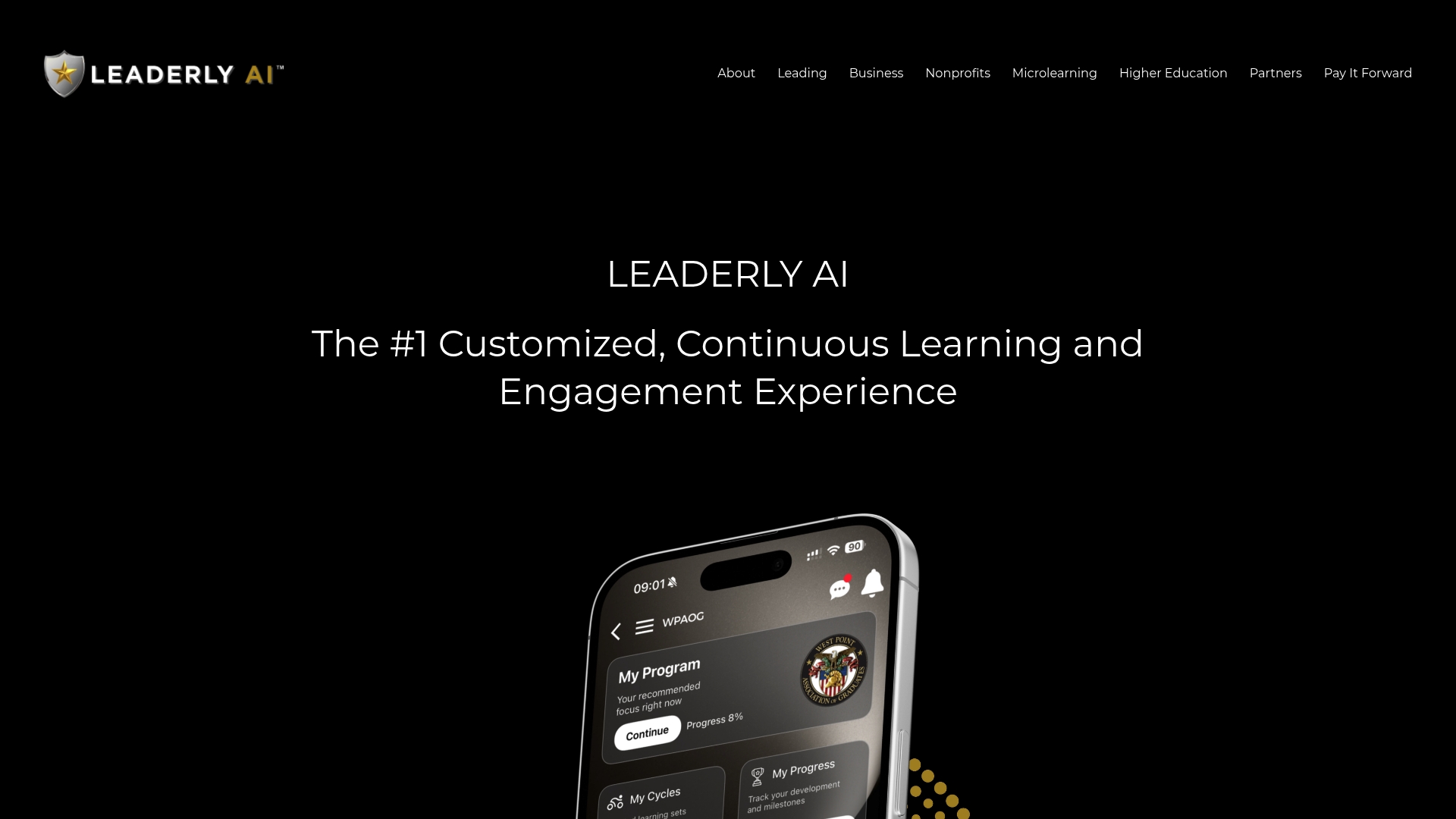
Leaderly AI is a mobile-first platform that helps organizations deliver personalized leadership microlessons, behavioral exercises, self-assessments, simulations and analytics to every employee, not just managers. HR teams, nonprofit directors and educators can customize learning journeys to their own context and watch engagement through dashboards.
If you want practice scenarios to sit inside a continuous program rather than a one-off course, explore Leaderly AI for your organization. Higher education teams can see our approach for colleges and universities, and nonprofit leaders can look at Leaderly AI for nonprofits.
FAQ
What is a branching scenario in leadership training?
It is an interactive exercise where a learner makes a series of decisions in a realistic workplace situation, and each choice changes what happens next. The learner sees the consequences of their approach and receives feedback. It is typically used for skills like feedback, conflict resolution and decision making.
How many decision points should a leadership scenario have?
There is no fixed number, but shorter is safer. Start with three or four decision points around one conversation, and chunk longer stories into chapters. Research on workplace branching scenarios recommends short, focused and well-sequenced decisions to avoid overwhelming learners.
Do I need special software to build one?
Not to begin. You can map the story on paper or in a flowchart tool and prototype one decision point with experts before choosing authoring software. The thinking about objectives, consequences and feedback matters more than the tool.
How do I know a scenario improved leadership behavior?
Define the target behavior before you build, then measure it after launch with surveys, interviews or focus groups, not just completion and satisfaction. Look at intermediate outcomes, such as what managers tried, and longer-term team indicators.
Sources
- Branching Out with Interactive Scenarios, Vanderbilt University
- Action First Learning Instructor's Guide, ATD
- Authoring branching storylines for training applications, Gordon
- Enhancing workplace eLearning with branching scenarios
- Instructional Design and Its Usability for Branching Model
- Curriculum Innovation: A Standardized Experiential Leadership Curriculum
- Federal Supervisory and Managerial Frameworks and Guidance, OPM
- But Did You Die? Developing Critical Thinking in Paramedics
- AI Change Management: 5 Steps Before You Scale