
Storytelling is the most reliable tool leaders have for turning information into action. A McKinsey study of 18,000 professionals across 150 countries identifies it as a foundational leadership skill for aligning teams and mobilizing change. The neuroscience backs that up: when a leader tells a well-structured story, listeners' brains mirror the storyteller's neural activity, a phenomenon called neural coupling that creates genuine shared understanding rather than passive reception. Leaderlyapp's microlesson library is built around exactly this evidence. Start applying it today with one concrete step: run a 20-minute story-sharing check-in at your next team meeting and ask each participant to share a two-sentence story about a recent challenge and what they learned.
Table of Contents
- What leadership storytelling actually is
- Why storytelling works: the neuroscience trainers need to know
- Core storytelling techniques every leader should master
- How to teach storytelling inside leadership development programs
- A ready-to-run 60–90 minute storytelling workshop
- How to measure whether storytelling training is actually working
- Common pitfalls, ethical concerns, and inclusion risks
- Key Takeaways
- The part most training programs get wrong
- Leaderlyapp makes storytelling practice continuous
- Useful sources for trainers and L&D professionals
What leadership storytelling actually is
Leadership storytelling is the deliberate use of narrative to communicate purpose, model values, and move people toward specific action. It is not public speaking polish, and it is not memoir-sharing for its own sake. The distinction matters because trainers who conflate the three end up teaching performance skills when the real need is meaning-making.
Three types of stories show up most often in leadership programs:
- Vision-casting story: A leader describes a specific future state through a concrete scene ("Picture the day our product ships to a hospital in rural Montana and a nurse uses it without any training") rather than a slide full of strategic pillars.
- Learning-from-failure vignette: A manager recounts a decision that went wrong, names what they missed, and says plainly what they would do differently. Research confirms this kind of narrative builds trust and self-awareness among program participants.
- Value-reinforcing anecdote: A short, true story about a team member who acted on a company value in a low-visibility moment, told publicly to signal what behavior actually gets recognized.
A story becomes the right choice over a data-only announcement when the audience needs to feel the stakes, not just understand them. Numbers tell people what happened; a story tells them why it matters to them personally.
Why storytelling works: the neuroscience trainers need to know
The case for spending program time on storytelling starts with the brain. Neural coupling occurs when a listener's brain activity synchronizes with a speaker's during narrative, which means a well-told story is not a one-way broadcast. It is closer to a shared experience. That synchrony is what makes stories persuasive in a way that bullet points simply are not.
Stories that include specific, concrete details lower anxiety during organizational change and increase the likelihood that people take action — business coach Jeff Gothelf, via HBR.
Emotion and specificity are the two levers. Emotional content tags memories for long-term storage; specificity reduces ambiguity so the brain does not have to fill in gaps with fear. For trainers, the practical implication is clear:
- Design story prompts that require concrete details, not general themes ("Describe the exact moment you realized the plan wasn't working" beats "Tell us about a challenge").
- Coach leaders to end stories with an explicit micro-action so listeners know what to do next.
- Build in paired reflection after story-sharing so listeners paraphrase the "so what" in their own words, which amplifies the coupling effect and improves retention.
Authenticity matters as much as structure. A polished story that feels scripted breaks the neural coupling effect because listeners shift from absorbing meaning to evaluating performance.
Core storytelling techniques every leader should master
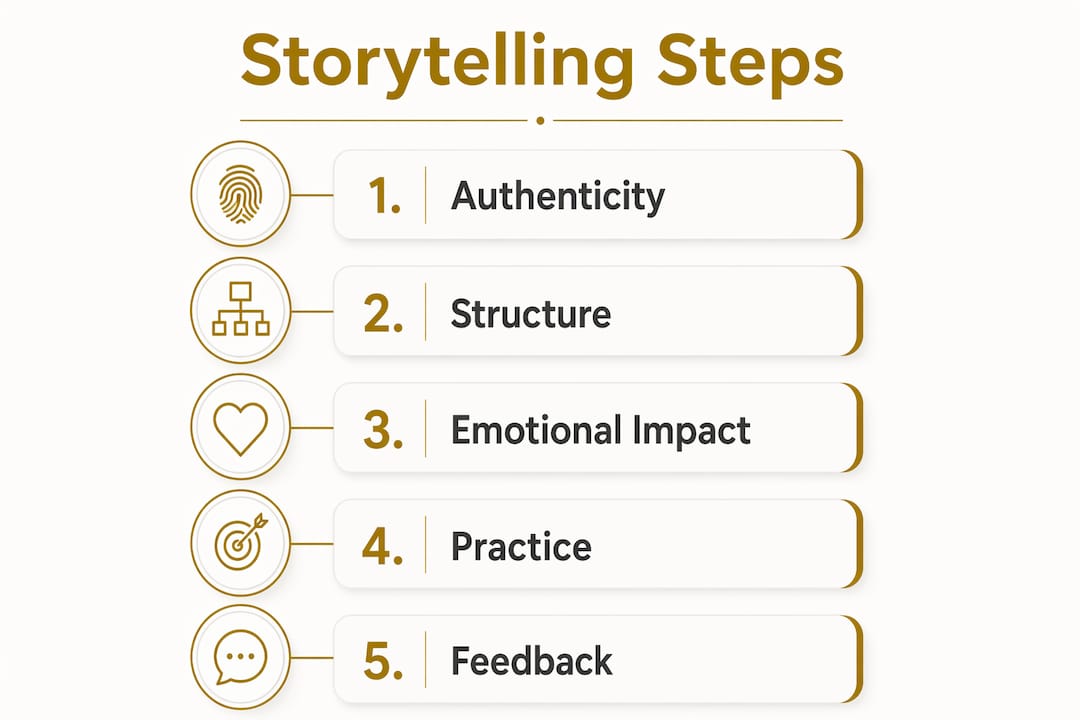
The six techniques below form a practical cheat sheet trainers can hand to leaders before a workshop. Each one has a clear purpose and a signal for when to use it.
| Technique | Core purpose | Best used when |
|---|---|---|
| Start with empathy | Establish shared ground before making a point | Opening a difficult conversation or change announcement |
| Use specificity | Reduce anxiety, increase credibility | Any story where the audience feels uncertain or skeptical |
| Include a clear call-to-action | Turn narrative into behavior change | After a vision or values story |
| Co-create the story | Build ownership and psychological safety | Team retrospectives, culture-building sessions |
| Use conflict and resolution | Create tension that holds attention | Explaining a strategic pivot or a hard decision |
| Keep it lean | Respect audience attention and signal confidence | One-on-one coaching, all-hands updates |
-
Start with empathy. Name the audience's current reality before introducing your own perspective. This is not a warm-up technique; it is the signal that the story is for them, not about you. Use it when leading through hard times or announcing unwelcome news.
-
Use specificity over grand rhetoric. Specificity reduces anxiety and makes stories feel real. "We lost the contract on a Tuesday afternoon in November" lands differently than "we faced a setback." Specific details are also harder to dismiss.
-
Include a clear call-to-action. Stories without an explicit "so what / now do this" rarely change behavior. The CTA does not need to be dramatic; it can be as simple as "I'm asking each of you to have one of these conversations this week."
-
Co-create stories with your team. Invite others to add their perspective to a narrative in progress. This builds belonging and surfaces details the leader would have missed. A qualitative study found that storytelling as an intervention in manager development programs increased trust and a sense of belonging among participants.
-
Use conflict and resolution. A story without tension is a report. Name the obstacle, the moment of choice, and what happened next. Leaders who skip the conflict to get to the lesson lose the audience before the lesson lands.
-
Keep it lean. A two-minute story told well beats a ten-minute story told thoroughly. Cutting forces leaders to identify what actually matters, which is itself a leadership skill.
Pro Tip: Avoid the "generic inspiration" trap: a story that could apply to any team in any industry signals that the leader has not done the work of connecting it to this audience's specific situation. Specificity is not just a stylistic choice; it is proof that the leader was paying attention.
How to teach storytelling inside leadership development programs
The most effective storytelling programs are iterative, not one-off. A single workshop creates awareness; repeated practice with reflection creates identity change. Here is how to build that into different program formats.

Cohort workshops work best when participants practice in front of peers and receive structured feedback. Pair leaders for a "2-minute arc" exercise: one person tells a story using conflict-resolution structure, the other reflects back the "so what" they heard. Rotate pairs so everyone practices both roles.
Peer coaching integration means building story prompts into regular 1:1 check-ins. A simple prompt like "Tell me about a moment this week when you led the way you want to be known for" generates a story and surfaces a coaching conversation simultaneously. Coaches can use the lean-narrative technique to help leaders tighten their stories over time.
Microlearning sequences deliver one technique per week with a short practice prompt. A leader reads a two-minute lesson on specificity on Monday, drafts a story using that technique by Wednesday, and shares it in a team meeting by Friday. This cadence builds the habit without requiring large blocks of time.
Leader-led story circles are 30-minute sessions where a senior leader shares a failure-to-learning story and then opens the floor. The format signals psychological safety from the top and gives emerging leaders a model to follow. Pair these with leadership communication skills development to reinforce the connection between narrative and day-to-day communication.
Leadership maps are a reflective exercise where participants map key moments in their leadership journey and identify the story each moment tells about their values. This technique, drawn from narrative inquiry research, supports leader identity development and works well as a pre-work assignment before a cohort session.
A ready-to-run 60–90 minute storytelling workshop
This agenda works for in-person or virtual cohorts of 8–20 participants. Adapt timing based on group size.
Materials checklist:
- Story prompt cards (one per participant, printed or digital)
- Timer visible to all participants
- Feedback rubric (see below)
- Whiteboard or shared digital workspace for reflection notes
- Optional: a short video clip of a leader telling a story well (2–3 minutes)
Agenda:
-
Opening and framing (10 minutes). Facilitator shares a brief story using the conflict-resolution structure, then names the technique explicitly. Ask participants: "What did you notice?" This sets the learning contract without a lecture.
-
Solo story drafting (10 minutes). Each participant writes a 2-minute story using the prompt: "Describe a moment when you had to lead through uncertainty. What did you do, and what did you learn?" Require at least one specific detail and one explicit next step.
-
Paired practice round 1 (15 minutes). Partners take turns telling their story (2 minutes each) while the listener uses the feedback rubric. Debrief: what felt authentic? What was unclear?
-
Whole-group share and coach (15 minutes). Two or three volunteers share with the full group. Facilitator coaches in real time, focusing on specificity and the call-to-action. Keep coaching brief and behavioral, not evaluative.
-
Reflection and leadership maps (10 minutes). Participants identify one story from their leadership history that they have never told at work. They write the headline and the lesson in two sentences.
-
Action planning (10 minutes). Each participant commits to one story they will tell in the next seven days, names the audience, and states the call-to-action. Partners hold each other accountable.
-
Close (5 minutes). Facilitator names two or three patterns observed across the group's stories. End with a question, not a summary: "What story does your team need to hear from you this week?"
Feedback rubric (3 criteria, 1–3 scale):
| Criterion | 1 — Needs work | 2 — Developing | 3 — Strong |
|---|---|---|---|
| Authenticity | Feels scripted or generic | Some genuine detail, some polish | Specific, personal, credible |
| Clarity of action | No clear next step | Implied next step | Explicit, concrete CTA |
| Audience fit | Story is about the teller | Partial connection to audience | Clearly framed for this audience |
How to measure whether storytelling training is actually working
Behavior change is the only metric that matters, but it is also the hardest to capture. Use a layered approach: quantitative signals for trend-spotting, qualitative vignettes for meaning.
| Metric | What it measures | Collection method |
|---|---|---|
| Message recall rate | Whether key narratives stick 30 days post-training | Short survey: "Describe in one sentence what the leader's story was about" |
| Behavioral observation score | Whether leaders use story techniques in real meetings | Manager or peer rating on a 3-item rubric post-meeting |
| Psychological safety pulse | Whether team members feel safe sharing their own stories | 2-item Likert scale in monthly engagement survey |
| Story frequency count | How often leaders use narrative in communications | Self-report log or communication audit |
| NPS-style training rating | Participant perception of program relevance | Single-question post-session survey |
| 90-day behavior change indicator | Whether specific story-driven behaviors persist | Manager interview or structured observation at 30/60/90 days |
Data collection tips:
- Run a pre/post survey using the same two questions: "How confident are you telling a story in a leadership context?" and "How often do you use narrative in team communications?" The gap between pre and post is your leading indicator.
- Collect one qualitative vignette per cohort at the 30-day mark. Ask: "Describe a moment in the last month when you used a story to communicate something important. What happened?" These short narratives are often more convincing to senior sponsors than aggregate scores.
- Pair quantitative data with behavioral observation. A high NPS score with no observable behavior change signals the training was enjoyable but not sticky.
Common pitfalls, ethical concerns, and inclusion risks
Storytelling in leadership programs carries real risks when it is not designed carefully. Trainers who ignore these tend to create sessions that feel powerful in the room and produce little lasting change outside it.
Common pitfalls:
- Performative stories. A leader who tells a vulnerability story without genuine reflection signals inauthenticity. The intention–perception gap is real: a story meant to be transparent can land as self-serving if it lacks specificity and behavioral follow-through.
- Over-personalization. Requiring participants to share deeply personal stories in a professional setting before psychological safety is established causes harm and erodes trust.
- Tokenizing. Asking a person from a marginalized group to share their "experience" as a story to educate others is not storytelling practice; it is extraction.
- Cultural appropriation. Using stories from cultures the leader does not belong to without attribution or permission undermines credibility and respect.
Inclusion guidelines:
- Make story-sharing voluntary, always. Offer alternative ways to participate (written reflection, listening role, story about a professional rather than personal experience).
- Design prompts that work across cultural storytelling norms. Linear conflict-resolution structure is not universal; some cultures use circular or relational narrative forms.
- Build psychological safety before asking for stories, not after.
Ethical pre-share checklist for leaders: Before telling a personal story in a professional context, ask: Does this story serve the audience, or does it primarily serve me? Does it include someone else's experience without their consent? Does it end with a clear action, or does it leave people with emotion and no direction?
Key Takeaways
Storytelling in leadership training works because it creates shared understanding at the neurological level, not just the intellectual one, and that shared understanding drives measurable behavior change.
| Point | Details |
|---|---|
| Neural coupling drives impact | Stories synchronize listener and speaker brain activity, making narrative more persuasive than data alone. |
| Specificity is the core technique | Concrete details reduce anxiety during change and make stories credible and actionable. |
| Iteration beats one-off workshops | Repeated practice with reflection, not a single session, produces lasting identity and behavior change. |
| Measure behavior, not just satisfaction | Track message recall, behavioral observation scores, and 90-day change indicators alongside NPS ratings. |
| Leaderlyapp scales the practice | Leaderlyapp's microlesson sequences and behavioral science foundation make storytelling practice continuous, not episodic. |
The part most training programs get wrong
There is a version of storytelling training that organizations run every year and leaders forget by the following Monday. It usually looks like this: a skilled facilitator runs a half-day workshop, participants feel inspired, and nothing changes in how those leaders actually communicate the following week. The workshop was good. The system around it was absent.
What the research consistently shows, and what practitioners who run these programs learn the hard way, is that storytelling skill is not built in a room. It is built in the repetition of small, specific practice moments over weeks. The narrative inquiry research on manager development programs is clear on this: identity change, which is what you are really after when you want a leader to communicate differently, requires iterative story-sharing, reflective mapping, and accountability, not a single peak experience.
The other thing most programs miss is the ethical scaffolding. Trainers get excited about the technique and skip the conversation about when not to use a personal story, how to protect participants who are not ready to share, and what it means to ask someone to be vulnerable in a professional context. That gap does not just create awkward moments; it creates harm that quietly undermines the psychological safety the program was supposed to build.
The most effective storytelling programs treat narrative as a leadership habit, not a presentation skill. That reframe changes everything: the cadence, the coaching integration, the measurement approach, and the way leaders think about their own stories between sessions.
Leaderlyapp makes storytelling practice continuous
Most organizations have the workshop. What they are missing is the system that keeps the practice alive between sessions. Leaderlyapp is built for exactly that gap: personalized microlessons grounded in behavioral science, delivered at the pace each leader actually needs, with content that adapts as their skills develop.
For storytelling specifically, a 6–8 week pilot works well: pair two cohort workshops (opening and mid-point) with weekly microlessons that deliver one technique at a time, a short practice prompt, and a reflection check-in. By week eight, leaders have practiced every core technique at least twice in a real context, not just a training room. Success looks like measurable shifts in behavioral observation scores and at least one qualitative vignette per participant showing story use in a real leadership moment.
The platform scales across teams of any size, so a pilot that works for 20 managers can roll out to 200 without rebuilding the program from scratch. Explore people-centric leadership development on Leaderlyapp to see how storytelling fits into a broader skill-building sequence, or review internal leadership cultivation tips to design a pilot that surfaces and develops storytellers already inside your organization.
Useful sources for trainers and L&D professionals
| Source | Why it's useful |
|---|---|
| Storytelling Can Make or Break Your Leadership — HBR | Practitioner-focused; covers specificity, anxiety reduction, and the call-to-action principle with concrete coaching guidance. |
| Who We Are Is How We Lead — DOI Study | Qualitative research on storytelling as a manager development intervention; covers identity, trust, belonging, and the intention–perception gap. |
| Why Leadership Storytelling Is Actually So Powerful — Forbes | Accessible summary of neural coupling research with practical implications for trainers designing reflection activities. |
| Storytelling Is a Foundational Leadership Skill — Forbes/McKinsey | Cites McKinsey's large-scale research; useful for making the business case to senior sponsors. |
| How Great Leaders Use Storytelling to Inspire Teams — Forbes | Practitioner essay with examples of vision and resilience stories; good for workshop illustration material. |
| How Leaders Can Influence, Teach, and Inspire — Harvard Business Publishing | Concise brief on storytelling for learning; covers emotional engagement and memory with a training design lens. |
| Leadership Storytelling — FBI Law Enforcement Bulletin | Practitioner perspective from a high-stakes leadership context; useful for credibility with public-sector or law enforcement audiences. |
| A Reflective Review of Instructor and Learner Storytelling in Leadership Education — JOLE | Academic review covering inclusive and ethical use of storytelling as an instructional strategy; essential for trainers designing for diverse cohorts. |
Recommended
- Six Leadership Techniques To Help Teams Execute Their Game Plans, Avoid Mistakes, And Win — Leaderly
- How To Improve Your Leadership Communication Skills — Leaderly
- Leaders: How Do We Tell The Story Of The Future We Want And Invite Others Into It? — Leaderly
- Does Great Leadership Really Make People Better? — Leaderly