
Veteran leadership programs are structured training experiences, ranging from three-day immersives to seven-month cohorts, that translate command experience into civilian executive skills like financial fluency and persuasive communication. They benefit transitioning service members, recent veterans within their first year out, and retirement-eligible senior leaders alike. The immediate move is simple: pick a program format that fits your timeline and career stage, then confirm eligibility before you apply.
TL;DR:
- Longer cohort programs build deeper relationships and skills, but require more time and commitment compared to short immersive workshops lasting two to four days.
- Successful programs teach veterans to translate military leadership experience into clear business language, emphasizing influence, financial literacy, and emotional intelligence.
- Eligibility varies widely; confirm the separation window, rank, or target career stage, and consider indirect costs like travel and lodging beyond tuition.
- Outcomes are stronger when programs include structured follow-up, alumni networks, and clear evidence of post-program management roles.
- Focus on programs with clear industry or mission alignment, and treat participation as the start of ongoing habit-building, not a one-time credential.
Table of Contents
- What Formats Do Veteran Leadership Training Programs Use?
- What Skills Do Graduates Actually Gain?
- Who Qualifies and What Does It Cost?
- How Should You Evaluate a Program Before Applying?
- Why Alumni Networks Matter More Than the Certificate
- What Do the Outcomes Actually Look Like?
- How Do These Programs Feed Into Hiring Pipelines?
- What Makes This Transition Different for Veterans?
- Are There Programs Built for Specific Regions or Industries?
- What Veterans Actually Report Works
- Keep the Skills Alive After the Program Ends
- Sources
What Formats Do Veteran Leadership Training Programs Use?
Program length varies more than most veterans expect, and the format you choose should match how much runway you have before your next job search.
Short immersive workshops run two to four days and work best for veterans who need a quick executive skills refresh without stepping away from a job search for long. Deloitte's CORE Leadership Program is a good example: a short executive-style course held at Deloitte University, offered multiple times per year for service members and veterans within 12 months of separation.
On the longer end, multi-month cohort programs build sustained peer relationships and ongoing coaching. Travis Manion Foundation's Spartan Leadership Program runs several months and centers on character-based growth tied to community impact.
For senior leaders closer to retirement, executive academies pack a full curriculum into a compact residency. The VET Academy at Johns Hopkins Carey Business School is a 10-day intensive built for retirement-eligible or recently retired senior leaders.
- Short immersives (2 to 4 days): fastest entry, narrowest scope
- Cohort programs (multiple months): deeper skill-building, strong peer networks
- Executive academies (around 10 days): dense curriculum for senior leaders
- Hybrid continuum models: short intensive plus months of follow-up support
What Skills Do Graduates Actually Gain?
The core payoff across most veteran leadership training is the ability to speak business language as well as lead people. Programs build executive presence, sharpen persuasive communication, and introduce financial fluency, meaning basic P&L literacy that lets a veteran sit in a budget meeting without translating on the fly.
The harder skill is reframing command experience as influence. A practitioner who moved from Army captain to chief operating officer put it plainly: veterans need to show employers how trust-building and mission delivery map to business outcomes, not just describe rank and responsibility.
Pro Tip: Rewrite your last performance review in business terms before you apply anywhere. If it still reads like a fitness report, an employer will read it that way too.
Programs also build emotional intelligence and mentorship instincts, both of which matter more in flat, consensus-driven organizations than a title ever will. Graduates consistently point to one thing as the most durable return: the alumni network and mentor access that outlasts the curriculum itself.
- Executive presence and boardroom communication
- Financial fluency and basic P&L reading
- Translating command authority into cross-functional influence
- Access to a lasting mentor and alumni network
Who Qualifies and What Does It Cost?
Eligibility rules differ sharply by program type, so check the fine print before you assume you qualify. Some programs, like Deloitte's CORE, require enrollment within 12 months of separation. Others, like the VET Academy, target retirement-eligible or recently retired senior leaders rather than junior transitioners.
Cost models split into three broad camps: corporate-sponsored programs that charge participants nothing, nonprofit-funded scholarships aimed at wider access, and tuition-based executive academies priced like other executive education. Vantage Point Foundation's Veteran Leadership Course is a multi-day program followed by several months of structured support, and sessions are often offered at no cost to participants.
Budget for indirect costs even when tuition is covered. Travel, lodging, and time away from a job search rarely show up in the advertised price.
- Ask directly whether VA benefits, an employer, or a corporate partner covers tuition
- Confirm the separation window or rank requirement before applying
- Factor in travel and lodging, not just program fees
- Look for scholarship language on the program's own site, not a third-party summary
How Should You Evaluate a Program Before Applying?
Start by matching format to your actual constraints. If you have three months before a job search deadline, a seven-month cohort is the wrong tool no matter how good its reputation.
- Define your timeline and target outcome first, then filter programs by format, not brand name.
- Ask admissions directly about alumni outcomes: specific placement examples, not general success language.
- Confirm mentor access and how long post-program support actually lasts.
- Verify who teaches: request a sample agenda and ask about the selection ratio for admitted participants.
- Ask whether scholarships or sponsor funding exist before assuming full tuition is your only option.
Pro Tip: If admissions staff can't name three recent alumni roles off the top of their head, that's a program leaning on reputation instead of results.
Red flags are consistent across weak programs: no structured follow-up after the last session, outcome language that stays vague ("leadership growth" with no specifics), and any hint of pressure to finance tuition on the spot. A program confident in its results will happily point you to its graduates.
Why Alumni Networks Matter More Than the Certificate
The certificate fades fast. What sticks is the network and the habits you build to keep using what you learned.
Treat the program as the start of an ongoing operating system, not a finish line. Keep a capstone project alive after the program ends, set a recurring cadence for reaching out to alumni contacts, and build a small microlearning habit to keep practicing new behaviors instead of letting them go stale. Programs like Vantage Point Foundation's course build this in deliberately, pairing a short intensive with six months of structured follow-up.
- Schedule quarterly check-ins with at least two program contacts
- Keep one capstone or applied project running past graduation
- Build a weekly habit of practicing one employer-facing skill, like written business updates
- Track your own progress instead of assuming the certificate does the talking
What Do the Outcomes Actually Look Like?
Program organizers rarely publish hard placement percentages, but the pattern across formats is consistent: veterans who complete a structured leadership program report faster movement into management-track roles than those who transition without one. That's not a coincidence. Employers hiring for leadership roles are screening for evidence that a candidate can operate outside a chain-of-command structure, and a completed program is one of the clearest signals available on a resume.
The stronger evidence is qualitative. Alumni from academy-style programs describe gaining access to high-level leadership conversations they couldn't get access to before, largely because the program gave them a peer network inside companies actively recruiting veterans. Cohort-based programs like the Spartan Leadership Program frame success less around job titles and more around sustained community leadership, which matters if your goal includes nonprofit or public-sector work rather than a corporate ladder.
The honest caveat: a program does not replace a job search strategy. It sharpens your pitch and expands your network, but you still have to apply, interview, and negotiate. Veterans who treat the program as a credential to display, rather than a set of habits to practice, tend to see the smallest return. The ones who keep using the language and the contacts months later are the ones who see the career jump the marketing materials promise.
How Do These Programs Feed Into Hiring Pipelines?
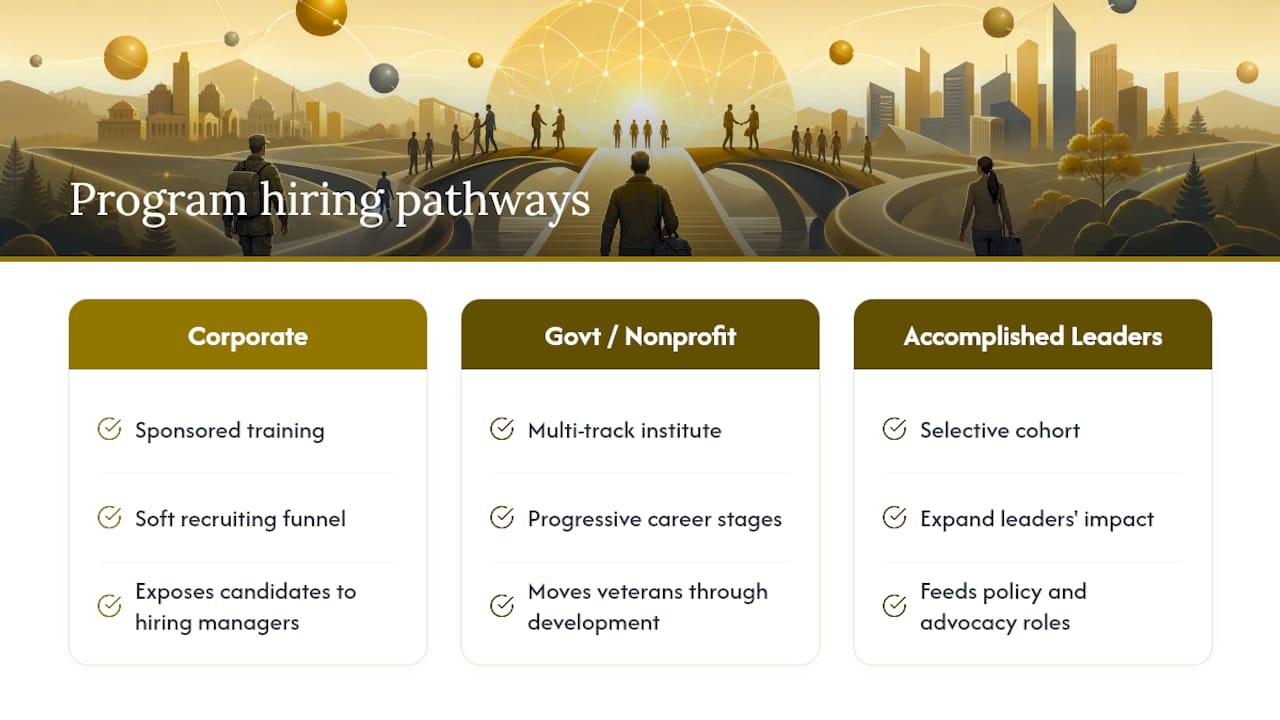
The strongest veteran leadership programs don't operate in isolation. They sit inside a pipeline that starts with corporate recruiting and ends with a specific hiring manager.
Deloitte runs its CORE Leadership Program as both training and a soft recruiting funnel, giving the firm a look at candidates before a formal application ever exists. That's typical of corporate-sponsored programs: the company underwrites the training partly because it shortens the distance between "promising veteran" and "hired leader."
Government and nonprofit pipelines work a little differently. Organizations like ATLVets structure their Leadership Institute as an ongoing, multi-track system rather than a single class, explicitly designed to move veterans through progressive stages of career development rather than a one-time credential.
The George W. Bush Presidential Center takes yet another angle with its Stand-To Veteran Leadership Program, aimed at accomplished leaders who want to expand their impact supporting other veterans, which feeds into policy and advocacy pipelines rather than corporate hiring.
If you're choosing a program partly for its hiring pipeline value, ask a direct question during admissions: does this program have a formal or informal relationship with employers, and does completing it put your resume in front of specific hiring managers? A program with genuine pipeline integration will answer that question fast and specifically. One without it will pivot to talking about the curriculum instead.
What Makes This Transition Different for Veterans?
The transition challenge veterans face isn't a leadership skills gap. Most veterans already lead effectively. The problem is the operating system underneath civilian leadership works differently.
Military leadership runs on structured authority: rank confers the right to direct people, and results get measured against clear objectives. Civilian organizations, especially flatter corporate and nonprofit structures, run on consensus and informal influence. A director title doesn't automatically earn cooperation the way command rank does. Veterans who expect civilian promotion to follow a linear, merit-based ladder similar to military rank structure often hit a wall they didn't see coming.
The best veteran leadership programs address this directly by teaching what amounts to advisory leadership: how to build influence without formal authority, how to read a room that won't simply follow an order, and how to mentor rather than command. Veterans who make this shift, sometimes described as moving from commander to advisor, tend to adapt faster because they stop waiting for rank to do the work that persuasion now has to do.

The other consistent gap is translation. Skills that read as obvious inside the military, like mission planning under pressure or building trust across a team fast, don't automatically register with a civilian hiring manager unless they're described in business terms. That's the exact gap military.com's profile of an Army captain turned COO calls out: veterans who learn to describe trust-building and mission delivery as business outcomes get hired faster than veterans who describe the same skills in military vocabulary. A good program teaches that translation explicitly instead of assuming it happens naturally.
Are There Programs Built for Specific Regions or Industries?
Some of the strongest veteran leadership programs are built around a specific industry or mission rather than a general leadership curriculum, and matching your program to your target field can matter as much as matching the format to your timeline.
Deloitte's CORE program is a clear industry-specific example: it feeds directly into consulting and professional services career paths, and the curriculum reflects that. The VET Academy's finance and executive-presence focus similarly signals a fit for veterans targeting corporate leadership over nonprofit or public-sector work.
On the mission-driven side, the Spartan Leadership Program and Vantage Point Foundation's course lean toward community impact and veteran advocacy rather than corporate placement, which makes sense if your target career involves nonprofit leadership, public service, or veteran-focused organizations. The Bush Center's Stand-To program goes further, targeting leaders who already have some track record and want to shape veteran policy or advocacy at a systemic level.
None of these regional or sector distinctions are formally labeled that way in program marketing, so the research step falls on you. Read a program's alumni outcomes and partner list closely. A program that regularly places graduates in consulting firms is telling you something different than one that regularly places graduates in nonprofit executive roles, even if both call themselves "leadership" programs on the homepage. This is also where understanding how military and corporate leadership styles differ helps you evaluate whether a program's specific curriculum actually fits the industry you're targeting.
What Veterans Actually Report Works
The programs that land aren't the ones with the flashiest curriculum. They're the ones that force you to practice translation: turning "led a 40-person platoon under pressure" into a sentence a hiring manager recognizes as leadership. Most veterans underestimate how much of this transition is about earning influence without rank, not proving competence, which they've already done.
After any program, run a short check: can you explain your leadership record in one business sentence? Do you have two live mentor relationships, not just contacts? Are you practicing the new language weekly, or did it stay in the workshop? Treat the program as day one of an ongoing habit, not a finished credential.
— Drew
Keep the Skills Alive After the Program Ends
A 10-day academy or a three-day intensive gives you the language and the network. What determines whether it actually changes your career is whether you keep practicing after everyone goes home, and that's the part most in-person programs aren't built to handle.
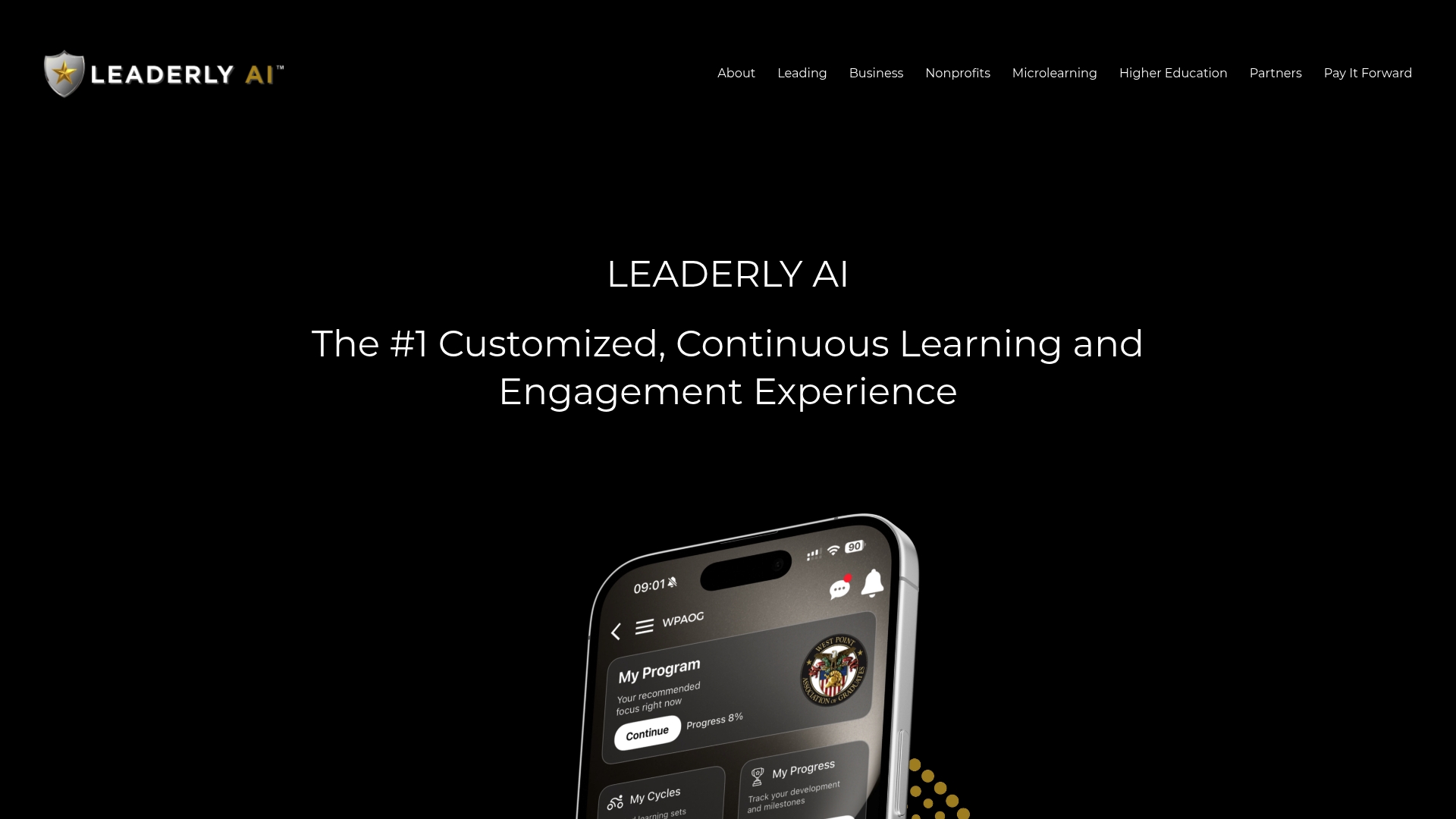
There are platforms designed to address that gap by using microlearning and habit-building tools to help leaders continue practicing executive presence, communication, and financial fluency introduced in their programs. Managers can access analytics dashboards to see if new leadership behaviors are actually taking hold, not just attendance records. For people moving into management roles, this kind of repeatable practice may provide more benefit than additional intensive training.
If you're evaluating how to sustain what a program like the VET Academy or CORE started, look at how Leaderly's approach to leadership development supports continuous habit-building rather than a one-time event, then request a demo to see how the platform fits your organization's onboarding or veteran hiring pipeline.
Sources
- VET Academy | JHU Carey Business School
- For Veterans | Veteran Leadership Course by VPF
- Spartan Leadership Program | Travis Manion Foundation