
Military leadership runs on mission-focused intent and disciplined execution. Corporate leadership runs on stakeholder-aligned adaptability and continuous feedback. The leaders who outperform both models borrow from each: centralized intent, decentralized execution, tight feedback loops. ADP 6-22 codifies this on the military side through leader attributes and competencies; Harvard Business School research confirms it plays out differently depending on which branch shaped a leader's instincts. Leaderlyapp builds training around this exact overlap.
Some contexts pull harder toward one pole than the other:
- Favor military-style command: crisis response, safety-critical operations, situations with high time pressure and low margin for miscommunication.
- Favor corporate-style collaboration: product strategy, cross-functional projects, and any environment where buy-in determines whether a decision actually gets executed well.
Most real jobs sit somewhere in between, which is why the hybrid model, not a pure version of either, tends to win.
Key Takeaways
The most effective leaders combine military-style intent and accountability with corporate-style feedback and adaptability, rather than choosing one system exclusively.
| Point | Details |
|---|---|
| Hybrid beats pure models | Centralized intent paired with decentralized execution outperforms either pure command or pure consensus. |
| Fit drives success | Harvard Business School research shows branch background predicts which corporate roles veteran leaders thrive in. |
| Feedback closes the loop | 360-degree feedback and after-action reviews both surface blind spots that self-assessment misses. |
| Culture determines transfer | Techniques that work in one organizational culture can fail in another without adaptation. |
| Leaderlyapp operationalizes the shift | Microlearning and analytics turn intent statements and AARs into tracked, repeatable habits. |
Table of Contents
- Leadership Styles Military Versus Corporate: A Side-by-Side Comparison
- What Each Domain Should Borrow From the Other
- How to Adapt Between Command and Collaboration
- Scaling the Hybrid Model With Leaderly AI
- Core Military Leadership Frameworks Worth Knowing
- How Corporate Leadership Models Build Capability
- How Culture Shapes Which Leadership Style Actually Works
- Communication Differences Between Command and Collaboration
- Where Each Style Breaks Down
- Real Examples of Both Styles in Action
- Why Emotional Intelligence Matters in Both Worlds
- Sources
Leadership Styles Military Versus Corporate: A Side-by-Side Comparison
Set the two models next to each other and the differences aren't about who's "tougher." They're about what each system optimizes for.
Purpose and accountability. Military leadership answers to mission accomplishment and the chain of command; a platoon leader's success is measured against an objective, and accountability runs vertically and legally. ADP 6-22 frames this through three leader attributes (character, presence, intellect) and three core competencies (leads, develops, achieves), all oriented around mission success. Corporate leadership answers to markets, boards, and a wider circle of stakeholders. The Harvard Business School analysis of veterans-turned-CEOs found that fit between branch background and corporate role is important: officers from the Army and Marine Corps tend to thrive in ambiguous, mission-led roles, while those from the Navy and Air Force often fit better in process-heavy, regulated industries.
Decision-making style. Military decision-making runs on mission orders and clear intent passed down the chain. A commander states the objective and the boundaries; subordinates fill in the how. Corporate decision-making is messier by design. It's iterative, informed by multiple stakeholders, and often slowed deliberately to gather buy-in before a launch or reorg.
Structure versus flexibility. Process discipline wins when the cost of error is high and repeatable procedure exists (a maintenance checklist, a pre-flight sequence). Flexibility wins when conditions shift faster than any manual can be updated. The TENSE leadership model argues these aren't opposites to pick between. Effective leaders manage the tension between control and empowerment continuously, not once.
Development and feedback. Military development runs on structured evaluations, formal schools, and a tiered leader model (direct, organizational, strategic) built for repeatable, practice-based growth. Corporate development leans on 360-degree feedback, simulations, and executive coaching to surface blind spots peers and bosses can see but the leader can't.
Risk tolerance and stakes. A bad military decision can cost lives; a bad corporate decision usually costs money, market share, or morale. That difference shapes everything downstream, from how much autonomy gets delegated to how quickly leaders are expected to reverse course.
- Purpose and accountability: mission vs. market.
- Decision-making: orders and intent vs. iteration and consensus.
- Structure vs. flexibility: procedure vs. adaptability.
- Development: formal evaluation vs. 360 feedback and coaching.
- Risk and stakes: physical consequence vs. financial consequence.
What Each Domain Should Borrow From the Other
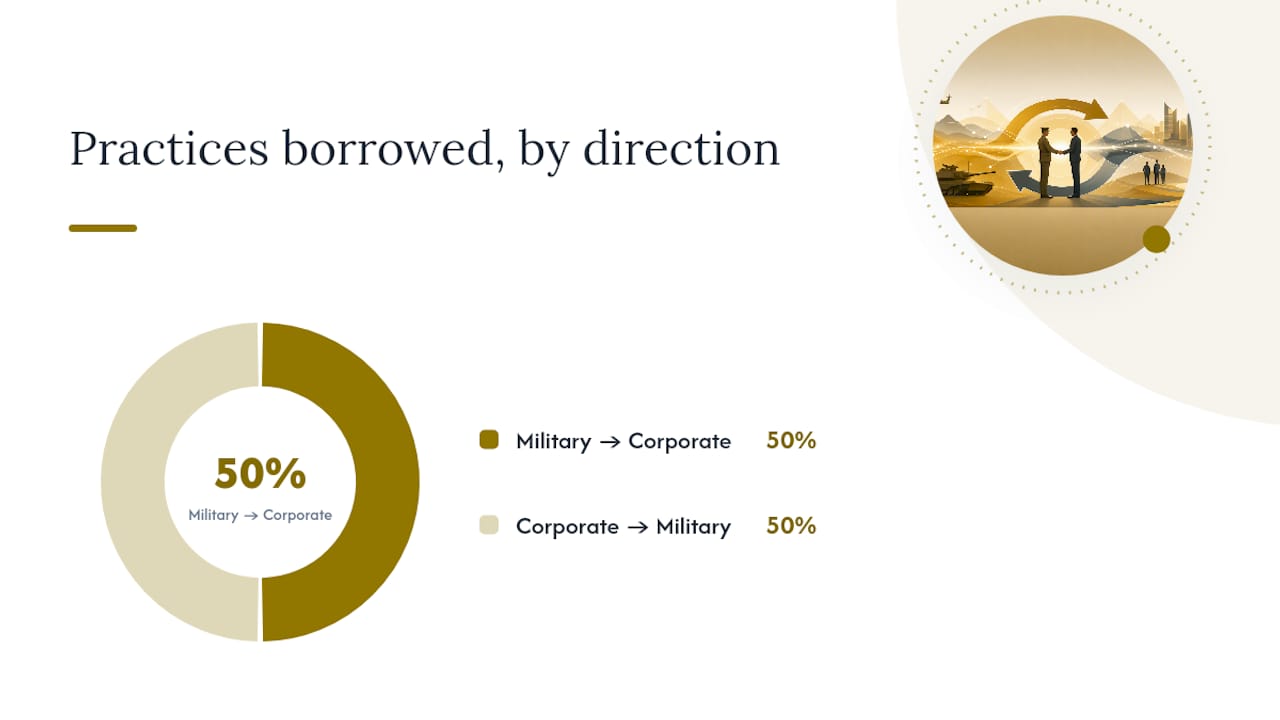
Neither model is complete on its own. The most useful move is stealing the other side's best habit, not switching systems wholesale.
Military-to-corporate borrows:
- Writing a one-line mission intent statement before delegating a project, so people know the goal even when the plan changes.
- Running disciplined after-action reviews (AARs) after every major initiative, win or lose, instead of only debriefing failures.
- Building values-based accountability into performance conversations, not just metrics-based ones.
Corporate-to-military borrows:
- Structured 360-degree feedback cycles that surface how a leader is actually perceived by peers and subordinates, not just superiors.
- Simulation-based training and reflective learning sessions that let people practice judgment calls before the stakes are real.
- Formal stakeholder mapping before major decisions, since military missions have fewer competing interests to manage than a corporate rollout does.
A regional sales director who starts every quarter with a one-paragraph intent statement (goal, boundaries, non-negotiables) generally sees fewer mid-quarter course corrections than one who hands out KPIs and lets people guess at priorities. Leaderlyapp's guide on how business leaders use commander's intent walks through the exact phrasing that works.
Pro Tip: Pilot one borrowed practice for a single team over one quarter before rolling it out company-wide. An AAR process that works for a five-person product team can feel bureaucratic at fifty people, so test the dose before you scale it.
How to Adapt Between Command and Collaboration
Blending styles isn't a mindset shift. It's a five-step operating routine.
- Assess the context. Rate the decision on three axes: how critical is it, how many stakeholders does it touch, and how fast does it need to move? High criticality and low tempo favor structure; high tempo and high ambiguity favor delegated judgment.
- Set an intent. Write one sentence stating the goal and one sentence stating what success looks like. Skip the twelve-slide deck.
- Institute short feedback loops. A 72-hour check-in cadence catches drift early without requiring daily oversight, and it gives people room to adapt the "how" while you monitor the "what."
- Train and rehearse. Short, repeated learning (microlessons, simulations, AARs) builds judgment faster than a single annual workshop. Leaderlyapp's piece on adaptability as a leadership capability covers why repetition beats intensity here.
- Measure early signals. Track engagement with the process, the quality of decisions made under the new model, and how quickly teams learn from mistakes rather than repeating them.
Run this as a 30-day experiment on one team before expanding it.
| Point | Details |
|---|---|
| Context first | Rate criticality, stakeholder count, and tempo before choosing how much structure to apply. |
| Intent over instructions | A two-sentence goal-and-success statement beats a long directive for enabling good delegation. |
| Short loops beat long reviews | A 72-hour check-in cadence catches problems earlier than a monthly status meeting. |
Scaling the Hybrid Model With Leaderly AI
Doctrine documents and leadership textbooks are dense; people don't retain them through one read. McKinsey's research on 21st-century leadership argues organizations need systems that build leadership capability at scale, not one-off training events. That's the gap Leaderlyapp's microlearning model addresses directly.
A typical micro-journey looks like this: a short lesson teaches commander's intent, a follow-up exercise has the learner practice delegating a real task using that framework, a 360 check-in gathers how the delegation actually landed with the team, and a brief AAR closes the loop.
Track adoption with a few concrete signals:
- Percentage of assigned tasks that include an explicit intent statement.
- Frequency of logged AARs or reflection exercises.
- Anonymous feedback scores on clarity and felt autonomy.
Core Military Leadership Frameworks Worth Knowing
Mission command is the backbone concept: commanders state intent and end state, then decentralize execution to subordinates who understand the ground truth better than anyone above them does. It only works when everyone shares a common understanding of the mission and enough trust exists to let go of the details.
ADP 6-22 builds this out through what's often shorthanded as BE, KNOW, DO: BE refers to character and identity (values, ethics, presence under pressure), KNOW covers competence (tactical and technical skill, people skills, conceptual understanding), and DO is action (leading, developing others, achieving results). The framework matters because it separates who a leader is from what a leader knows from what a leader actually does, and it insists all three have to align.
Leading Marines adds another layer with 15 leadership traits and 11 principles, things like knowing your people and looking after their welfare, setting the example, and taking responsibility for your actions. These aren't abstractions. They're evaluated behaviors that show up in fitness reports and promotion boards, which is part of why they get followed rather than just posted on a wall.
The throughline across FM 22-100 and current doctrine is a tiered leader model: direct, organizational, and strategic levels, each requiring different skills but the same underlying character base. A squad leader and a four-star general are graded on different competencies, but both are still measured against the same values.
How Corporate Leadership Models Build Capability
Corporate development doesn't have a single doctrine the way the military does, but a handful of tools dominate. The 360-degree feedback process, where a leader is rated by superiors, peers, direct reports, and sometimes clients, remains one of the most widely used multi-rater assessment tools precisely because it surfaces gaps a self-assessment or a single boss's opinion would miss.
Simulations have grown more sophisticated, from tabletop crisis exercises to software-based scenario training that puts leaders through a layoff conversation or a product-launch decision before they face the real version. Executive coaching fills a different gap: sustained, one-on-one reflection over months rather than a single feedback report.
The common thread across all three tools is that corporate leadership development treats growth as something that has to be engineered deliberately, because unlike the military, there's no built-in institutional pipeline forcing every manager through the same schools and evaluations at each rank. McKinsey's leadership research calls this out directly, arguing organizations need to build "leadership factories" rather than relying on ad hoc promotions and hoping capability develops on its own.
How Culture Shapes Which Leadership Style Actually Works
The same leadership technique can succeed in one organization and fail in another, and the difference usually comes down to culture rather than the technique itself. A scholarly comparison of military and corporate socialization found that military culture builds around unit identity and mission loyalty, where the group's success matters more than individual recognition. Corporate culture, by contrast, tends to reward individual initiative and market adaptation, sometimes at the expense of collective cohesion.
That cultural gap explains why transplanting a technique wholesale often backfires. A rigid chain-of-command structure dropped into a startup with a flat, consensus-driven culture will likely trigger quiet resistance or outright turnover, because the underlying values don't match the mechanism. The reverse holds too: a heavily collaborative, feedback-everywhere approach imposed on a unit that runs on speed and clear hierarchy can slow decisions when speed is the whole point.
Effective leaders read the existing culture before importing a new practice. A defense contractor with veteran leadership might adopt mission-command language easily, since the workforce already understands the vocabulary. A consumer tech company with a young, flat org chart might need to translate the same idea into softer terms, framing intent statements as "alignment docs" rather than "commander's intent," even though the mechanics are identical. The substance transfers more easily than the language does.
Communication Differences Between Command and Collaboration
Military communication favors directness and brevity almost as a survival trait. Orders are stated plainly, ambiguity gets called out immediately, and formality (rank, protocol, structured briefings) exists to keep communication fast and unambiguous under pressure. Feedback tends to be blunt and immediate, delivered in the moment rather than saved for a quarterly review.
Corporate communication is generally softer and more layered. Directness varies widely by company and even by department, and a lot of feedback gets filtered through diplomatic language designed to preserve relationships and avoid legal exposure. Formal feedback mechanisms, performance reviews, 360 surveys, skip-level meetings, exist partly because informal directness isn't guaranteed to happen otherwise.
Neither approach is inherently better; each is calibrated to its environment. Military bluntness works because the culture has built shared norms around receiving criticism without it becoming personal. Drop that same bluntness into a corporate team without that shared norm, and it reads as harsh rather than efficient. Corporate diplomacy, meanwhile, can slide into vagueness that leaves people unsure what they actually did wrong or what to fix. The strongest leaders in either domain learn to dial directness up or down based on the specific person and moment, not just the domain's default setting.
Where Each Style Breaks Down
Military-style leadership struggles when a situation has no clear mission to rally around, or when the "enemy" is ambiguous, like a slow cultural decline or a diffuse market shift rather than a discrete objective. Rigid hierarchy can also suppress the kind of dissent that would have caught a bad decision early, since questioning orders isn't always rewarded even when it should be.
Corporate-style leadership struggles under time pressure and high stakes, when the appetite for consensus and iteration becomes a liability rather than a virtue. Decision paralysis, death by committee, and diluted accountability (where a bad outcome has five owners and therefore none) are the predictable failure modes of a system built for stakeholder buy-in.
Team dynamics absorb both failure modes differently. Overly rigid command structures in a corporate setting often produce compliance without genuine buy-in. People do what they're told and stop offering ideas, because the system never asked for them. Overly loose, consensus-driven structures dropped into a high-stakes military-adjacent context (emergency response, aviation, surgery) can produce hesitation at exactly the moment decisiveness saves outcomes. Matching the style to the actual stakes of the moment, not defaulting to whichever style a leader personally prefers, is what prevents both failure modes.
Real Examples of Both Styles in Action
The clearest illustration of fit mattering more than pedigree comes from the Harvard Business School research on veteran CEOs. Officers with Army and Marine Corps backgrounds, trained for ambiguous, high-tempo combat environments, tended to succeed in corporate roles that required navigating uncertainty and leading through change. Officers from the Navy and Air Force, shaped by more standardized, technically regulated environments, tended to succeed in corporate roles with heavier compliance and process requirements. Neither group was "better" at leadership; each was well-matched to a different kind of corporate demand.
On the failure side, a common pattern shows up when a newly hired executive with a purely command-and-control background enters a matrixed corporate structure and tries to issue directives the way they would to subordinates in uniform. Without the legal and cultural authority that military rank carries, those directives often get quietly ignored or resisted, and the executive burns credibility fast. The inverse failure, an executive who imports pure consensus-building into a crisis that needed a fast, unilateral call, shows up just as often in postmortems of stalled product launches or delayed crisis responses. Both cases point to the same lesson: the tool has to match the terrain.
Why Emotional Intelligence Matters in Both Worlds
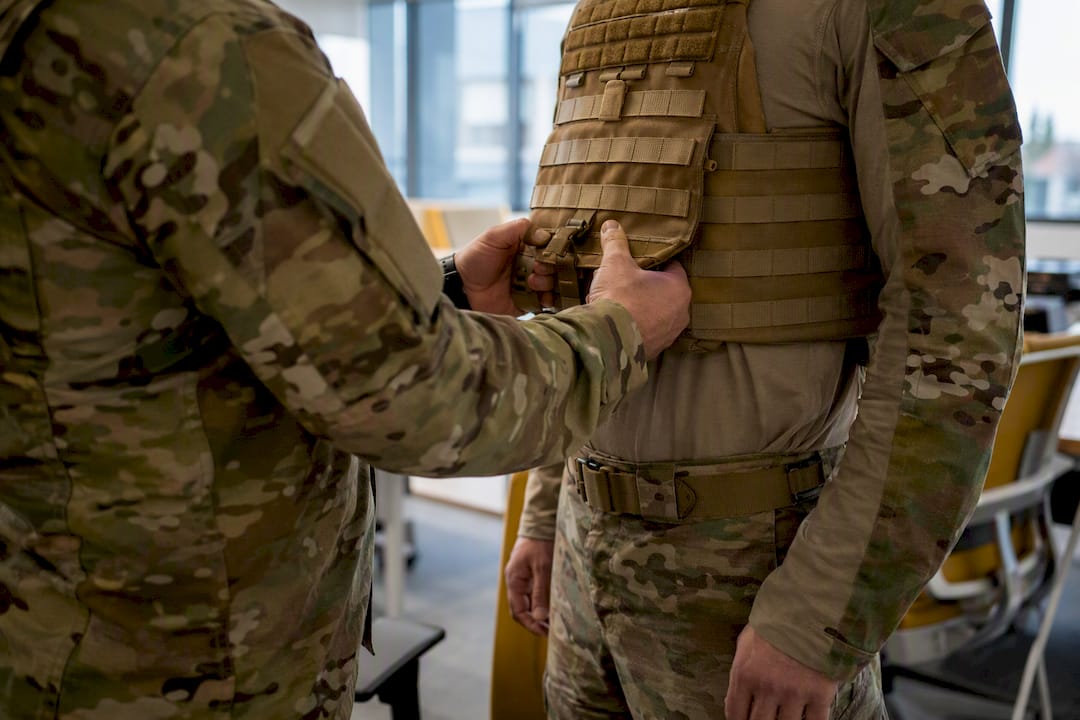
Emotional intelligence isn't a soft add-on in either domain; it's load-bearing in different ways. Military leadership, despite its reputation for toughness, depends heavily on a leader's ability to read fear, fatigue, and morale in a unit and respond to it, because a leader blind to those signals will make tactically sound but practically disastrous calls. Leading Marines explicitly builds "knowing your Marines and looking out for their welfare" into its core traits, which is emotional intelligence by another name.
Corporate leadership needs emotional intelligence for a different reason: influence without formal authority. A department head can't simply order a peer team to prioritize a shared project the way a company commander can order a platoon. Reading stakeholder motivations, building trust across silos, and managing one's own reactions during high-stakes negotiations are core interpersonal skills that show up repeatedly in coaching and 360 feedback results.
The difference is less about whether emotional intelligence matters and more about what it's used for: managing morale under physical stress in one domain, managing influence and ambiguity in the other.
Translating Doctrine Into Practice
The gap between reading about commander's intent and actually writing one is bigger than it looks. Most leaders overcomplicate the sentence, cramming in five priorities instead of one clear objective and a boundary. What works better is brutal simplicity: state the outcome, state what's off-limits, then stop talking.
This isn't a universal fix. Test it on a small team first and watch what actually changes in how people make decisions without you in the room. If nothing changes, the intent wasn't clear enough.
— Drew
Leaderly AI: Scaling the Hybrid Model Across Your Organization
Leaderlyapp is built for the exact gap this article describes: leaders know the theory behind mission command and stakeholder-driven feedback, but translating either into daily habit rarely survives a single workshop. The platform delivers personalized microlessons and behavioral exercises that turn concepts like commander's intent, 360 feedback, and after-action reviews into short, repeatable practice rather than a one-time training event.
A mid-sized operations team piloting this kind of micro-journey typically starts with one habit, writing a one-line intent before delegating, then adds a 360 check-in cycle once that habit sticks. Analytics dashboards track engagement and behavior signals along the way, so HR and team leads can see adoption in weeks rather than guessing at impact a year later. If you're ready to move past doctrine reading and into practiced habit, Leaderly AI's platform is where to start, or explore how it approaches cultivating leaders internally for a closer look at the pilot structure.
Sources
- Which of These People Is Your Future CEO? - Harvard Business School
- The art of 21st-century leadership — McKinsey (2024)