
Recognition is relational, frequent, and often costs nothing beyond a manager's attention. Rewards are transactional, occasional, and tied to a tangible payout. Use recognition constantly to sustain morale and retention; save rewards for measurable outcomes or genuine milestones, and never let one substitute for the other.
TL;DR:
- Recognition should be delivered immediately in daily workflow tools to reinforce ongoing behaviors without additional cost or administrative burden.
- Rewards are best suited for clear outcomes like hitting quotas or milestones, often requiring a budget and typically following a delay.
- Using recognition for repetitive behaviors boosts engagement and retention more cost-effectively than spending on rewards for every achievement.
- Combining recognition and rewards strategically, with recognition for ongoing effort and rewards for measurable results, enhances overall motivation.
- Building recognition habits through microlearning and gamification ensures sustained program effectiveness and avoids common pitfalls like generic praise or infrequent acknowledgment.
Table of Contents
- Recognition vs Rewards: What Actually Separates Them
- What Recognition and Rewards Look Like in Practice
- When Should You Use Recognition Instead of a Reward?
- How to Design a Recognition and Rewards Program That Lasts
- What Metrics Actually Prove Your Program Is Working
- Common Mistakes That Undermine Recognition and Rewards Programs
- Why Habit Formation, Not Just Good Intentions, Makes Recognition Stick
- Turn Recognition Into a Habit, Not a Task
- Sources
- FAQ
Recognition vs Rewards: What Actually Separates Them
Recognition taps intrinsic motivation. It tells an employee their specific behavior mattered, right when it happened, and it costs a manager two minutes and a sentence. Rewards tap extrinsic motivation. They deliver a tangible payoff, usually planned in advance, tied to hitting a number or reaching a tenure milestone.
That distinction shapes everything else about how each tool behaves. Recognition works best delivered within days, sometimes minutes, of the behavior it's marking. Wait three weeks to tell someone their client save was impressive, and the message loses most of its force. Rewards operate on a longer clock by design. A spot bonus for closing a deal, a five-year service award, or a quarterly sales incentive all assume a delay between the triggering event and the payout, and that's fine because the reward isn't trying to reinforce a fleeting moment. It's marking a threshold.
Cost follows the same split. Recognition scales at near-zero marginal cost because it's a behavior, not a budget line. A Slack shout-out, a specific comment in a one-on-one, a peer nomination on an internal wall of fame. Rewards require a funded line item, however small, because someone has to receive something of material value.
Here's where the two tools diverge in practice:
- Recognition fits everyday effort, collaboration, and behaviors you want repeated tomorrow.
- Rewards fit outcomes with a clear finish line: a closed deal, a shipped project, a five-year anniversary.
- Recognition costs attention; rewards cost budget.
- Recognition can happen the same day; rewards usually follow a review cycle or milestone date.
- Conflating the two, treating a gift card as recognition, or treating a "thank you" as the reward, is one of the most common mistakes organizations make, and it dilutes the effect of both, according to a Mindset Online analysis.
The stakes for getting this right are bigger than most HR teams assume. Organizations with strong recognition practices report markedly higher engagement and lower voluntary turnover, according to SHRM's research with Globoforce. Harvard Business Review has reached a similar conclusion from a different angle: consistent, genuine recognition is one of the simplest and cheapest ways to lift morale, yet it remains the most underused lever most managers have.
What Recognition and Rewards Look Like in Practice
Every recognition and rewards program is really a menu, and the trick is matching the right item to the right moment rather than defaulting to whatever's easiest to administer.
- Manager-delivered recognition. A direct, specific comment from a supervisor, "the way you handled that escalation call kept the account," delivered in the moment or in a one-on-one.
- Peer-to-peer recognition. Colleagues nominate each other for contributions a manager might not even see, which catches collaborative work that never shows up in a status report and can be enhanced by tools like Get Reward QR for delivering quick, experiential incentives.
- Public shout-outs. Team channel posts, all-hands mentions, or a recognition wall. These work best when specific and rare enough to stay meaningful.
- Badges and points systems. Gamified recognition platforms let employees earn visible markers over time, which helps frequency without inflating cost.
- Spot rewards. A small cash amount or gift card tied to a specific, immediate win. Low administrative overhead, high emotional payoff.
- Milestone rewards. Service anniversaries, certification completions, or project launches, usually planned and budgeted in advance.
- Cash bonuses. Reserved for outcomes with clear financial impact, since anything smaller than "meaningful" tends to feel like an insult rather than a reward.
- Extra PTO or development stipends. Increasingly popular alternatives to cash, especially for younger employees who value flexibility and growth over a one-time payout.
Peer recognition and badge systems scale cleanly across a large workforce because they run on behavior, not budget approval. Cash bonuses and development stipends need more governance, since someone has to decide who qualifies and how much is fair. For tight budgets, manager-delivered recognition and peer shout-outs deliver most of the retention value at close to zero cost, which is exactly why they should never get cut first when budgets tighten.
When Should You Use Recognition Instead of a Reward?
The decision usually comes down to four questions: Is this about a behavior or an outcome? How often does it happen? How visible should it be? And does everyone have a fair shot at it?
Behaviors that repeat, teamwork, initiative, mentoring, call for recognition because you want to reinforce the pattern immediately. Outcomes with a clear finish line, hitting quota, shipping a product, completing a certification, call for a reward because there's a concrete result to mark. Frequency matters too: if something happens weekly, it needs a frequent, low-cost response, not a budget request every time.
A few scenarios make the split concrete:
- An employee stays late to fix a client issue. Recognize it same-day, specifically, from the manager. No reward needed.
- A team hits an aggressive quarterly target. Reward it. This is exactly what incentive budgets exist for.
- A new hire completes onboarding milestones. Recognize each step publicly; save any reward for full 90-day completion.
- An employee refers a great hire who stays past six months. This calls for a reward, since it's a discrete, measurable outcome tied to a policy.
- A quiet contributor consistently helps others without asking for credit. Recognize it through peer nomination, since this is precisely the kind of contribution that formal reward systems tend to miss.
Layering both works better than choosing one. A milestone reward paired with public recognition ("Sarah just hit five years, and here's what she's taught this team about patience") lands harder than either alone.
Pro Tip: Ask your team, once a year, in an engagement survey or a simple one-on-one question, whether they'd rather be recognized publicly or privately, and whether they value cash, time off, or public acknowledgment most. Preferences vary more by individual than by generation, and guessing wrong wastes the gesture.
How to Design a Recognition and Rewards Program That Lasts
A durable program runs recognition and rewards as two parallel tracks with different owners, cadences, and budgets, not one blended initiative that collapses into whichever is easier to fund.
Recognition should sit close to the manager and team level: fast, informal, and owned by whoever's closest to the work. Rewards need more structure, usually owned by HR or a program administrator, with clear eligibility rules so nobody feels the process is arbitrary. Transparency matters here more than generosity. Employees forgive a modest reward budget faster than they forgive a system that looks rigged.
Budget framing that works with leadership: instead of asking for a lump sum, tie the ask to turnover cost. The Bureau of Labor Statistics' National Compensation Survey provides baseline compensation data you can use to model what even a modest reduction in voluntary turnover is worth, then frame the recognition and rewards budget as a fraction of that number.
Integration touchpoints that keep the program alive:
- Slack or Teams for real-time peer and manager recognition
- Your HRIS for tracking milestone dates and reward eligibility automatically
- Performance review cycles, where recognition patterns can inform (not replace) formal feedback
A rollout works best staged rather than launched all at once:
- Days 1 to 30: Pilot recognition in one or two teams; train managers on specific, immediate feedback; set a baseline engagement score.
- Days 31 to 60: Add a lightweight rewards catalog for milestones and spot bonuses; integrate recognition into existing chat tools.
- Days 61 to 90: Measure participation and engagement lift, adjust based on manager feedback, and prepare a scaling plan for the rest of the organization.
Vendor-neutral templates that separate recognition types, peer, spot, milestone, and performance, make governance and measurement far simpler down the line, according to Vantage Circle's program template. For a step-by-step pilot structure, our own guide to launching peer recognition programs in eight weeks walks through KPIs teams can track from week one.
The sustainment checklist is short: keep recognition inside daily workflow tools rather than a separate portal nobody opens, review reward eligibility quarterly, and audit for fairness across departments so recognition doesn't cluster around whichever manager talks the loudest in meetings.
What Metrics Actually Prove Your Program Is Working
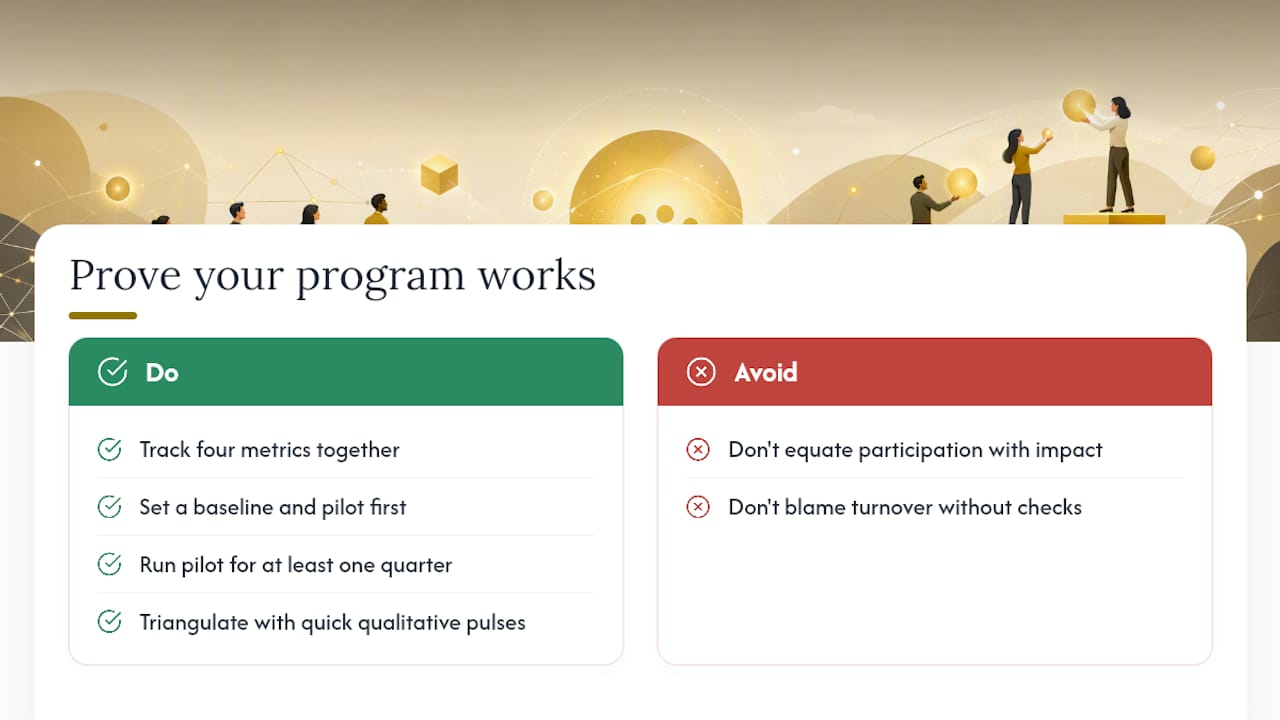
Four metrics matter most: eNPS or engagement score, voluntary turnover rate, program participation rate, and spend per employee. Track them together, not in isolation, because participation without turnover improvement usually means the program is popular but not meaningful.
Set a baseline before you launch anything. Run the new program in one division or team first, track that cohort against a comparable group that hasn't changed, and give it at least one full quarter before drawing conclusions. Recognition's effect on morale can show up fast; its effect on turnover takes longer to surface.
The biggest attribution trap is assuming any turnover drop is your program's doing when compensation changes, market conditions, or a new manager could just as easily explain it. Triangulate: pair the quantitative dashboard with short qualitative pulses, a few open-ended survey questions or exit interview notes, to confirm the story the numbers are telling.
Longitudinal analyses consistently link high-quality recognition to markedly lower turnover and higher engagement, which is the benchmark worth comparing your own results against. Report quarterly to leadership with four numbers on one page: participation rate, eNPS trend, voluntary turnover trend, and cost per participant. Anything more detailed belongs in an internal appendix, not the leadership deck. Our guide on turning engagement scores into action covers how to build that dashboard without overcomplicating it.
Common Mistakes That Undermine Recognition and Rewards Programs
Most program failures trace back to one of four habits, and every one of them is fixable without new budget.
- Do keep recognition and rewards as separate practices with separate language, so employees know which one they're receiving and why.
- Don't reach for a gift card when a specific, timely thank-you would have done the job better and cheaper.
- Do offer choice in rewards and train managers to name the exact behavior they're recognizing, not just "great job."
- Don't confine recognition to an annual awards ceremony. Build it into weekly team rhythms instead.
| Mistake | Fix |
|---|---|
| Treating rewards as recognition | Separate the language and the process for each |
| Vague praise ("nice work") | Train managers to name the specific behavior and impact |
| Annual-only recognition events | Embed recognition into weekly workflows and chat tools |
| One-size-fits-all rewards | Offer choice: cash, time off, or development stipends |
Why Habit Formation, Not Just Good Intentions, Makes Recognition Stick
Most recognition programs don't fail from a lack of enthusiasm. They fail because managers never build the habit of noticing and naming specific moments in real time, and no software fixes that on its own.
This is where microlearning earns its place. Short, repeated lessons on giving specific feedback train the behavior the way spaced repetition trains any skill, in small doses that stick rather than a one-time workshop that fades within a month. Gamified recognition adds a frequency layer on top: badges and points give employees a reason to recognize each other daily without asking a single department to fund a bigger rewards budget. Manager capability, not the platform itself, ultimately decides whether frequent recognition feels genuine or performative.
An effective solution provides managers bite-sized behavioral lessons on specific recognition, pairs it with gamified peer recognition, and pilots with one team before scaling organization-wide.
— Drew
Turn Recognition Into a Habit, Not a Task
Most recognition programs stall because managers know the theory but never build the habit of noticing specific moments in real time. Personalized microlearning trains managers on specific, timely recognition in minutes a day, while gamified recognition features let employees give and receive it inside the flow of daily work, rather than through a separate portal few use.
The practical path is to start small. Pick one team, run a 90-day pilot pairing manager microlessons with peer recognition, track eNPS and participation the way this article outlines, then extend it once the results hold. Leaderlyapp's business platform is built for exactly that kind of phased rollout, whether you're an enterprise HR team, a nonprofit, or a higher education program. Visit Leaderly AI to see how the analytics dashboard tracks recognition frequency alongside engagement scores, and reach out to set up your pilot cohort.
Sources
- Employee recognition program template — Vantage Circle
- 5 design considerations for effective employee recognition programs — Quantum Workplace
- Bureau of Labor Statistics — National Compensation Survey
FAQ
What Is a Recognition and Rewards Program?
A recognition and rewards program is a structured system that combines frequent, low-cost acknowledgment of behavior (recognition) with occasional, tangible incentives tied to outcomes or milestones (rewards). The strongest programs run both tracks in parallel with separate ownership and cadence, rather than treating them as interchangeable.
How Do You Say Thank You for a Reward or Recognition?
Name the specific behavior, the context it happened in, and the impact it had, rather than a generic "thanks" or "great job." For a reward tied to a milestone, pair the thank-you with public acknowledgment so the gesture carries both the tangible payout and the relational value of recognition.
What Are the Five Pillars of Recognition?
Definitions vary across sources, but the practices that consistently show up include specificity, timeliness, frequency, visibility, and fairness. Programs that hit most of these tend to sustain participation far longer than ones built only on generic praise, according to Quantum Workplace's design research.
What Are the Five Types of Rewards?
Common categories include cash bonuses, milestone or service awards, spot rewards, extra paid time off, and development stipends such as training budgets or certification funding. Which type fits best depends on whether you're marking a discrete outcome or a longer tenure milestone.
Does Leaderlyapp Help With Recognition Programs?
Leaderlyapp supports recognition through gamified features and manager microlearning that builds the habit of giving specific, timely feedback. Pricing details are available directly on the Leaderlyapp site.