
Nonprofit leadership development turns individual skill building into organizational capacity: a leader gets sharper at finance, fundraising, or governance, and the whole organization gets stronger because of it. The fastest way to see results is not a semester-long course. Start with an 8 to 12 week cohort that pairs a real organizational project with coaching, then measure what changes.
TL;DR:
- Cohort-based programs and certificates deepen leadership skills through real projects and coaching, leading to higher retention, fundraising growth, and more proactive decision-making.
- Programs that include practical projects, measurable outcomes, and ongoing coaching outperform purely academic courses in developing effective nonprofit leaders.
- Running an internal pilot with a small, cross-role cohort, a clear outcome, and regular measurement can build organizational capacity efficiently and cost-effectively.
- Leaderly’s AI-driven microlearning supports ongoing staff development by delivering personalized daily exercises and assessments at scale, complementing deep learning programs.
- Evaluating program providers requires questions about role fit, real project support, outcome history, cohort size, and post-program follow-up to avoid ineffective or vague offerings.
Table of Contents
- Why Leadership Development Matters for Nonprofits
- Cohorts, Certificates, Workshops, or Microlearning: Picking the Right Format
- What Should a Quality Program Actually Teach?
- How Do You Choose the Right Leadership Program?
- Building an Internal Pilot: From One Cohort to Organization-Wide
- Three Lessons From Watching Nonprofit Programs Succeed and Fail
- How Leaderly Fits Into Your Leadership Strategy
- Where This Article's Claims Come From
- Sources
- FAQ
Why Leadership Development Matters for Nonprofits
A stronger leader changes what an organization can do. Boards run better meetings, fundraising pipelines get longer, and staff stick around instead of burning out under a manager who never learned to delegate. That connection between individual growth and organizational outcomes is the entire point of leadership development, not a side benefit.
The biggest obstacle isn't budget. It's time. Executive directors run from crisis to crisis, and few ever get a scheduled block to step back and think strategically. Programs at institutions like Harvard Kennedy School are built specifically to force that pause, structuring the curriculum so participants can't skip the strategic work in favor of email.
Track outcomes that actually reflect leadership growth, not just attendance:
- Fundraising pipeline growth over two to three quarters
- Staff retention rates among direct reports of program participants
- Board engagement, measured by meeting attendance and committee participation
- Number of decisions made proactively versus reactively during the program window
Cohorts, Certificates, Workshops, or Microlearning: Picking the Right Format
Format determines whether a program fits your calendar and your budget, so match it to what your organization can actually sustain.
- Cohort-based programs group leaders from different organizations who tackle real problems together, then stay connected afterward through an alumni network. The Institute for Nonprofit Practice's Core Certificate Program runs management seminars alongside small practice cohorts and in-person retreats, which builds both skill and a lasting peer network.
- Executive certificates through universities carry academic weight and typically run for months rather than weeks. Harvard Extension School's Nonprofit Management Graduate Certificate requires four courses and can be finished in about eight months at two courses per semester, or stretched to three years for a lighter pace.
- Workshops and short courses target one skill, like grant writing or board recruitment, and fit into a single afternoon or day.
- Microlearning delivers short, frequent lessons that scale across an entire staff, not just senior leadership, which matters when you need every program manager building the same habits.
Choose cohorts or certificates for depth and credentialing. Choose workshops or microlearning when time and headcount make anything longer impractical.
What Should a Quality Program Actually Teach?
The best nonprofit leadership training covers a specific set of competencies, not generic management theory. Look for a curriculum that includes:
- Nonprofit finance and budgeting, including restricted funds and audit readiness
- Governance and board engagement
- Fundraising strategy and donor pipeline management
- Strategic planning under resource constraints
- People management and staff retention
- Diversity, equity, inclusion, and belonging (DEIB) in program and hiring decisions
- Impact measurement tied to funder reporting requirements
Curriculum alone doesn't produce better leaders. Programs that pair coaching with a concrete project see higher transfer of learning because participants apply new skills to a real problem instead of a hypothetical case study. Regional cohort programs like CVNL's Executive Leadership Program build around five practical competencies, responsive leadership, strategic thinking, fund development, and financial health, delivered through seminars and coaching rather than lecture alone.
Statistic Callout: Programs that combine cohort learning with coaching and a concrete deliverable report better participant satisfaction and stronger application of what they learned back on the job, according to program design research from the Institute for Nonprofit Practice.
How Do You Choose the Right Leadership Program?
Match the program to the role first. A program built for emerging program managers won't serve a sitting executive director, and vice versa. Beyond role fit, weigh these criteria:
- Cohort composition: Are peers at a similar organizational level and stage?
- A defined project deliverable, not just discussion
- Access to individual coaching during and after the program
- Documented outcomes from past participants, not just satisfaction scores
- Total cost against your training budget and the time commitment against your calendar
Ask providers directly before you commit. Useful questions include:
- How does the program support applying learning to our organization specifically?
- What measurable outcomes do past participants report six months later?
- Who leads the coaching sessions, and what's their background?
- How large is each cohort, and how are peers selected?
- What happens if a participant's project stalls mid-program?
Red flags show up fast once you know what to look for: no project component, no peer cohort, vague claims about "leadership growth" with no metric behind them, or instructors whose nonprofit experience isn't clearly stated anywhere.
Pro Tip: Block program hours on the calendar as paid work time, not something squeezed in after 6 p.m. Then tie the cohort project directly to a current funder or donor priority, so the work counts twice: once for the leader's growth, once for the organization's actual goals.

Building an Internal Pilot: From One Cohort to Organization-Wide
Running your own pilot beats waiting for budget to send someone to an external program. The sequence that works:
- Define the outcome first. Decide what "better" looks like before recruiting anyone.
- Recruit a small cohort, ideally cross-role, so an executive director, a program director, and a finance lead work the same problem together for faster organizational buy-in.
- Assign one real organizational project with a deadline and a visible deliverable.
- Pair each participant with a coach, internal or external, for regular check-ins.
- Measure twice: short-term through project milestones and participant satisfaction, medium-term through retention, promotions, and fundraising results tied to the project.
Run the pilot on an 8 to 12 week cadence, with a named program sponsor, a coach, and someone handling logistics so nothing falls through administrative cracks.
Three Lessons From Watching Nonprofit Programs Succeed and Fail
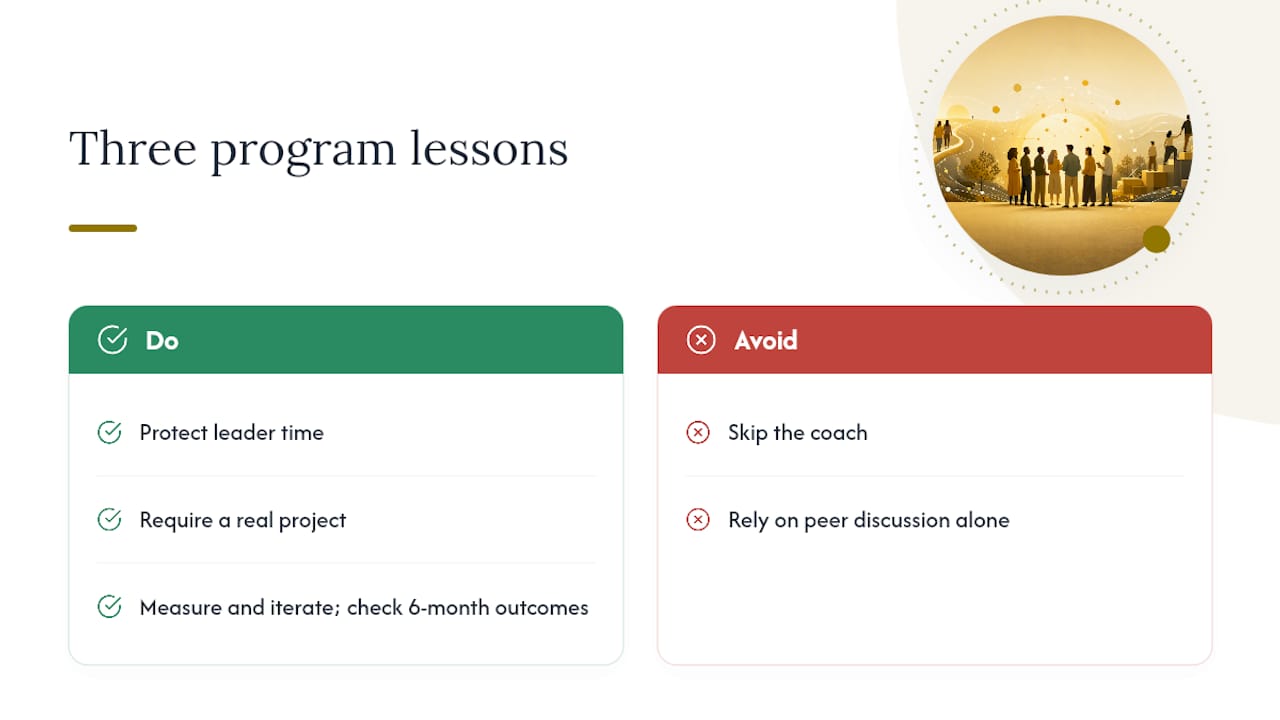
Protect leader time before you protect anything else. A program with brilliant content still fails if participants attend with one eye on their inbox. Second, require a real project. Case studies teach concepts; a live deliverable tied to an actual funder deadline teaches judgment. Third, measure and iterate. A pilot that doesn't check retention or project completion six months out is a nice retreat, not a development program.
The most common internal pilot failure isn't bad curriculum. It's skipping the coach and hoping peer discussion alone will change behavior. It rarely does.
— Drew
How Leaderly Fits Into Your Leadership Strategy
Cohort programs and certificates do the deep work well: strategic thinking, governance, fundraising fundamentals. What they can't do is reach every program coordinator and volunteer manager on your staff, week after week, at a cost that scales with your organization instead of against it.
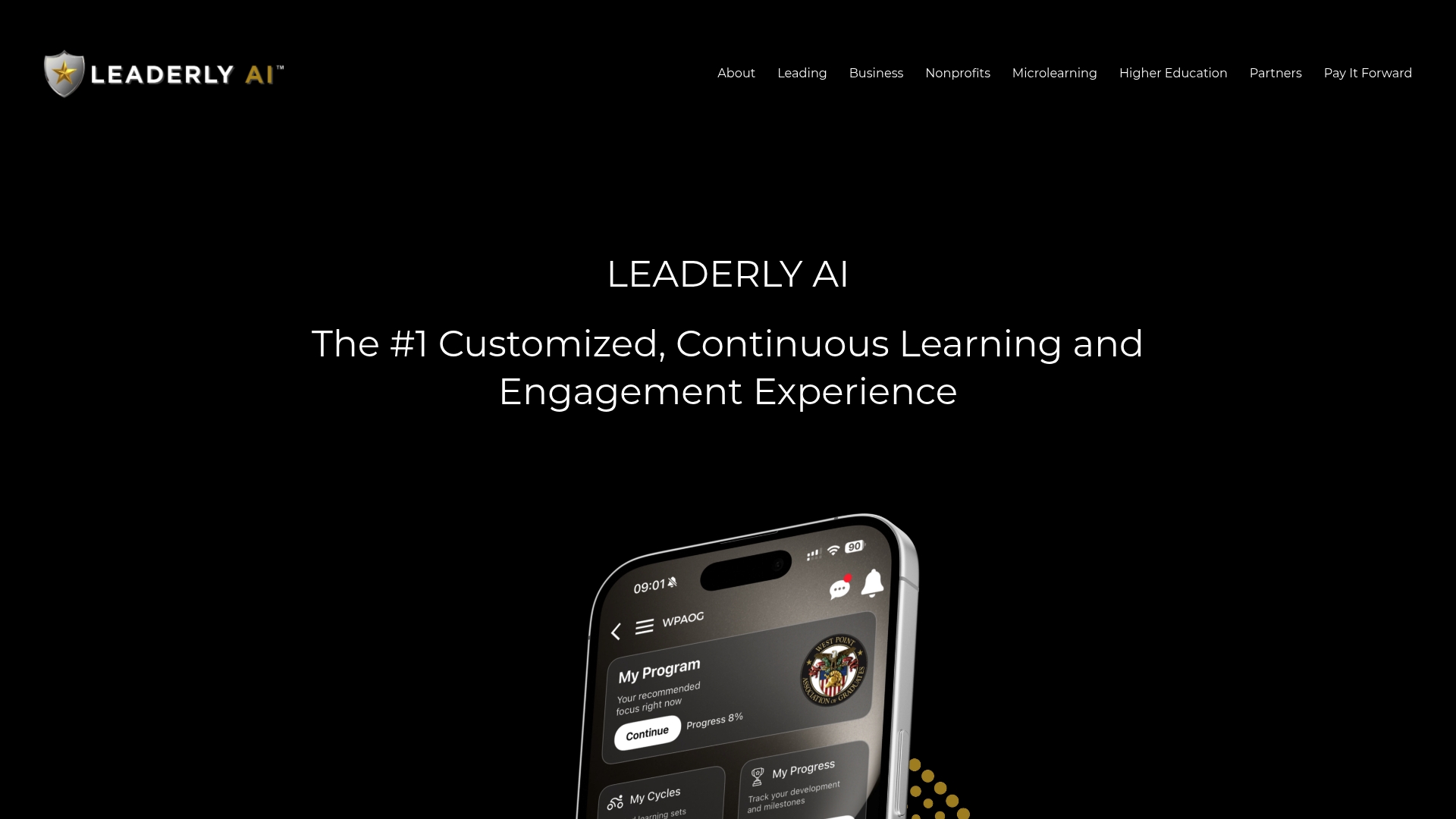
That's the gap Leaderly AI for Nonprofits is built to close. It delivers personalized microlearning and behavioral habit-building exercises to every team member, not just the executive director sent to a certificate program once every few years, using machine learning to adjust content as each person's role and skills change. Pair it with a cohort pilot for your senior leaders and let AI-driven microlearning support ongoing development with daily practice, self-assessments, and accessible analytics. If you're weighing options for next quarter's training budget, request more detail on the nonprofit platform and see how the two approaches stack together.
Where This Article's Claims Come From
Program details and research cited above come from the following sources: Harvard Kennedy School, Harvard Extension School, Bridgespan, Institute for Nonprofit Practice, CVNL, and SMU Meadows.
Sources
- Nonprofit Management Graduate Certificate (Harvard Extension School)
- National Core Certificate Program - Institute for Nonprofit Practice
- Leading for impact (Bridgespan)
- Nonprofit management and leadership (Harvard Kennedy School executive education)
- Executive Leadership Program (CVNL)
FAQ
What Is the 33% Rule for Nonprofits?
The "33% rule" isn't a standardized industry benchmark with a single agreed definition, and it doesn't appear in the program research behind this article. If you've seen it referenced for overhead or reserve ratios, treat it as informal guidance rather than a governing standard, and check with your accountant or state nonprofit association for the figure that applies to your organization.
Is CNP Certification Worth It?
Credentialed certificates add external validation and a built-in professional network that internal training can't replicate, which matters if you're job hunting or building sector-wide credibility. Whether it's worth it depends on your role: a program like Harvard Extension's certificate makes sense for a rising leader planning to stay in the sector long-term, while a project-based internal pilot may deliver faster, more contextual results for someone already running programs day to day.
What Should Be Included in a Leadership Development Program?
A solid program covers nonprofit finance, governance and board engagement, fundraising strategy, strategic planning, people management, and DEIB, paired with a real project and ongoing coaching. Programs like CVNL's Executive Leadership Program build around five practical competencies rather than abstract theory, and that project plus coaching combination is what drives actual behavior change rather than just knowledge.
How Much Does a Nonprofit COO Make?
Compensation for a nonprofit chief operating officer varies widely by organization size, budget, and region, and no figure in the research behind this article establishes a reliable national average. Check sector-specific salary surveys from your state nonprofit association or a compensation benchmarking service for numbers relevant to your organization's size and location.