
Faculty leadership development programs are structured, cohort-based experiences that build the interpersonal, budgeting, and strategic skills needed to move from the classroom into administrative roles. They range from single-day workshops to year-long executive certificates, and the right one depends entirely on your career stage. Before applying, check two things first: the actual time commitment and your institution's nomination or application window, since both can quietly disqualify you if you miss them.
TL;DR:
- Cohort-based leadership programs lasting eight months to a year foster peer relationships and accountability, which are essential for lasting behavior change.
- Selecting the right program depends on your career stage, with emerging leaders focusing on early assessment tools and senior roles emphasizing operational impact.
- Most programs require institutional nomination, a clear demonstration of your commitment, and alignment with your long-term leadership goals.
- An applied capstone project with measurable operational results is crucial for demonstrating leadership growth and advancing your career.
- Combining deep cohort training with microlearning platforms can provide ongoing reinforcement and skill maintenance throughout your leadership development journey.
Table of Contents
- What Are the Main Formats for Academic Leadership Training?
- Which Program Track Fits Your Career Stage?
- What Does the Curriculum Actually Cover?
- How Do You Get Nominated or Apply?
- What Do You Actually Get Out of It?
- How Do You Choose the Right Program for Your Situation?
- Why Do Cohort and Applied-Project Designs Work Better?
- What I've Learned Watching Faculty Navigate These Programs
- A Practical Complement to Cohort Programs: Continuous Microlearning
- Where to Go Next for Program Details
- Sources
What Are the Main Formats for Academic Leadership Training?
Not every faculty member needs a year-long commitment to start building leadership skills. The format that fits you depends on how much runway you have and how far along you already are.
- Short workshops and seminars: Single-session or multi-day events focused on one skill, like conflict navigation or budget literacy. Low time cost, good for testing interest before committing further.
- Cohort-based programs (8 months to a year): The dominant model for serious academic leadership training. Programs such as Harvard's Executive Certificate in Higher Education Leadership run across a full academic year, pairing seminars with applied projects and ongoing mentorship.
- Executive certificates and multi-institution consortia: Modular formats aimed at faculty already eyeing dean or provost tracks, often combinable with other credentials.
Cohort length matters more than most faculty realize. Shorter programs teach concepts; year-long cohorts build the peer relationships that keep you accountable after the program ends.
Which Program Track Fits Your Career Stage?
Higher education leadership programs almost always sort participants by rank and ambition, not just interest. Picking the wrong track wastes a nomination slot.
- Emerging leaders: Assistant and early-tenure faculty exploring administrative interest, often through programs like Penn State's PSEAL track, which pairs participants with assessment tools like CliftonStrengths to map early strengths.
- Department and unit leaders: Chairs, program directors, and associate deans working on team management and budget authority.
- Advanced and senior leader tracks: Faculty positioning for dean, provost, or president roles, usually requiring prior administrative experience.
Placement assessments and 360-degree feedback aren't just diagnostic exercises. They shape your individualized development plan and give you language to describe your leadership style in future interviews. Most flagship programs run on nomination, not open application, so your chair or dean's support often decides whether you get a seat at all.
What Does the Curriculum Actually Cover?
Academic leadership curricula tend to organize around four competency buckets: personal self-awareness, interpersonal skill, team management, and systems-level understanding of governance and finance. Carnegie Mellon's Lead Well program structures its sessions almost exactly this way, moving from individual reflection to institutional strategy over the course of the program.
Expect session topics like these across most cohort programs:
- Conflict navigation and difficult conversations
- Budgeting and resource allocation basics
- Strategic planning and change management
- Mentoring and succession planning
- Equity-centered leadership and inclusive decision-making
The applied project and peer forum structure is where the real learning transfer happens, not the lecture slides. Programs commonly borrow a "Critical Friends" model, small peer groups that troubleshoot real campus problems together, because formal training alone rarely produces lasting behavior change.
Pro Tip: Pick your applied project topic in the first two weeks of any cohort program, not the last month. The projects with visible operational impact, the ones your dean can point to, are what actually move the needle on your next review.
How Do You Get Nominated or Apply?
Getting into a strong program is often more about institutional politics than personal qualification. Here's the practical sequence:
- Confirm eligibility early. Most programs require a minimum number of years in rank and explicit departmental support, meaning your chair has to sign off before you apply.
- Map the time commitment honestly. Expect a full day monthly for in-person cohorts, or weekly virtual sessions for hybrid formats, with mandatory attendance built into the design.
- Ask about funding before you assume it exists. Some programs are covered by the provost's office; others require a departmental request. Bring a one-page case for the return on that investment when you ask.
What Do You Actually Get Out of It?
Completing a faculty leadership program should leave you with more than a certificate on a wall.
- A written leadership action plan tied to your specific institutional context
- A completed applied or capstone project with measurable operational impact
- One or more mentor relationships that outlast the program itself
- A credential or program endorsement you can cite in your annual review or promotion packet
Use the applied project as evidence, not the attendance record. A dean reviewing a promotion file cares far more about "redesigned the department's onboarding process, cutting new-hire ramp time by six weeks" than "completed 40 hours of leadership training." Participants who complete a strong capstone project often report the clearest career movement afterward, whether that's a chair appointment or a lateral move into a center directorship.
How Do You Choose the Right Program for Your Situation?
Run any program you're considering through a short checklist before committing your semester to it.
- Does the time commitment match your current teaching load and service obligations?
- Does the track align with your actual career goal, not just your current title?
- Is the cohort small enough for genuine peer relationships, or is it a lecture hall with a certificate at the end?
- Does the curriculum include a real applied project, not just case-study discussion?
- Does the program address equity and inclusive leadership explicitly, or treat it as an afterthought?
- Does your department have the budget and willingness to back your nomination?
Ask program managers directly what percentage of participants complete an applied project with a documented institutional outcome. A program that can't answer that question, or hedges with generic language about "leadership growth," is likely long on seminars and short on transfer. That vagueness is the biggest red flag: strong programs can point to specific alumni projects and where those people work now.
Pro Tip: If a program can't name a single alumnus who moved into a chair, dean, or provost role within three years, ask why. Strong programs track this data because it's their best recruiting tool.
Why Do Cohort and Applied-Project Designs Work Better?
Higher education leadership scholarship has moved away from hierarchical, individual-hero models of leadership toward shared-power, equity-oriented approaches, a shift researchers like Rozana Carducci have pushed for explicitly in recent scholarship. Programs that still teach leadership as a solo command function are behind the field.
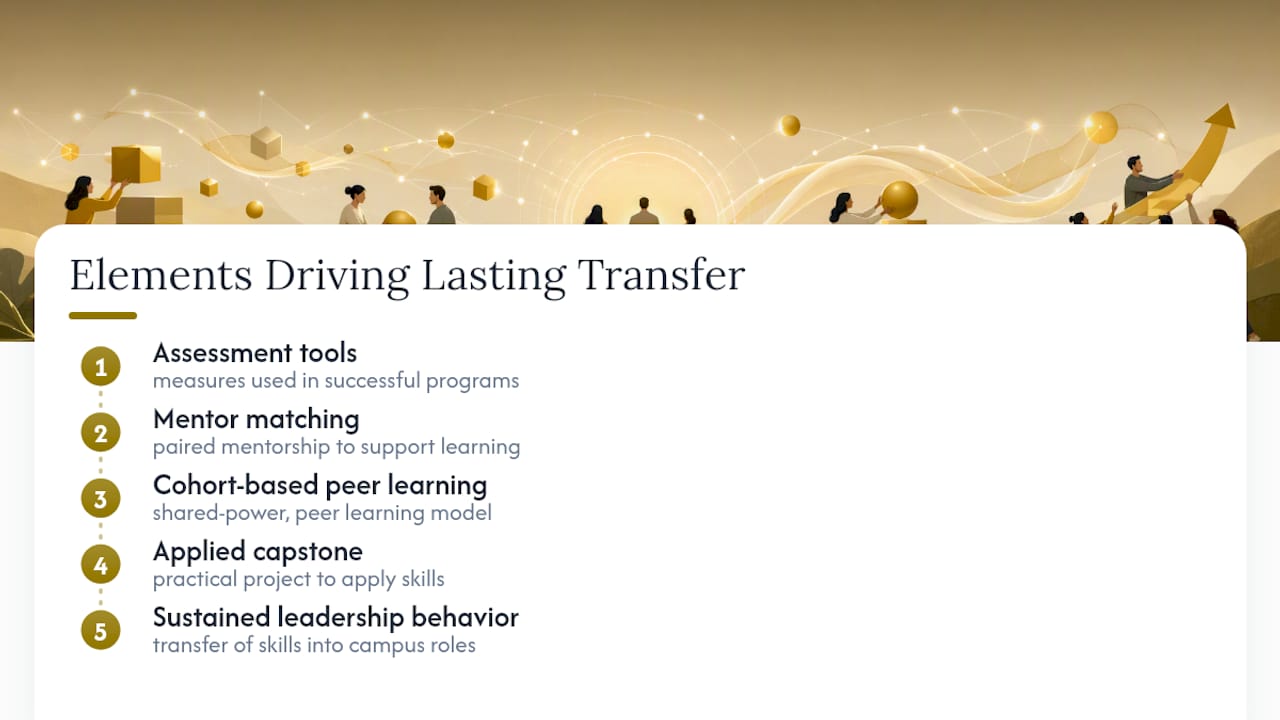
The programs that produce lasting behavior change combine four elements: assessment tools, mentor matching, cohort-based peer learning, and an applied capstone. That combination consistently shows the highest reported transfer of leadership skills back into actual campus roles. If a program is missing two or more of those pieces, treat it as supplemental, not a primary leadership development experience.
What I've Learned Watching Faculty Navigate These Programs
Getting nominated is often harder than doing the program itself. You'll need to make the case to your chair months before any deadline, and that conversation works best when you frame it as an institutional investment, not a personal favor. One applied project I've seen work well: a mid-career faculty member redesigned a fractured student advising workflow as their capstone, and that single project became the thing that got them tapped for an associate dean search a year later. Go in expecting some of your time to get eaten by committee politics that have nothing to do with your leadership growth. That's not a flaw in the program. It's just what institutions are.
— Drew
A Practical Complement to Cohort Programs: Continuous Microlearning
Cohort programs give faculty depth once a year. The gap they can't close is the other fifty weeks, when a new chair needs a quick refresher on giving feedback or a committee lead needs a five-minute primer before a tense meeting. A platform can fill that gap with personalized microlessons built on behavioral science, adjusting to each person's role and pace rather than delivering the same static training to everyone.
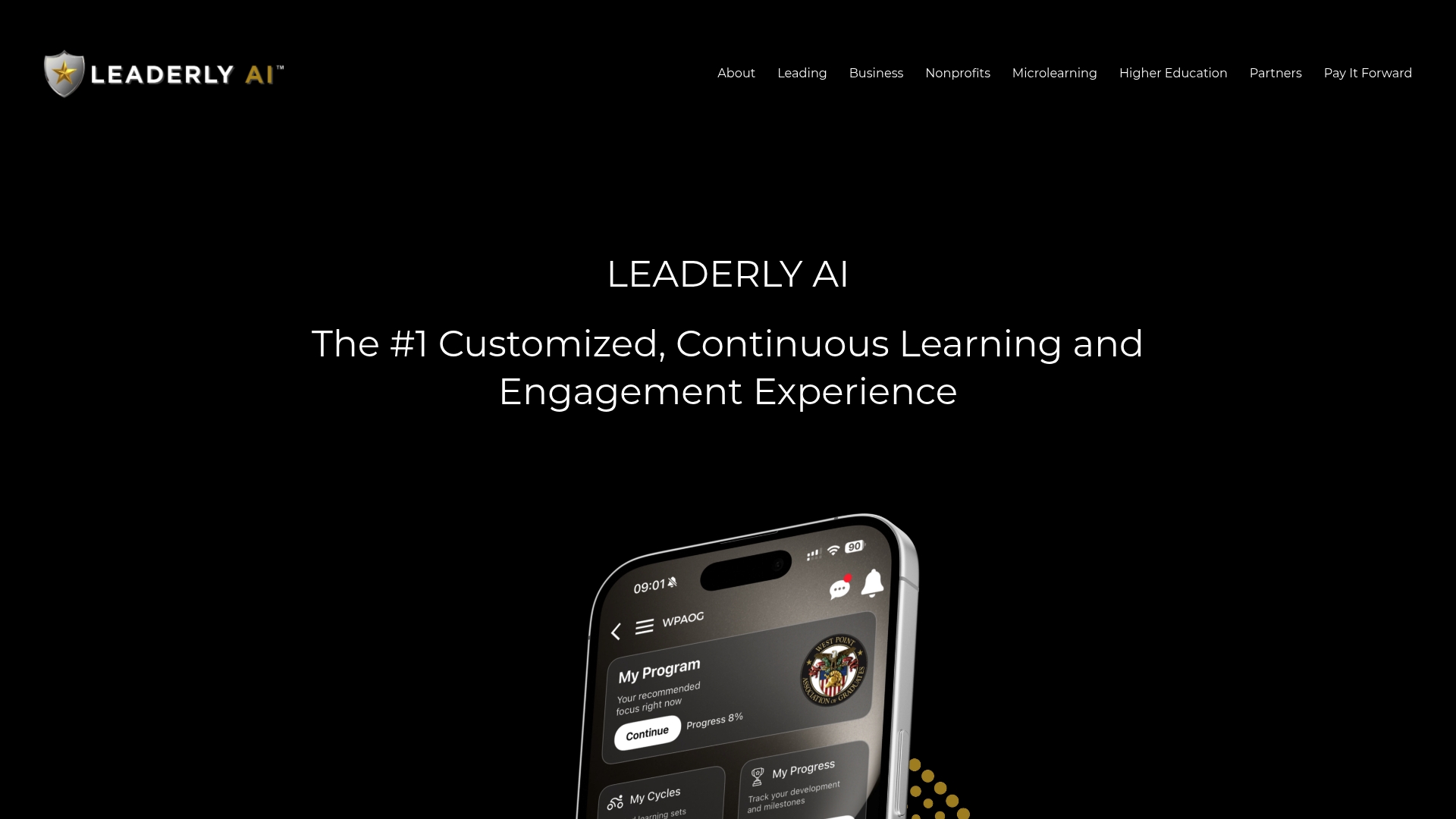
For a department or teaching center, the practical move is pairing the two: keep the flagship cohort program for the deep, applied leadership work, and layer Leaderly in for the ongoing reinforcement between cohorts, tracking growth through built-in assessments and analytics dashboards rather than a single end-of-year survey. If you're weighing how to integrate structured microlearning into an existing academic leadership pipeline, review how leadership curriculum fits into academic programs, then reach out through Leaderly's platform overview to talk through a pilot for your department or faculty cohort.
Where to Go Next for Program Details
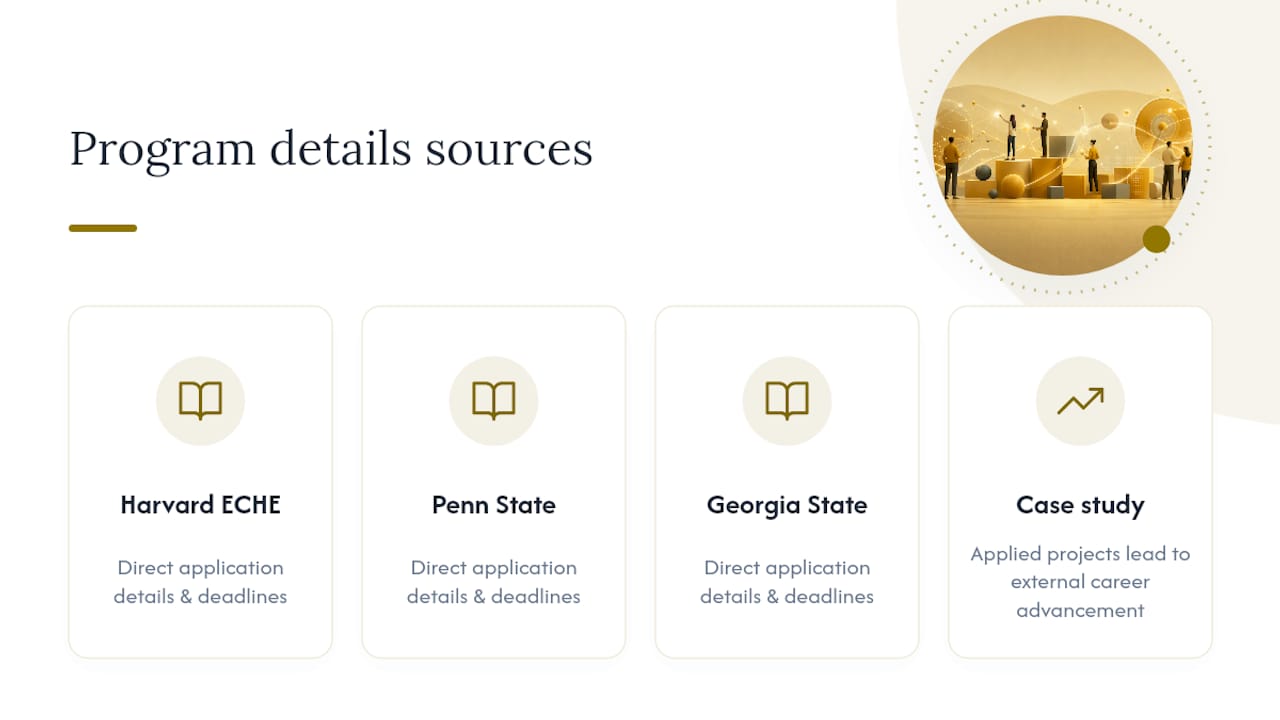
For direct application details and deadlines, start with Harvard's ECHE program, Penn State's Excellence in Academic Leadership Program, and Georgia State's Academic Leadership Institute for Faculty. For a case study on how applied project work translates into career advancement outside academia, see this continuous improvement certification story.
Sources
- Executive Certificate in Higher Education Leadership (ECHE) | Harvard Graduate School of Education
- Lead Well: Foundations of Academic Leadership - Carnegie Mellon University
- Academic Leadership Institute for Faculty | GSU
- Penn State PSEAL program | Penn State