
A personalized learning journey is a route through content that changes for each person, based on what they already know, what they want to achieve and how they progress. At work, that means a new hire, a first-time manager and a senior director do not all get the same course in the same order. This guide explains the parts every journey needs, shows how real organizations have built them, and gives you a plan you can start this quarter.
TL;DR
- A journey is more than a playlist: it links a learner profile, a sequence of content, checkpoints and decisions about what comes next.
- Four components keep appearing in the research: learner profiles, personal paths, competency-based progression and flexible environments.
- Start small: one audience (new hires or emerging leaders), one goal, a short diagnostic and a few weeks of content.
- Measure behavior change and performance, not only completion rates.
- Short, mobile-friendly microlessons make journeys practical for every employee, not just managers.
Table of Contents
- What a personalized learning journey is
- The four components every journey needs
- Examples of personalized learning journeys at work
- How to build a personalized learning journey in six steps
- The role of AI and feedback in personalization
- Challenges when you scale
- Our perspective
- See it in practice with Leaderly
- FAQ
- Sources
What a personalized learning journey is
The phrase comes from two worlds that rarely talk to each other: schools and workplaces. Both mean the same core idea.
In education, RAND describes personalized learning as practices that tailor the pace and focus of instruction to the needs and goals of each student. Those needs, goals and progress are visible, discussed often and updated. That contrasts with approaches where a shared pace or grade-level test takes priority over the individual.
At work, the same logic applies to employees. Instead of assigning a single course to everyone, you build a path for each person from their role, current skills and goals.
It also helps to remember where most adult learning happens. The Pew Charitable Trusts describes personal learning as learning rooted in how people live their daily lives and what they take from experience. It is personal, purposeful and powerful, and it keeps changing behavior, skills, knowledge and attitudes. NEBHE, citing the Center for Creative Leadership, notes that more than 80% of what we know comes from learning outside school. A good workplace journey connects to that reality: it fits into the day, builds on experience and gives people a reason to practice.

Learning journey or learning path?
People use the two terms interchangeably, and search behavior reflects it. A useful way to separate them:
- A learning path is the sequence of content. A personalized path adjusts that sequence for one learner based on prior knowledge, goals or preferences. One practical guide describes it as a structured route through content that changes with what the learner knows and wants to accomplish.
- A learning journey is the wider experience around the path: the kickoff, the practice on the job, the manager conversations, the reflection and the recognition.
The same guide stresses that a pathway is not just a list of recommended videos. It connects learner information, content sequence, checkpoints and decisions. A learner might take a short diagnostic, complete a foundational activity, skip what they can already demonstrate and receive a practice task matched to their goal.
The four components every journey needs
The Bill & Melinda Gates Foundation's Early Progress report found four consistent components in personalized learning systems. They were written for schools, but they translate cleanly to employee development.
| Component | In the report | What it looks like at work |
|---|---|---|
| Learner profile | An up-to-date record of strengths, needs, motivations, progress and goals | Role, tenure, self-assessment results, stated goals, manager input |
| Personal learning path | A customized path that adapts to progress, motivations and goals | Content order that changes after each check-in or exercise |
| Competency-based progression | Progress is assessed against clear goals; learners advance when they show mastery | Skip what someone already does well; move on after a practice task, not after seat time |
| Flexible learning environment | Student needs drive staffing, space and time | Lessons on a phone, in short bursts, in the flow of the workday |
Other frameworks use different labels but land in the same place. Ohio's Department of Education and Workforce centers its Personalized Learning Framework on being learner-driven, flexible environments, authentic learning, evidence of learning and feedback, and an optimal path and pace. Education Elements' Core Four white paper lists flexible content and tools, targeted instruction, data-driven decisions, and reflection and ownership.
The pattern across all three: know the learner, adapt the route, check for mastery, and let the learner own the process.
Examples of personalized learning journeys at work
Leadership programs
Two programs documented by EFMD show how organizations structure leadership journeys.
Capgemini's Making Leaders, designed with emlyon Executive Education in 2018, is a 10-month learning journey with more than 500 alumni. It combines a kickoff convention, three two-day sessions, weekly action tips, an LMS and a personal development thread built around DISC and a learning journal.
NatWest Group's OBLT program, created with IMD in 2023, is a three-phase blended journey that used micro-experimentation to build skills and mindset. Participants reported collaboration across boundaries at 84%, operational efficiencies at 75% and employee satisfaction at 73%.
Both share a pattern worth copying: a self-assessment at the start, small repeated actions between sessions, and reflection built in.
Onboarding paths
A personalized onboarding path is the same idea applied to a new hire's first weeks and months. Three documented examples:
- Spelman College built the year-long, AI-supported Jaguar Journey. It runs from offer acceptance through the first year, with touchpoints at 30, 60 and 90 days, a six-month checkpoint and a one-year reflection. Its three pillars are milestone integration, manager accountability and AI-assisted personalization by role, department and responsibilities.
- Duke University published a competency-based onboarding program for clinical research professionals in Frontiers in Medicine. It has an online foundational experience, a 90-day learning plan template with customizable paths, and applied activity packets.
- Greystar reports that its unified onboarding, which includes role-based journeys and skill paths, cut 90-day turnover from 20.5 percent in early 2022 to 6.4 percent by 2024, according to Training Magazine.
Notice what these have in common: fixed milestones (30, 60, 90 days), a role-specific layer on top of a shared foundation, and a named manager responsible for follow-through.
How to build a personalized learning journey in six steps
- Pick one audience and one outcome. "New customer success hires reach full productivity faster" or "first-time managers hold better one-on-ones" are workable. "Develop everyone" is not.
- Build the learner profile. Combine role, tenure and goals with a self-assessment. Personality and style tools such as DISC, MBTI or an emotional intelligence assessment give each person a starting point for reflection and a shared vocabulary with their manager.
- Run a short diagnostic. A few questions or a scenario tells you what someone can already do, so they can skip it. This is the competency-based part: progress by demonstrated ability, not time spent.
- Break content into small units. Lessons that take a couple of minutes get used between meetings. Our guide to turning long material into short lessons shows how to cut a long document into a set of focused microlessons. If your people are mostly on phones, mobile learning design matters as much as the content itself.
- Attach a practice task to every lesson. A journey changes behavior only when people do something: run a feedback conversation, try a new meeting format, write a reflection. Ask them to log what happened.
- Set checkpoints with the manager. Borrow Spelman's rhythm of 30, 60 and 90 days. At each checkpoint, review progress, adjust the path and recognize what has improved.
The role of AI and feedback in personalization
Personalization by hand works for 20 people. It breaks at 2,000. That is where machine learning helps: it reads the learner profile and recent activity and decides which lesson or exercise comes next.
There is early evidence that this pays off. A mixed-method study of 326 survey respondents across 12 technology and financial enterprises, plus 12-month case studies, found that AI-supported learning systems improved work efficiency, reduced error rates and raised job satisfaction. Personalized paths and real-time feedback contributed by supporting autonomy and competence.
Feedback is the engine. Every completed exercise, quiz or self-rating tells the system what to adjust. Without that loop, you have a static playlist with a person's name on it.
Before adding AI to any workflow, including learning, it is sensible to check your foundations: data handling, access controls and security. An AI readiness assessment can help you score where your organization stands first. For the learning side, we explain how this works in practice in AI learning personalization at work, and how to keep people in the loop in AI content curation with human review.

Challenges when you scale
Most journeys that work for a pilot group stumble at scale. Research summarized by Training Industry notes that organizations commonly cite cost, technical integration and staff workload as barriers. It also points out that digital learning is often judged by completion rates rather than changes in behavior or performance, and that when success is defined as scale and efficiency, personalization loses priority.
Practical ways to handle each:
- Cost: Start with one audience and expand once the pilot shows results, rather than buying for the whole company on day one.
- Integration: Choose a tool that works on the devices people already use and does not require a long IT project.
- Workload: Let the system handle sequencing and reminders so L&D and HR time goes to content quality and manager coaching. Content that HR or educators can customize easily keeps this manageable.
- Measurement: Decide before launch which behavior you expect to change. Pair completion data with manager observations, pulse surveys and the practice logs from each lesson. Our piece on an evidence-first plan for leadership personalization walks through this from the buyer's side.
Our perspective
Most leadership programs are built for managers and delivered a few times a year. We think that is backwards. Leadership is a set of habits, and habits form through small actions repeated often, in the middle of real work.
That is why we built Leaderly around behavioral science and frequent microlearning. Personalization driven by machine learning means each person's path evolves with their own journey, and built-in assessments give them a place to start. We designed it so HR teams and educators can customize programs and scale them to all employees, not only the people with "manager" in their title.
If you take one idea from this article, make it this: a journey is judged by what people do differently on Monday, not by how many lessons they finished on Friday.
Drew
See it in practice with Leaderly
Leaderly AI is a mobile-first platform for organizations that delivers personalized leadership development through microlessons, habit-building exercises and customizable learning journeys. It includes self-assessments (DiSC, EQ and MBTI), analytics dashboards, surveys, simulations and gamified recognition. There are versions for businesses, higher education and nonprofits.
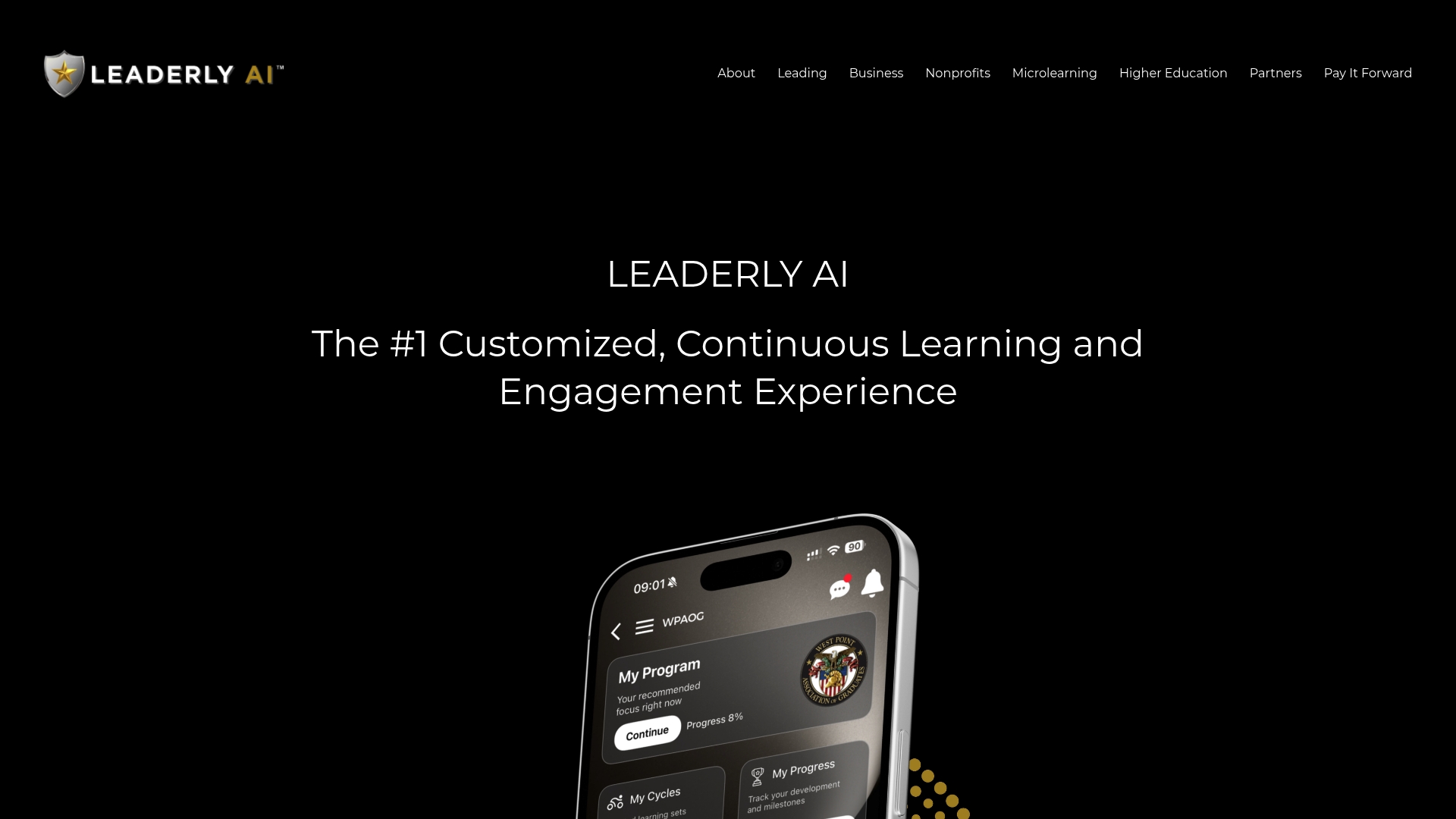
If you are planning a pilot for new hires, emerging leaders or students, explore Leaderly AI and see how a journey could be set up for your group. Pricing is tiered by organization size or user count, so the team can scope it with you.
FAQ
What is a personal learning journey?
It is the ongoing process of gaining knowledge, skills and new habits through experience and deliberate practice. The Pew Charitable Trusts describes it as personal, purposeful and powerful. At work, an organization supports it by giving each person a path matched to their role, goals and progress.
What is a personalized learning pathway?
It is a route through content whose sequence is selected or adjusted for an individual based on prior knowledge, goals or preferences. Two people entering the same program can follow different routes. Skipping what you already know and getting practice matched to your goal are the defining features.
How do I create a personalized onboarding path?
Start with a shared foundation for everyone, then add a layer by role and department. Set milestones, such as 30, 60 and 90 days, and make a manager accountable for each checkpoint. Spelman College's year-long program follows this structure, and Duke's uses a 90-day learning plan with customizable paths.
How is a learning journey different from a course?
A course is a fixed sequence everyone completes in the same order. A journey adapts: it starts with a profile or diagnostic, changes based on progress, includes practice on the job and checks for demonstrated ability before moving on.
How do I know a learning journey is working?
Look past completion rates. Track behavior change, manager observations, practice logs and performance indicators tied to the outcome you chose at the start. Compare those results against the baseline you set before launch.
Sources
- RAND: How Does Personalized Learning Affect Student Achievement?
- The Pew Charitable Trusts: Personal Learning
- NEBHE: Learning from Everywhere
- Learnstream: Personalized Learning Pathways
- Bill & Melinda Gates Foundation: Early Progress
- Ohio Department of Education and Workforce: Personalized Learning
- Education Elements: The Core Four of Personalized Learning
- EFMD: Capgemini and emlyon, Making Leaders
- EFMD: NatWest Group and IMD
- CUPA-HR: How Spelman College Is Using AI to Transform Onboarding
- Frontiers in Medicine: On-demand onboarding for clinical research professionals
- Training Magazine: L&D Best Practices (January 2025)
- Journal study: The Impact of Learning Analytics in Organizations
- Training Industry: Personalized Learning, Why Digital Training Falls Short