
Mentorship is defined as a structured relationship in which an experienced leader provides guidance, knowledge transfer, and psychosocial support to help another professional develop leadership capabilities. The role of mentorship in leadership growth extends well beyond career advice. Regression analysis confirms that mentorship quality is a significant predictor of leadership competency scores, including strategic thinking, emotional intelligence, influence, and teamwork. These are not soft benefits. They are measurable outcomes that separate leaders who plateau from those who keep advancing. Professionals who engage in high-quality mentoring relationships build the inner confidence and outer skills that formal training rarely delivers on its own.
How does mentorship cultivate key leadership competencies?
Mentorship directly shapes the leadership skills that matter most in real organizations. Transformational leadership theory explains why: effective mentors use role modeling, intellectual stimulation, and individualized support to help mentees grow. These are not abstract concepts. When a mentor challenges a mentee to think through a difficult decision rather than handing over the answer, that is intellectual stimulation in practice.
The competencies that mentorship builds most reliably include:
- Strategic thinking. Mentors expose mentees to complex, real-world decisions and help them see patterns across situations.
- Emotional intelligence. Regular, honest feedback from a trusted mentor builds self-awareness at work and the ability to read others accurately.
- Communication. Mentors model how to frame difficult conversations, give feedback, and build trust with teams.
- Influence. Watching a skilled leader navigate organizational politics teaches mentees how to move people without authority.
Social learning theory reinforces this. Leaders learn by observing credible role models, not just by reading frameworks. A mentor who demonstrates calm under pressure teaches that behavior more effectively than any workshop. The mentee internalizes it, then replicates it in their own leadership moments.
Pro Tip: Ask your mentor to walk you through a real decision they made under pressure. The reasoning behind their choice teaches more than any debrief of the outcome.

Mentorship also builds emotional intelligence in leaders through repeated, candid dialogue. A mentor who names what they observe, "You shut down when challenged in that meeting," gives a mentee data they cannot get anywhere else. That kind of feedback, delivered with care, accelerates self-awareness faster than annual reviews or 360-degree surveys.
What distinguishes mentorship from coaching in leadership development?
Mentorship and coaching are complementary, but they are not the same thing. Confusing them leads organizations to underinvest in one or the other, and both gaps show up in leadership quality over time.
Mentorship offers long-term career guidance and psychosocial support, while coaching provides goal-oriented feedback focused on performance improvement. The distinction matters because leaders need both at different stages and for different challenges.
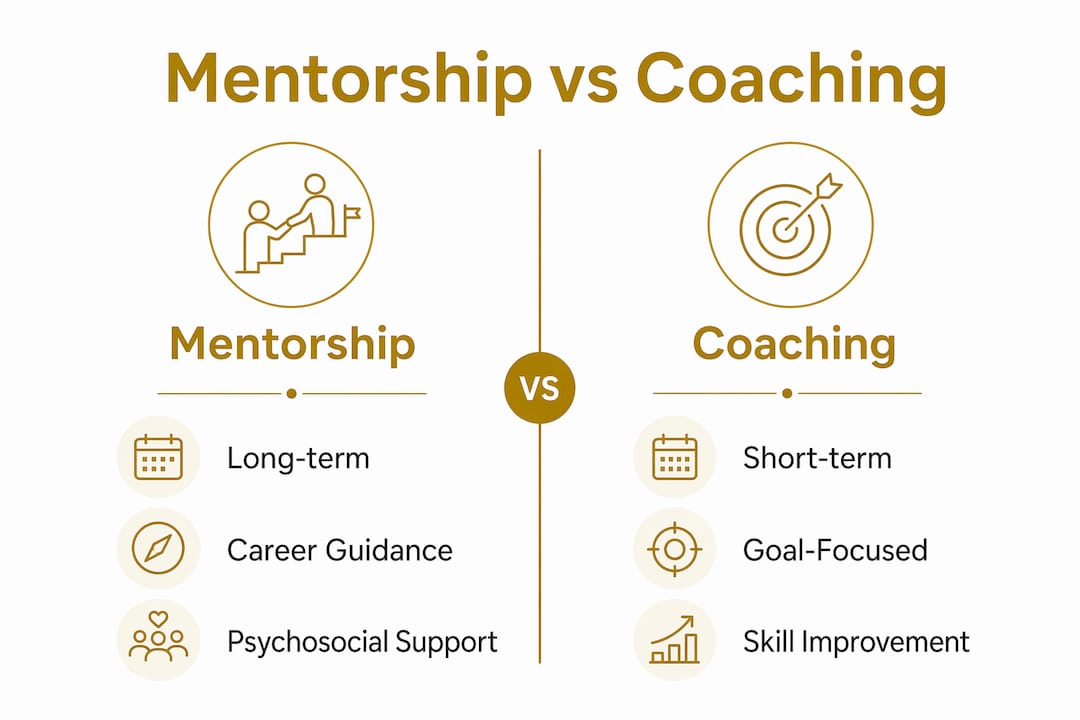
| Dimension | Mentorship | Coaching |
|---|---|---|
| Time horizon | Long-term relationship | Short-term engagement |
| Focus | Career, identity, and values | Specific skills or goals |
| Direction | Mentor-led wisdom sharing | Coach-facilitated reflection |
| Psychosocial support | Central to the relationship | Secondary to performance |
| Outcome | Leadership identity and confidence | Measurable behavior change |
A mentor helps a rising leader figure out who they want to become. A coach helps that same leader get better at a specific behavior, like running more effective meetings or delegating with clarity. The benefits of coaching are real and well-documented, but coaching without mentorship leaves the deeper questions of purpose and identity unaddressed.
Organizations that institutionalize both mentoring and coaching gain a compounding advantage. Coaching sharpens specific skills. Mentorship builds the leader underneath those skills. Together, they create professionals who perform well and keep growing.
What are the mutual benefits of mentorship for mentors and mentees?
Mentorship is not a one-way transfer. The research is clear that both parties develop through the relationship.
Peer mentors show significant improvements in leadership behaviors when they take on active guidance roles. Mentees gain measurable gains in self-efficacy. That bidirectional growth is what makes mentorship one of the most efficient leadership development tools available.
For mentees, the primary gains include:
- Self-efficacy. Consistent encouragement from a credible mentor builds the belief that you can handle harder challenges.
- Professional confidence. Knowing an experienced leader sees your potential changes how you carry yourself in high-stakes situations.
- Expanded networks. Mentors open doors to relationships and opportunities that would take years to build independently.
For mentors, the benefits are equally concrete. Mentors enhance organizational awareness, communication skills, and leadership initiative through the act of guiding others. Explaining your reasoning forces clarity. Listening to a mentee's perspective surfaces blind spots you did not know you had. Senior leaders who mentor regularly often report that the relationship keeps them connected to ground-level realities in their organizations.
Upward mentorship, where a junior professional mentors a senior leader on emerging trends or new technologies, adds another layer. It challenges the assumption that mentorship only flows downward and creates genuine mutual respect.
Pro Tip: Set a shared agenda at the start of each mentoring session. Both mentor and mentee should arrive with one question they want to think through together. That structure prevents the relationship from drifting into casual conversation.
How can aspiring leaders implement effective mentorship relationships?
Effective mentorship does not happen by accident. Organizations that leave mentorship to chance risk stagnant leadership pipelines. Professionals who want to benefit from mentorship need to build and maintain these relationships with intention.
-
Identify what you actually need. Before approaching a potential mentor, get specific. Are you trying to develop strategic thinking, navigate a career transition, or build confidence in executive settings? Clarity about your goal helps you find the right person and have a productive first conversation.
-
Choose mentors aligned with your goals, not just your admiration. A leader you admire is not automatically the right mentor for your specific development needs. Look for someone who has navigated the challenges you are facing, not just someone who has achieved a title you want.
-
Build psychological safety into the relationship. The most productive mentoring conversations happen when you can be honest about your fears and failures. Growth-centered mentorship addresses psychological barriers like imposter syndrome, not just skill gaps. A mentor who only hears your wins cannot help you with your real obstacles.
-
Show up prepared and consistent. Mentors invest more in mentees who take the relationship seriously. Come to each session with specific questions, updates on what you tried since the last meeting, and honest reflection on what worked and what did not.
-
Revisit your goals regularly. Leadership development is not linear. What you need from a mentor at the start of a new role differs from what you need two years in. Schedule a quarterly check-in to assess whether the relationship is still addressing your most pressing growth areas.
A concrete example: a mid-level manager preparing for a first VP role might work with a mentor who has made that transition before. The mentor helps her think through how to shift from doing to directing, how to build credibility with a new peer group, and how to handle the isolation that often comes with senior roles. That kind of guidance cannot be replicated in a training course. It requires a relationship built on trust and time.
Mentor leadership is not a passive role. The best mentors ask hard questions, challenge comfortable assumptions, and hold mentees accountable to the goals they set for themselves.
Key Takeaways
Mentorship is the most direct path to building leadership competencies because it combines knowledge transfer, psychosocial support, and real-time feedback in a single, sustained relationship.
| Point | Details |
|---|---|
| Mentorship predicts leadership competency | Research confirms mentorship quality is a significant predictor of strategic thinking, emotional intelligence, and influence. |
| Mentorship and coaching serve different needs | Mentorship builds leadership identity over time; coaching targets specific, measurable behavior change. |
| Both parties develop through mentorship | Mentors gain organizational awareness and leadership behaviors; mentees build self-efficacy and professional confidence. |
| Growth-centered mentorship addresses psychology | Effective mentoring goes beyond skills to tackle imposter syndrome and other inner barriers to leadership. |
| Intentional structure drives results | Shared agendas, clear goals, and regular check-ins prevent mentoring relationships from losing momentum. |
Why mentorship is the infrastructure leaders cannot afford to skip
C-suite leaders increasingly depend on mentorship as a form of strategic infrastructure, not a nice-to-have perk. That framing resonates with me because it names something I have watched play out repeatedly. The leaders who struggle most in high-pressure roles are not the ones who lack technical skills. They are the ones who have no trusted space to think out loud.
The most common mistake I see is treating mentorship like consultancy. Professionals approach a mentor expecting answers, and mentors sometimes oblige by giving them. That is the wrong dynamic. Agenda-free counsel is what makes executive mentoring genuinely useful. A mentor who has no stake in your decision can help you think more clearly than any advisor who does.
The second mistake is limiting mentorship to skill development. The leaders who grow the most are the ones whose mentors help them work through the psychological weight of leadership: the self-doubt, the loneliness at the top, the fear of being exposed as less capable than people assume. Addressing imposter syndrome through mentorship is not a therapy substitute. It is a practical leadership intervention.
My honest advice: do not wait until you feel stuck to find a mentor. Build those relationships before you need them, and invest in them the same way you invest in any other professional skill. The return is compounding.
— Drew
How Leaderlyapp supports your leadership development
Leadership growth through mentorship requires consistent practice, honest reflection, and the right tools to reinforce what you learn between mentoring sessions.
Leaderlyapp delivers personalized microlessons built on behavioral science, helping professionals build the habits that mentorship conversations point toward. Whether you are working on people-centric leadership skills or deepening your self-awareness as a leader, Leaderlyapp adapts to your specific growth stage. The platform uses machine learning to evolve with you, so the content stays relevant as your leadership challenges change. Mentorship gives you direction. Leaderlyapp gives you the daily practice to get there.
FAQ
What is the role of mentorship in leadership growth?
Mentorship accelerates leadership growth by providing guidance, psychosocial support, and knowledge transfer that build competencies like strategic thinking and emotional intelligence. Research confirms mentorship quality is a significant predictor of leadership competency scores.
How does mentorship differ from coaching for leaders?
Mentorship focuses on long-term career guidance and identity development, while coaching targets specific, measurable performance goals. Both are valuable, and organizations that use both together build stronger leadership pipelines.
Can mentors also benefit from mentoring relationships?
Mentors gain improved organizational awareness, communication skills, and leadership behaviors through active guidance roles. Research on peer mentoring shows sustained leadership behavior improvements in those who take on mentor responsibilities.
How do I find the right mentor for leadership development?
Choose a mentor who has navigated the specific challenges you are facing, not just someone who holds a title you admire. Clarity about your development goals before the first conversation makes the relationship far more productive.
What makes a mentorship relationship effective for leadership growth?
Effective mentoring relationships are built on trust, psychological safety, and a shared agenda. Growth-centered mentorship addresses both skill gaps and psychological barriers like imposter syndrome, producing more resilient and authentic leaders.