
Coaching is the most direct path for emerging leaders to build the self-awareness, decision-making ability, and team management skills that formal training consistently fails to deliver. Understanding why emerging leaders need coaching starts with a hard fact: only 44% of managers globally receive formal management training. That gap leaves the majority of new leaders to figure out leadership on their own, often at the cost of their teams and their careers. Coaching fills that gap with personalized, evidence-based support that accelerates real behavior change. Leaderlyapp is built on exactly this principle, using behavioral science and machine learning to deliver that development at scale.
Why emerging leaders need coaching to close critical skill gaps
New leaders face a specific set of challenges that classroom training and online courses rarely address. The transition from individual contributor to manager is one of the most psychologically demanding shifts in any career. You are no longer measured by your own output. You are measured by the output of people you lead.
Only 1 in 10 people have natural management talent. That means the overwhelming majority of new managers step into leadership roles without the instincts the role demands. Coaching provides the structured support that compensates for this gap.

One of the most common traps new leaders fall into is the "Expert Mindset." This is the tendency to keep doing the technical work yourself because you are good at it, rather than delegating and developing your team. Coaching addresses this mindset shift directly, providing accountability and a safe space to practice delegation and empowerment before the stakes get too high.
Traditional leadership training also has a structural problem. A two-day seminar teaches concepts. It does not change behavior. Leadership development integrated into daily work produces far better results than one-off programs. Coaching is the mechanism that makes that integration possible.
- Expert Mindset trap: New managers default to doing rather than leading, which limits team growth.
- Delegation deficit: Without coaching, most new leaders struggle to let go of tasks they used to own.
- Feedback avoidance: New leaders often avoid giving direct feedback because they lack the confidence and language to do it well.
- Boundary setting: Without guidance, new managers frequently overwork themselves and burn out within the first year.
- Peer-to-manager transition: Managing former peers is one of the most emotionally complex challenges coaching helps leaders navigate.
Pro Tip: Before your first coaching session, write down three specific situations at work where you felt stuck or unsure. Concrete scenarios give your coach the raw material to deliver real, targeted guidance.
How does coaching improve leadership skills and organizational outcomes?
The evidence for coaching's impact is specific and measurable. Coaching produces statistically significant gains in cognitive behaviors like goal-setting and complex skill adoption, outperforming traditional leadership seminars on nearly every metric. That matters because behavior change, not knowledge transfer, is what determines whether a new leader succeeds.
The organizational benefits extend well beyond the individual leader. Leadership quality accounts for 70% of the variance in employee engagement across teams. When leaders improve, their entire team improves with them.
"Leadership development that includes coaching does not just build better leaders. It builds better organizations. Turnover drops, culture strengthens, and performance improves at every level of the team."
Turnover drops by up to 29 percentage points after targeted leadership development. For any organization calculating the cost of replacing employees, that number represents a significant financial return. Coaching is not a soft benefit. It is a business result.
| Outcome | Impact |
|---|---|
| Employee engagement | Leadership quality drives 70% of engagement variance |
| Organizational culture | 79% of organizations report culture improvement with leadership development |
| Job performance | 68% of coached leaders report measurable performance gains |
| Turnover reduction | Up to 29 percentage points drop after leadership interventions |
| Burnout reduction | Coaching decreases burnout symptoms in randomized trials |
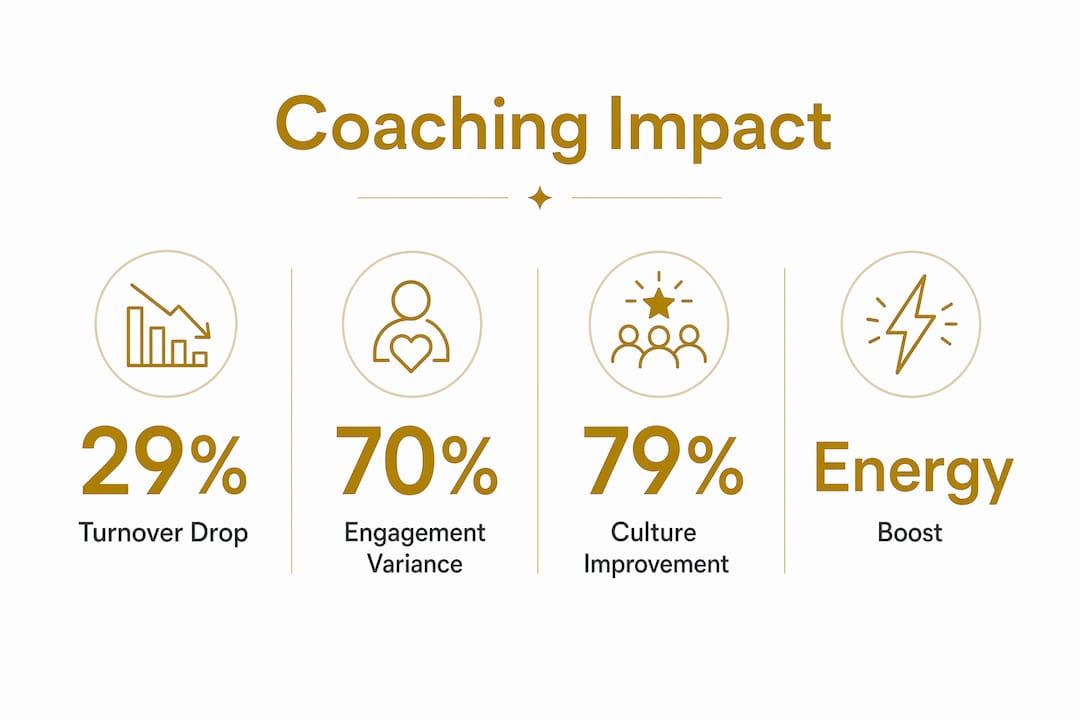
79% of organizations report improved organizational culture when leadership development is offered broadly. Culture is not abstract. It shows up in how teams communicate, how conflicts get resolved, and how quickly new employees get up to speed. Coaching drives all of those outcomes.
Coaching also addresses burnout directly. Coaching reduces burnout symptoms and increases leader energy by supporting boundary setting and recovery. New leaders who learn to protect their capacity early in their careers perform better and stay longer.
What makes coaching different from other leadership development methods?
Coaching is personalized in a way that no seminar, course, or book can replicate. A coach works with your specific challenges, your team dynamics, your communication patterns, and your career goals. That specificity is what produces lasting change.
The mechanism behind coaching's effectiveness is an iterative cycle: act, reflect, adjust, repeat. Coaching bridges theoretical frameworks to moment-by-moment behavior shifts. You do not just learn what good leadership looks like. You practice it, get feedback, and refine it in real time.
Accountability is the other factor that separates coaching from passive learning. When you commit to a behavioral goal with a coach, you are far more likely to follow through. Coaching is most effective when behavioral goals are specific and the leader is motivated and supported by their organization. That combination of specificity and accountability is what produces the results that training alone cannot.
Pro Tip: Treat your coaching goals like performance targets. Write them down, assign a timeline, and review your progress at the start of every session. Vague intentions produce vague results.
The benefits of coaching for leaders also include a confidential space to process difficult situations. New leaders rarely have a safe outlet to admit uncertainty about a decision or a team conflict. A coach provides that outlet without judgment, which makes honest reflection possible.
Different coaching formats serve different needs. Peer coaching, executive coaching, and platform-based microcoaching each address specific development stages. Understanding the types of coaching available helps emerging leaders choose the format that fits their current challenges and organizational context.
How can emerging leaders get the most from coaching?
Getting real value from coaching requires active participation, not passive attendance. The leaders who grow fastest treat coaching as a practice, not a service.
-
Bring specific scenarios to every session. Vague topics produce vague advice. Describe a real conversation that went wrong, a decision you are wrestling with, or a team dynamic that is creating friction. Concrete leadership challenges give your coach the material to deliver guidance that actually applies to your situation.
-
Practice new skills between sessions. Coaching is not a weekly conversation. It is a weekly commitment to try something different. Actively practicing new behaviors with feedback loops between sessions is what separates leaders who grow from those who just show up.
-
Use your coach as a confidential sounding board. New leaders often feel they must project confidence at all times. Your coach is the one relationship where honesty about uncertainty is an asset, not a liability. Use it.
-
Shift your identity, not just your skills. The deepest work in coaching is not learning new techniques. It is letting go of the identity of the expert and building the identity of the leader. That shift requires time, reflection, and support. Coaching provides all three.
-
Measure your progress. Track the specific behaviors you are working on. Note what changed in a team meeting, a feedback conversation, or a difficult decision. Progress that is not measured tends to stall. Feedback mechanisms built into your coaching practice keep momentum going between sessions.
Nearly 50% of organizations now offer leadership development programs at all employee levels, not just for executives. That shift reflects a growing recognition that leadership skills need to be built early. Emerging leaders who access coaching now build a compounding advantage over peers who wait.
Developing leadership skills is not a one-time event. The leaders who sustain growth treat development as an ongoing practice, not a box to check.
Key Takeaways
Coaching is the single most effective tool for emerging leaders to close the gap between formal training and the real demands of managing people and driving results.
| Point | Details |
|---|---|
| Training gap is real | Only 44% of managers receive formal training, making coaching a critical supplement. |
| Behavior change over knowledge | Coaching produces measurable gains in goal-setting and complex skills that seminars cannot match. |
| Organizational impact is significant | Leadership quality drives 70% of employee engagement variance and reduces turnover by up to 29 points. |
| Personalization drives results | Coaching tailored to specific workplace challenges produces faster and more lasting behavior change. |
| Active practice is required | Leaders who practice new skills between sessions and bring real scenarios get the highest return from coaching. |
The case for coaching early, not eventually
I have worked with enough emerging leaders to know that the ones who wait for coaching are the ones who pay for it later. Not in money. In lost team trust, in avoidable conflicts, and in the slow erosion of confidence that comes from leading without a feedback loop.
The most common mistake I see is treating coaching as remedial. Leaders assume coaching is for people who are struggling. That belief costs them years of development. The leaders who grow fastest are the ones who seek coaching before they need it, when they are still forming their habits and their identity as a manager.
The second mistake is treating coaching as optional. Organizations that offer coaching only to senior executives are leaving their biggest development opportunity on the table. The habits that define a leader's style are set in the first two years of management. Coaching during that window produces compounding returns that no amount of later intervention can fully replicate.
My honest advice: do not wait for your organization to offer coaching. Seek it out, build the case for it, and treat it as the professional investment it is. The leaders who do this consistently are the ones who build teams that perform, retain talent, and grow.
— Drew
Build your leadership foundation with Leaderlyapp
Emerging leaders who want to close the gap between where they are and where they need to be have a direct path forward with Leaderlyapp.
Leaderlyapp delivers personalized microlessons grounded in behavioral science, designed to build leadership habits in the flow of daily work rather than through one-off training events. The platform adapts to each leader's specific development stage, making it practical for new managers who need targeted support without a heavy time commitment. Whether you are working on delegation, feedback, or cultivating people-centric leadership, Leaderlyapp gives you the structure and consistency that coaching strategies for emerging leaders require to produce real results.
FAQ
Why do emerging leaders need coaching specifically?
Emerging leaders face a unique transition from individual contributor to manager that formal training rarely prepares them for. Coaching provides personalized, accountability-driven support that accelerates the behavior change this transition requires.
How does coaching help new leaders with delegation?
Coaching addresses the Expert Mindset trap directly, giving new managers structured accountability to practice delegation and empowerment before high-stakes situations arise. This is one of the most common and consequential gaps coaching fills for first-time managers.
What is the organizational impact of leadership coaching?
Leadership quality drives 70% of the variance in employee engagement, and organizations that invest in leadership development report culture improvements and turnover reductions of up to 29 percentage points. The return extends well beyond the individual leader.
How often should emerging leaders engage in coaching?
Coaching is most effective when it is consistent and integrated into daily work rather than delivered in isolated sessions. Regular sessions with active skill practice between meetings produce the strongest and most lasting results.
Is coaching only for struggling leaders?
Coaching is most valuable when leaders are forming their habits early in their careers, not only when performance problems appear. The leaders who access coaching proactively build stronger foundations and advance faster than those who treat it as a last resort.