
Most teams pay between $4 and $12 per learner per month for a SaaS microlearning platform, $40,000 to $80,000 to build a minimum viable custom platform, and about three thousand six hundred dollars to up to about eighteen thousand dollars per finished hour of custom content depending on production polish. If your organization has fewer than roughly 1,000 monthly active learners or no proprietary AI requirement, a SaaS subscription almost always beats building your own. The sections below break down every cost driver, from per-seat pricing to hidden three-year expenses.
TL;DR:
- SaaS microlearning platforms cost organizations between $4 and $8 per user monthly for small to medium teams and nearly the same for large deployments, excluding added features.
- The total cost of ownership includes licensing, content creation, integrations, hosting, and migration, with ongoing AI inference costs in personalized platforms possibly increasing expenses significantly.
- Per-seat pricing remains stable up to 500 users but jumps for enterprise contracts with add-ons like white-labeling, AI, and advanced analytics, requiring detailed, fully-loaded quotes for accurate budgeting.
Table of Contents
- How Much Does Microlearning Cost? A Quick-Reference Table
- What Pricing Models Should You Expect From Vendors?
- What Are Typical Per-Seat and Enterprise Pricing Ranges?
- How Much Does It Cost to Produce Microlearning Content?
- Should You Build a Custom Platform or Buy a SaaS Subscription?
- What Should Be in Your Microlearning Budget Request?
- What Questions Should You Ask Vendors Before Signing?
- What Actually Drives Microlearning ROI
- How Leaderlyapp Fits Your Leadership Development Budget
- Sources
- FAQ
How Much Does Microlearning Cost? A Quick-Reference Table
Before you walk into a vendor call or a budget meeting, it helps to see every major pricing path side by side. The table below compresses the ranges L&D teams actually encounter, from a single purchased module to a fully custom-built platform.
| Option | Typical Cost | Best For |
|---|---|---|
| One-time mini-module | between seven and under one hundred dollars per module | Small teams testing a single skill or compliance topic |
| Consumer subscription app | between ten and twenty-five dollars per month for individuals | Individual learners or very small teams |
| SaaS per-seat (small team) | $4–$8 per user/month | Teams under 500 seats needing fast deployment |
| Enterprise SaaS per-seat | $5–$8+ per user/month, custom quotes above 500 seats | Larger organizations needing SSO, analytics, white-labeling |
| Custom-build MVP | tens of thousands upfront | Organizations with unique IP or compliance needs at scale |
| Custom-build full platform | over one hundred thousand dollars upfront | Enterprises with 1,000+ monthly active learners |
Four things jump out once you line these up. First, per-seat SaaS pricing rarely moves much between a 50-person team and a 400-person team, but it jumps sharply past the 500-seat mark when vendors start quoting custom enterprise contracts. Second, content polish, not run time, is what pushes a module from about three thousand six hundred dollars to up to about eighteen thousand dollars. Third, a custom build only pencils out once your learner count and feature list justify the fixed cost. Fourth, integrations (SSO, HRIS, analytics exports) are almost never included in the advertised per-seat rate and deserve their own line item in your budget.
What Pricing Models Should You Expect From Vendors?
Microlearning vendors sell through five recognizable structures, and each one changes how your finance team should think about the contract.
- Subscription (flat monthly/annual fee): Predictable, but you pay the same whether five people use it or fifty, which makes it a poor fit for organizations with fluctuating headcount.
- Per-seat pricing: Scales with your actual user count and is the dominant model for B2B microlearning platforms, typically billed monthly or annually with volume discounts kicking in above a few hundred seats.
- Freemium: Free tier for individual learners or small pilots, with paid tiers unlocking admin dashboards, reporting, or content libraries. Useful for a proof of concept before committing budget.
- One-time purchase: A single payment for a module or content pack, priced anywhere from $7 to $97, common in consumer-facing microlearning but rare for enterprise platforms that need ongoing content refreshes.
- Hybrid/tiered: A base subscription plus paid add-ons (advanced analytics, AI coaching, white-labeling), which is where most enterprise deals actually land once negotiations start.
For corporate buyers, the model you choose affects more than the invoice. Per-seat models feel fairer at first glance, yet they create administrative overhead: someone has to track who's an active seat and who isn't, especially with seasonal or contractor workforces. The vendors who win renewal conversations tend to keep their primary pricing dead simple and layer optional add-ons on top, rather than forcing buyers into a tangle of tiers before anyone has proven the platform works for their team.
What Are Typical Per-Seat and Enterprise Pricing Ranges?
Vendor conversations go faster when you already know the going rate. Small to midsize teams typically see quotes in the $4 to $8 per user per month range for core microlearning functionality: content delivery, basic tracking, and mobile access.
Enterprise pricing works differently. Case studies and vendor disclosures commonly show enterprise per-seat contracts starting near $5 to $8 per user per month for deployments above 500 seats, but that floor moves fast once you add features. Three additions reliably push you into custom enterprise quoting:
- White-labeling and branded UI: Removing vendor branding and matching your company's visual identity typically adds a flat platform fee on top of per-seat costs.
- AI-driven personalization: Adaptive learning paths, AI coaching, or generative content features carry their own licensing layer, often priced separately from the base seat fee.
- Advanced analytics and integrations: SSO, HRIS syncing, and custom reporting dashboards are almost always enterprise-tier add-ons rather than standard inclusions.
Stat callout: Deployments above 500 seats routinely see per-seat pricing anchor near $5 to $8 monthly, but that figure excludes AI features and white-labeling, which push the effective cost well above the advertised rate once contracts are signed.
Pro Tip: Ask every vendor to quote your base seat price and your fully-loaded price (with the integrations and analytics you actually need) as two separate numbers. The gap between them tells you more about total cost than either figure alone.
When you're comparing quotes, cross-reference the vendor's public pricing page against what current customers report on review platforms like G2 or Capterra. Advertised rates and negotiated rates diverge more often than vendors admit.
How Much Does It Cost to Produce Microlearning Content?
Content production is where microlearning cost estimates go wrong most often, because buyers price by run time instead of production complexity. A five-minute module and a fifteen-minute module can cost nearly the same if the shorter one has branching scenarios and the longer one is a narrated slideshow.
Industry benchmarks group custom development into three practical tiers based on interactivity, not length:
| Production Tier | What's Included | Cost per 5–15 Minute Module |
|---|---|---|
| Basic | Narrated slides, simple quiz, minimal branding | Roughly about three thousand six hundred dollars |
| Interactive | Branching scenarios, custom graphics, knowledge checks | Mid-range, typically several thousand dollars above basic |
| Advanced simulation | Custom animation, decision trees, adaptive feedback | Up to roughly up to about eighteen thousand dollars |
Those figures break down into recognizable line items: scriptwriting, professional voiceover, custom media or animation, interactivity programming, quality assurance passes, and accessibility compliance (captions, screen reader compatibility, color contrast checks). Skipping accessibility work isn't cheaper, either. It just moves the cost downstream into remediation, legal risk, or a lower completion rate among learners who can't use the content as built.
The in-house versus outsourced decision usually comes down to volume and cadence. If you need one or two modules a quarter, outsourcing to a freelance instructional designer or boutique studio makes sense; you're not paying to staff a permanent production team for occasional work. If you're refreshing content monthly across multiple business units, an in-house designer or small team often pays for itself within a year, since agency markups on repeat work add up fast. Market commentary in the past year points to rising demand for polished, brand-aligned visuals in onboarding and upskilling content, which is nudging average project quotes upward regardless of which route you choose.
Should You Build a Custom Platform or Buy a SaaS Subscription?
The honest answer is: buy, unless your numbers say otherwise. Running a three-year total cost of ownership (TCO) comparison is the only way to know which side of that line you're on.
Four variables drive the math: monthly active learners (MAL), infrastructure and maintenance, migration costs if you're switching from an existing system, and AI inference costs if personalization or coaching features are part of the platform. That last one catches teams off guard. Personalized micro-coaching features run on ongoing AI inference and storage costs that scale with usage, not a flat license fee, so a platform that looks affordable at launch can get expensive as adoption grows.
Here's how the scenarios typically play out over three years:
- SaaS at 200 seats, $6/seat/month: roughly forty thousand dollars over three years, plus content and integration costs. No upfront capital outlay.
- Custom MVP build: tens of thousands upfront, plus several thousand to tens of thousands per year in infrastructure and maintenance, landing between $64,000 and $200,000 over three years depending on scale.
- Full custom platform: over one hundred thousand dollars upfront, plus ongoing costs, easily clearing hundreds of thousands of dollars over three years.
Break-even analyses generally show custom builds only win on three-year TCO once you're above roughly 1,000 monthly active learners, or when proprietary AI or deep brand integration is non-negotiable for legal or competitive reasons. Below that threshold, the fixed cost of building rarely gets absorbed fast enough to beat a subscription. Before you sign off on either path, make sure your TCO includes data migration, staff training time on the new system, and the refresh cycle for content that ages out within 12 to 18 months.
What Should Be in Your Microlearning Budget Request?
A budget request that survives finance review itemizes every cost category instead of presenting one bundled number. Use this as a starting checklist:
- Platform licensing — per-seat or subscription fee, quoted for your actual headcount plus 10% to 15% growth buffer.
- Content production — number of modules multiplied by production tier multiplied by expected revision rounds (budget at least two rounds per module).
- Localization — per-language cost if you operate across regions; this is frequently forgotten until launch.
- Hosting and infrastructure — especially relevant for custom builds or platforms with heavy media assets.
- Integrations — SSO, HRIS, analytics exports; get a fixed quote, not a "contact sales" placeholder.
- QA and accessibility review — a separate line item, not folded into production.
- Vendor services — implementation support, onboarding, and customer success fees some vendors bill separately.
A simple sizing formula helps here: multiply the number of modules by your chosen production tier's per-module cost, then multiply by expected revision rounds. That gives you a defensible base number before contingency.
Content that ages out unrefreshed is the most common reason microlearning budgets blow past their first-year estimate.*
For a broader view of how leadership-specific training budgets typically get sized as a share of payroll, it's worth reviewing how much organizations budget for leadership training relative to overall headcount costs.
What Questions Should You Ask Vendors Before Signing?
The fastest way to expose a vendor's real pricing structure is to ask questions that force specificity instead of accepting a glossy sales deck.
- How exactly is a "seat" defined: named user, active monthly user, or concurrent login?
- What happens if we exceed our contracted seat count mid-term, and what's the overage fee?
- Can we export our content and learner data if we switch platforms, and what does migration support cost?
- What's the SLA for uptime and support response time, and what's the penalty if you miss it?
- Who owns the data we generate, and can we use it for other internal analytics tools?
- What's on your AI feature roadmap, and is it included in our current tier or a future upsell?
Red flags worth walking away from: vendors who won't quote a fully-loaded price upfront, contracts that auto-renew without a 60-day cancellation window, and "unlimited" plans with usage caps buried in the fine print. Before committing budget, request a pilot or proof-of-concept period, ideally 30 to 60 days, with a small user group and clear success metrics defined in writing before you start. If a vendor resists a pilot, that's information too. Cross-check whatever they quote against user-reported experiences on Capterra, where actual customers often reveal pricing details that never make it onto a sales call.
What Actually Drives Microlearning ROI
Most cost conversations focus on the wrong number. Everyone wants to know the price per module or the per-seat rate, but the return on microlearning rarely comes from spending less per finished hour. It comes from what happens after the module gets built.
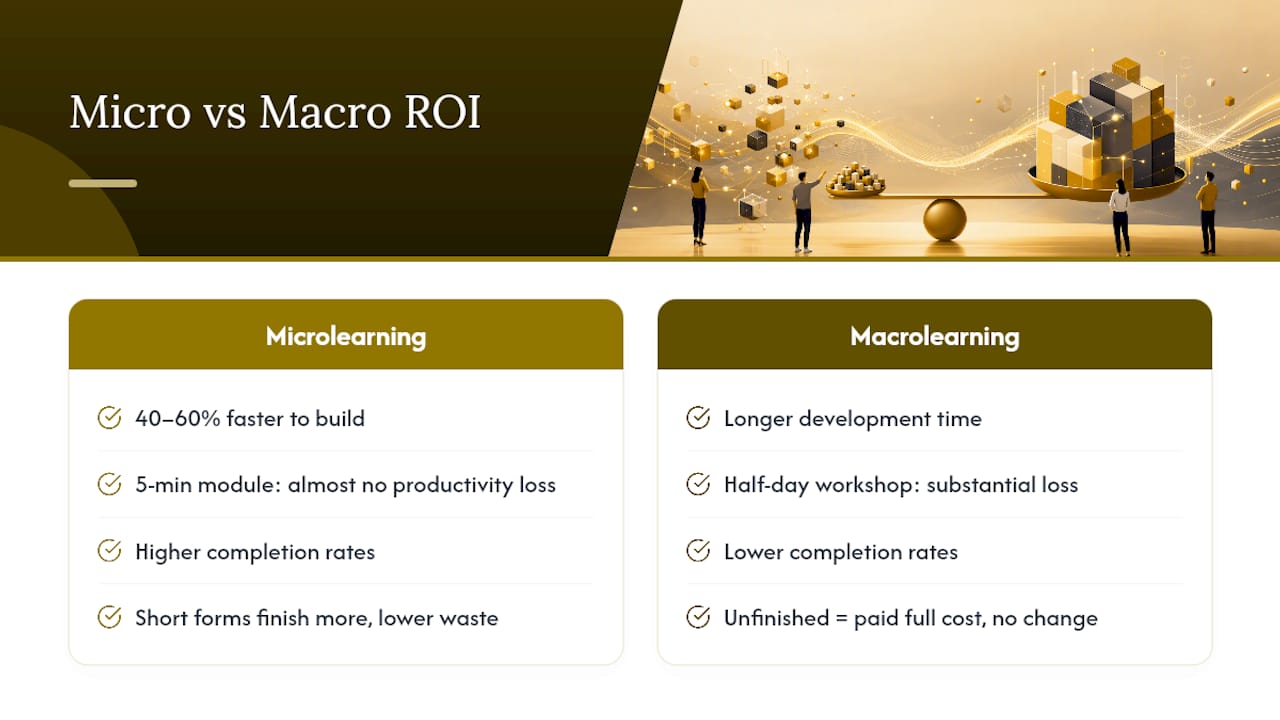
Development time savings of 40% to 60% compared to traditional e-learning are real, and they matter for planning cycles. But the bigger financial story is opportunity cost. A five-minute module pulled up between meetings costs an organization almost nothing in lost productivity, compared to pulling an employee out of the office for a half-day workshop. Completion rates follow the same pattern: shorter, mobile-friendly content gets finished at higher rates than long-form courses, and unfinished training is the most expensive kind, because you paid full production cost for zero behavior change.
That reframes the buying decision. A platform's real value shows up in whether people actually use it consistently, not in how many features are listed on the pricing page. Leaderlyapp's approach leans into that by prioritizing mobile delivery, spaced reminders, and built-in assessments before layering on visual polish, since a beautifully produced module nobody finishes delivers zero return regardless of what it cost to build. That priority order (completion mechanics first, aesthetics second) is the single biggest lever most budget conversations miss. For a deeper look at how microlearning compares to macrolearning for skill retention, it's worth reading before finalizing a content strategy.
— Drew
How Leaderlyapp Fits Your Leadership Development Budget
If you're comparing per-seat SaaS quotes against a custom build, Leaderlyapp gives you a third path: a subscription platform built specifically for leadership development, priced for organizations that need to scale personalized coaching without the six-figure upfront cost of a custom build.
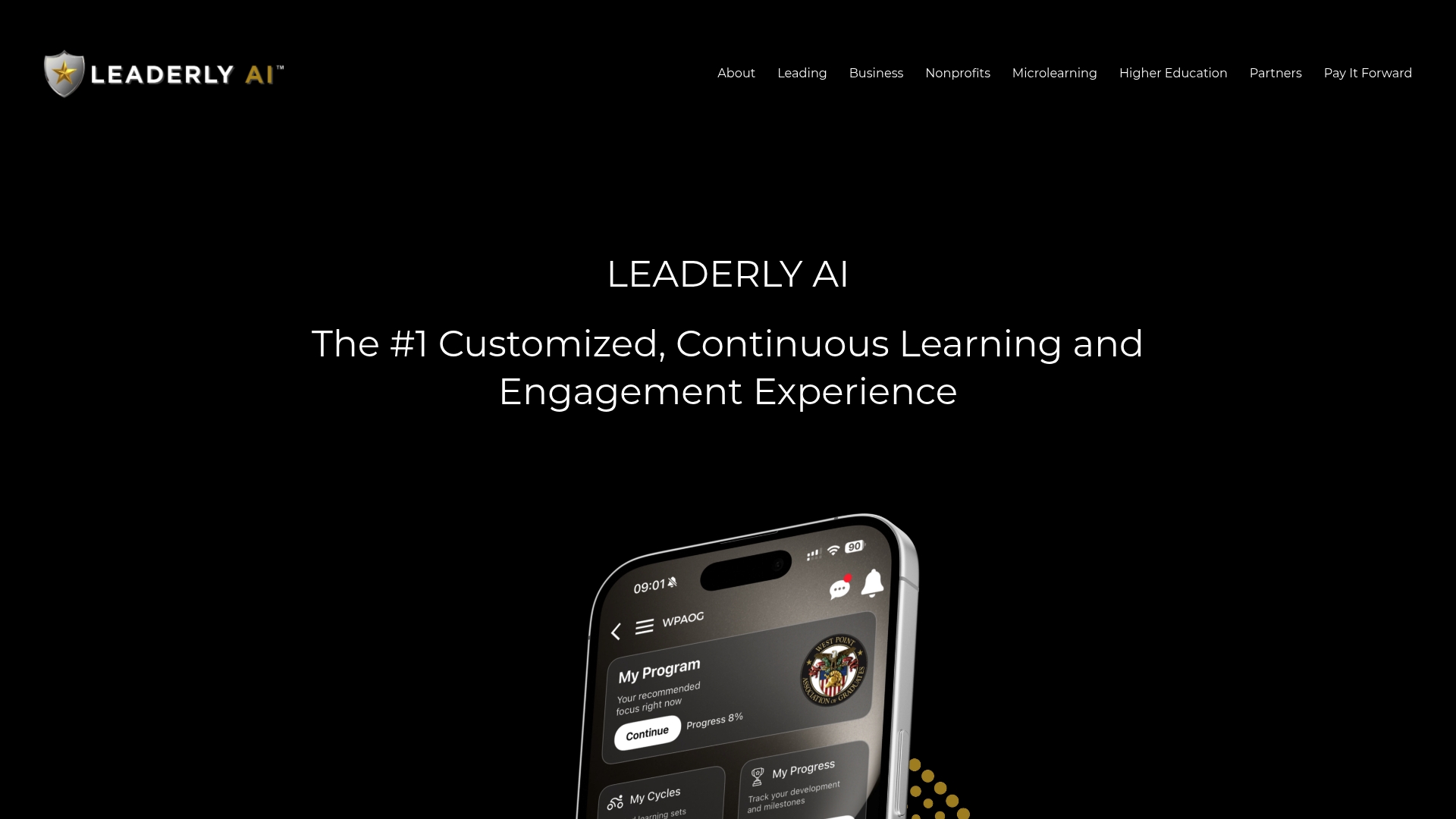
There are subscription platforms designed to fit scalable needs across corporate, nonprofit, or educational teams, sometimes including self-assessments and behavioral habit-building exercises engineered into the platform rather than billed as separate add-ons. Subscription-based and tiered models by organization size may help avoid migration and infrastructure costs associated with building proprietary coaching from scratch, while aiming to provide personalization adapting to each user's development path. For teams under roughly 1,000 monthly active learners, a subscription platform designed around leadership growth may be a more defensible line item for a budget cycle than a custom build. Explore how the platform approaches people-centric leadership development or request a look at pricing and demo options to see how it maps against the numbers you've just budgeted.
Sources
- Microlearning Platform for Corporate Training in 2026
- Trainingcost
- Microlearning ROI: Why 5-Min Modules Cut Training Costs 40% in 2026
- Pricing models that work for microlearning products 2026
- Connecteam listing on Capterra
FAQ
How much does microlearning typically cost?
SaaS platforms run $4 to $8 per user per month for smaller teams, with enterprise deployments above 500 seats often starting near the same range before AI and white-label add-ons. Custom content development ranges from about about three thousand six hundred dollars to up to about eighteen thousand dollars per finished hour depending on production complexity.
Is there a free microlearning app?
Many vendors offer freemium tiers for individual learners or small pilot groups, with paid tiers unlocking admin dashboards, analytics, and larger content libraries; a genuinely free enterprise-grade platform with full features is uncommon.
What are the downsides of microlearning?
Short-form content can struggle to cover deeply complex or highly sequential topics, and production costs rise sharply once you add interactivity or branching scenarios, so cost savings depend heavily on choosing the right production tier for the material.